In-Line Umbrella Assembly QC Before Final AQL Inspection
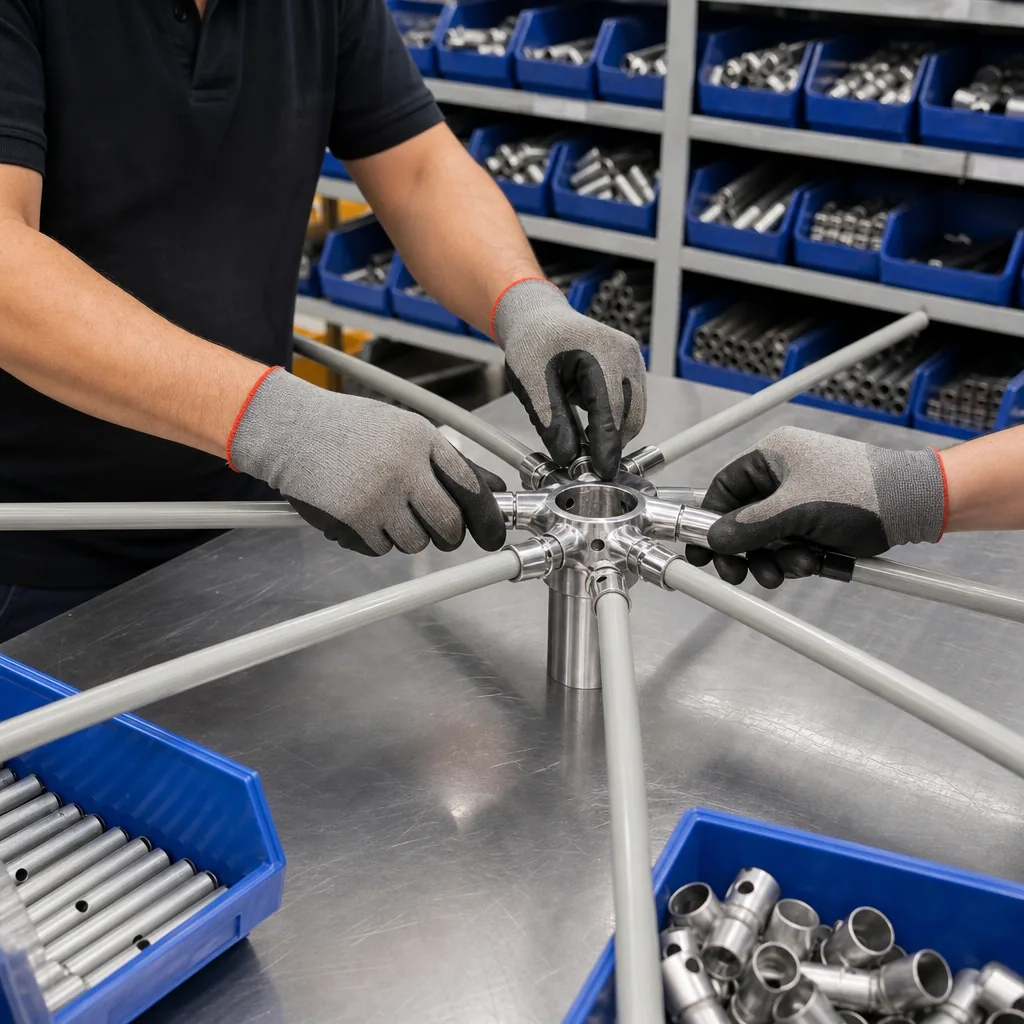
By the time an OEM umbrella order reaches final AQL 2.5 inspection, every loose runner, weak spring, twisted rib, or uneven canopy has already become expensive rework. On our Songxia assembly lines, umbrella assembly quality control is built into each station so operators catch functional and cosmetic defects before cartons are sealed. The goal is simple: keep production flowing, protect shipment dates, and make the final inspection confirm quality rather than discover problems.
Why Final Inspection Alone Is Too Late
Final AQL 2.5 inspection is the wrong place to discover a bad runner, loose rib rivet, twisted stretcher, or canopy seam slippage. By then the umbrella has already passed through frame assembly, fabric cutting, panel printing, sewing, tipping, shaft mounting, handle fixing, labeling, polybagging, and carton packing. If an AQL 2.5 umbrella inspection fails on a 5,000-piece PO, the defect is no longer one operator’s mistake; it becomes a warehouse-level problem. Opening cartons, removing bags, sorting units, replacing frames, steaming canopies, and repacking can easily consume 2–4 extra days, and that assumes spare parts are still available. In OEM umbrella production, this is especially painful because colors, logos, custom handles, and retail barcodes are order-specific. You cannot simply swap in stock goods without buyer approval. That is why umbrella assembly quality control must happen while the product is still moving through the line, not after it is sealed in export cartons.
Frame and mechanism defects are the most expensive late-stage failures because they are hidden until someone opens and cycles the umbrella properly. A 23-inch auto-open stick umbrella may look acceptable in a polybag, but if the spring force is weak, the runner catches on the shaft, or one fiberglass rib is installed with the wrong curvature, the canopy will open unevenly or collapse in wind testing. On compact auto-open-close models, a misaligned notch or poor spring compression can create a high failure rate after only 20–30 open-close cycles. In-line umbrella inspection catches these issues at the umbrella frame assembly station, where a technician can reject a batch of steel ribs, adjust rivet pressure, or stop using a problematic runner before 1,000 pieces are sewn and packed. Our standard practice at ZheBrella is to check mechanism function, rib symmetry, and shaft straightness before the canopy is attached, because correction time is measured in minutes there, not days.
Stitching defects also become far more costly when they are found at final inspection. A loose topstitch on 190T pongee, uneven panel tension on a double-canopy vented windproof umbrella, or skipped stitches near the tips may require partial disassembly, not just trimming threads. If the goods are for a promotion, event, or retail launch, the shipment window is usually fixed; a two-day rework delay can push a vessel cutoff or make air freight necessary. For DDP orders, the risk is even higher because the supplier is responsible for the full delivery chain, including export customs, inland trucking, ocean or air freight, import clearance, and final delivery. One failed final inspection can turn a planned FOB Ningbo shipment into an urgent DDP recovery job with higher logistics cost and less margin. Good umbrella assembly quality control reduces that risk by isolating problems at the station level and keeping final AQL as confirmation, not crisis management.
Frame Assembly Checkpoints on the Production Line
Frame problems are cheapest to catch before the canopy is tied on, so our in-line umbrella inspection starts with the bare frame opened and closed several times at the assembly bench. For steel ribs, inspectors look for plating scratches, burrs at the rivet holes, weak temper, and inconsistent rib curvature that will telegraph into a wavy canopy later. For fiberglass ribs, the focus shifts to splintering at cut ends, loose end caps, cracked resin, and poor bonding where fiberglass ribs connect to metal stretchers. The notch must sit square on the shaft, the runner must slide without grinding, and every stretcher rivet must rotate freely without side play. On 23-inch and 27-inch stick umbrellas, shaft straightness is checked by rolling the shaft on a flat table and by sighting down the tube after assembly; a small bend can cause rubbing, slow auto-open action, or an off-center canopy peak. This is basic umbrella assembly quality control, but it prevents many final-stage failures.
Rib count changes the inspection standard because tension and handling time are different on 8K, 10K, and 16K frames. An 8K frame is faster to assemble and easier to balance, but each rib carries more canopy load, so inspectors pay close attention to rib symmetry, stretcher length, and whether one panel position opens lower than the others. A 10K frame spreads the load better and gives a rounder canopy profile, but it adds more rivet points where loose joints or misaligned stretchers can hide. A 16K frame is the slowest on the line; if one rib is short by even 2-3 mm, the canopy will show uneven tension after sewing and tie-off. In OEM umbrella production, we often separate frame checkpoints by product type: compact auto-open-close frames need spring and runner checks, while golf umbrellas with 30-inch fiberglass ribs need stronger attention to rib recovery and windproof geometry.
A practical frame checkpoint is not just a visual pass; it is a functional test with reject limits that operators understand. Runners should lock cleanly at the top notch, release without excessive thumb force, and not drop under light shaking. Tips should line up in a consistent circle when closed, especially on 210T pongee windproof models where tight rolling is part of the customer’s packaging requirement. For double-canopy vented umbrellas, inspectors verify that the main ribs and secondary support ribs are not twisted before the sewing line receives the frames, because a twisted rib will distort the vent gap and reduce wind performance. At ZheBrella, our standard practice is to record recurring frame defects by lot and supplier batch before final AQL 2.5 umbrella inspection, not after it. That matters because final inspection can reject the shipment, but in-line correction keeps the production line moving and prevents the same notch, runner, or stretcher defect from repeating across thousands of units.
Mechanism and Opening Tests During Assembly
Mechanism testing has to happen before the canopy hides the sins of the frame. On manual umbrellas, the operator should feel a clean slide from handle to runner with no grinding, rib crossing, or notch misalignment; the runner lock must click positively and hold when the canopy is lightly shaken. For auto-open models, we check spring force by confirming the shaft reaches full extension without a second push, while avoiding an overly violent launch that can tear 190T pongee at the tips after sewing. In umbrella frame assembly, I also look at the latch pin, runner notch, and top spring seat because small burrs there are what cause late-stage failures. Our standard practice at ZheBrella is to test the first 10 pieces from each workstation after setup, then hold the line until the mechanic signs off on spring, runner, and button function.
Auto-open-close umbrellas need stricter in-line umbrella inspection because the closing spring stores more energy and exposes weak parts quickly. The button must open the canopy fully, retract the ribs smoothly on the second press, and leave the shaft ready for safe hand compression without kickback. If the telescopic shaft jams between sections, the issue is often oil contamination, tube ovality, or a plastic slider that was molded slightly tight; forcing production forward only turns a 2% defect into a carton-level problem. For OEM umbrella production, we normally cycle-test samples at the assembly table: 20 to 30 open-close cycles for compact 21" models and at least 10 cycles for larger 23" or 27" frames where spring load is heavier. Any failed button, weak lock, or unsafe rebound should trigger a stop-and-sort before more fabric is attached.
Sampling frequency should be written into the line plan, not left to the supervisor’s mood. After the first-piece approval, a practical umbrella assembly quality control method is to test 5 pieces every 30 minutes per assembly line, plus the first 3 pieces after any spring, runner, shaft, handle, or button lot change. For high-risk builds such as 10K fiberglass windproof frames, double-canopy vented umbrellas, or auto-open-close promotional orders with tight delivery dates, I prefer 100% mechanism testing before packing the semi-finished goods into WIP racks. These checks reduce surprises at the final AQL 2.5 umbrella inspection, where a stuck runner, failed auto button, or unsafe closing action is normally judged as a major defect. Catching it during assembly is cheaper than opening finished cartons, removing sleeves, and explaining to the buyer why a simple button problem delayed shipment by two days.
Canopy Mounting, Tension, and Appearance Controls
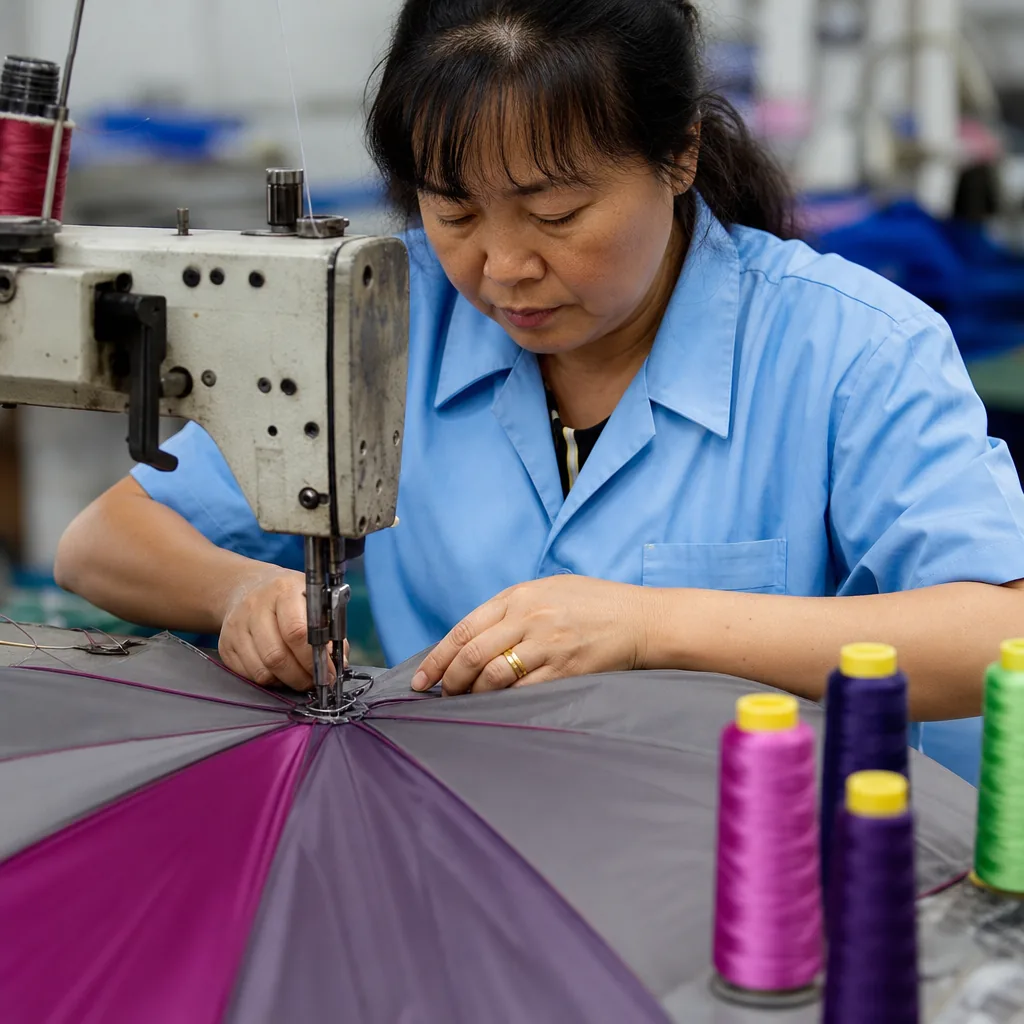
Canopy mounting is where small cutting or sewing errors become visible, so the first in-line umbrella inspection is done before the top cap is locked and before the runner is cycled too many times. Operators open the umbrella to roughly 80–90% tension and check that each panel seam sits directly over its rib, not drifting left or right toward the fabric center. On an 8K or 10K umbrella frame assembly, we normally allow only a few millimeters of seam deviation at the rib tip because a crooked seam will twist the canopy after 200–300 open-close cycles. Tip attachment is checked one by one: the fabric must be seated fully into the plastic or metal tip cup, stitching must not bite too close to the edge, and no rib end should push through the seam allowance. This is a core part of umbrella assembly quality control because a final AQL 2.5 umbrella inspection may catch the obvious failures, but it is too late to correct a whole batch of misaligned canopies economically.
Tension is judged differently by fabric type. Standard 190T pongee has more give, so it can hide minor panel imbalance, but if operators overpull the canopy during tying, the seams become wavy after the fabric relaxes. 210T pongee is denser and looks cleaner on retail umbrellas, but it exposes cutting variation more quickly; one short panel will create radial puckering between two ribs, especially on 23 inch and 27 inch auto-open models. For coated UPF 50+ canopies, including silver or black UV backing, the tolerance is tighter because the coating reduces stretch and makes needle tension marks more obvious under side light. Our standard practice at ZheBrella is to inspect coated canopies both opened and slightly relaxed, because a canopy that looks flat at full tension may show puckering beside the seam when the runner drops 10–15 mm. Operators also check that the tie stitch does not crack the coating or create white stress lines.
Double-canopy vented windproof umbrellas need an additional control point: the upper canopy must cover the vent evenly without choking airflow. On a 10K or 16K fiberglass frame, the vent overlap is checked around the full circle so one side does not lift higher than the other in wind. If the vent seam is placed too close to the rib joint, the upper layer catches on the stretcher during closing; if it is too loose, the umbrella flutters and looks defective even when the frame is strong enough for a 50+ mph wind-tunnel claim. In OEM umbrella production, we mark critical vent positions on the sewing template and verify them again during mounting, not only after final assembly. Appearance controls include checking for panel shade variation, oil marks from rib assembly, twisted tips, uneven top cap pressure, and fabric puckering under normal shop lighting plus angled light. This in-line umbrella inspection prevents rework from moving into packing, where replacement usually means cutting the whole canopy off the frame.
Linking In-Line QC Records to Final AQL and Shipment Approval
Final AQL does not start at the inspection table; it starts with the defect history from the line. During OEM umbrella production, our in-line umbrella inspection records track issues by operation: runner locking failure, loose tips, bent steel ribs, cracked fiberglass ribs, poor stitch tension on 190T or 210T pongee, off-center logo printing, canopy skew, and handle pull-out. Each defect is logged with date, line, operator group, model size such as 21 inch, 23 inch, 27 inch, or 30 inch, and repair result. For umbrella assembly quality control, the important point is not only how many pieces failed, but whether the same failure repeats after adjustment. If 3% of 23-inch auto-open frames show weak spring force before packing, the final inspector should not treat the lot as clean just because repaired pieces look acceptable. That issue must be carried into the AQL 2.5 umbrella inspection checklist with extra attention to opening force, runner engagement, and safety cap locking.
Repaired units need a closed-loop record, otherwise they become a hidden risk inside export cartons. In a proper umbrella frame assembly workflow, a failed umbrella is tagged, repaired, and reinspected before it can return to the finished-goods area. For example, if a double-canopy vented golf umbrella fails wind simulation because one rib joint is loose, replacing the rivet is not enough; QC should also reopen and close the umbrella 20 to 30 cycles and check canopy tension around that panel. Pre-pack audits add another layer by checking hang tags, polybags, silica gel, barcode labels, carton marks, inner quantity, and master carton strength. A carton may contain visually good umbrellas but still fail shipment approval if the POE, PVC, or EVA canopy color is mixed, the retail sleeve is wrong, or the carton count does not match the packing list. At ZheBrella, repaired-piece records are kept separate from first-pass records so the buyer can see whether the lot was stable or heavily corrected.
Before FOB release or DDP shipment, buyers should request three documents: the in-line defect summary, the repair-and-recheck log, and the pre-pack/carton audit report. These records support the final AQL 2.5 inspection because they tell the third-party inspector where to sample more carefully, even when the normal sampling table is followed. If earlier logs show coating rub-off on UV UPF 50+ canopies or water leakage after Teflon treatment, the final inspection should include a focused rub test and spray test instead of only checking appearance. If carton audits found crushed corners or weak tape on export cartons, the shipment approval should verify carton drop resistance and pallet condition before container loading. Good umbrella assembly quality control makes the final AQL result more reliable, not more complicated. The buyer does not need every factory worksheet, but the critical records should be available before balance payment, FOB booking release, or DDP dispatch to the destination warehouse.
Frequently Asked Questions
How is in-line QC different from a final AQL inspection?
In-line QC happens during production and catches process defects before thousands of units are packed. Final AQL inspection samples finished goods, so it confirms shipment quality but is less efficient for fixing systemic issues.
Which umbrella defects should be checked before packing?
Factories should check opening function, rib alignment, canopy tension, loose tips, handle fit, print placement, and carton pack-out before packing. These are common sources of rework in OEM and promotional umbrella orders.
At what production stage should in-line umbrella checks start for an OEM order?
In-line checks should start with the first approved production run, usually within the first 50-100 pieces after line setup. This lets the factory catch frame alignment, spring installation, and canopy sewing issues before they affect the full lot.
Which assembly defects are most likely to cause failure at final AQL 2.5 inspection?
The most common failures are broken or loose ribs, weak runner locking, canopy panel misalignment, poor canopy tension, and incorrect retail packing. These defects often count as major issues because they affect opening function, appearance, or saleability.
Can in-line QC reduce delays on large custom umbrella orders?
Yes. For larger OEM runs, in-line QC can reduce rework time by catching recurring defects during assembly instead of after 100% production is finished. Buyers often see smoother final inspection and fewer shipment delays when defect trends are corrected within the same production day.
Looking to Launch Your Custom Umbrella Line?
ZheBrella is a Zhejiang-based OEM/ODM umbrella manufacturer with 17 years of export experience. Free design, low MOQ from 100 pieces, windproof construction, full-color print.
Get Free Quote Now »People Also Search For
Related Articles
Inline Umbrella Assembly QC Before Final AQL Inspection
Build better OEM orders with inline assembly QC checkpoints that catch frame, canopy, handle, and packaging defects befo...
Read More »
Inline Umbrella Assembly QC Gates Before Final Inspection
Map practical in-line QC gates for frames, canopies, auto-open mechanisms, and export packing so defects are caught befo...
Read More »
Inline Umbrella Assembly Checks Before Final Inspection
Use inline assembly checks to catch frame, fabric, handle, and mechanism issues earlier, reducing rework before final AQ...
Read More »