Inline Umbrella Assembly Checks Before Final Inspection
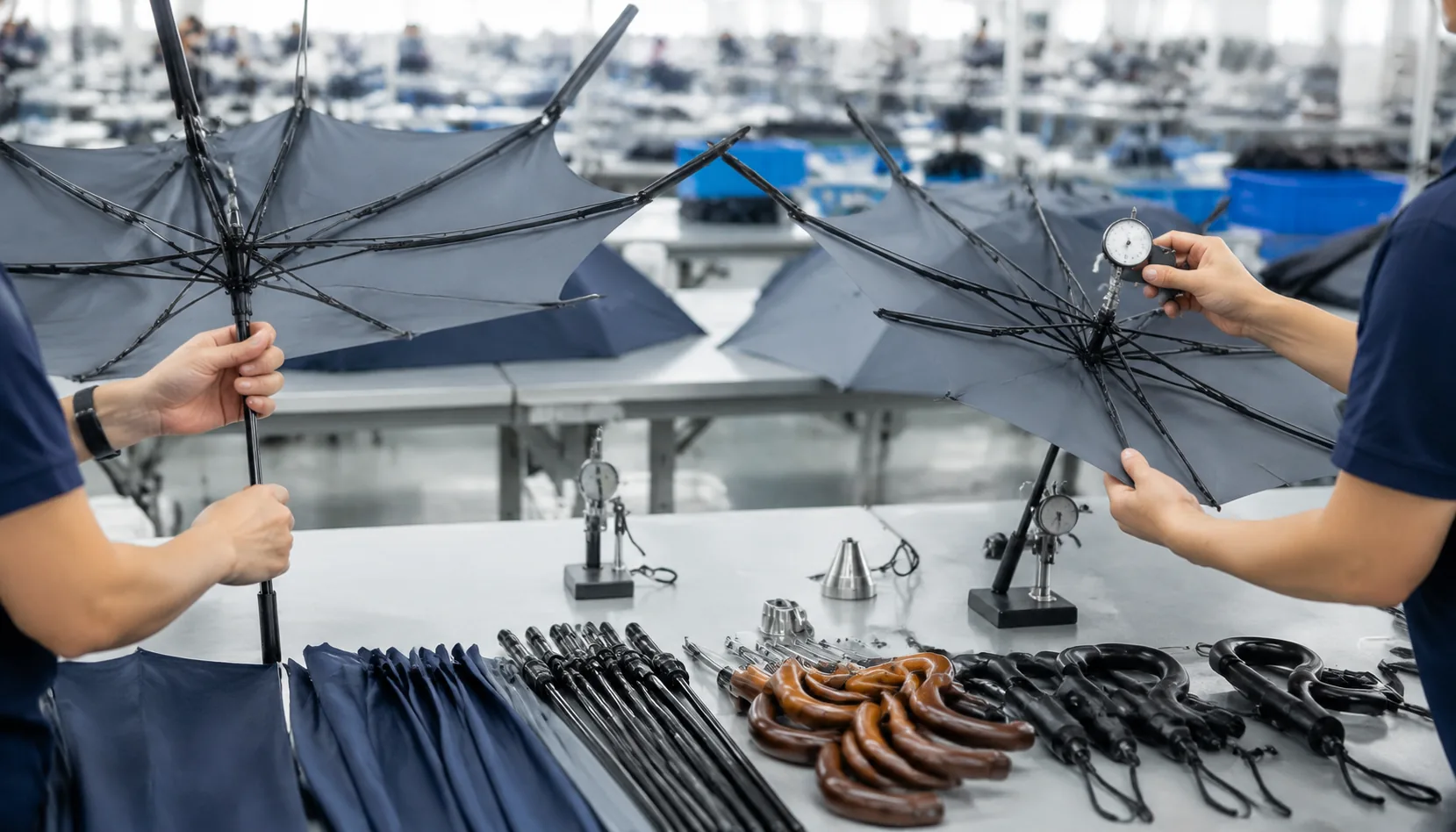
By the time an umbrella reaches final AQL 2.5 inspection, a crooked rib, loose runner, mismatched panel, or weak handle joint has already consumed labor and packing time. On our Songxia assembly lines, umbrella inline quality checks focus on the few points where defects usually start: frame setting, canopy tension, stitch alignment, handle fixing, and open-close action before the carton is ever built.
Why Inline QC Matters Before AQL Inspection
Final AQL 2.5 inspection is necessary, but it is a late filter, not a production control system. By the time a third-party inspector opens cartons and pulls samples under AQL 2.5 umbrellas criteria, the factory has already paid for frame assembly, canopy sewing, printing, trimming, labeling, bagging, and export carton packing. If the sample finds loose rivets, twisted panels, or oily handprints on 190T pongee, the rework cost is much higher because defects are buried inside finished goods. Good umbrella inline quality checks catch the pattern when only 50 or 100 pieces have passed a station, not after 5,000 pieces are sealed for FOB loading. On our floor, the most useful inline records are not fancy; they show defect type, station, operator, time, and corrective action. That is how OEM umbrella QC moves from arguing over rejected cartons to preventing the same failure from repeating all afternoon.
Frame fitting is where inline QC pays back fastest because small assembly drift becomes a customer complaint later. For 8K and 10K straight umbrellas, inspectors should check rib symmetry, stretcher alignment, runner locking force, tip seating, and whether steel or fiberglass ribs are mixed according to the BOM. On auto-open and auto-open-close models, we cycle samples at the assembly table, not only in final inspection, because weak springs, rough shafts, and mis-set buttons show up before canopy attachment. For windproof double-canopy models, a missed vent gap or reversed top panel can ruin performance even if the umbrella looks acceptable in a closed position. A practical umbrella assembly inspection also checks sharp burrs around rivets, cap tightness, handle glue overflow, and whether the open diameter matches the approved 21 inch, 23 inch, 27 inch, or 30 inch specification within tolerance.
Canopy sewing and packing need the same discipline because many export claims come from repeatable, station-level mistakes. During sewing, inline inspectors should measure panel tension, seam allowance, stitch density, top notch alignment, tie-wrap position, and print placement on heat-transfer or screen-printed logos before the canopy is fixed to the frame. One operator sewing 210T pongee with uneven feed can create eight-panel twisting across a whole lot if nobody stops the line. Packing checks should confirm hangtags, sleeve size, barcode, silica gel if required, carton marks, and inner quantity before master cartons are taped. These umbrella inline quality checks are the bridge between umbrella production control and final inspection: AQL confirms the shipment risk, while inline QC reduces the risk before value is locked into finished goods.
Frame and Mechanism Checks at Assembly Stations
Frame and mechanism control has to start at the assembly station, not after the umbrella is already dressed with canopy. For umbrella inline quality checks, the first gate is simple: ribs must sit square in the stretcher pockets, the shaft must not show visible bow, and the runner has to travel smoothly without grinding. On 8K frames, the geometry is more forgiving, but on 16K the balance is tighter and one mismatched rib length will twist the whole crown. In umbrella assembly inspection, I check rib symmetry against the center shaft, then cycle the open-close action several times to catch drag, loose rivet heads, or a half-seated ferrule before they become scrap.
Auto-open units need more than a quick click test. OEM umbrella QC should measure trigger force consistently, because a weak spring can misfire under package pressure while an over-stiff one gives customers a broken-feeling mechanism. I look for full spring return, runner lock engagement, and release timing, especially on compact 21" and 23" products where travel tolerance is small. Fiberglass frames hide some problems because they flex without obvious deformation, but they can also mask a bad rivet or cracked tip until wind load exposes it; steel frames are more stable, yet any bend in the shaft or crown arm throws the whole mechanism off. That is why umbrella production control has to catch these defects in-line, not in final packing.
Double-canopy vent alignment is another point that gets missed when crews rush. The upper vent opening and lower canopy panels must share the same centerline, or the vent edge pulls unevenly and creates a visible wave after heat-setting or sewing. I also check whether the vent seam clearance is uniform around the crown, because a shifted vent can rub the stretcher tips during opening. For AQL 2.5 umbrellas, this station-level screening reduces reject carryover before formal sampling, and it gives a cleaner handoff to final inspection. In practice, umbrella inline quality checks should flag rib misalignment, shaft wobble, weak spring return, and vent offset in one pass, because those are the defects that turn into customer complaints later.
Canopy, Handle, and Accessory Verification
Canopy verification starts at the cutting table, not after the umbrella is fully packed. For 190T and 210T pongee, I want operators checking fabric hand-feel, color lot, panel direction, and coating side before sewing begins, because one reversed UPF 50+ panel can make the whole canopy fail a buyer’s UV claim. On silver or black UV-coated pongee, the coated face must match the approved PP sample orientation; for most rain umbrellas the water-repellent face is outside, while UV-blocking promotional models may specify the darker or coated face inward. These umbrella inline quality checks should include panel count, grain direction, obvious weaving slubs, oil stains, needle holes, and whether Teflon or other water-repellent treatment beads consistently across panels. A good umbrella assembly inspection also confirms that 8K, 10K, or 16K panel geometry matches the frame, because a canopy cut even 3-5 mm short at the edge will pull the ribs out of alignment after cycling.
Seam placement is where weak production control shows up quickly. Each panel seam should sit centered over the rib line, with no twisting around the top notch, and the crown reinforcement must be flat without puckering. Tip attachment needs a pull check, especially on fiberglass rib models where plastic tips can crack if the bar-tack is too tight; on steel ribs we watch for sharp burrs cutting the thread. Ferrules should match the PP sample in length, finish, and color, whether it is a black plastic cap, metal cap, or branded special part. For OEM umbrella QC, we compare open-canopy diameter, arc size, stitch density, thread color, and seam allowance against the signed PP sample before bulk packing. If a buyer ordered 23-inch auto-open umbrellas with heat-transfer logos, the logo position must be measured from the panel seam and lower edge, not judged by eye.
Handles, straps, sleeves, and accessories deserve the same discipline as the canopy because buyers notice these defects first when cartons arrive. Wood, EVA, rubberized, plastic, and straight ABS handles should be checked for grip alignment, glue overflow, scratches, odor, and correct logo orientation after final tightening. Wrist straps need length, color, knot security, and pull resistance checked against the PP sample; a loose strap looks small in the factory but becomes a return issue in retail. Sleeves must match the umbrella size, fabric, drawcord, snap, zipper, piping, and label placement, with no shade difference from the canopy. Our standard practice at ZheBrella is to record these umbrella inline quality checks before final AQL 2.5 umbrellas inspection, because AQL is a sampling gate, not a repair system. Proper umbrella production control catches wrong sleeves, off-center logos, missing ferrules, and mixed handle batches while the line can still correct them without opening finished cartons.
Defect Coding and Corrective Action Loops
Defect coding only works if the line inspectors use the same language as final QC. In umbrella assembly inspection, we separate defects into critical, major, and minor before anyone talks about pass rate. Critical means a safety or legal risk: sharp exposed rib tips, loose runner lock that can collapse on the user, cracked plastic handle with cutting edges, incorrect warning label, or banned material substitution on PVC/POE children’s umbrellas. Major means the umbrella may fail normal use or the buyer will reject it at AQL 2.5 umbrellas inspection: canopy off-center by more than 8-10 mm, skipped stitching on a rib pocket, bent steel rib, weak ferrule riveting, auto-open misfire, water leakage through top cap, or logo print position outside tolerance. Minor defects are cosmetic but still coded: loose thread under 10 mm, slight chalk mark, small wrinkle on 190T pongee, or handle color shade within approved limit.
Good umbrella inline quality checks trace every defect back to a production variable, not just a worker’s name. On our floor, a defect tag records order number, model size such as 23 inch or 27 inch, frame type such as 8K fiberglass or 10K steel, canopy fabric lot, sewing group, assembly station, time window, and inspector code. If five umbrellas in one hour show rib-pocket tearing, I first check fabric tension, needle size, stitch density, and whether the operator is forcing 210T pongee over a frame with higher rib arc than the approved sample. If several auto-open-close units fail after 20 cycle tests, the issue may be spring batch hardness, runner molding burrs, or wrong shaft lubrication, not the final assembler. This is where OEM umbrella QC needs discipline: one code for one failure mode, photos attached, and no vague entries like 'bad workmanship.'
Production should pause when the defect trend proves the process is unstable, not only when a final inspector rejects cartons. My practical trigger is three repeated major defects from the same station within 30 minutes, any critical defect at all, or a sudden spike above the control limit agreed in the pre-production meeting. For example, if double-canopy vented windproof umbrellas start showing misaligned vent panels, continuing for another 1,000 pieces only creates rework and late shipment risk. The line leader should stop that operation, quarantine the affected WIP by batch card, inspect the last accepted bundle, and run a 5-Why check before restart. Corrective action may be changing a sewing guide, replacing a riveting die, retraining one operator, or rejecting a fabric roll. ZheBrella’s standard practice is to release production again only after 10-20 consecutive pieces pass the same umbrella inline quality checks that caught the defect.
Buyer Reporting for OEM and ODM Orders
For OEM and ODM programs, buyers should not wait for the final inspection report to find out whether the line is under control. Ask for umbrella inline quality checks with time-stamped photos from frame assembly, canopy stitching, tip insertion, and closing/opening tests, because most defects start before packing. The report should show the exact style code, color, PO number, and inspection station, not just a generic “OK.” For umbrella assembly inspection, I want a measurement sheet with rib length, open diameter, shaft length, canopy panel alignment, stitch pitch, and handle fit, plus a defect summary that separates cosmetic issues from function failures. If the supplier is serious about OEM umbrella QC, they should also state which defects were corrected inline and which were pushed to rework.
Buyers should ask for rework records that show the defect type, quantity, root cause, repair method, and whether the repaired goods were rechecked under AQL 2.5 umbrellas. That matters because a line can look clean after a sort, but still fail if the same sewing tension issue or ferrule crack keeps coming back. I also want carton readiness confirmed early: inner polybag count, carton mark accuracy, master carton dimensions, gross weight, and pallet status if the order is shipping by palletized FOB. If the factory cannot prove carton readiness, the shipment risk is still open even if the umbrellas themselves pass. This is where umbrella production control becomes real: the report should link inspection results to packing progress, not treat them as separate jobs.
The last item buyers should demand is a clear schedule note. A good inline report should say whether MOQ is met, how much lead time is lost if rework continues, and whether the shipment still fits the promised FOB or DDP window. For FOB, the key risk is missing the vessel cutoff; for DDP, it is usually late consolidation, missing carton data, or a mismatch between packed quantity and declaration paperwork. In my view, umbrella inline quality checks only matter if they help the buyer decide one thing: release, hold, or split the order. The report should give that answer plainly, with the current pass rate, remaining open defects, and the expected ship date after correction, so procurement can manage the order instead of chasing the factory for updates.
Frequently Asked Questions
Does inline QC replace final AQL 2.5 inspection?
No. Inline QC reduces defects during production, while final AQL 2.5 verifies finished goods before shipment. Buyers should use both for larger OEM and ODM orders.
When should inline umbrella checks start?
They should begin as soon as pilot production or the first mass-production batch is assembled. Early checks are especially important for auto-open mechanisms, new molds, new fabrics, or first-time MOQ orders.
At which production stages should inline umbrella assembly checks be done?
For OEM umbrella orders, inline checks are usually done after frame assembly, fabric cutting or panel sewing, canopy attachment, handle installation, and open-close mechanism testing. A practical checkpoint is every 20-30% of production progress before the final AQL 2.5 inspection.
What defects can be caught before final AQL 2.5 umbrella inspection?
Inline assembly checks can catch bent ribs, loose stretchers, uneven canopy tension, skipped stitches, incorrect logo placement, weak handle bonding, and faulty auto-open or manual mechanisms. Finding these before packing reduces rework, replacement parts, and shipment delays.
Can buyers request inline QC reports for custom umbrella production?
Yes. Importers can request inline QC reports with defect photos, checked quantities, defect rates, corrective actions, and approval status. For larger OEM orders, this is commonly added before mass packing, especially when the MOQ is 1,000-3,000 pieces per design.
Looking to Launch Your Custom Umbrella Line?
ZheBrella is a Zhejiang-based OEM/ODM umbrella manufacturer with 17 years of export experience. Free design, low MOQ from 100 pieces, windproof construction, full-color print.
Get Free Quote Now »People Also Search For
Related Articles
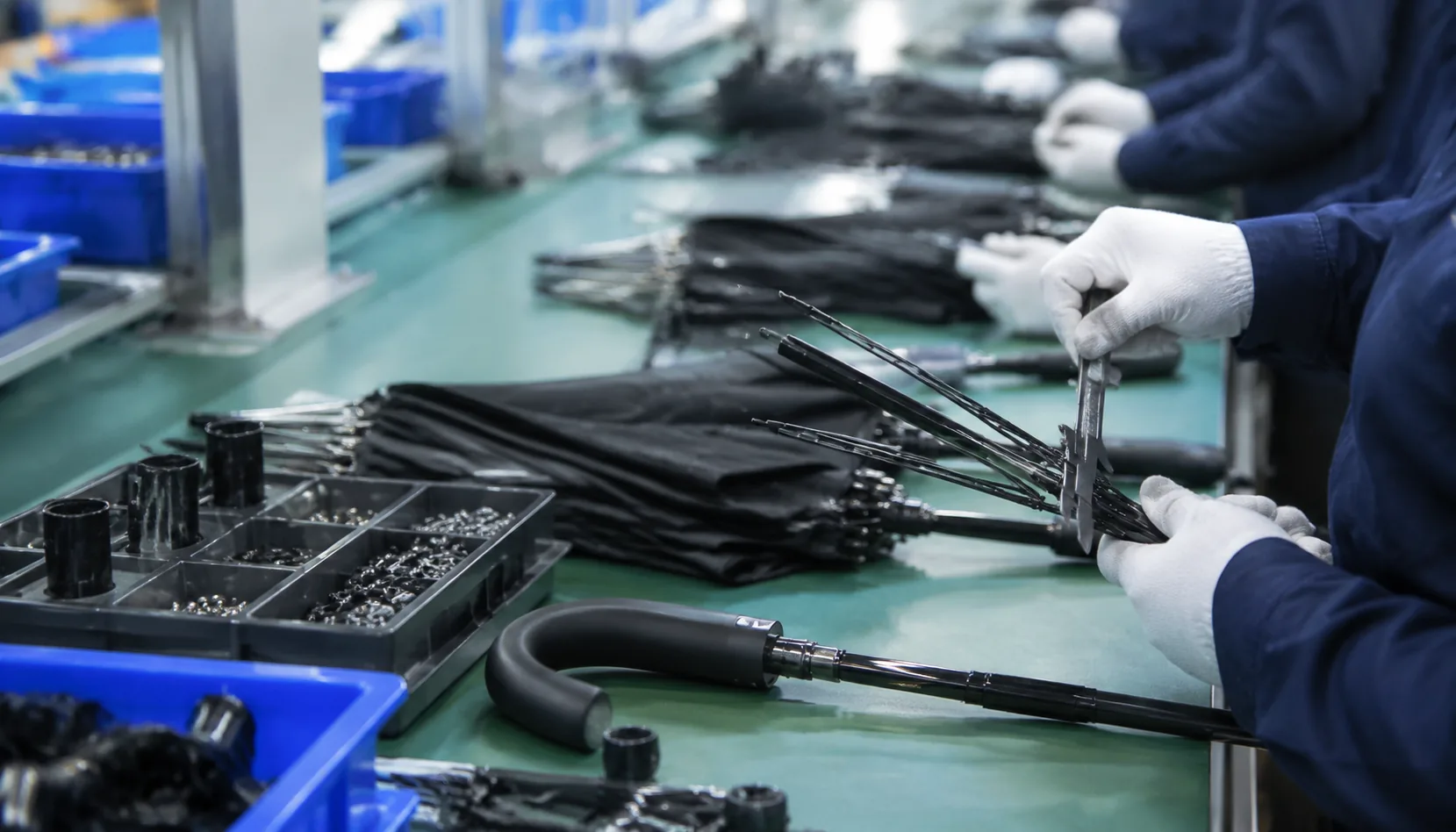
Inline Umbrella Assembly QC Gates Before Final Inspection
Map practical in-line QC gates for frames, canopies, auto-open mechanisms, and export packing so defects are caught befo...
Read More »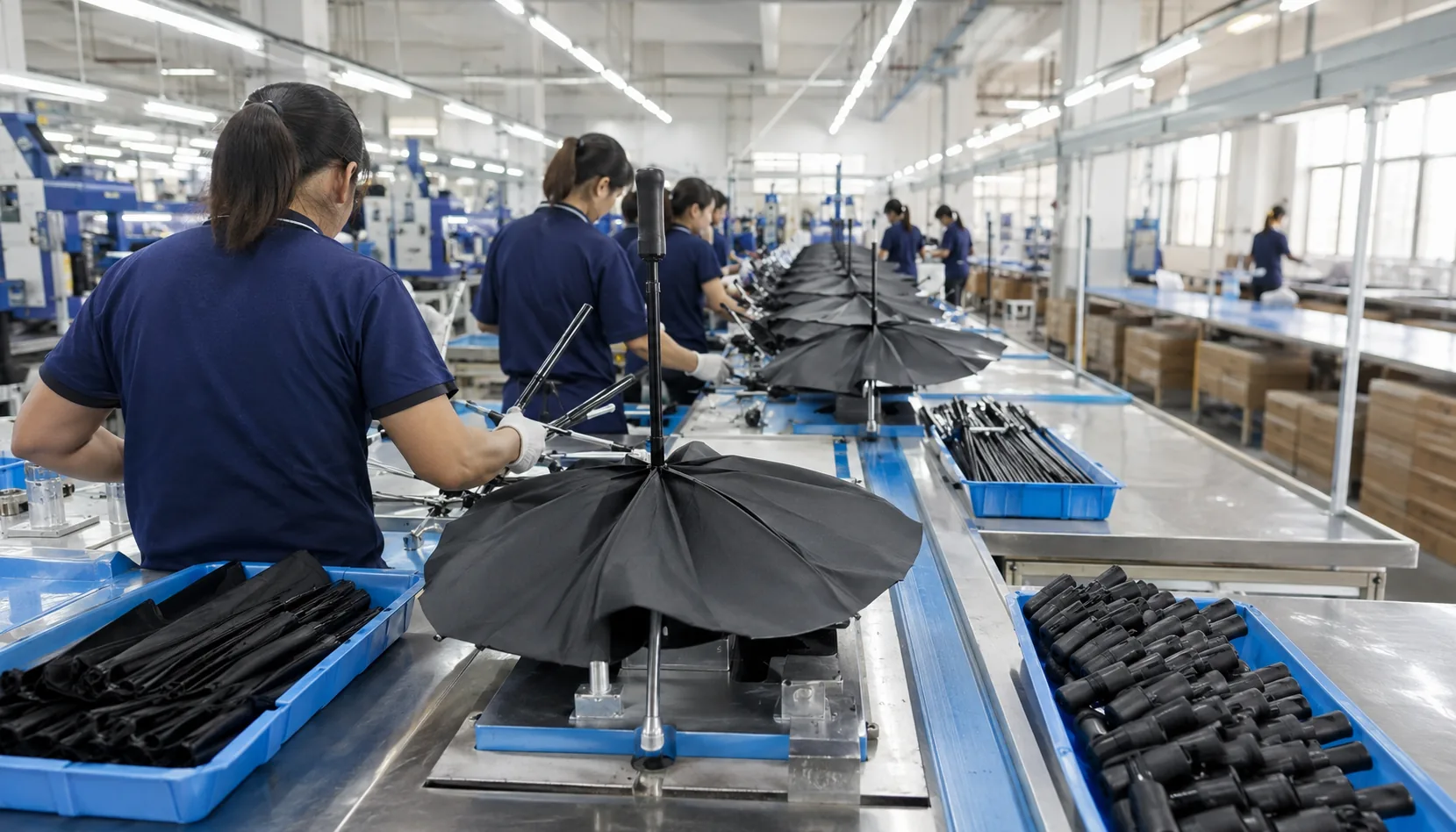
Umbrella Final Assembly Line Balancing for OEM Production
Plan umbrella assembly cells with takt time, inline QC gates, and pack-out checks to stabilize output, lead times, and A...
Read More »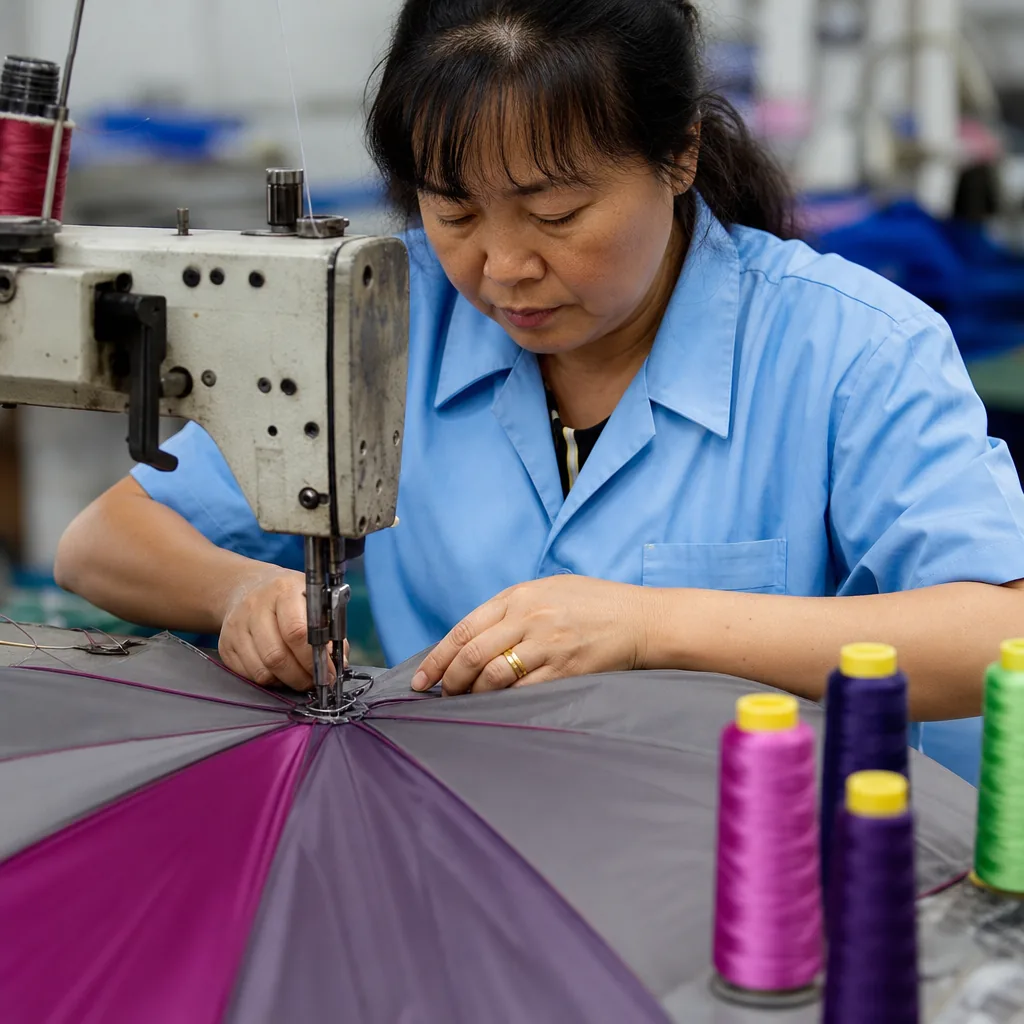
Umbrella Final Assembly Line Setup for Consistent OEM Quality
Design an umbrella assembly line with workstations, jigs, torque checks, and inline QC to improve consistency across MOQ...
Read More »