Umbrella Final Assembly Line Setup for Consistent OEM Quality
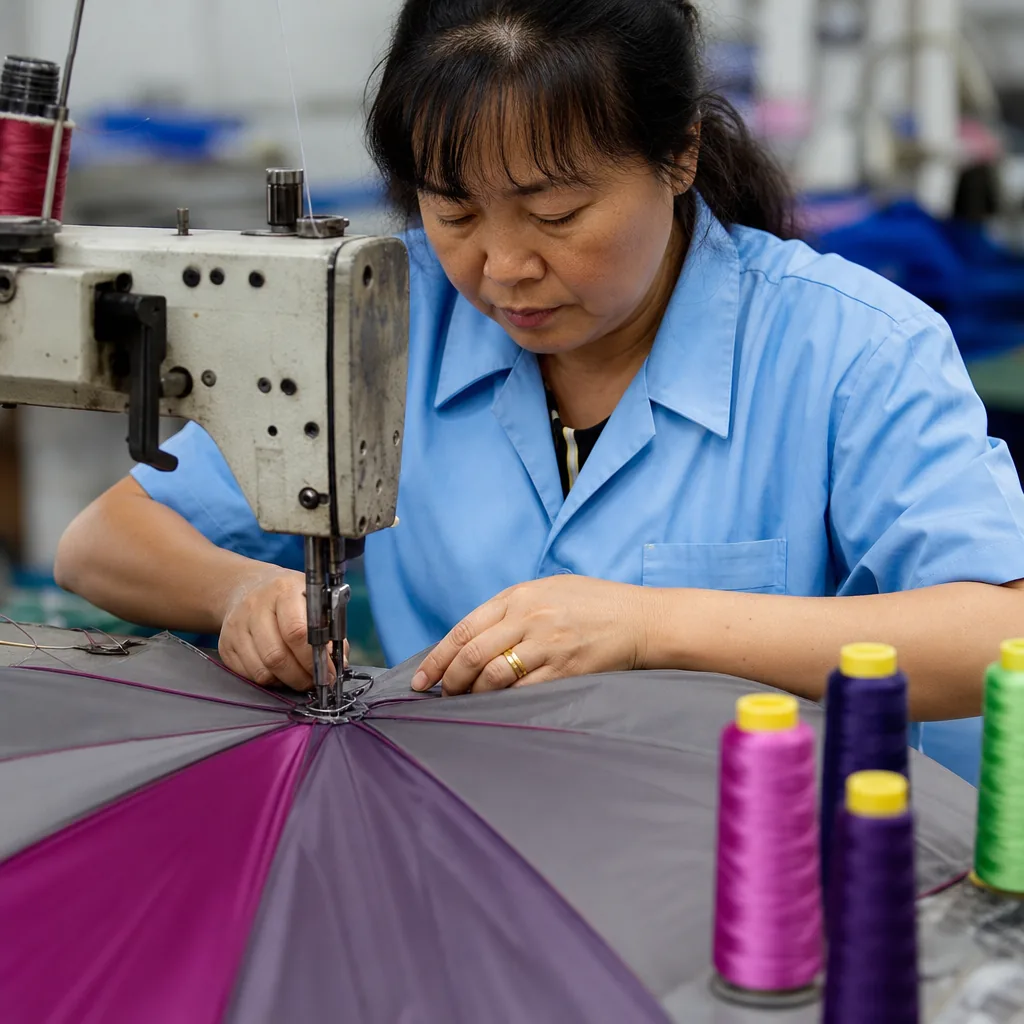
When OEM umbrella orders move from sampling to MOQ production, small assembly differences can turn into loose tips, uneven canopies, weak closures, and carton-level claims after FOB or DDP delivery. On our Songxia factory floor, a stable umbrella final assembly line means fixed workstations, matched jigs, controlled screw torque, and inline QC points that catch variation before packing, not after the buyer’s inspection.
What Happens in Final Umbrella Assembly
Final assembly is where loose components become a shippable product, and it starts with frame preparation, not the canopy. For a 23" auto-open stick umbrella, the line leader first checks shaft straightness, runner travel, spring force, notch position, and rib symmetry before any fabric is mounted. Steel ribs are watched for burrs at the rivets; fiberglass ribs are checked for splintering and correct flex memory. On 8K and 10K frames, one weak stretcher shows immediately when the canopy is tensioned, so we reject it early instead of hiding it under fabric. In OEM umbrella manufacturing, this is also where mixed components cause trouble: a 210T pongee canopy cut for a 23" arc will not sit cleanly on a slightly undersized frame, and a vented double-canopy design needs the upper and lower panels aligned before sewing ties are pulled tight. This first station sets the rhythm for the entire umbrella final assembly line.
Canopy mounting is mostly hand skill supported by simple fixtures. Operators place the crown cap, align the center hole, spread the panels evenly over the ribs, then secure the canopy at the rib tips and intermediate tie points. Tip fixing can use metal tips, plastic tips, or sewn-in pockets depending on the model; poor tip alignment creates twisted panels and ugly peak tension even if the printing is perfect. For printed promotional umbrellas, we check logo orientation against the handle direction before final fastening, especially on 27" golf umbrellas and 30" event umbrellas where panel order is obvious. Handle attachment comes next: straight wooden handles are glued and pinned, EVA foam handles are press-fitted, and plastic J handles or rubberized grips are torqued to avoid wobble after repeated open-close cycles. Our standard practice at ZheBrella is to test manual, auto-open, and auto-open-close action at this stage because mechanism defects are cheaper to catch before sleeve packing.
The last third of the umbrella production workflow is cleaning, sleeve packing, carton pack-out, and inspection. Each umbrella is opened, shaken, and visually checked for oil marks, skipped stitches, exposed thread ends, cracked tips, loose caps, and canopy skew. Umbrella assembly QC also includes functional sampling: smooth opening, secure runner lock, no rib inversion under normal pressure, correct strap position, barcode match, and packed length tolerance. For retail orders, sleeves may be PVC, pongee, or self-fabric with woven labels; for promotional orders, we confirm carton marks, inner polybag requirements, and assortment ratios before sealing. Cartons are packed by fixed count, often 24 or 36 pieces depending on size and handle bulk, then weighed against the packing list to catch shortages. Pre-shipment inspection normally follows AQL 2.5 quality control for major defects, with critical defects set to zero tolerance. A disciplined umbrella final assembly line should produce cartons that pass inspection without rework, not cartons that depend on inspectors to rescue the order.
Workstation Design for Stable Output
A stable umbrella final assembly line starts with line balancing, not with more people. In OEM umbrella manufacturing, the bottleneck is usually not sewing or frame making; it is the mismatch between station time and model complexity. A 21-inch manual stick umbrella may only need trimming, button pressing, and final wipe-down, while a 30-inch auto-open-close model needs spring tension checks, shaft lock verification, and repeated open-close cycling. If every workstation is forced to handle all styles, output swings hard and umbrella assembly QC becomes reactive instead of preventive. The better setup is to balance each station to a clear takt target, then group tasks by skill: one operator for canopy finish, one for handle and tip fitting, one for function testing, and one for packing and label control. ZheBrella's standard practice is to separate these checks before cartons ever reach the pallet stage.
Operator specialization matters because the final assembly line is where small mistakes become customer claims. A worker who only handles manual umbrellas can move faster on rib-tip insertion, ferrule inspection, and strap folding, while a more experienced operator should own auto-open and auto-open-close mechanisms, where trigger alignment, spring preload, and safe closure force need to be checked by feel and by cycle count. Double-canopy vented windproof models should sit in a separate flow because they require different canopy symmetry checks, vent seam inspection, and frame tension control than a standard 8K or 10K promotional umbrella. Keeping these models apart also makes the umbrella production workflow easier to control: each lane gets its own fixture, parts bin, and in-process checklist, so operators are not mixing steel-rib repair work with fiberglass-rib finishing or stopping the line to hunt for the wrong handle type.
WIP control is what keeps the umbrella final assembly line predictable during peak season. I prefer small FIFO buffers between stations, usually 10 to 20 pieces per model family, so the line can absorb a short delay without letting half-finished umbrellas pile up around the packing tables. Once WIP grows too much, defects hide inside the pile: loose stitching, off-center logos, missing end caps, and canopy wrinkles that should have been caught at handoff. For OEM umbrella manufacturing, the final gate should use AQL 2.5 quality control on appearance, function, and carton count, with a simple reject-and-rework loop for failures in open/close cycling, tip security, or print alignment. That last check is where the line proves itself; if the flow is clean, the inspection team sees a consistent product, not a random mix of styles and rushed fixes.
Jigs and Gauges That Reduce Variation
Variation usually enters the umbrella final assembly line at the boring stations, not the dramatic ones. A canopy positioning jig is the first fixture I insist on for OEM umbrella manufacturing because a 3 mm off-center canopy makes an otherwise good 23" or 27" umbrella look twisted after tying. We use a center-cap locating pin, rib-tip reference marks, and a rotating plate so operators align the 190T or 210T pongee panels to the same rib sequence every time, whether the frame is 8K steel, 10K fiberglass, or 16K fashion construction. For printed orders, the jig also protects logo orientation; a heat-transfer logo that drifts one panel clockwise is a reject in retail packaging even if the sewing is strong.
Handle torque fixtures are just as important because hand-tightening is not a process control method. On straight wood, EVA foam, rubberized plastic, and crook handles, we set torque by shaft diameter and thread type, then verify that the handle does not rotate under normal opening load. Too much torque can split a wooden handle or deform an aluminum shaft; too little creates warranty returns after a few rainy days. Shaft straightness checks should be done before the runner and handle are locked in, using a V-block or dial gauge rather than eyeballing down the tube. For 21" folding umbrellas, even a small shaft bend can cause auto-open-close drag; for 30" golf umbrellas, it shows up as canopy wobble.
Rib-span gauges keep the finished profile consistent across the umbrella production workflow. A simple go/no-go gauge checks whether each rib tip lands within tolerance, which catches mixed rib batches, uneven stretcher riveting, and fiberglass ribs that were overheated during forming. On double-canopy vented windproof models rated for 50+ mph wind-tunnel survival, span control also keeps the vent gap even so the top canopy does not flap like a loose sail. Auto-open mechanism function checks belong at the same station: open force, lock engagement, runner travel, and closing effort should be sampled by size and mechanism type. Our standard practice at ZheBrella is to record these checks under umbrella assembly QC and apply AQL 2.5 quality control before cartons move to final packing.
Inline QC Before AQL Final Inspection
Defect escalation must be written into the umbrella production workflow before AQL 2.5 quality control starts. At ZheBrella, a single major defect such as failed auto-open, broken rib, detached tip, wrong logo placement, or incorrect carton mark triggers line isolation for the previous production bundle, normally 50 to 100 pieces depending on the station output. Minor defects like untrimmed thread, light dust, or loose polybag tape are repaired immediately and recorded by operator number. Carton labeling is checked before sealing: PO number, SKU, color, size such as 21 inch or 23 inch, quantity, gross/net weight, carton dimensions, and destination marks for FOB or DDP shipment must match the packing list. Only after inline issues are closed should final random inspection begin under AQL 2.5, using the correct lot size and sample code. AQL is a gate, not a repair department; if inline QC is weak, final sampling only tells you the shipment is already expensive to fix.
Planning Capacity, Lead Time, and Shipping Terms
Capacity planning starts with the real bottleneck, not the sales MOQ. On an umbrella final assembly line, a balanced 18–24 operator cell can usually finish 2,500–4,000 straight umbrellas per 8-hour shift, or 4,000–6,000 compact 3-fold umbrellas if the frames arrive pre-assembled and the canopy sewing line is not starving the line. A 10,000-piece MOQ therefore does not mean 3 production days; it means PP sample approval, bulk fabric arrival, cutting, printing, sewing, frame preparation, final assembly, inspection, and carton packing all have to be sequenced. For a standard 23-inch 8K auto-open umbrella with 190T pongee and one-color screen print, I normally plan 25–35 days after PP sample sign-off. For 16K fiberglass golf umbrellas, full-panel sublimation, custom molded handles, or UPF 50+ coating, 40–55 days is more realistic because material approval and process setup take longer than the stitching itself.
PP sample approval is the control gate in OEM umbrella manufacturing. The approved sample must lock the frame size, rib count, shaft material, canopy fabric, coating, print position, handle color, tips, runner, sleeve, hangtag, inner carton, and master carton marks. If the buyer approves only the logo and ignores mechanics, disputes happen later during umbrella assembly QC when the bulk auto-open spring feels stronger, the fiberglass rib color shifts, or the 210T pongee has a different hand feel from the sample. Our standard practice at ZheBrella is to release the umbrella production workflow only after a signed PP sample and confirmed packaging artwork are on file. AQL 2.5 quality control should then be scheduled into the lead time, not squeezed in after packing. For export orders, pre-final inspection is best done when 80% is packed and 100% is assembled, giving enough time to replace crooked tips, weak stitching, loose ferrules, oil marks, or failed opening cycles before shipment booking.
Shipping terms change the paperwork workload as much as the freight cost. Under FOB Ningbo or Shanghai, the factory normally prepares the commercial invoice, packing list, booking details, carton measurements, HS code reference, and export customs declaration; the buyer or forwarder handles ocean freight, insurance, destination clearance, duty, and local delivery. For DDP shipments, especially to the U.S. or EU, documentation must be tighter: product description by material, declared value, carton-level packing data, importer tax details, duty classification, compliance labels, and sometimes test reports for restricted substances in PVC, POE, EVA, inks, or coated fabrics. DDP also requires earlier carton dimension confirmation because courier, LCL, and FCL costs change sharply with volume. A poorly planned umbrella final assembly line may finish goods on time but miss the vessel because final weights, carton marks, or inspection reports are late. Good production planning ties daily output, MOQ, PP approval, AQL inspection, and shipping documents into one calendar before cutting the first canopy panel.
Frequently Asked Questions
Why should buyers ask about line setup instead of only final inspection?
Final inspection catches defects after cost is already built in. A controlled assembly line prevents repeat issues such as loose handles, crooked canopies, and failed auto-open mechanisms.
Do windproof umbrellas need a different final assembly flow?
Usually yes. Double-canopy models and fiberglass rib frames need extra checks for vent alignment, rib tension, and canopy clearance during opening and closing.
What stations should be included in an umbrella final assembly line?
A typical line includes frame pre-check, canopy alignment, rib tension verification, handle fitting, torque check, opening/closing test, and final visual inspection. For export programs, many factories also add barcode tracking and packing verification before carton-out.
How does AQL 2.5 apply to umbrella final inspection?
AQL 2.5 is commonly used for major or mixed defect sampling on OEM umbrella orders, especially when the buyer wants a standard export inspection level. For large batches, the sample size is usually based on lot size under ISO 2859-1, with acceptance and rejection numbers set before production starts.
Can a final assembly line support different order terms like MOQ, FOB, and DDP?
Yes. The line setup is usually the same, but the packing, labeling, carton count, and shipment documentation checks change by term. DDP orders often need an extra packing and compliance checkpoint because the goods must be ready for door-delivery handling.
Looking to Launch Your Custom Umbrella Line?
ZheBrella is a Zhejiang-based OEM/ODM umbrella manufacturer with 17 years of export experience. Free design, low MOQ from 100 pieces, windproof construction, full-color print.
Get Free Quote Now »People Also Search For
Related Articles
Umbrella Line Balancing for Consistent Mass Assembly
Understand how balanced workstations, takt time, and in-process QC keep OEM umbrella assembly stable for auto-open, wind...
Read More »
Umbrella Final Assembly Line Balancing for OEM Production
Plan umbrella assembly cells with takt time, inline QC gates, and pack-out checks to stabilize output, lead times, and A...
Read More »
Inline Umbrella Assembly QC Gates Before Final Inspection
Map practical in-line QC gates for frames, canopies, auto-open mechanisms, and export packing so defects are caught befo...
Read More »