Umbrella Line Balancing for Consistent Mass Assembly
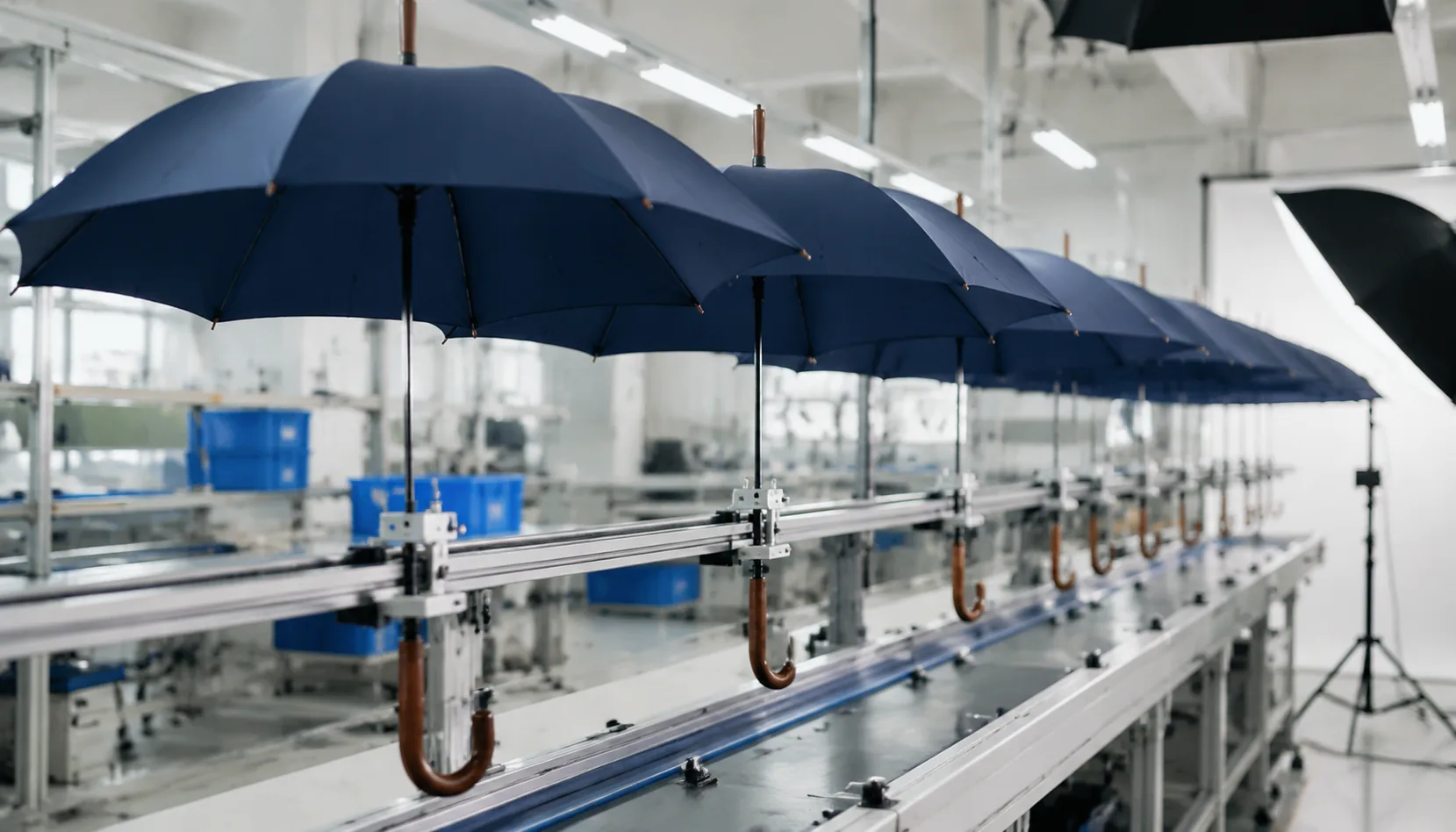
When an OEM umbrella order moves from samples to mass assembly, the real risk is not one slow operator—it is an uneven line that hides defects until packing. On our Songxia floor, umbrella line balancing starts with takt time, station-by-station work content, and in-process QC points for ribs, springs, runners, fabric tension, and auto-open function. Without that control, windproof and retail programs drift into rework, missed cartons, and inconsistent AQL results.
Why Line Balance Matters in Umbrella Manufacturing
Umbrella line balancing matters because an umbrella is not one operation; it is a chain of small timing commitments. If canopy sewing takes 48 seconds per panel set but frame assembly averages 32 seconds, semi-finished goods pile up between sewing and mounting. If handle fitting slows to 55 seconds because a curved EVA grip needs extra adhesive curing alignment, the upstream workers keep producing while the downstream station becomes a wall. In umbrella mass assembly, that wall usually turns into shortcuts: operators stack 23" frames too high, mix black powder-coated steel shafts with chrome shafts, or push wet printed pongee 190T canopies forward before heat-transfer ink has stabilized. A balanced OEM umbrella production line keeps each workstation close to takt time, usually within 5–8 seconds on basic manual-open models and tighter on auto-open-close compact umbrellas where spring and runner fit are less forgiving.
The first place imbalance shows up is canopy sewing, because fabric hides mistakes until the umbrella is opened. A fast cutter may deliver 10K panel bundles faster than sewing can control seam allowance, so operators start batching by color instead of work order. That is how navy 210T pongee panels end up sewn into a batch marked royal blue, or a UPF 50+ coated canopy gets mixed with a standard Teflon-coated rain canopy. Frame assembly has a different failure mode: if rib riveting or stretcher linking lags, workers may borrow 8K fiberglass rib sets from another table to keep moving, especially when two similar 21" promotional umbrellas are running side by side. Good umbrella factory process control uses clear WIP limits, labeled component trays, and first-piece checks at every changeover, not just a final inspection table at the end.
Final packing suffers most when the line is unbalanced because it becomes the place where everyone tries to recover lost time. A rushed packing team may skip full open-close checks, miss loose tips, fold vented double-canopy umbrellas unevenly, or put a 27" golf umbrella into a carton spec’d for 23" straight umbrellas. That creates crushed ferrules, bent steel ribs, wrong polybag labels, and carton count disputes at AQL 2.5 inspection. In custom umbrella manufacturing, our standard practice at ZheBrella is to balance by product family: manual straight umbrellas, auto-open folding umbrellas, 30" golf umbrellas, and POE/PVC/EVA transparent styles each get separate timing sheets because the constraint station changes. The goal is not to make every worker move faster; it is to prevent one slow operation from forcing QC, component control, and packing accuracy to absorb the damage.
Setting Takt Time by Umbrella Complexity
Takt time should be set by the slowest real operation, not by the sales description of the umbrella. A simple 21" or 23" manual 8K umbrella with steel ribs, straight handle, and 190T pongee canopy can run fast because the BOM is short: shaft, runner, 8 ribs, tips, cap, tie strap, and one basic canopy. In a stable OEM umbrella production line, one trained cell can usually complete frame-to-canopy assembly with fewer stoppages, and daily output may reach 2,500–4,000 pieces depending on printing, packing style, and inspection level. For this type, umbrella line balancing focuses on keeping rib fixing, canopy sewing, top-notching, and final packing moving at the same rhythm, because no single station should build up more than one hour of WIP.
The takt time changes sharply when the umbrella moves to auto-open, auto-open-close, 10K or 16K rib structures, fiberglass ribs, vented double-canopy sewing, or UPF 50+ coated 210T pongee. These models add springs, buttons, sliders, reinforced joints, safety covers, extra panels, and more hand-feel checks. A double-canopy windproof umbrella rated for 50+ mph in a wind tunnel needs alignment between upper and lower canopies; if the vent gap is uneven, the umbrella may look fine closed but twist under load. Coated fabrics also slow cutting and sewing because Teflon, UV, or black-out layers must avoid needle damage, oil marks, and heat-transfer temperature mistakes. Capacity can drop to 800–1,500 pieces per day for complex 16K or vented models, especially with logo printing and individual retail packaging.
Good umbrella factory process control treats QC points as part of takt time, not as something added after production is late. A manual 8K promotional umbrella may need fabric shade check, print adhesion test, open-close function, rib symmetry, and AQL 2.5 final inspection. A 16K auto-open UPF 50+ windproof model adds spring force testing, button life cycling, fiberglass rib flex checks, UV coating verification, water-repellency checks, and double-canopy airflow inspection. In custom umbrella manufacturing, our standard practice at ZheBrella is to separate these models into different balancing sheets before confirming MOQ, lead time, and FOB or DDP schedule. For repeat orders, a simple manual line may ship in 25–35 days; complex coated windproof models often need 40–55 days because pre-production sampling, material curing, printing approval, and added inline QC consume real calendar time. Cutting that time usually creates rework, not efficiency.
Workstation Layout and Material Flow
WIP limits are where many factories lose control. If frame assembly builds 5,000 semi-finished units while sewing has only finished 2,000 matching canopies, the floor fills with look-alike inventory and the risk of component mixing climbs fast. Our standard practice at ZheBrella is to cap WIP by workstation and SKU, usually one to two hours of output at each buffer, with red tags for blocked lots and green tags for released lots. Barcode scanning is best for larger programs, but laminated traveler cards still work well for smaller MOQ orders if operators sign off critical steps: shaft length, rib material, canopy fabric, print approval, handle model, and carton mark. Final packing should never be the first place SKU identity is checked. By the time AQL 2.5 inspection starts, the umbrella should already have a traceable path through kitting, assembly, sewing, finishing, and packing, with no loose parts floating between orders.
In-Process QC Gates on the Assembly Line
The best QC gate is placed before a defect gets buried under the next operation. On an OEM umbrella production line, I set the first gate after canopy sewing, not after full assembly. Inspectors check panel alignment, seam bite, loose thread, notch position, top cap hole centering, and whether 190T or 210T pongee has been stretched or puckered by bad tension. For printed canopies, we also check logo position against the approved artwork, usually within ±3 mm for promotional orders, because a shifted screen print becomes very expensive once the frame is attached. This is where umbrella line balancing matters: if sewing runs faster than frame assembly, operators start stacking semi-finished canopies and defects multiply unnoticed. A simple red-tag rack for rejected sewn canopies keeps bad WIP from entering umbrella mass assembly and protects the final AQL 2.5 result.
The second and third gates belong at frame mounting and function testing. For 8K, 10K, or 16K frames, inspectors check rib symmetry, stretcher riveting, runner travel, tip seating, and canopy tension after tying or sewing the tips. Steel ribs should not show burrs near the notch, and fiberglass ribs should flex evenly without whitening or splitting. Runner lock testing is done every cycle: open, lock, shake lightly, close, and confirm the catch does not slip. For auto-open and auto-open-close models, we test spring force, shaft extension, button rebound, and closing resistance; a weak spring may pass visually but fail after 20 cycles. Our standard practice at ZheBrella is to pull samples from each assembler every 30 to 60 minutes, with higher frequency at line start-up and after material changeover. That is practical umbrella factory process control, not paperwork.
The last in-process gates cover handle adhesion, finishing, and carton pack-out, where many shipment holds actually start. EVA, plastic, wooden, and rubberized handles need pull and twist checks after curing; for glued handles, we normally avoid immediate packing because adhesive that feels firm at 5 minutes can still fail during inland trucking. Canopy tension is rechecked before sleeve packing: no twisted panels, exposed rib tips, uneven tail length, or loose Velcro strap stitching. Carton pack-out inspectors verify SKU, color ratio, barcode, hangtag, polybag warning, inner quantity, master carton count, and carton drop-test condition for FOB or DDP orders. In custom umbrella manufacturing, these gates reduce final inspection failures because AQL 2.5 should confirm process stability, not discover basic mistakes. Good umbrella line balancing gives QC enough time to catch defects without stopping the whole line, which keeps lead times predictable and prevents rework from blocking container loading.
Planning Capacity for MOQ, Reorders, and Shipping Terms
Capacity planning starts before fabric is cut, because MOQ is not just a sales number; it is the batch size that decides how many sewing operators, frame assemblers, inspectors, and packing stations must be locked for that job. For a 1,000-piece promotional order, we may run one compact cell with 8K steel frames, 190T pongee canopy panels, and manual-open handles. For a 10,000-piece retail reorder using 23" auto-open fiberglass frames and UPF 50+ coating, the OEM umbrella production line needs staged material release, duplicate jigs, and a daily output target tied to AQL 2.5 inspection. Good umbrella line balancing should explain this link clearly: if sample approval slips by three days, the production window does not magically stay the same. Either overtime, extra lines, or a later shipment date must be negotiated before the factory floor gets crowded.
Reorder consistency depends on keeping the same process route, not simply repeating the same artwork file. In umbrella mass assembly, a reorder should confirm frame supplier, rib count, shaft diameter, canopy fabric lot, coating standard, print method, carton size, and barcode position before scheduling. A 21" folding umbrella with heat-transfer logos does not consume the same labor minutes as a 30" golf umbrella with double-canopy venting and screen printing on four panels. Writers should connect custom umbrella manufacturing decisions to line balance: sublimation panels require drying and color checking; POE or EVA canopies need different sewing tension than 210T pongee; auto-open-close mechanisms need more function testing than manual models. Our standard practice at ZheBrella is to compare approved samples against pre-production materials before mass cutting, because catching a handle color mismatch after 5,000 units are packed is not process control—it is avoidable rework.
Shipping terms change the real production deadline. FOB Ningbo or Shanghai usually needs finished goods ready several days before vessel cutoff for final inspection, carton labeling, palletizing, customs documents, and export booking. DDP orders need a wider buffer because trucking, consolidation, destination customs, duties, and last-mile delivery are part of the promise, not someone else’s problem. Peak season from roughly March to July is where weak umbrella factory process control shows: carton marks get changed late, rework queues block packing tables, and booking space tightens before rain-season promotions. A practical umbrella line balancing plan should reserve time for inline inspection, final AQL 2.5 sampling, failed-unit repair, carton drop checks, and label verification. For repeat SKUs, a 25–35 day lead time may work after materials are confirmed; for new molds, custom handles, or complex printing, 45–60 days is more realistic.
Frequently Asked Questions
How does line balancing affect umbrella lead time?
A balanced line reduces waiting time between sewing, frame assembly, inspection, and packing. For complex auto-open or double-canopy orders, poor balance can add days through bottlenecks and rework queues.
Should buyers ask for in-process QC reports or only final AQL inspection?
For large OEM orders, buyers should request key in-process QC records as well as final AQL 2.5 inspection. This is especially useful for auto-open mechanisms, 16K frames, and orders with multiple fabric colors or SKUs.
How is takt time used in OEM umbrella mass assembly?
Takt time is set from the order quantity and delivery schedule, then used to balance tasks such as frame fitting, canopy attachment, handle installation, and final testing. For example, a 30,000-piece order over 15 working days requires output of about 2,000 umbrellas per day before adding buffer for QC and packing.
Which assembly points usually need extra QC for auto-open and windproof umbrellas?
Auto-open umbrellas need checks on spring force, runner locking, button response, and open-close cycling. Windproof umbrellas usually require rib joint inspection, shaft alignment, canopy tension checks, and sample wind-resistance testing before bulk packing.
Can different umbrella models run on the same production line?
Yes, but factories usually group similar models by frame type, size, handle design, and canopy construction to reduce changeover time. Mixed production is easier when materials are pre-kitted and the line has clear workstation instructions for each SKU.
Looking to Launch Your Custom Umbrella Line?
ZheBrella is a Zhejiang-based OEM/ODM umbrella manufacturer with 17 years of export experience. Free design, low MOQ from 100 pieces, windproof construction, full-color print.
Get Free Quote Now »People Also Search For
Related Articles
Umbrella Assembly Line Balancing for OEM Production
Plan umbrella assembly stations, labor allocation, and QC gates to keep bulk OEM orders on schedule without sacrificing ...
Read More »
Umbrella Assembly Line Balancing for Reliable Bulk Output
Learn how balanced umbrella assembly lines reduce bottlenecks, stabilize lead times, and protect quality for high-volume...
Read More »
Umbrella Final Assembly Line Balancing for OEM Production
Plan umbrella assembly cells with takt time, inline QC gates, and pack-out checks to stabilize output, lead times, and A...
Read More »