Umbrella Assembly Line Balancing for OEM Production
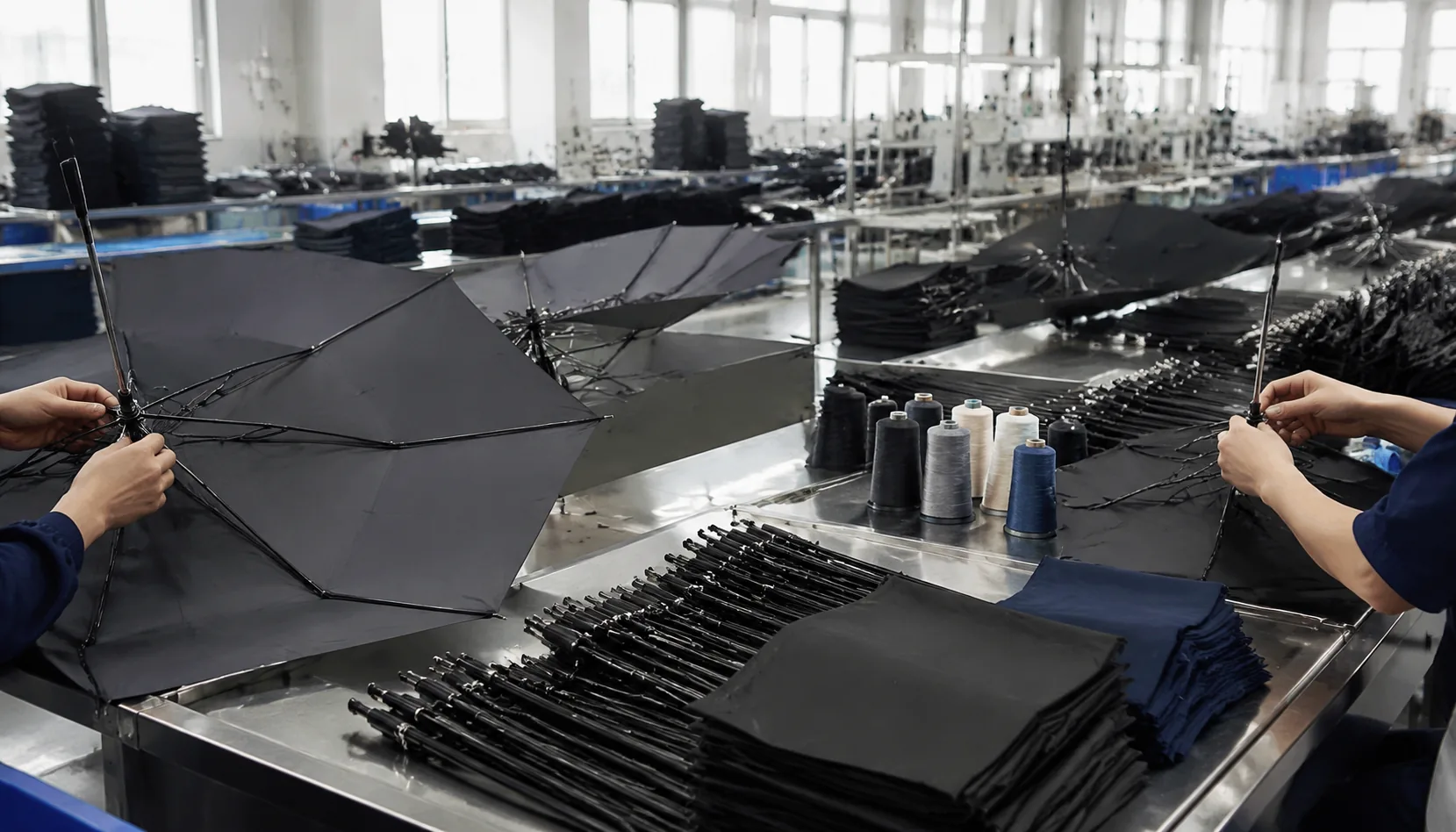
For OEM umbrella orders, the real schedule risk is rarely one slow worker; it is an unbalanced flow between frame preparation, canopy sewing, final assembly, and inspection. On our Songxia factory floor, a stable umbrella assembly line process means matching station takt time to order mix, training float labor for bottlenecks, and placing QC gates before defects become packed cartons. Buyers feel the difference in fewer missed ship dates and fewer mechanism or canopy claims.
Mapping the Umbrella Assembly Workflow
A balanced umbrella assembly line starts by separating frame work from fabric work, because those two streams move at different speeds. In a normal umbrella factory workflow, frame preparation covers shaft cutting or incoming shaft checking, runner and notch positioning, 8K or 10K rib assembly, spring testing, tip alignment, and opening force checks before the frame ever meets the canopy. In parallel, canopy sewing starts with 190T or 210T pongee cutting, panel matching, logo orientation control, seam sewing, tie-wrap stitching, and top-cap hole punching. For PVC, POE, or EVA clear umbrellas, sewing may be replaced by heat sealing or reinforced stitching at stress points. In OEM umbrella production, this is where a good supervisor prevents downstream chaos: if printed panels are mixed by shade, or ribs arrive with inconsistent bow, the final mounting station becomes a repair bench instead of an assembly station. Our standard practice at ZheBrella is to release frames and canopies in matched batch cards so operators can trace size, color, print version, and frame type through the umbrella assembly line process.
The frame-canopy mounting station is the real pace-setter in bulk umbrella manufacturing. Operators align the canopy crown to the shaft, secure the top cap, attach each panel tip to the rib ends, then stitch or fasten the canopy to key rib positions depending on product class. A 23 inch manual straight umbrella with 8 steel ribs is fast: fewer moving parts, simpler spring action, and lower torque during opening. A 27 inch golf umbrella with 8K or 16K fiberglass ribs needs more spacing control, especially if it uses a double-canopy vented windproof construction rated for 50+ mph tunnel testing. Auto-open models add checks for spring compression, button release, runner travel, and safe lock engagement. Auto-open-close folding umbrellas are slower again because the shaft sections, rewind spring, and runner mechanism must be tested before and after canopy mounting; one burr in the telescopic tube can cause a failure that looks like poor sewing but is really frame friction.
After mounting, handle fitting, in-line umbrella QC, final inspection, packaging, and carton sealing should be treated as separate stations, not one crowded finishing table. Handle fitting includes glue or screw fixing, logo orientation, strap attachment, and torque checking, especially on EVA foam golf handles, plastic J handles, and rubber-coated straight handles. In-line QC should catch loose tips, twisted panels, exposed needle ends, weak tie-wraps, crooked heat-transfer logos, and slow auto-open response before the umbrella reaches final packing. Final inspection is usually run to AQL 2.5 for major defects, with tighter internal checks for export retail orders. Packaging then follows the buyer specification: individual polybag, sleeve, hangtag, silica gel if required, inner box, master carton, carton mark, and barcode label. Carton sealing is not glamorous, but it protects the shipment; weak tape, wrong carton size, or over-compressed umbrellas can create claims even when the umbrella assembly line process itself was technically correct.
Balancing Labor Across Bottleneck Stations
The fastest way to lose money in OEM umbrella production is to balance the line by headcount instead of takt time. For a 5,000-piece PO running one 8-hour shift at 90% practical efficiency, the takt target is about 6.2 seconds per finished umbrella leaving final packing, but no single operator works that fast because stations are grouped by operation bundles. We convert that into station output targets: canopy panel joining may need 900-1,100 canopies per sewer per day on standard 8K 23-inch umbrellas, while rib-tip attachment may target 1,400-1,800 pieces depending on whether tips are hand-pressed, bar-tacked, or reinforced with extra stitching. A good umbrella factory workflow posts hourly WIP counts at cutting, sewing, frame assembly, canopy mounting, inspection, and packing, not just the daily shipment target. If one station runs 12% below takt for two hours, the whole umbrella assembly line process starts hiding shortages under tables.
Canopy sewing is usually the first real bottleneck because fabric behavior changes by material and design. A 190T pongee straight umbrella with 8 panels is predictable; a 210T pongee double-canopy vented windproof model adds a second canopy layer, vent alignment, extra seam handling, and more trimming, often adding 3-5 labor minutes per umbrella before it even reaches frame mounting. POE, PVC, and EVA transparent canopies slow sewing further because operators must avoid stretch marks, needle heat, and visible stitch wandering. Rib-tip attachment is the next constraint on 16K designs: doubling from 8K to 16K does not just double tip points, it increases canopy tension checks, rib spacing correction, and defect exposure at every seam intersection. In bulk umbrella manufacturing, a 16K double-canopy umbrella can consume 25-40% more assembly labor than a standard 8K auto-open model, even when the diameter stays at 23 inches.
Auto-open mechanism adjustment is the bottleneck buyers underestimate because it looks like a small metal or plastic component, not a labor-heavy operation. On manual umbrellas, frame opening force and runner travel are simple checks; on auto-open and auto-open-close models, operators must tune spring force, shaft lock engagement, button response, and closing resistance so the umbrella does not misfire during in-line umbrella QC. Our standard practice at ZheBrella is to separate mechanism adjustment from final inspection when the order includes windproof fiberglass ribs, 10K/16K frames, or double-canopy construction, because combining those checks creates false productivity. A balanced umbrella assembly line process keeps a floating helper between sewing rework, rib-tip correction, and mechanism tuning, then audits with AQL 2.5 before cartons are sealed. That buffer is cheaper than stopping packing because 300 umbrellas need button-force correction at 6 p.m.
Material Staging for Continuous Production
Material staging decides whether an umbrella line runs at 900 pieces a shift or spends the afternoon waiting for a missing runner carton. For OEM umbrella production, we kit every work order by model, size, rib count, and color before it reaches the assembly benches: 8K or 10K rib sets, steel or fiberglass shafts, matching runners, handles, tips, ferrules, woven labels, hang tags, polybags, inner boxes, and export cartons. Canopies are staged separately by cut bundle, usually 21", 23", 27", or 30", with barcode labels tied to the PO and colorway. A good umbrella assembly line process does not let operators “borrow” parts from the next order; that is how black ferrules end up on navy umbrellas and how carton counts go wrong at final packing. Our standard practice at ZheBrella is to release one full shift of material plus a controlled buffer, not a whole week of parts, because crowded staging areas create mix-ups faster than they prevent shortages.
Fabric lot control needs more discipline than most buyers realize, especially when 190T and 210T pongee are both running in the same umbrella factory workflow. A 190T promotional umbrella and a 210T retail umbrella may look similar on a cutting table, but they sew differently, stretch differently over ribs, and take screen printing or heat-transfer logos with slightly different hand feel. We keep fabric rolls, cut panels, and sewn canopies segregated by denier, coating, color lot, and print status; UV UPF 50+ or Teflon-coated lots are tagged so they do not get mixed with plain water-repellent pongee. Color-matched components are checked under consistent light before release: canopy, sleeve, handle trim, end cap, strap, label thread, and sometimes even the carton mark if the retailer requires it. This is also where in-line umbrella QC starts in bulk umbrella manufacturing, because catching a shade mismatch or wrong ferrule before assembly is far cheaper than reworking 2,000 finished umbrellas after AQL 2.5 inspection finds the pattern.
In-Line QC Gates Before Final Inspection
The first QC gate belongs immediately after frame assembly, not at the end of the line when rework is expensive. On 8K and 10K straight umbrellas, I want rib spread checked on a flat jig so the crown sits centered and every steel or fiberglass rib opens to the same arc; a 3-5 mm rib height difference at this stage becomes a twisted canopy later. Runners, stretchers, rivets, and springs are sampled in-line, with special attention to loose rivet heads and burrs that can cut 190T or 210T pongee during mounting. For windproof double-canopy models, the lower rib set and vent support ribs must be matched before sewing operators receive the frames. This is where an umbrella factory workflow either stays balanced or starts feeding defects downstream. In OEM umbrella production, our standard practice is to separate frame rejects into repairable, supplier-return, and scrap bins so the umbrella assembly line process does not hide chronic tooling problems.
After canopy mounting, QC should check fabric tension, rib alignment, tip security, and surface handling before the umbrella is cycled. The canopy seam must sit directly over the rib, especially on logo panels, because a 10 mm rotation can make screen-printed artwork look crooked even when printing was correct. Tips are pull-checked by hand on every operator bundle; loose metal tips, plastic tips, or sewn-in safety tips are one of the most common field complaints in bulk umbrella manufacturing. For Teflon-coated, PU-coated, or UV UPF 50+ fabric, inspectors should not drag the canopy across dirty tables or clamp it with oily fixtures, because water-repellent performance can be damaged before the customer ever uses the umbrella. I also like a quick spray or bead test per fabric roll change, not only per finished lot, since coating variation often appears between dye lots rather than between finished cartons.
Mechanism QC is the gate that protects the final AQL 2.5 inspection from becoming a repair station. Manual-open units should lock cleanly without runner slip; auto-open and auto-open-close umbrellas need repeated function checks, usually 3-5 cycles in-line and more for new tooling, with attention to spring force, button travel, shaft wobble, and safe closure. A 21 inch folding umbrella can pass visually but fail because the telescopic shaft does not seat fully after closing. Before packing, inspectors confirm dry canopy condition, strap position, sleeve fit, hangtag and barcode accuracy, carton count, and polybag ventilation requirements for POE, PVC, or EVA styles. In-line umbrella QC should remove mixed-color panels, wrong handles, loose caps, and stained fabric before final inspection. Final AQL 2.5 then verifies the shipment statistically, but the real control is built into the umbrella assembly line process at each handoff.
Production Planning Data Buyers Should Request
The most useful production-planning sheet is not a pretty Gantt chart; it is a dated capacity and material-readiness record tied to your approved sample. Buyers should ask for daily capacity by model, not just factory-wide output. A basic 23" auto-open steel-frame umbrella may run 3,000–5,000 pcs/day on a balanced line, while a 30" double-canopy golf umbrella with 8K fiberglass ribs, vent sewing, and large screen print may drop below 1,200 pcs/day. The approved sample date matters because bulk fabric cutting, frame assembly, and printing should not start until canopy size, logo position, handle, tips, runner, and packing are frozen. In OEM umbrella production, I also want to see whether 190T or 210T pongee, POE/PVC/EVA panels, Teflon coating, UV UPF 50+ coating, cartons, hangtags, and color boxes are physically in-house or only booked with suppliers.
MOQ constraints should be stated before the line plan is accepted, because umbrella factory workflow changes sharply between 500 pcs, 3,000 pcs, and 20,000 pcs. A small promotional order may be grouped with other jobs for cutting and sewing, while bulk umbrella manufacturing needs dedicated fabric spreading, rib subassembly, canopy stitching, final assembly, and packing stations. Ask the factory to show estimated lead time in days by stage: 3–7 days for final artwork and sample approval, 7–15 days for material preparation, 5–20 days for printing depending on screen, heat-transfer, or sublimation, and 7–25 days for assembly and AQL 2.5 inspection. Our standard practice at ZheBrella is to flag the critical path separately, because one late molded handle or mismatched 16K rib set can stop an otherwise ready order.
FOB and DDP milestones should be written into the same plan as production, not discussed after packing. For FOB Ningbo or Shanghai, buyers should request target dates for final in-line umbrella QC, pre-shipment inspection, carton completion, warehouse release, customs documents, and vessel cutoff. For DDP, add inland pickup date, container loading window, export declaration, ocean or air transit, import clearance, and final delivery appointment. A transparent umbrella assembly line process reduces rush rework because supervisors can see when printing, sewing, frame loading, and packing are competing for the same labor. It also protects shipment dates: if a 50+ mph wind-tunnel-rated vented umbrella needs extra seam reinforcement, that time is visible before the booking is made, not discovered when cartons are already due at the forwarder.
Frequently Asked Questions
Why can two umbrella styles with the same MOQ have different lead times?
Complexity changes line speed. A basic manual 8K umbrella moves faster than a 16K double-canopy auto-open model with more sewing, assembly, and QC steps.
What assembly data should procurement teams ask for before placing a bulk order?
Ask for sample approval timing, material arrival dates, estimated daily output, in-line QC checkpoints, and final inspection timing. These details help align production with FOB or DDP delivery dates.
How many QC gates should an OEM umbrella assembly line include?
A typical bulk umbrella line should include at least 3 QC gates: incoming material inspection, in-line checks after frame/canopy assembly, and final AQL inspection before packing. For automatic or windproof models, add a mechanism open-close test before final packing.
What production bottlenecks most often delay bulk umbrella orders?
Common bottlenecks include canopy sewing output, frame riveting or runner assembly, logo printing approval, and final packing capacity. Balancing these stations early helps keep daily output stable, especially for orders above 10,000 pieces.
How should labor be allocated for a large OEM umbrella production run?
Factories usually assign more operators to sewing, frame assembly, and final inspection because these steps determine both speed and defect rate. For repeat OEM styles, labor can often be balanced after the first pilot run of 100-300 pieces.
Looking to Launch Your Custom Umbrella Line?
ZheBrella is a Zhejiang-based OEM/ODM umbrella manufacturer with 17 years of export experience. Free design, low MOQ from 100 pieces, windproof construction, full-color print.
Get Free Quote Now »People Also Search For
Related Articles
Umbrella Assembly Line Balancing for Reliable Bulk Output
Learn how balanced umbrella assembly lines reduce bottlenecks, stabilize lead times, and protect quality for high-volume...
Read More »
Umbrella Line Balancing for Consistent Mass Assembly
Understand how balanced workstations, takt time, and in-process QC keep OEM umbrella assembly stable for auto-open, wind...
Read More »
Umbrella Factory Line Setup for Mixed-SKU OEM Orders
See how factories plan mixed-SKU umbrella lines, balance frame assembly, canopy sewing, printing, QC, and packing to red...
Read More »