Inside-Panel Umbrella Printing for Subtle Brand Messaging
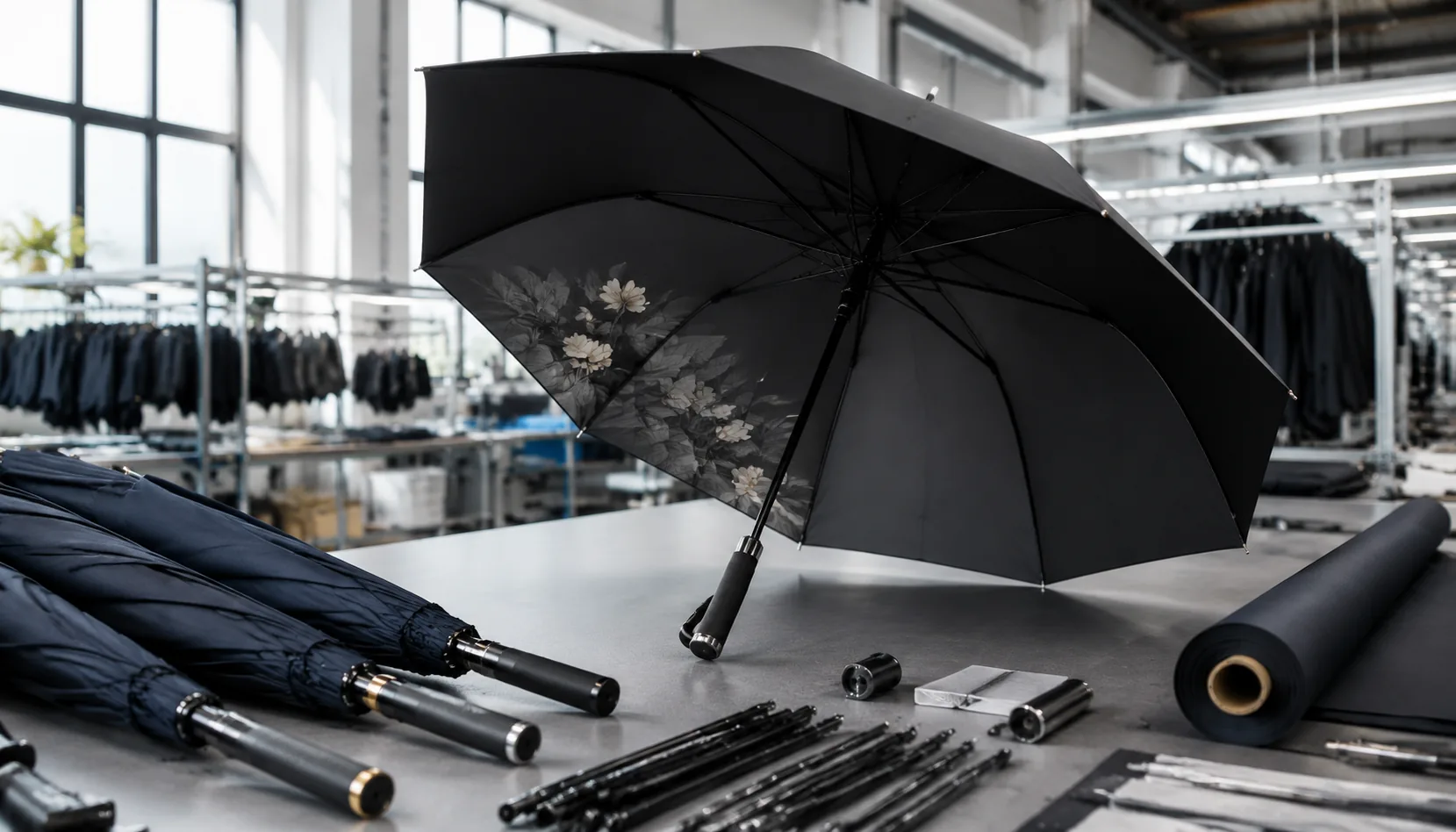
Buyers often want logo visibility without turning an umbrella into a billboard, especially for premium retail, hospitality, and corporate gifts. Inside-panel umbrella printing solves that need when the artwork, rib layout, and canopy construction are matched correctly, but the result depends on real production limits such as seam placement, panel count, and print alignment. At our Songxia factory, we see the difference between a concept that looks good in a mockup and one that still reads cleanly after folding, opening, and daily use.
When inside-panel printing makes strategic sense
inside panel umbrella printing makes sense when the brand is selling restraint, not volume. In premium retail, luxury gifts, and executive programs, the canopy’s outer face stays clean while the interior carries the message, so the umbrella reads as an object first and an ad second. That is the right move when the buyer wants subtle umbrella branding, a quiet logo reveal, or a design that feels intentional instead of shouted across the street. We see this work best on 21" to 23" compact promotional models and on higher-end 27" or 30" stick umbrellas with pongee 190T or 210T canopies, where the print looks sharper and the reveal feels more deliberate.
It also fits campaign launches that depend on surprise. A reverse canopy print or interior canopy logo can stay hidden while the umbrella is closed, then appear in motion as the user opens it in front of a crowd, on a photo wall, or during a product drop. That change from closed to open is the whole point: the first impression is plain, but the second impression carries the message when attention is already focused on the object. For brand message umbrellas used in launches, nonprofit activations, and trade show storytelling, that reveal creates a cleaner path to recall than a loud exterior print that people ignore after one glance.
This approach works when the brand story matters more than immediate shelf visibility. Interior graphics are useful for phrases, campaign dates, skyline art, wayfinding cues, or a single color block that frames the user from underneath; they are not ideal if the brief needs mass-distance recognition on rainy sidewalks. ZheBrella typically recommends testing the artwork at full-open diameter first, because a print that looks balanced on a flat template can read too small once the ribs pull the canopy taut. If the goal is subtle first impression with a controlled reveal, inside-panel umbrella printing is the cleanest way to do it without turning the umbrella into a billboard.
Print methods and fabric constraints inside the canopy
Inside panel umbrella printing is usually a matter of choosing the least-bad method for the fabric and the artwork, not chasing the cheapest quote. Screen printing gives the best ink deposit on simple logos and a clean reverse canopy print when the graphic is bold and single-color, but it starts to break down on tight copy, gradients, or anything that must sit close to the seam. Digital printing handles more detail and short runs better, while transfer methods are useful when the interior canopy logo needs sharper registration on a small panel or a mixed-color design. For subtle umbrella branding, I normally steer buyers toward artwork that tolerates slight distortion, because the inside of a curved canopy is never a flat poster.
190T or 210T pongee is the right base when color hold and edge clarity matter. The tighter weave gives better definition than loose polyester, and 210T usually holds fine lines a little cleaner because the yarn density resists ink bleed and haloing at the edge. That matters for brand message umbrellas where the message has to stay readable from the inside, especially under backlight. Coarser PVC or EVA can work for novelty use, but the print edge is softer and the surface can show distortion once the panel is tensioned over the frame. On production floor checks, we look at how the ink sits after the canopy is stretched, not just how it looks on a flat swatch.
Panel seams, curvature, and rib count control alignment more than buyers expect. On an 8K or 10K frame, each panel is wider, so the artwork can breathe a little; on 16K or higher, the panel gets narrow and the logo often has to be split or simplified to avoid seam clashes. The seam line itself eats a small band of visible area, and the print will appear to climb or dip as it crosses the crown to the hem because the fabric is never at a constant angle. With inside panel umbrella printing, the cleanest result comes from designing the artwork to the panel geometry first, then matching the print method to the fabric and the actual rib pattern, not the other way around.
Visibility, contrast, and viewing distance
Inside panel umbrella printing only works when you design for the way people actually see it: mostly from below, then briefly from the side as the umbrella tilts. A reverse canopy print looks clear when the shape is simple, the stroke weight is thick enough, and the contrast is strong; thin serif fonts and hairline details disappear fast on moving fabric. For subtle umbrella branding, I usually tell buyers to treat the interior canopy logo like a sign viewed at arm’s length in low light, not like a brochure graphic. Dark ink on white pongee reads best; on colored or coated canopies, you need either a high-value contrast or a very deliberate one-color silhouette. If the message has to be recognized at a glance, keep the main mark large enough to cross several panels instead of hiding it inside one small wedge.
On 8K canopies, panel geometry is forgiving enough for centered logos, but you still need to respect seam lines and the curved edge near the tip pocket. Put the interior canopy logo in the upper-middle area of the panel if you want it visible when the umbrella is open above eye level, and avoid placing critical letters across the seam where sewing tension can warp them. On 16K canopies, the narrower panels make distortion more obvious, so break the artwork into simpler zones or use a repeated brand message umbrellas layout rather than one long line of text stretched across one panel. The cleanest result is usually a short mark repeated on every other panel, or a central motif scaled to the panel width with generous clear space around it.
If you want the message to survive motion, rain, and imperfect opening angles, use bold shapes, not fine copy. A practical rule is that the smallest readable element should still hold up when the umbrella is viewed from 1 to 2 meters below; if it only reads when the canopy is perfectly flat, it is too small. For promotional programs, we usually separate decorative reverse canopy print from the actual brand cue: one can carry the look, the other carries the name. That approach gives subtle umbrella branding without turning the underside into visual clutter, and it keeps the graphic legible even when the canopy is slightly twisted, which happens constantly in real use.
Construction details that protect the print
Inside-panel umbrella printing lasts longer when the umbrella is built to stop the canopy from fighting itself. A double-canopy windproof frame keeps the inner fabric from ballooning and slapping against the outer layer in gusts, which matters a lot for reverse canopy print and any interior canopy logo placed on the inside face. Fiberglass ribs are the right call here because they flex instead of snapping under load, so the panel tension stays more even across the print area. For brand message umbrellas, that stability is worth more than a slightly cheaper steel frame that transmits shock straight into the seam and coating.
Reinforced stitching at the panel joins and tip pockets is the second thing buyers should care about, because that is where fabric stress shows up first. On a loose build, the print may look fine flat on the table and then start whitening along the fold line after a few open-close cycles. Good subtle umbrella branding depends on keeping the interior graphic away from hard crease paths and controlling where the fabric bears against the runner, tips, and ferrule. If the sew line is weak or the thread tension is inconsistent, the canopy will distort before the ink fails, and the design will look crooked even if the artwork was perfect.
Any serious buyer should ask for sample umbrellas and test them the same way users will. Open and close them repeatedly, then inspect the inside panel umbrella printing at the fold lines, the high-abrasion points near the rib tips, and the panel edges where the fabric rubs against itself. Look for cracking in screen or heat-transfer inks, especially on darker grounds or on coated pongee where the surface stiffness is higher. I also check the inner canopy after a wet-dry cycle, because some prints only show stress whitening once the fabric relaxes. If the sample survives that abuse cleanly, the production run is much safer.
Spec sheet items buyers must confirm upfront
For inside panel umbrella printing, buyers need to lock down artwork orientation before anyone touches film or screens. The logo looks wrong the moment the panel map is flipped, so the factory needs the exact panel count, which panel carries the mark, reading direction from the user’s side, and whether the interior canopy logo sits centered, offset near the seam, or repeated across multiple gores. Approved color references should be specified as Pantone or a signed physical sample, because subtle umbrella branding depends on the right ink density on a dark pongee or POE canopy, not a vague RGB file that looks fine on a monitor and fails on fabric.
Procurement teams should also confirm MOQ, target lead time in days, and the inspection standard up front. Inside printing usually needs tighter preproduction approval than a simple exterior logo because the reverse canopy print must be checked for alignment, bleed, and show-through before bulk sewing starts; our standard practice is to approve a strike-off or digital proof first, then release production only after the buyer signs off. If the order is for brand message umbrellas, ask for AQL 2.5 inspection coverage, the packing method, carton count, and whether the commercial term is FOB Ningbo/Shanghai or DDP to the final destination.
Shipping terms matter because they change what the buyer actually controls. FOB means the buyer owns the freight booking and clearance after the port handoff; DDP means the factory or forwarder carries more of the delivery burden, which is useful when the order is time-sensitive or the consignee has weak import handling. Capture all of this in one spec sheet: artwork file format, panel map, color references, MOQ, sample approval deadline, lead time, AQL 2.5, and the agreed Incoterm. If any of those are missing, inside panel umbrella printing usually slows down later, and the fix costs more than the original print run.
Frequently Asked Questions
Is inside-panel printing visible when the umbrella is closed?
Usually not much, which is the point for subtle branding. Most of the effect appears when the umbrella opens, so it works best when the brand wants a reveal rather than constant exposure.
Does inside printing cost more than standard canopy logos?
Often yes, because alignment and print positioning are more sensitive and sampling is more important. The final price depends on fabric type, number of panels, and whether the decoration needs special setup.
How much of the inside canopy is usually printable on a standard 23-inch umbrella?
Most buyers can print one to four panels, but the exact print area depends on seam allowance, panel shape, and venting. On a 23-inch canopy, a single panel is often around 8 to 11 inches wide at the hem, but the safe artwork size should be confirmed with the factory dieline before production.
Will inside-panel printing affect umbrella opening or durability?
Not if the artwork is applied with the right ink system and cured properly. The main construction checks are fabric weight, seam reinforcement, and whether the print area overlaps stress points near the tips, ribs, or stitching lines.
What should a buyer approve before mass production?
Request a full-size panel template, Pantone targets, and a position mockup showing the umbrella open and in use. For OEM orders, it is also common to confirm sample color accuracy and a production MOQ, which for custom printed umbrellas is often 500 to 1,000 pieces per design depending on material and print method.
Looking to Launch Your Custom Umbrella Line?
ZheBrella is a Zhejiang-based OEM/ODM umbrella manufacturer with 17 years of export experience. Free design, low MOQ from 100 pieces, windproof construction, full-color print.
Get Free Quote Now »People Also Search For
Related Articles
Under-Canopy Printing for Reverse-Fold Brand Messaging
Place brand messages inside reverse-fold umbrellas to create a visible surprise effect, while protecting logo placement ...
Read More »
Inside-Canopy and Reverse Printing for Umbrella Branding
Compare inside-canopy and reverse-print branding methods for umbrellas, including legibility, protection, and factory se...
Read More »Inside-Canopy Brand Messaging for Event and Retail Umbrellas
Explore inside-canopy branding for umbrellas, including layout limits, visibility, print methods, and buyer checks for r...
Read More »