Under-Canopy Printing for Reverse-Fold Brand Messaging
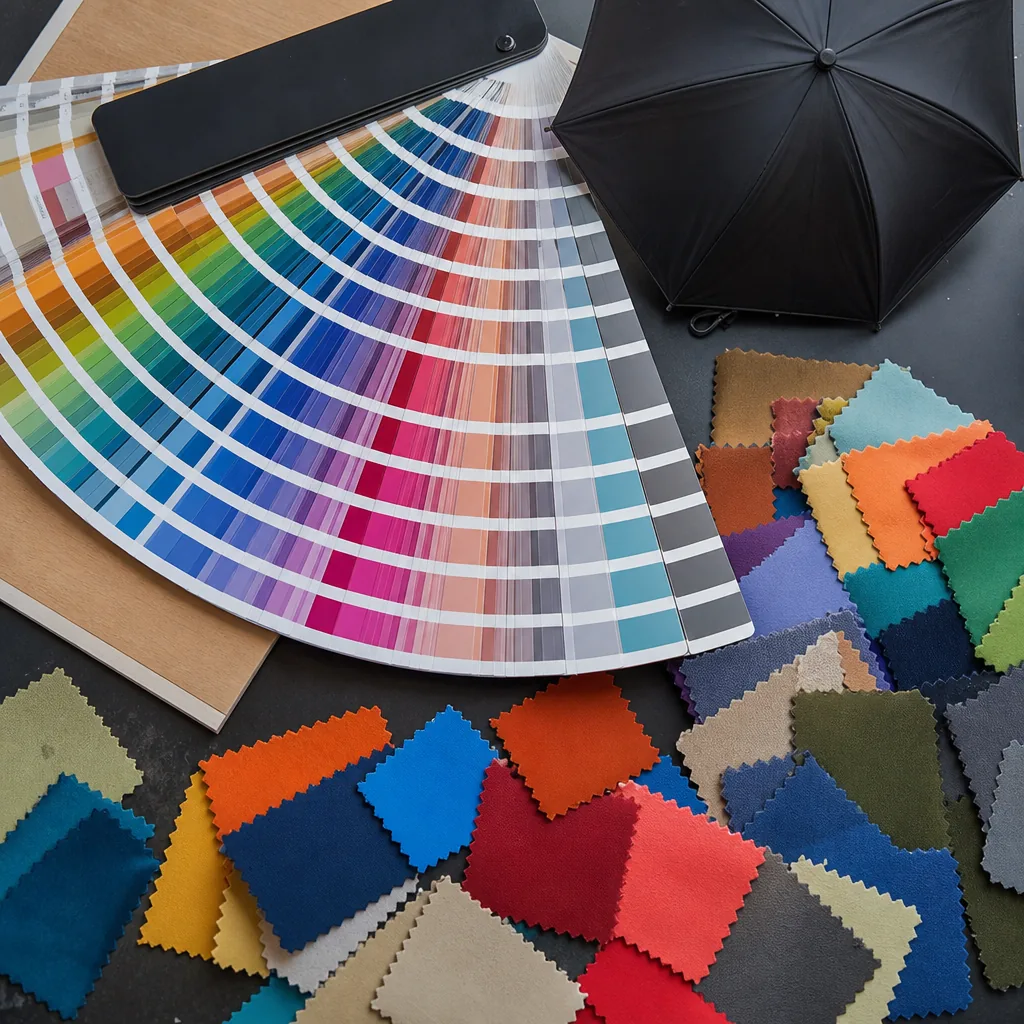
When a buyer specifies reverse fold umbrella printing, the challenge is not just putting a logo on fabric but keeping the message visible, protected, and aligned with how the umbrella actually opens and closes in daily use. On the factory floor, that means planning under-canopy placement, ink adhesion, seam movement, and abrasion points so the reveal feels intentional instead of worn or misregistered.
Why the inside canopy is a branding asset
The inside canopy is the part people actually see when a reverse-fold umbrella opens in front of them, which is why reverse fold umbrella printing works better than a lot of buyers expect. On an inverted frame, the canopy flips upward as it closes, so the message stays visible to the user, the person stepping into a car, and anyone standing close by. That makes under-canopy branding a real functional surface, not just decoration, especially for event giveaways, hospitality programs, and premium gifts where the first impression happens at arm’s length.
A clean inside umbrella logo usually reads more clearly than a crowded outer-panel print because the viewing distance is short and the graphic is framed by the arc of the ribs. With a branded inner canopy, you can place one centered mark, repeat a small pattern across panels, or use a high-contrast message that appears when the umbrella opens and then flashes again during closure. Buyers like this because the reverse opening umbrella print feels unexpected; it turns a routine weather item into something that looks custom and considered without needing oversized artwork.
From a factory standpoint, the best results come from planning the artwork around panel geometry, seam loss, and how the canopy folds back into the frame. Dark interiors can hide low-contrast ink, while lighter pongee or polyester gives better color payoff for fine text and logos. For promotions, I usually recommend simple shapes, fewer gradients, and a layout that stays legible on 8K to 16K constructions, because the inside surface is what gives the umbrella its premium feel and makes the branding memorable instead of generic.
Fabric and print method choices for the inner side
For reverse fold umbrella printing, the inner side has to be treated as a viewing surface, not just the back of the cloth. 190T pongee is the safer base when you want a softer hand and a little more forgiveness in the drape; it usually takes ink well enough for simple under-canopy branding, but heavy coverage can start to telegraph through if the color is dark or the canopy is stretched hard. 210T pongee is tighter and cleaner, so it gives better ink holdout and less show-through, which matters when the inside umbrella logo needs to stay sharp against daylight coming from the outside. In production, I prefer 210T when the artwork has fine edges, small type, or a branded inner canopy that needs to look crisp from a seated height.
Digital print is the right call for gradients, photos, soft shadows, and any reverse opening umbrella print that depends on tone shifts rather than hard edges. Screen print still wins for solid logos, bold fills, and large typography because the ink film is more opaque and the edge definition is cleaner on repeating panels, especially when the design has only one or two spot colors. Transfer print sits in the middle: it is useful when you need decent detail without building a custom screen set, but it is weaker on very large blocks of color and can feel more noticeable on the inner surface. On 190T pongee, digital and transfer both need tighter heat control; on 210T, the same art usually lands cleaner and with less distortion at the seams.
The practical rule is to match fabric and method to how the umbrella will be opened and viewed. If the buyer wants a promotional piece with a large message that must read instantly from the inside, 210T pongee plus screen print is the most dependable combination. If the job is a full-color brand story, event artwork, or a detailed map that wraps the canopy, digital print is more flexible, but you should accept slightly softer contrast and verify that the ink does not muddy at panel joins. For premium under-canopy branding, I would avoid overloading 190T with dense black fills unless the sample has already proven the show-through level; once the fabric is wet or backlit, weak ink control becomes obvious very fast.
Registration, alignment, and seam planning
For reverse fold umbrella printing, the first thing I tell buyers is that the inside surface is not a flat poster; it is a segmented cone with seams, overlap allowances, and motion points that all distort artwork if you ignore them. On an 8K frame, the panel geometry is wide enough that a headline can sit cleanly across two or three panels, but on a 16K frame the smaller panels create more seam interruptions and more opportunities for text to land on a stitch line. If the canopy is double-layer vented, the inner and outer layers may also shift slightly against each other during opening, so the branded inner canopy needs extra margin around logos and any fine linework.
The safest layout for under-canopy branding is to keep the main message in the upper-middle area of each panel, away from the center cap, the rib junctions, and the lower stress zone near the tips. The center point of a reverse opening umbrella print is usually the worst place for legible text because it gets compressed by panel convergence and loses clarity when the umbrella is partially open. I usually reserve at least 15 to 20 mm of no-critical-copy space on both sides of every seam, then push logos outward so the viewer reads them as separate panel elements instead of one distorted ribbon. That matters even more on an inside umbrella logo, where the eye is looking up from below and sees every registration error immediately.
For consistent registration, the artwork should be built from the actual panel template, not a generic circle, and the print method has to match the fabric stretch. Sublimation on 190T or 210T pongee tolerates fine gradients better than screen print, but both need a hard seam map before approval. ZheBrella’s standard practice is to mark rib count, vent cutouts, and stress points on the artwork proof so the customer can see exactly where a letter, icon, or QR code will break. If the design depends on precise alignment, keep the key text on only one or two panels and avoid crossing the seam at the fold line; that gives a cleaner result and reduces the chance of visible distortion after repeated opening cycles.
Durability, UV performance, and color stability
If the product is a sun umbrella, the inside print cannot be treated as decoration only; it has to survive the same UV load as the canopy. In practice, reverse fold umbrella printing should be specified alongside the fabric finish, because a PU-coated or UV-treated pongee can still fail the brief if the inks chalk or fade early. For true outdoor use, I ask for UPF 50+ on the fabric system as a whole, then confirm the under-canopy branding does not reduce that performance with heavy ink coverage, especially on 190T or 210T polyester where dense solids can change hand feel and light transmission.
Abrasion is the other failure point. An inside umbrella logo sits close to the rib heads, stretch points, and the folding line, so repeated opening and closing will scuff weak ink films fast. Thermal transfer and low-grade screen inks tend to crack first on high-stress panels; better results come from fine-mesh screen printing or sublimation on compatible fabric, with cure control and wash-rub testing before approval. For branded inner canopy work, I expect the client to define both opening cycles and rub resistance targets, because a print that looks clean on day one can ghost or smear after a few hundred uses.
Color stability matters most on dark solids and high-contrast branding, where any drift shows immediately. Black, navy, and deep red can hide poor ink penetration, so we check both face color and reverse bleed-through when the canopy is stretched under light. For reverse opening umbrella print applications, the better standard is not just “looks good” but measurable colorfastness against sunlight and rubbing, with no visible mottling at seams or seam tape. If the artwork uses white on dark fabric, I usually push for a sample approval under daylight and LED light, because that is where weak coverage and edge feathering show up first.
Approval samples and production controls
On a strike-off for reverse fold umbrella printing, I check the image at actual size, not just on a screen mockup. For under-canopy branding, the first failure is usually soft edges from poor transfer pressure or a mesh count that is too low, so the inside umbrella logo has to read cleanly from arm’s length with no haloing around fine text. I also check opacity against a strong backlight because a branded inner canopy that looks solid on white fabric can turn weak once the canopy is stretched over a dark frame or viewed from underneath in daylight.
Color shift is the other point buyers miss. A reverse opening umbrella print that matches Pantone under indoor LEDs can drift noticeably under daylight, especially on PU-coated pongee or darker POE panels, so approval should be signed off outdoors or under a daylight lamp, not in the office. I also confirm registration, panel alignment, and ink hand-feel; if the print sits too thick, it cracks when the frame folds at the rib joints and the repeat order becomes a complaint later.
For production control, our standard practice is AQL 2.5 on finished goods, with extra attention on print position, panel symmetry, and open-close cycling so the artwork does not rub against wet canopy fabric during inversion. For custom repeat orders, a practical lead time is 12 to 18 days when the frame spec is unchanged and the artwork is already approved; new frame tooling, special coatings, or multicolor inside print usually pushes it closer to 20 to 30 days. If the buyer wants a faster release, I recommend keeping one signed strike-off and one retained production standard so the second run does not drift in shade or placement.
Frequently Asked Questions
Is under-canopy printing visible from the outside?
It depends on fabric weight, ink opacity, and canopy color. Light-colored canopies often show faint shadowing, while darker pongee fabrics hide most of the reverse print.
What artwork works best for reverse-fold umbrellas?
Large text, simple icons, and bold messages work best because the print is read at opening distance. Very fine details can blur across seams or lose impact when the canopy is partially collapsed.
What print methods work best for under-canopy branding on reverse-fold umbrellas?
Screen printing is commonly used for simple logos and slogans, while digital heat transfer is better for gradients, photo-style artwork, or full-panel graphics. For bulk OEM orders, factories typically recommend screen printing when the artwork uses 1–4 solid colors.
Does printing on the inner canopy improve logo durability?
Yes. Because the artwork is placed on the underside of the canopy, it has less direct exposure to rain, UV, and abrasion compared with an outside canopy logo. This makes it a good option for long-term promotional or retail umbrella programs.
What artwork size is recommended for an inside umbrella logo?
For a standard 23-inch reverse umbrella, a single-panel inner logo is often kept within about 18–25 cm wide to avoid distortion near the ribs. Larger messages can be split across multiple panels if the design is prepared with seam and rib positions in mind.
Looking to Launch Your Custom Umbrella Line?
ZheBrella is a Zhejiang-based OEM/ODM umbrella manufacturer with 17 years of export experience. Free design, low MOQ from 100 pieces, windproof construction, full-color print.
Get Free Quote Now »People Also Search For
Related Articles
Inside-Panel Umbrella Printing for Subtle Brand Messaging
Learn when inside-panel umbrella printing works, how it looks in use, and what artwork and construction limits buyers sh...
Read More »Inside-Canopy and Underside Logo Printing on Branded Umbrellas
See how inside-canopy logo printing expands branding space on umbrellas, with guidance on artwork, fabric choice, and pr...
Read More »
Inside-Canopy and Reverse Printing for Umbrella Branding
Compare inside-canopy and reverse-print branding methods for umbrellas, including legibility, protection, and factory se...
Read More »