Inside-Canopy and Underside Logo Printing on Branded Umbrellas
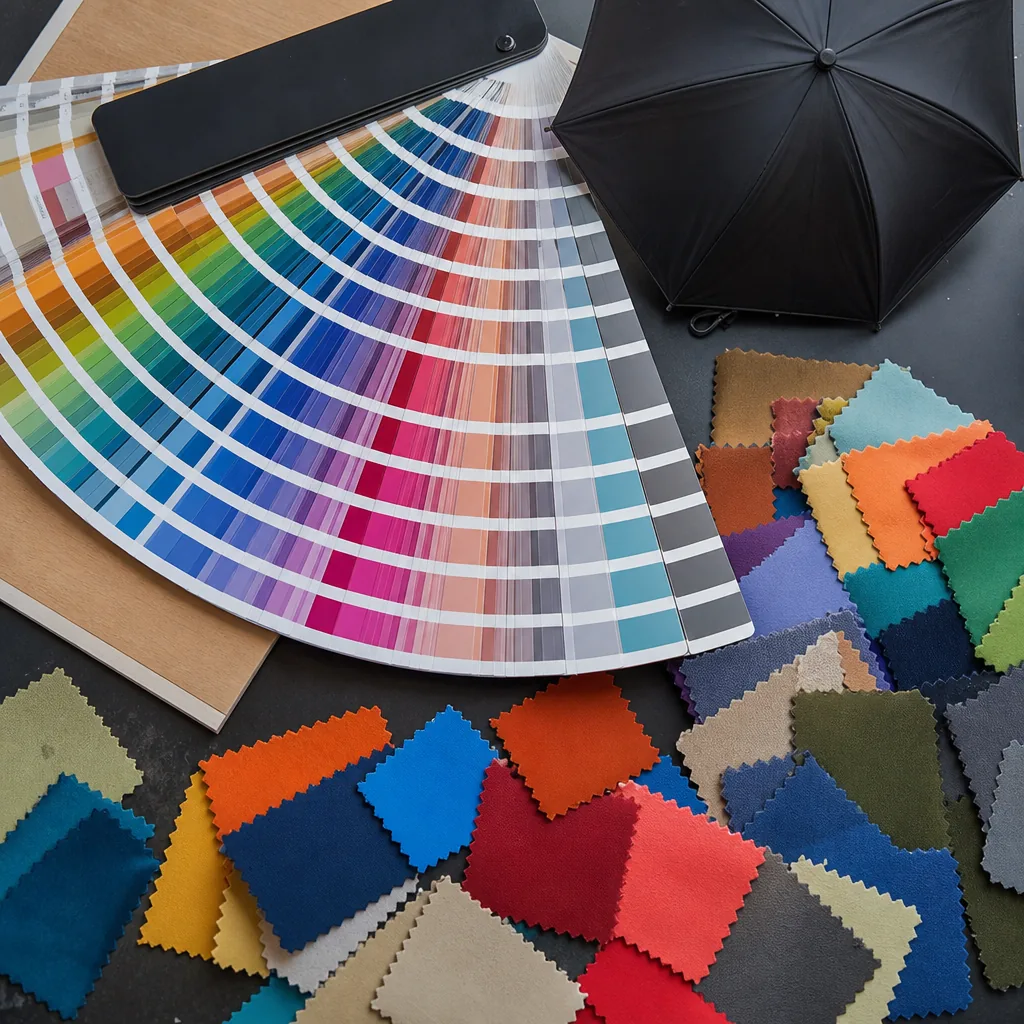
When buyers ask for more brand presence on an umbrella, the real constraint is not the logo size but the canopy geometry, fabric behavior, and how the print will read from both sides. Inside canopy printing opens a larger, cleaner branding field, but it only works well when artwork, panel count, ink coverage, and production tolerances are matched to what the factory can actually hold on the line.
Why the Underside Becomes Valuable Branding Space
Inside canopy printing turns the dead space people look at during use into the only surface they actually see while standing under the umbrella. That matters in hospitality, where guests read the message while waiting at an entrance or walking between buildings, and in retail or brand activations where the umbrella is part of the scene, not just rain protection. On a windy street or at a crowded event, the underside umbrella logo is often more visible than the outside panel because the canopy is tilted, lifted, or framed by the user’s head and shoulders.
This is different from exterior canopy logo placement, which is aimed at distance viewing, passing traffic, and simple identification from outside. Inner canopy branding works better when you want storytelling, pattern work, or a repeated brand cue that feels intentional rather than slapped on. For branded umbrella decoration, the inside view usually creates stronger recall because the audience is beneath the product for several minutes, with the artwork filling the full field of vision instead of disappearing into the background.
Reverse print umbrellas are useful when the campaign depends on what people experience from below, not what they spot from across the street. I see the best results when the inside artwork is designed with high contrast, limited text, and a layout that follows the panel geometry instead of fighting it. If the goal is event photography, hotel arrival zones, or premium retail giveaways, inside-canopy printing can carry more brand memory than a standard exterior logo alone, especially when the umbrella is open in a dense crowd where only the underside is clearly visible.
Print Technologies for Inner-Canopy Artwork
Direct print is the workhorse for inside canopy printing when the artwork needs to sit on the fabric itself, not as a loose label. On 190T or 210T pongee, it gives the cleanest edge and the most stable color block, especially for logos with solid fills or small type. If the buyer wants an underside umbrella logo that stays readable from the inside without bleeding through to the outside, we usually start by checking canopy opacity first; thin polyester will telegraph the print, while denser pongee hides the strike-through better. Rib count matters too: 8K and 10K frames leave broader panels, which are easier to register cleanly, while 16K designs divide the canopy into narrower segments and punish sloppy alignment.
Panel-by-panel artwork is the smarter option when the branded umbrella decoration needs to follow each canopy segment instead of sitting as one centered mark. That approach gives better control over inner canopy branding on segmented layouts, but it only looks sharp if the panel seams and artwork breakpoints are planned before cutting. Reverse print umbrellas add another layer of complexity because the image is viewed from inside, so the art file has to be mirrored and checked against vent openings, runner position, and seam allowances. On double-canopy vented windproof umbrellas, the inner layer usually gives better visual separation, because the outer layer blocks light and reduces show-through from the print beneath.
For the best result, the print method has to match the structure, not just the logo. A high-opacity 210T pongee canopy handles inside canopy printing more consistently than low-density fabric, while lighter materials need heavier ink deposition or a print area that avoids fine detail. Where the canopy is single-layer and translucent, show-through becomes the main problem; on double-canopy construction, clarity improves because the layers act like a light filter and keep the underside artwork from ghosting. Our standard practice is to test a sample under strong backlight before approval, because a logo that looks fine on a table often fails once the umbrella is opened outdoors.
Artwork Layout, Panel Alignment, and Seam Control
Inside canopy printing only works when the artwork is built around the umbrella’s rib map, not just dropped onto a flat circle. On an 8K frame, each panel is wide enough that the logo can survive a modest amount of seam interruption, but on a 16K frame the same mark gets chopped into thinner slices and every panel break becomes visible. The safe way is to lay out the underside umbrella logo against the actual panel count, then reserve seam allowance at each stitch line so key letters, icons, and borders do not land in the fold. For branded umbrella decoration, I always check the open-diameter template, the panel apex, and the position of the runner so the artwork is centered where the user actually looks when the canopy is open.
Reverse print umbrellas are unforgiving if the art is centered to the pattern file instead of the frame hardware. Auto-open models can shift the visible centerline slightly because the canopy snaps open under spring tension, and that movement often exposes a different “visual middle” than a manual umbrella. That matters most for inner canopy branding with circular logos, photo marks, or text that must read level from below. Our standard practice is to mark the true center on the cutting file, then proof the first sample with the frame fully opened and locked, because a 5 to 10 mm drift is enough to make the logo look off on a clean white or black interior.
For 8K and 16K umbrellas, I verify three things before production: panel symmetry, seam-to-seam repeat, and how the artwork wraps across the vent or top cap area if the design uses one. A logo that looks fine on screen can end up split awkwardly across a seam if the repeat is not adjusted for the actual cloth stretch and sewing pull. The print file should respect the panel edges, not fight them, and the stitch line should never cut through critical text. That is the difference between a usable inside canopy printing job and one that looks misregistered the moment the customer opens the umbrella.
Durability, Color, and Lighting Considerations
Inside canopy printing takes more abuse than people expect because the graphic sits on the same fabric that is constantly flexed, creased, and rubbed every time the umbrella opens and closes. The weak point is not the artwork itself; it is the ink bond and how well the fabric was pretreated before the print hit the panel. On polyester pongee, a proper inside print should survive repeated folding without cracking at the rib crossings or scuffing where the canopy stacks. With reverse print umbrellas, I look hard at whether the artwork lands on a smoother panel section and away from high-stress seams, because poor layout will wear out faster than a good ink system ever will.
Sunlight is a different problem from indoor lighting. Under strong UV, cheap pigment blacks look gray fast, reds drift toward orange, and deep brand blues lose density first; under office or retail lighting, those same colors can look fine until the viewer compares them against a Pantone reference. For branded umbrella decoration, the safest route is a controlled color target, pre-production strike-off, and expectation-setting on fabric absorbency, because silk screen, heat-transfer, and sublimation each shift color differently on 190T, 210T, or UPF 50+ coated canopies. If the program depends on a high-contrast underside umbrella logo, ask for a measured tolerance on the proof, not a verbal promise that the shade will be exact across every batch.
Inner canopy branding works best when the art stays bold and simple, with enough edge contrast to read through the darker interior shadow created by the ribs and stretch lines. Very fine text and hairline logos disappear once the umbrella is moving, especially on auto-open-close models where the canopy snaps open and the viewer sees the print for only a second. For UPF 50+ programs, the coating can also change the way light passes through the cloth, so a white logo on dark fabric may look sharper in showroom light than in daylight, while a dark logo on a light canopy may flatten under backlight. The practical answer is to test the actual production fabric, not a flat digital file, before locking the artwork for inner canopy branding.
Production Requirements and Buyer Sign-Off
Before mass production, the buyer needs to sign off on a real pre-production sample, not just a PDF mockup. For inside canopy printing, check the artwork position from the opening side, seam-to-seam alignment, panel count, color density on pongee 190T or 210T, and whether the underside umbrella logo reads correctly when the umbrella is open and viewed from below. If the design crosses multiple panels, insist on a panel map and a stitched sample, because a logo that looks centered on screen can drift once the canopy is cut, sewn, and tensioned on the frame.
Minimum order quantity and lead time should be confirmed in writing before the run starts. For most branded umbrella decoration jobs, the MOQ depends on canopy size, printing method, and whether the frame is standard 8K, 10K, or 12K; a one-color reverse print umbrellas order is usually simpler than full inner canopy branding across several panels. Standard production windows are commonly counted in days from sample approval and deposit, but buyers should lock the schedule to the confirmed material and mechanism, whether manual, auto-open, or auto-open-close.
Inspection tolerance should be set to AQL 2.5, with clear rules for what counts as acceptable variation in print registration, seam mismatch, color shift, and small mark-off around the ribs. For export, FOB is the cleanest term when the buyer controls freight, while DDP is better when the shipment needs landed-cost clarity; both should be quoted against the final carton count and destination. Our standard practice is to treat inside-print artwork spanning multiple panels as a higher-risk operation, so the buyer should approve a signed sample before release to cutting and print screens.
Frequently Asked Questions
Will inside-canopy printing make the umbrella heavier or harder to open?
Usually no, if the print coverage is planned within normal production limits. The main concern is fabric feel and curing, not mechanism weight.
Is underside printing better on solid-color or transparent canopies?
It is generally better on solid-color canopies because the graphic reads more clearly and stays controlled. Clear or highly translucent materials can let the artwork show through in ways that weaken the intended effect.
Can inside-canopy printing be used on both single-layer and double-layer umbrellas?
Yes, but double-layer umbrellas are usually better for inner branding because the outside canopy can remain clean while the underside carries the design. For single-layer umbrellas, ink opacity, fabric color, and show-through must be tested before mass production.
What artwork works best for underside umbrella logo printing?
Large logos, repeated patterns, skyline graphics, and simple brand messages work best because the canopy is viewed at an angle when open. Fine text under 5 mm height or very thin lines may lose clarity on pongee or polyester fabric.
Does inside canopy printing affect production time or MOQ?
It can add 3–7 days to sampling and bulk production depending on print method and coverage area. For OEM orders, typical MOQs start around 500–1,000 pieces per design, with higher quantities recommended for full-panel or all-over underside printing.
Looking to Launch Your Custom Umbrella Line?
ZheBrella is a Zhejiang-based OEM/ODM umbrella manufacturer with 17 years of export experience. Free design, low MOQ from 100 pieces, windproof construction, full-color print.
Get Free Quote Now »People Also Search For
Related Articles
Inside-Canopy and Reverse Printing for Umbrella Branding
Compare inside-canopy and reverse-print branding methods for umbrellas, including legibility, protection, and factory se...
Read More »Under-Canopy Printing for Reverse-Fold Brand Messaging
Place brand messages inside reverse-fold umbrellas to create a visible surprise effect, while protecting logo placement ...
Read More »Inside-Canopy Printing for High-Visibility Event Umbrellas
Create event umbrellas with inside-canopy branding that stays visible in crowds, photos, and video while protecting prin...
Read More »