Logo Print Durability Testing for Branded Umbrella Orders
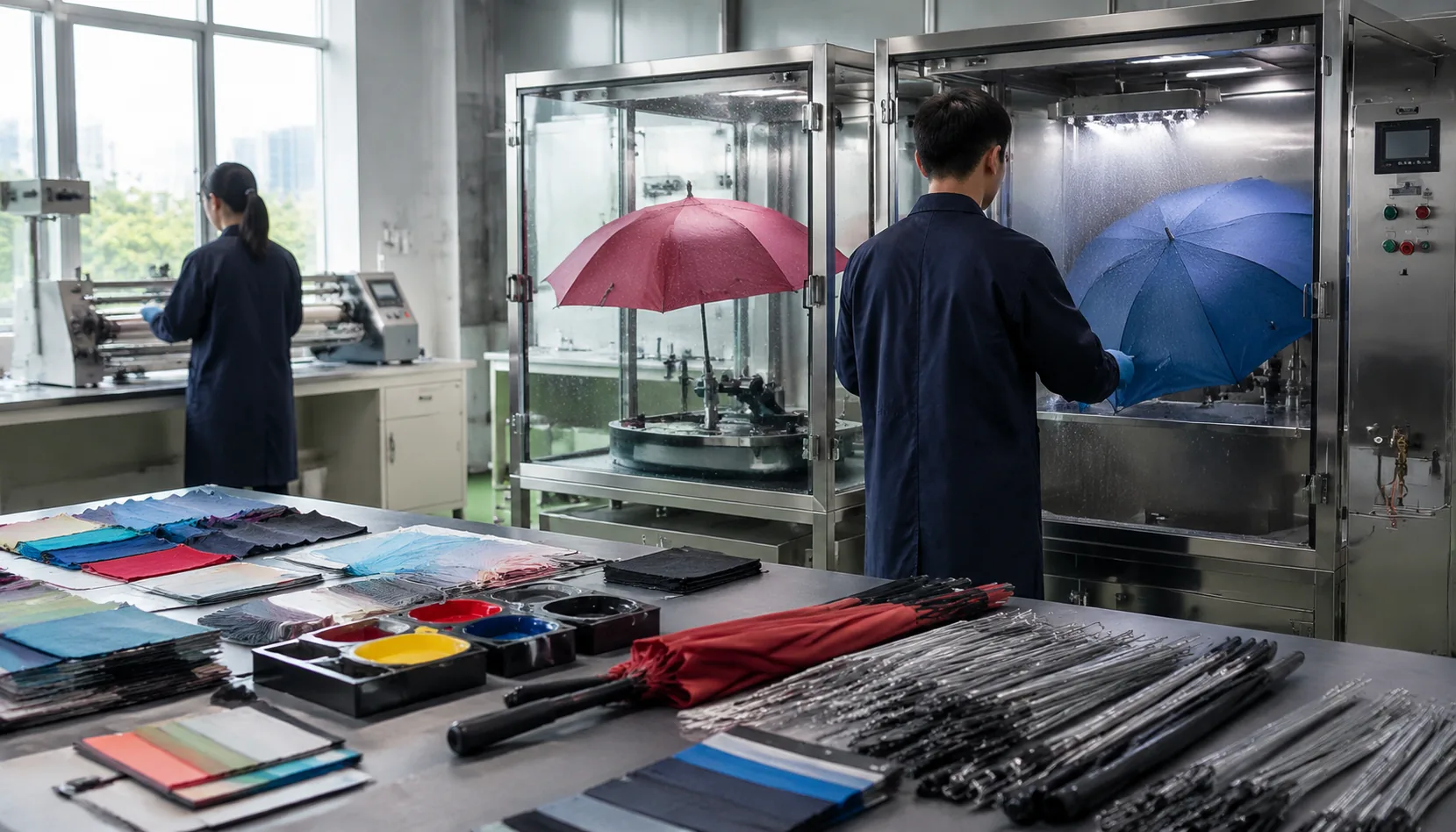
A branded umbrella can pass color approval and still fail the buyer when the logo scuffs in cartons, lifts under tape, or smears after the first wet event. On our Songxia factory floor, umbrella logo durability testing is treated as a production control point, not a lab formality: we check ink system, curing, fabric coating, abrasion, tape pull, and wet rub before goods reach AQL 2.5 inspection.
Why Logo Durability Belongs in the Branding Spec
Logo failure usually starts before the end user ever opens the umbrella. Freshly printed panels rub against neighboring panels during folding, the sleeve scrapes the same logo edge every time it is packed, and export cartons vibrate for 20–35 days on ocean freight or several days in truck handling. Rain adds another problem: water sits in the fabric valleys of 190T or 210T pongee, then carries dirt and mild acidity across the ink film as the canopy is folded wet. That is why umbrella logo durability testing should be written into the branding spec, not treated as a final visual check. A logo can look sharp after screen printing or heat transfer, but still fail after 20 wet-fold cycles, 500 dry rub strokes, or repeated sleeve insertion. For branded umbrella QC, I want the buyer to define acceptable cracking, edge lift, color transfer, and gloss change before bulk production starts, because “logo looks good” is not an inspection standard.
Pongee fabric is forgiving, but it is not risk-free. On 190T pongee, the looser weave can drink more ink, which helps adhesion but may blur fine letters under 1.5 mm. On 210T pongee, the tighter surface gives cleaner print edges, but plastisol or silicone-based ink must be cured correctly or it can sit on top and crack across fold lines. Coated UPF 50+ fabric is harder: silver, black, or UV-block coatings can reduce ink bite, especially if the print is placed on the coated side or near a high-tension rib seam. For those orders, a logo adhesion test with cross-hatch tape pull, wet rub, and low-temperature folding is more useful than a simple hand scratch. Our standard practice at ZheBrella is to test the exact bulk fabric, coating, ink system, and logo size together before approving the production sample, because changing only one of those variables can change the result.
Clear POE panels create a different failure pattern. The surface is smooth and non-absorbent, so ink depends heavily on surface treatment, primer, and curing temperature; too little treatment causes peeling, while too much heat can distort the panel or leave a cloudy halo around the logo. PVC and EVA behave differently again, so the print method cannot be copied blindly from pongee. A serious umbrella print inspection should include dry rub, wet rub, tape pull, folding friction, sleeve abrasion, and carton vibration checks, then connect those results to AQL 2.5 umbrellas inspection at shipment. I prefer setting a major defect for visible peeling, ink transfer to adjacent panels, or logo cracking seen from 50 cm, while minor defects can cover small pinholes or slight color variation within an approved tolerance. Umbrella logo durability testing is cheap compared with replacing 5,000 event umbrellas after the sponsor logo flakes off in the first rain.
Core Tests Buyers Should Request Before Mass Production
The first gate in umbrella logo durability testing is tape adhesion, because weak ink will fail before the order ever sees rain. We normally print pre-production samples on the actual canopy cloth—190T or 210T pongee, POE, PVC, or coated polyester—not a lab substitute. For screen print, heat transfer, reflective ink, and digital print samples, apply 3M 600 or equivalent tape over the cured logo, press firmly with a roller or thumb pressure for 10 seconds, then pull back at roughly 180 degrees. A practical pass is no visible logo lifting and no more than tiny edge specks under normal viewing at 30 cm. If a heat-transfer film peels at corners, or reflective ink flakes in a grid pattern, do not approve bulk printing.
Dry rub and wet rub checks catch problems that tape tests miss, especially on dark canopies with white, silver, or metallic logos. For dry rub, use clean white cotton cloth and rub the printed area 20 cycles with consistent hand pressure; pass means no obvious color transfer and no logo smearing, cracking, or gloss change. For wet rub, dampen the cloth with clean water, repeat 20 cycles, then inspect after the logo dries for 10 minutes. A slight mark on the cloth may be acceptable for some digital prints, but visible logo fading is not. For branded umbrella QC, buyers should require these checks before signed PP sample approval, not after 5,000 panels are already cut and stacked.
Scratch and fold-line checks matter because umbrellas flex at the panel seams, tips, and storage folds more than buyers expect. Use a fingernail or plastic scraper across the logo with moderate pressure; pass means no ink powdering, no film gouging, and no exposed base fabric. Then fold the canopy along natural rib lines and across the printed area 10 times, open it, and inspect under daylight. Logos placed over seams, heavy PU coatings, or double-canopy vent gaps are higher risk. Our standard practice at ZheBrella is to record these results in the umbrella print inspection file and keep approved samples beside the line for comparison during AQL 2.5 umbrellas inspection, so mass production is judged against a physical pass standard, not a salesperson’s PDF mockup.
How Frame and Fabric Choices Change Wear Points
Logo wear usually starts where the canopy is forced to move against hardware, not in the middle of a clean fabric panel. On a standard 23" 8K straight umbrella, the highest-risk zones are the fold lines above each rib, the tip pockets, the tie strap area, and the sleeve mouth where the folded canopy is pushed in and pulled out. A chest-size logo placed across two panels may look good in artwork, but if the edge of the print lands directly over a rib seam, repeated opening cycles can create whitening, cracking, or ink lift. On 21" folding umbrellas, the risk is worse because the canopy is compressed into tighter folds; wet 190T pongee with a heavy screen print can stick to itself inside the sleeve, then peel slightly when the user opens it again. That is why umbrella logo durability testing must include open-close cycling, sleeve insertion, and strap rubbing, not only a flat-panel tape pull.
Rib count changes the stress pattern. An 8K umbrella has wider panels, so a large logo has more uninterrupted fabric area, but each rib carries more load and the panel flexes more between support points in wind. A 16K umbrella divides the canopy into narrower panels, which reduces fabric flutter but creates twice as many seam and rib-contact lines where print edges can rub. Golf umbrellas, usually 27" to 30" with 8K or 10K frames, add another problem: the canopy has a larger sail area, so logos near the lower third of the panel experience more snapping and flutter during gusts. For branded umbrella QC, our standard practice at ZheBrella is to mark the artwork position on a production sample, then check whether any logo edge crosses rib stitching, tip reinforcement, vent overlap, or the strap attachment before bulk printing starts.
Frame material matters because flex behavior transfers directly into the printed fabric. Steel ribs are rigid and hold shape well, but in a gust they can create sharper pressure points along the rib seam, especially on PVC, POE, or coated pongee where the ink film sits more on the surface. Fiberglass ribs bend and recover better, which helps windproof models survive 50+ mph tunnel tests, but that spring action can repeatedly stretch printed panels on double-canopy vented umbrellas. During umbrella print inspection, I like to combine a logo adhesion test with 30 to 50 open-close cycles, wet rubbing on the strap zone, and a sleeve abrasion check after the canopy is slightly damp. For AQL 2.5 umbrellas, defects such as ink cracking at rib lines, transfer flaking near tips, or color loss from strap friction should be classified clearly before shipment, because these are use failures, not cosmetic factory dust.
Setting AQL, Sampling, and Approval Standards
Set approval standards before bulk fabric is cut, not after the first 5,000 panels are printed. For umbrella logo durability testing, I like a three-step lock: one golden sample signed by the buyer, one pre-production sample made on the actual line, and final random inspection under AQL 2.5 for major logo defects. The golden sample fixes artwork size, Pantone or CMYK target, print method, canopy material, logo position, and acceptable hand feel. The pre-production sample proves the factory can repeat it on 190T or 210T pongee, POE, PVC, EVA, or coated fabric after tensioning on a real frame. For branded umbrella QC, do not approve only from a flat fabric swatch; a logo that looks centered on a table can shift 8–12 mm once sewn onto an 8K or 10K canopy and stretched over ribs. Our standard practice at ZheBrella is to keep the signed sample beside the inspection table and compare every checked unit against it under consistent light.
For sampling, treat logo defects as major when they affect brand appearance or likely field durability. Under AQL 2.5 umbrellas inspection, inspectors pull cartons randomly across the packed lot, not just from the top layer or one production shift. The umbrella print inspection should check color shift against the approved sample, missing ink, pinholes, ghosting, blurred edges, cracking at fold lines, misregistration on multi-color logos, and logo position tolerance. For most promotional orders, I recommend ±3 mm for small sleeve logos, ±5 mm for single-panel canopy logos, and ±8 mm for large multi-panel prints, but tighter tolerances require better jigs and slower loading. A logo adhesion test should also be defined by print type: 3M tape pull for screen print, controlled rub test for heat transfer, and fold-flex inspection after opening and closing the umbrella 20–30 cycles. UV-coated and Teflon-treated fabric needs extra attention because poor pretreatment can make ink sit on the surface instead of bonding.
Final approval should separate cosmetic variation from rejectable defects so the inspector is not negotiating carton by carton. Slight color variation within an agreed Delta E or a half Pantone shade may be acceptable on sublimation or dark 210T pongee, but missing strokes, cracked letters, wrong logo direction, obvious off-center placement, or transfer film lifting should fail as major defects. If the order uses auto-open or auto-open-close frames, inspect logos after operating the mechanism because canopy snap can expose weak adhesion near rib tips and fold creases. For retail or event deadlines, I prefer holding 2–3% overrun panels until the final random inspection is passed; replacing bad printed panels after full assembly is slow and usually damages sewing efficiency. The inspection report should include photos of passed and failed logos, carton numbers, measured logo positions, test method used, defect count, AQL result, and shipment decision. That paperwork is what protects both sides when FOB or DDP schedules are tight.
Lead Time and Cost Impact for Factory Orders
Durability testing should be scheduled before bulk cutting, not after the PO fabric is already on the sewing line. For most branded umbrella QC plans, a logo adhesion test and basic umbrella print inspection add 2–5 days to sample approval: 1 day to print the strike-off, 24 hours for ink or transfer curing, then 1–3 days for wet rub, dry rub, tape pull, folding abrasion, and rain-spray checks. Screen print on 190T pongee usually needs a longer cure window than sublimation on white polyester, while heat-transfer logos on 210T pongee or POE panels need edge-lift checking after repeated folding. In our standard practice at ZheBrella, we do not release bulk printing until the approved sample survives normal handling tests because one weak ink formula can turn a 5,000-piece order into a full rework problem.
MOQ changes the economics of umbrella logo durability testing. On a 500-piece promotional run, buyers often accept in-house testing only because a third-party lab fee can cost more than the print setup. For 1,000–3,000 pieces, especially auto-open 23 inch umbrellas or golf umbrellas with 27 inch and 30 inch panels, I recommend at least a documented factory test with photos, pull-tape results, and folded-panel abrasion notes. For 5,000 pieces and above, or retail programs using AQL 2.5 umbrellas inspection, a pre-production sample plus random bulk logo checks are worth the extra time. If the logo fails before bulk production, the decision is simple: adjust mesh count, ink hardener, transfer temperature, dwell time, or fabric coating compatibility, then reprint the sample. If it fails after bulk printing, rework may mean stripping is impossible and replacement canopy panels are the only clean solution.
FOB and DDP terms do not automatically include third-party inspection costs unless they are written into the quotation. Under FOB Ningbo or Shanghai, the factory normally covers internal QC, carton drop checks, and standard umbrella print inspection, while the buyer pays SGS, Intertek, Bureau Veritas, or another nominated inspector directly. Under DDP, some suppliers bundle inspection into the landed price, but it is still a cost item, not free; confirm whether the quote includes only final random inspection or also lab-style logo adhesion test work. A practical order timeline is 5–7 days for logo sample preparation, plus 2–5 days for testing, then 25–40 days for bulk production depending on frame stock, canopy fabric, and printing method. Skipping the test may save a week, but it increases the risk of rejected cartons, chargebacks, or event deadlines missed because the logo cracks after the first rainy-day fold.
Frequently Asked Questions
Can every umbrella logo print pass the same durability test?
No. Screen print, heat transfer, reflective ink, and digital print have different adhesion behavior, especially on coated UPF 50+ or water-repellent pongee. The test standard should match the fabric and decoration method.
When should durability testing happen in the order process?
Run tests on the pre-production sample before mass production and repeat spot checks during final inspection. For large retail orders, keep one approved golden sample at the factory and one with the buyer.
What logo durability tests should be written into a branded umbrella PO?
Specify dry abrasion, wet-rub, and tape adhesion checks in the PO or QC checklist. For typical branded umbrella orders, buyers often require 20–50 rub cycles and no major logo peeling, smearing, or unreadable artwork after testing.
How is logo print quality judged during AQL 2.5 umbrella inspection?
Inspectors usually classify unreadable logos, large ink loss, wrong logo position, or severe color mismatch as major defects under AQL 2.5. Minor issues may include small pinholes, slight edge roughness, or tiny ink specks outside the approved artwork tolerance.
Should logo adhesion be tested before mass production or only during final inspection?
Logo adhesion should be checked on pre-production samples before bulk printing, then rechecked during inline and final inspection. This helps catch ink, coating, drying, or fabric compatibility issues before thousands of panels are printed.
Looking to Launch Your Custom Umbrella Line?
ZheBrella is a Zhejiang-based OEM/ODM umbrella manufacturer with 17 years of export experience. Free design, low MOQ from 100 pieces, windproof construction, full-color print.
Get Free Quote Now »People Also Search For
Related Articles
Logo Durability Testing for Branded Umbrella Orders
Build a logo durability test plan for branded umbrella orders, covering adhesion, rub, water, folding, AQL 2.5 checks, a...
Read More »
Logo Print Durability Tests for Branded Umbrella Orders
Learn which rub, tape, fold, and wet tests help buyers confirm umbrella logo durability before bulk production and final...
Read More »
Print Durability Testing for Branded Umbrella Programs
Compare rub, adhesion, rain, UV, and folding tests for umbrella prints, with practical specs for 190T/210T pongee and AQ...
Read More »