Metallic and Neon Logo Printing on Branded Umbrellas
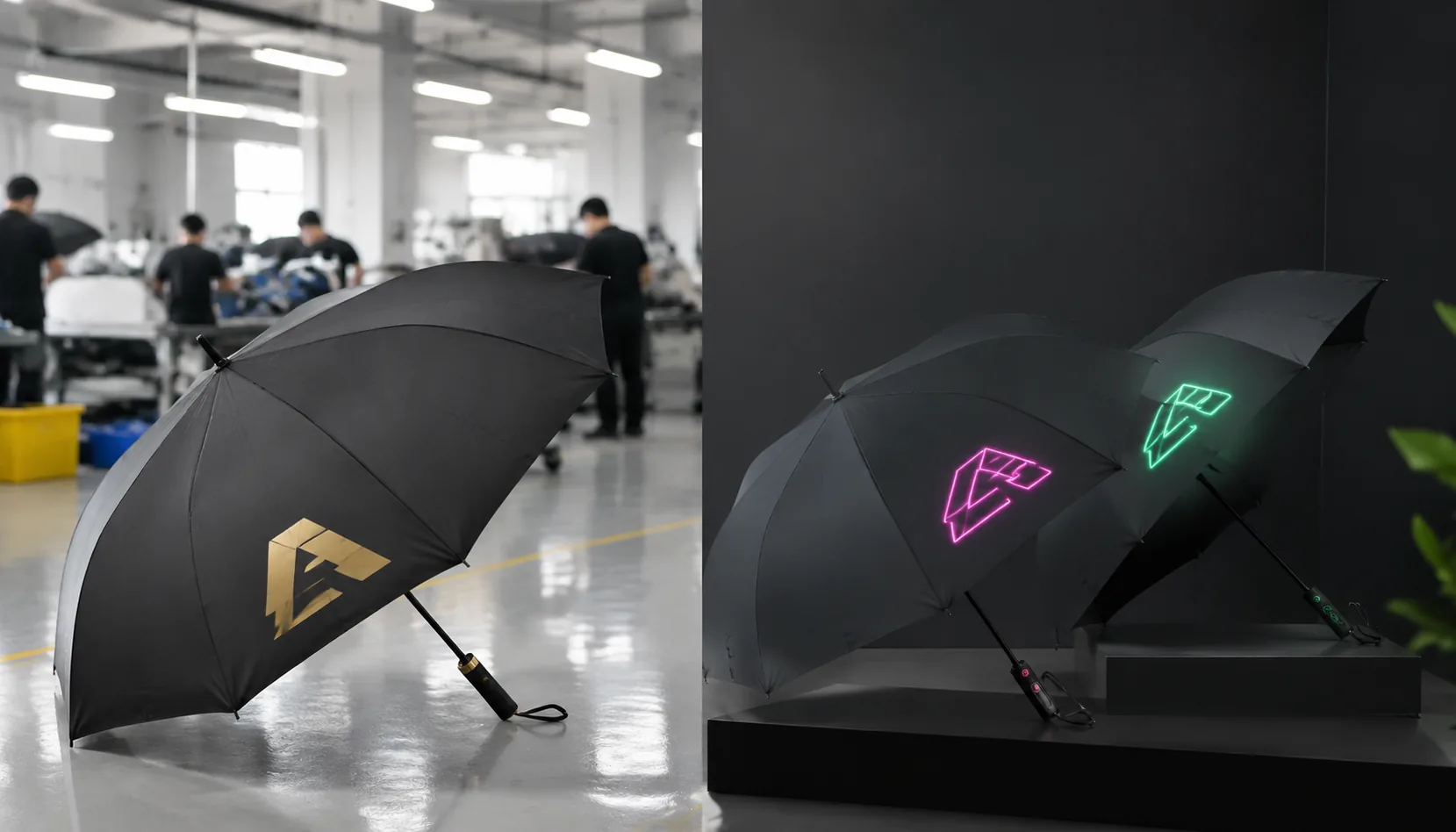
Metallic and neon logos can make a branded umbrella look premium, but they also expose every weak point in ink adhesion, fabric coating, and print positioning. On our Songxia production floor, metallic logo umbrella printing is treated differently from standard spot-color work because shimmer pigments, fluorescent inks, and dark canopy fabrics all change curing, coverage, and inspection standards. Buyers need clear limits before sampling, not after bulk panels are already cut.
What Specialty Inks Can and Cannot Achieve
Metallic ink is not foil stamping, and that is the first expectation I correct with buyers asking for metallic logo umbrella printing. A silver or gold specialty ink uses fine metallic particles suspended in the binder, so it gives a soft reflective glint when the canopy moves under light, not a mirror finish. On 190T or 210T pongee, the woven texture breaks the reflection and makes the effect more satin than shiny. The same artwork printed on smooth PVC or POE will look brighter because the surface is flatter and less absorbent. Standard spot colors, by comparison, are cleaner and more predictable: a Pantone 186C red or Reflex Blue can be controlled within normal umbrella print specifications, especially on white or light canopies. Metallic gold is warmer and less opaque than many buyers expect, so we usually recommend a white underbase on dark navy, black, or burgundy panels if the logo must stay readable from 2 to 3 meters away.
Fluorescent neon behaves differently from metallic. Neon umbrella logos are about high chroma, not reflection; neon yellow, orange, pink, and green absorb UV and throw back a brighter-looking color in daylight. They work well for event umbrellas, beach promotions, safety campaigns, and branded promotional umbrellas where visibility matters more than luxury tone. The limitation is coverage and color stability. Fluorescent inks are usually less opaque than standard spot inks, so printing neon pink directly on royal blue pongee will look dirty unless we add a white base layer. They also fade faster under long UV exposure than conventional pigments, even when the canopy has a UPF 50+ or water-repellent coating. For outdoor retail programs, I tell clients to treat neon as a strong visual accent rather than a lifetime color promise; it is best for logos, slogans, trim graphics, and limited seasonal campaigns.
Specialty ink umbrellas need tighter artwork control than ordinary one-color screen printing. Thin strokes below about 0.35 mm, small reversed text, and halftone gradients are risky because metallic particles and fluorescent pigments do not pass through the mesh as cleanly as standard plastisol or water-based spot colors. On a 23 inch auto-open umbrella with 8K fiberglass ribs, a 180 to 220 mm logo on one panel is usually safe; oversized prints across seams or double-canopy vent gaps need separate testing because tension changes after sewing. Our standard practice at ZheBrella is to print a strike-off on the actual canopy fabric, then check it under indoor LED and outdoor daylight before approving bulk production. For metallic logo umbrella printing, that sample step matters more than the Pantone callout, because the buyer is really approving the surface effect, not just the color name.
Best Umbrella Surfaces for Metallic and Neon Logos
Canopy panels give the cleanest read for metallic and neon work because the surface is broad, tensioned, and visible from distance, but the fabric choice decides whether the logo looks premium or cheap. For metallic logo umbrella printing, 190T pongee is usually the safest promotional grade: tight enough for sharp screen edges, matte enough to make silver, gold, or copper ink stand out, and still cost-controlled for branded promotional umbrellas at 500–3,000 pcs. 210T pongee prints better when the buyer wants a retail feel; the denser weave reduces ink bleed around small type, especially on 23" auto-open or 27" golf umbrellas where panels are cut larger and distortion is more visible after sewing. Standard polyester is workable, but I reject it for fine metallic lettering unless the client accepts a slightly rougher edge and lower hand feel. Our standard practice at ZheBrella is to test metallic ink on the actual coated fabric, not a swatch from another batch, because water-repellent treatment and heat-setting can change adhesion.
Neon umbrella logos need a different mindset than metallics: brightness comes from opacity, not just color selection. On dark navy, black, or forest green canopies, fluorescent pink, orange, lime, and yellow normally need a white underbase before the neon layer, otherwise the logo looks dull after curing. 210T pongee handles this two-pass screen print better than loose polyester because registration stays cleaner when the panel is clamped. 190T pongee is acceptable for bold marks above 25 mm height, but tiny distributor text below 6 pt can close up once the second ink layer lands. Clear POE bubble umbrellas are a special case. Neon umbrella logos can look strong on transparent POE because light passes through the canopy, but metallic ink often appears flatter and more fragile unless the ink system is selected for plastic film. POE also has stretch and slip, so umbrella print specifications should call out print side, curing temperature, adhesion test, and whether the logo must survive folding, rubbing, and carton compression.
Straps, sleeves, and packaging are better treated as supporting branding surfaces, not substitutes for the canopy. A woven or Velcro closure strap can carry a small metallic mark, but the print area is narrow, usually 12–18 mm high, so simple icons beat fine slogans. Sleeves work well for specialty ink umbrellas because the fabric lies flatter than a sewn canopy panel; metallic foil transfer or high-opacity neon screen print can look very clean on a 190T or 210T matching sleeve, especially for executive giveaways where the umbrella is handed over closed. Outer packaging gives the most controlled surface of all. A kraft box, white tuck box, or OPP sleeve insert can hold metallic logos with fewer adhesion problems than coated umbrella fabric, and neon inks stay brighter on white paperboard than on dark canopy cloth. For AQL 2.5 inspection, I like to define separate acceptance standards for canopy, sleeve, and packaging prints, because a tiny pinhole on a carton is not the same defect risk as ink cracking on a folding panel.
Print Method, Line Weight, and Artwork Limits
Minimum line weight is where most metallic and neon jobs succeed or fail. For metallic logo umbrella printing on 190T or 210T pongee, I do not like lines under 0.35 mm for screen printing, and I push that to 0.45 mm if the logo sits across a seam or near a panel curve. Knockout text inside a metallic block is riskier than buyers expect because ink spread, fabric texture, and panel tension can close the open space; reverse letters below 8 pt often look dirty after drying. On POE or PVC clear umbrellas, edges can print sharper, but ink adhesion and curing become the bigger concern. Simple vector logos perform best because the screen mesh, squeegee pressure, and umbrella panel movement all punish tiny details. Our standard practice at ZheBrella is to request AI, EPS, or PDF vector files with Pantone references, outlined fonts, and a 1:1 print layout before sampling.
Screen printing is usually the cleanest method for neon umbrella logos when the artwork uses solid spot colors and the order quantity justifies screen setup. Fluorescent inks need enough deposit to look bright on dark navy, black, or bottle-green canopies, so we often add a white underbase; without it, neon yellow can turn muddy and neon pink loses punch. Metallic inks behave differently: aluminum or pearl particles make the ink thicker, so fine halftones, hairlines, and tight gaps are harder to hold. For specialty ink umbrellas, screen printing also requires controlled drying because stacked wet panels can offset if curing is rushed. Heat transfer works better for multi-color logos, small order runs, or designs needing sharper edges, but metallic foil transfers can crack earlier on fold lines, especially on compact 21 inch auto-open-close umbrellas that are tightly wrapped after each use.
Gradients are the first artwork feature I challenge in umbrella print specifications. A smooth silver-to-charcoal fade may look good on a laptop screen, but screen printing converts it into halftone dots, and dots can fill in on woven pongee or break apart over rib pressure points. Heat transfer can reproduce gradients better, including CMYK photographic effects, but it adds a film layer that may feel heavier and can show a rectangular edge unless the design is contour cut. Small text has similar limits: I recommend at least 10 pt for positive text, 12 pt for metallic ink, and 14 pt for knockout lettering if the buyer wants legibility from normal viewing distance. Branded promotional umbrellas are moving objects, not flat posters, so logos should be bold enough to read while the canopy curves, flexes in wind, and rotates in a crowd. Clean vector marks, limited colors, and generous spacing consistently outperform complex artwork.
Durability Testing and Bulk QC Standards
Durability testing for metallic logo umbrella printing has to start after the ink system is fully cured, not when the print “feels dry” on the table. For metallic silver, gold, or copper inks, we normally allow 24 hours at room temperature after screen printing, or follow the heat-transfer film supplier’s dwell and peel window exactly, because under-cured binder is the main reason logos smear during packing. Rub resistance is checked with dry and wet cloth passes over the logo area, usually 20 to 50 cycles depending on the buyer’s umbrella print specifications. On 190T or 210T pongee, the risk is not only ink loss; heavy metallic pigment can polish unevenly and leave a dull patch that looks like shade variation under retail lighting.
Folding abrasion is where specialty ink umbrellas fail most often, because the logo sits on fabric that is repeatedly creased around ribs and tie wraps. We open and close sample umbrellas 20 to 30 times, then inspect the printed panels at rib contact points, especially on 23 inch auto-open models and 30 inch golf umbrellas with 8K or 16K frames. Neon umbrella logos need the same abuse test, but we also check color brightness after water exposure because fluorescent pigments can look strong indoors and weaker after soaking. A practical test is to spray or shower the canopy, leave it folded for a short dwell, then reopen and dry it before checking adhesion, transfer marks, cracking, and edge lift.
Bulk QC should treat print defects as seriously as frame defects on branded promotional umbrellas, because a perfect fiberglass rib system does not save an umbrella with a broken logo. Our standard practice at ZheBrella is to inspect finished lots under AQL 2.5, with clear defect definitions: visible pinholes, missing ink, off-register artwork, print cracking on fold lines, metallic flake contamination, and panel-to-panel shade variation beyond the approved sample. Inspectors compare production against a sealed pre-production sample and a Pantone or physical color standard, not just a PDF on a phone. For mixed-panel designs, we pull units across cartons, not just from the top layer, because heat press temperature drift and screen ink viscosity changes often show up halfway through a batch.
Cost, MOQ, and Production Planning
Metallic and neon inks are not priced like a standard one-color screen print because the setup risk is higher. For metallic logo umbrella printing, we usually need a separate mesh, slower squeegee speed, and tighter ink viscosity control so the aluminum or pearl pigment does not streak on 190T or 210T pongee. Neon umbrella logos also need a cleaner underbase when the canopy color is black, navy, red, or other dark fabric; otherwise the fluorescent tone looks dirty after curing. On branded promotional umbrellas, I tell buyers to budget for a paid pre-production sample rather than approving from a PDF mockup, because specialty ink umbrellas must be judged under real light, not only on a Pantone callout. MOQ is commonly 1,000–3,000 pieces for custom specialty ink work, depending on logo size, panel count, and whether the same artwork runs across 21-inch compact, 23-inch stick, or 27-inch golf umbrellas.
Production planning should start from the umbrella print specifications, not from the delivery date alone. A standard white logo can move through screen printing and sewing quickly, but metallic and neon prints often need longer rack drying or controlled heat curing before panels are bundled for canopy stitching. If the ink surface is still soft, it will block, scuff, or transfer when stacked; that failure usually appears only after assembly, when it is expensive to rework. Our standard practice at ZheBrella is to add 3–5 days for strike-off sampling and another 2–4 days in bulk production for specialty ink drying checks, especially on large 8-panel prints or double-canopy vented umbrellas. If the umbrella uses an auto-open or auto-open-close mechanism, sampling should also confirm that the print position does not distort when the canopy snaps open under spring tension.
Frame selection affects the schedule more than many buyers expect. Fiberglass ribs, especially 8K or 10K windproof frames, are better for retail-grade umbrellas and can survive stronger inversion testing than basic steel ribs, but they require confirmed component allocation before printing starts. If you are planning FOB Ningbo or Shanghai, reserve time for carton drop tests, AQL 2.5 inspection, and export booking; for DDP to the U.S. or Europe, add customs clearance and last-mile delivery buffers instead of treating the factory completion date as the arrival date. A realistic timeline for metallic logo umbrella printing is often 7–10 days for sampling, 25–35 days for bulk production after approval, and 20–40 days for ocean freight depending on destination. Rush orders are possible, but cutting drying time is the wrong place to save days; it creates smearing, dull metallic shine, and uneven neon color that buyers notice immediately.
Frequently Asked Questions
Are metallic umbrella logos as shiny as foil stamping?
Usually not. Metallic ink gives a reflective effect, but woven pongee texture and canopy curvature reduce mirror-like shine compared with foil on paper packaging.
Can neon inks be matched to Pantone colors exactly?
Neon inks can be guided by Pantone references, but exact matching is harder than standard spot colors. A physical strike-off should be approved before bulk production.
What print area is usually available for metallic or neon logos on umbrellas?
Most folded promotional umbrellas allow a logo panel area of about 10-14 inches wide, while golf umbrellas may allow 12-16 inches or more depending on the canopy panel count. Exact print size depends on rib length, panel shape, and whether the logo sits on one panel or repeats across multiple panels.
Do metallic and neon inks require different fabric choices?
Yes. Metallic inks usually show best on darker polyester or pongee canopies, while neon colors are strongest on white or light-colored fabric. For best opacity, buyers usually request a fabric swatch test before bulk approval.
What should a buyer confirm before placing a bulk order?
Confirm ink limit per color, logo placement, Pantone target, and whether the design needs a screen print or heat transfer method. A typical OEM flow is artwork proof, pre-production sample, then bulk production; MOQ often starts around 200-500 pieces depending on canopy style and number of print colors.
Looking to Launch Your Custom Umbrella Line?
ZheBrella is a Zhejiang-based OEM/ODM umbrella manufacturer with 17 years of export experience. Free design, low MOQ from 100 pieces, windproof construction, full-color print.
Get Free Quote Now »People Also Search For
Related Articles
White Ink Underbase for Dark Umbrella Canopy Logos
Learn when white underbase improves logo opacity on dark umbrella canopies, with fabric, ink, sampling, MOQ, and QC tips...
Read More »
Metallic Gold and Silver Logos on Branded Umbrellas
Specify metallic gold or silver umbrella logos with realistic shine, fabric limits, sample checks, MOQ, cost factors, an...
Read More »
Metallic Ink Umbrella Logos for Premium Brand Programs
Plan metallic umbrella logos with the right fabric, ink, placement, and QC controls so premium brand programs look consi...
Read More »