Metallic Logo Printing on Umbrellas for Premium Promotions
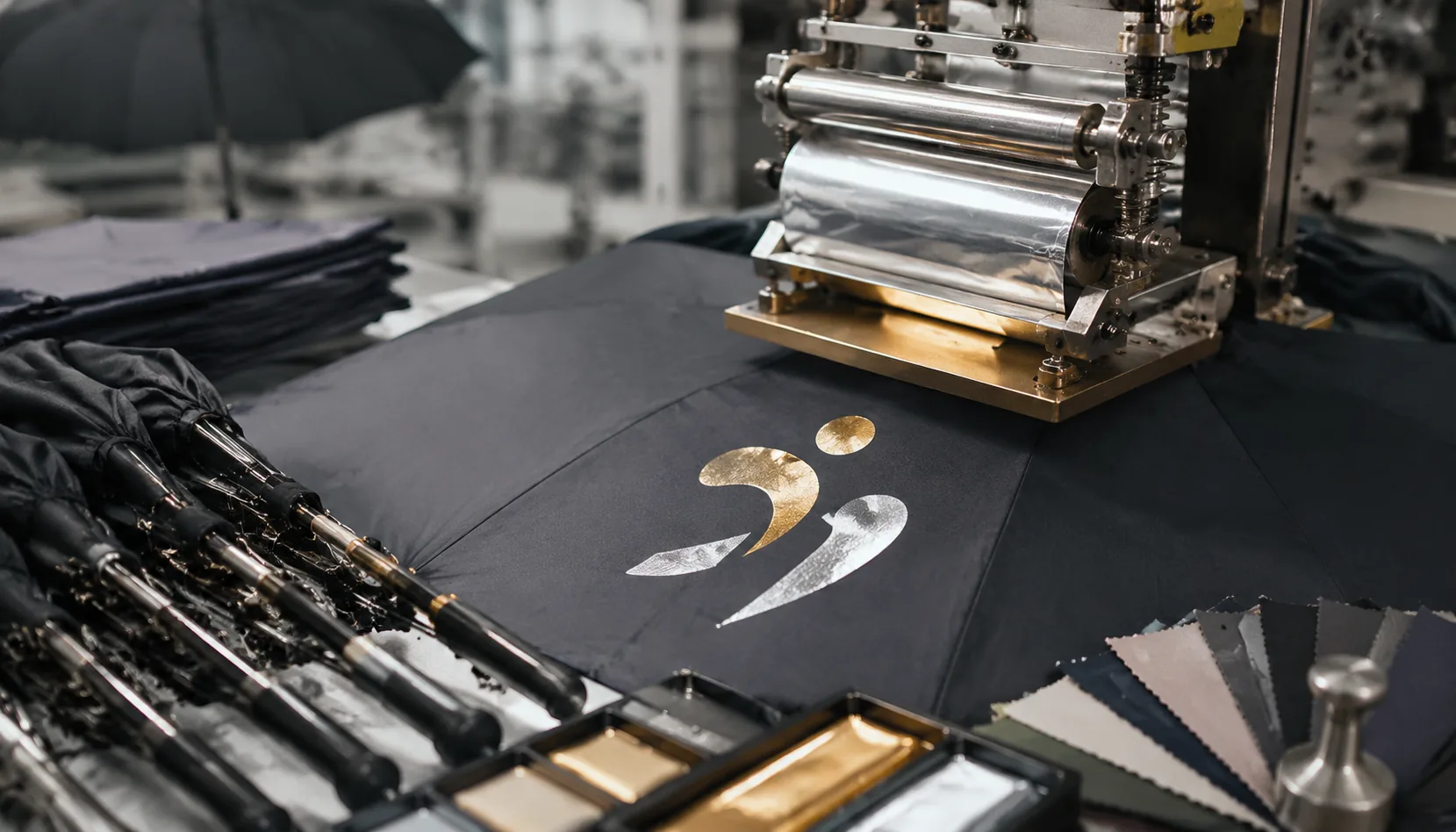
Premium umbrella programs can lose their polish fast when a metallic logo cracks on pongee, dulls after rubbing, or shifts color under different light. On our Songxia production floor, metallic logo umbrellas require tighter control than standard screen prints: ink system, mesh count, curing temperature, panel tension, and placement all affect the final shine and durability. Buyers need specs that look sharp in the sample room and still pass bulk QC.
Where Metallic Branding Adds Value
Metallic branding earns its cost when the umbrella is part of a high-trust, high-ticket program: private banking, insurance anniversaries, luxury retail openings, automotive launches, five-star hotel suites, and VIP investor gifts. On these orders, a normal white screen print can look too flat, especially on black, navy, charcoal, burgundy, or bottle-green 190T/210T pongee. Metallic umbrella printing gives a controlled highlight that reads like hardware, not decoration. For finance and hotel buyers, I usually recommend silver, champagne gold, or gunmetal foil rather than bright yellow gold; it looks more restrained under lobby lighting and does not fight with the fabric color. For automotive brands, a small chrome-effect mark on a 27" or 30" golf umbrella pairs well with fiberglass ribs, EVA handle, and double-canopy windproof construction rated around 50+ mph.
The best metallic logo umbrellas are not covered in metallic ink. One or two canopy panels are usually enough, especially on 8K or 10K golf umbrellas where the panel width gives the logo breathing room. If the brand guide requires a large emblem, place it on alternating panels and keep the print height within the lower third of the panel so it remains visible when carried but does not turn the umbrella into a billboard. Sleeve marks are another strong option for premium branded umbrellas because the sleeve is what the recipient sees first in a gift box. A 60–90 mm metallic logo on the sleeve, matched with a woven label or printed care tag, often feels more expensive than a large canopy print and keeps AQL 2.5 inspection risk lower because registration is simpler on a flat sleeve piece.
Straps and handle badges are good places for subtle hierarchy. A foil logo umbrella can use a matte canopy logo, then a metallic snap button, PU strap patch, or small domed badge on a straight rubberized handle to create the premium cue at close range. On folding umbrellas, especially 21" auto-open-close models, I prefer sleeve or strap decoration because the canopy panels are smaller and creases can disturb foil adhesion after repeated folding. Our standard practice at ZheBrella is to test metallic transfer samples on the exact canopy lot, then run cross-hatch adhesion, wet rub, and opening-cycle checks before bulk cutting. A serious promotional umbrella supplier should confirm whether the logo will be screen metallic ink, heat-transfer foil, or metal badge, because each method has different MOQ, lead time, and durability behavior.
Metallic Ink, Foil Transfer, and Heat Transfer Options
Metallic screen ink is the most practical starting point when the buyer wants shine without turning the umbrella into a fragile gift-box item. We print it through a lower mesh count than standard spot-color ink so the aluminum or bronze pigment lays down thick enough to catch light, especially on black, navy, burgundy, or forest green 190T/210T pongee. The finish is more satin-metal than mirror, but it survives folding better than most foil effects because the ink film flexes with the canopy. For metallic logo umbrellas ordered as event giveaways or retail add-ons, this is usually the best cost-to-durability balance. Typical MOQ can stay close to normal custom umbrella production, often 500–1,000 pieces depending on canopy color and logo size. The main control point is curing: under-cured metallic ink rubs off at rib contact points, while over-cured ink can feel brittle after repeated opening and closing.
Foil-style transfer gives the brightest flash, closest to a true foil logo umbrella, but it is also the least forgiving on umbrellas because the canopy is not a flat T-shirt panel. The process uses adhesive, heat, pressure, and a metallic foil layer, so shine is strong on simple logos, block letters, and anniversary marks. It performs poorly on fine gradients, tiny registered trademarks, or large solid panels placed near rib seams where the fabric bends sharply. Cost is higher than metallic umbrella printing by screen ink because there are more process steps, more scrap risk, and usually a stricter logo size limit. I normally recommend foil transfer for premium branded umbrellas in 23-inch or 27-inch straight models, not ultra-compact 21-inch folding umbrellas that crease hard around the logo. MOQ is usually 1,000 pieces and up because setup loss, foil roll matching, and press calibration are not worth it for very small runs.
Metallic heat-transfer logos sit between screen ink and foil: cleaner edge definition than screen printing, better flexibility than traditional foil, but not as mirror-bright as a hot-stamped foil surface. They work well for multi-color badges, shield logos, or metallic silver/gold marks on pongee, polyester, or some PVC/POE panels, provided the transfer film is matched to the canopy coating. Highly flexible 190T/210T pongee always needs adhesion testing before bulk approval; Teflon water-repellent finish, UV coating, and silicone-like hand feel can all reduce bonding. Our standard practice at ZheBrella is a tape pull test, wet rub test, 24-hour folded pressure check, and open-close cycling before confirming bulk production for a promotional umbrella supplier order. Metallic heat transfer typically costs more than screen ink but less than complex foil transfer, with MOQ around 500–1,000 pieces if artwork is simple. For export orders, approve a physical pre-production sample, not just a digital mockup, because metallic reflection changes under warehouse light, daylight, and camera flash.
Canopy Color and Logo Contrast Rules
Dark canopy colors do most of the work in metallic umbrella printing. Black, navy, charcoal, burgundy, and deep green give the foil or metallic ink a clean edge because the eye reads the reflective layer against a low-brightness background. On 190T or 210T pongee, a silver logo on black or charcoal is usually the safest premium look; gold on navy or burgundy also performs well for finance, hotel, and VIP event programs. Deep green works when the logo is warm gold, champagne, or copper, but it can make cool silver feel slightly flat under indoor lighting. For premium branded umbrellas, I usually avoid mid-gray unless the logo is large, because the fabric and metallic layer can sit too close in value and lose separation at 10–15 feet.
Light canopies reduce metallic visibility because reflection needs contrast, not just shine. White, ivory, pale blue, beige, and pastel panels can look elegant in a mockup, but a foil logo umbrella on those colors often reads weaker outdoors, especially when the sky is bright and the canopy is already reflecting light. If a buyer insists on a light canopy, increase the logo size by 10–20%, use a darker metallic such as gunmetal or antique gold, or add a thin dark outline through screen printing before applying heat-transfer foil. On POE or PVC transparent umbrellas, metallic decals need extra caution because glare from the clear canopy competes with the logo; a solid printed backing layer usually improves readability.
Pantone matching for metallic effects should be treated as an approximation, not a hard promise. Flat Pantone chips are printed on paper and judged by pigment color, while metallic inks and foils change with viewing angle, light source, film thickness, and fabric texture. A Pantone 871C gold reference, for example, can guide the target tone, but it will not look identical on 210T navy pongee after heat press at 150–160°C. Our standard practice at ZheBrella is to approve metallic logo umbrellas by physical strike-off, not only by digital artwork: one canopy color, one metallic finish, and one production method tested before bulk cutting. For export orders, that small approval step prevents arguments later during AQL 2.5 inspection, when the issue is usually not adhesion but whether the buyer expected paper-Pantone color from a reflective surface.
Construction Choices for a Premium Feel
Metallic branding looks expensive only when the frame underneath feels controlled, quiet, and stable. For premium branded umbrellas, I usually steer buyers toward fiberglass ribs rather than painted steel, especially on 23" and 27" stick umbrellas. Fiberglass has better flex memory in gusts, so the canopy does not chatter as much and the metallic logo stays visually flat instead of rippling across loose panels. An 8K frame is acceptable for compact retail programs, but 10K or 16K gives a more refined circular profile; 16K in particular makes metallic logo umbrellas feel closer to a gift item than a giveaway. Pair that with 190T or 210T pongee, because thin polyester makes metallic ink, foil, or heat-transfer film look harsher at the edges. If the target is executive gifting, I would rather reduce print size than downgrade the frame.
A double-canopy vented windproof structure is the better match when the logo uses metallic umbrella printing on one or two panels. The vent releases pressure before the ribs invert, and that matters because foil and metallic transfers are less forgiving than ordinary screen ink when the canopy is repeatedly twisted. On a 27" golf umbrella, a fiberglass shaft with 8K or 10K ribs can survive 50+ mph wind-tunnel testing when the runner, stretcher, and rib tips are correctly matched. For a more formal silhouette, 16K ribs on a 23" or 25" stick umbrella produce smaller panel arcs, which makes a foil logo umbrella look cleaner under office lobby lighting. Our standard practice at ZheBrella is to approve metallic placement after a pre-production sample, because seam position, panel tension, and logo angle change the final shine more than buyers expect.
Steel ribs still have a place, but mostly for budget event giveaways where the umbrella will be used once or twice and unit cost matters more than hand feel. A 21" or 23" manual-open steel frame with 190T pongee can carry a small metallic logo if the artwork is not too close to the panel seam and the order is inspected under AQL 2.5 for print rub, pinholes, and frame opening force. For higher-perceived-value programs, auto-open or auto-open-close mechanisms are worth the added cost because the user feels the upgrade before seeing the logo. A promotional umbrella supplier should separate these tiers clearly: steel for mass distribution, fiberglass auto-open for corporate gifts, and double-canopy 16K construction for VIP programs where metallic logo umbrellas need to justify a premium FOB or DDP price.
Sampling, Rub Testing, and AQL Inspection
Do not approve metallic umbrella printing from a PDF mockup only; require a real strike-off on the same canopy fabric, coating, and logo size planned for production. Metallic ink, foil transfer, and heat-press films behave differently on 190T pongee, 210T pongee, PVC, and EVA, especially when the canopy has Teflon water-repellent or UV UPF 50+ coating. For metallic logo umbrellas, I ask for at least 2 finished sample panels plus 1 complete umbrella sample, then check the logo under daylight, warehouse LED, and low-angle light because metallic defects hide until the angle changes. The sample sheet should record Pantone target, metallic ink batch, mesh count or transfer temperature, dwell time, pressure, and curing time. If the order is a foil logo umbrella for retail gifting, include a tape-pull adhesion check after 24 hours, not immediately after printing, because weak foil often looks fine when warm but lifts after cooling and folding.
Open-close flex testing matters because an umbrella logo is printed on a curved, moving surface, not a flat tote bag. A 23 inch auto-open or 27 inch golf umbrella should be opened and closed at least 25 cycles during sampling, with the printed panel folded naturally along ribs and tips. On 8K and 10K frames, the main stress is along the rib valleys; on 16K fashion umbrellas, smaller panel widths can distort fine metallic lines if registration is loose. Our standard practice at ZheBrella is to run dry rub and wet rub checks with white cotton cloth, 10 strokes each direction, then inspect for metallic dusting, smearing, color transfer, and edge breakdown. For premium branded umbrellas, I also recommend a fingernail scratch at the logo edge and a mild alcohol wipe only if the buyer’s use case includes event handling, hotel bell desks, or outdoor retail displays.
Final inspection should define AQL 2.5 before FOB or DDP shipment, not after cartons are packed and the forwarder is waiting. Major defects for metallic logo umbrellas should include visible smudging, foil lift, pinholes larger than 0.5 mm in the logo area, misregistration over 1.0 mm on multi-color artwork, wrong metallic tone, and logo position deviation over plus or minus 5 mm from the approved spec. Minor defects can include tiny isolated specks outside the logo viewing zone, slight shade variation within the approved strike-off tolerance, or non-facing panel marks that do not affect brand presentation. A promotional umbrella supplier should inspect packed goods by SKU, handle type, canopy color, and print method, then photograph defects with carton number and umbrella position. For shipment release, require passed open-close function, clean canopy, correct carton marks, barcode if needed, and inspection records tied to the purchase order. Metallic decoration is expensive to rework; catching one bad curing batch before export is cheaper than sorting 2,000 umbrellas overseas.
Frequently Asked Questions
Can metallic logos be matched to Pantone gold or silver?
They can be visually aligned, but metallic reflection changes under different light. Buyers should approve a physical strike-off instead of relying only on a Pantone reference.
Are metallic umbrella logos durable in rain?
They can be durable when the ink or transfer is matched to pongee fabric and properly cured. Bulk production should follow approved rub, flex, and water-resistance test results.
Can metallic logos be printed on pongee umbrella fabric without cracking?
Yes, metallic ink can be screen printed on 190T or 210T pongee if the ink system is matched to polyester and cured correctly. For premium programs, request adhesion testing, rub testing, and opening/closing checks before bulk production.
What logo placements work best for metallic umbrella printing?
The most common placement is one or two panels, centered 12–18 cm from the lower edge for visibility. Metallic logos can also be placed on the sleeve or strap, but small fine lines should usually be at least 0.3 mm to avoid filling during printing.
What is the typical MOQ and lead time for premium metallic logo umbrellas?
Typical OEM MOQ is about 500–1,000 pieces per design, depending on frame, fabric, and logo method. Sampling usually takes 5–10 days after artwork approval, and bulk production is commonly 25–45 days.
Looking to Launch Your Custom Umbrella Line?
ZheBrella is a Zhejiang-based OEM/ODM umbrella manufacturer with 17 years of export experience. Free design, low MOQ from 100 pieces, windproof construction, full-color print.
Get Free Quote Now »People Also Search For
Related Articles
Metallic Ink and Foil Logos for Premium Umbrella Branding
Compare metallic ink and foil logo options for premium umbrellas, including fabric limits, durability tests, MOQ, sampli...
Read More »
Metallic Ink and Foil Effects for Premium Umbrella Logos
Compare metallic ink, foil transfer, and subtle shine effects for premium umbrellas, including fabric limits, durability...
Read More »
Metallic Logo Effects on Premium Branded Umbrellas
Compare metallic ink, foil transfer, and subtle premium logo effects for umbrellas, including fabric limits, durability ...
Read More »