Private Label Umbrella Programs for Retail Buyers
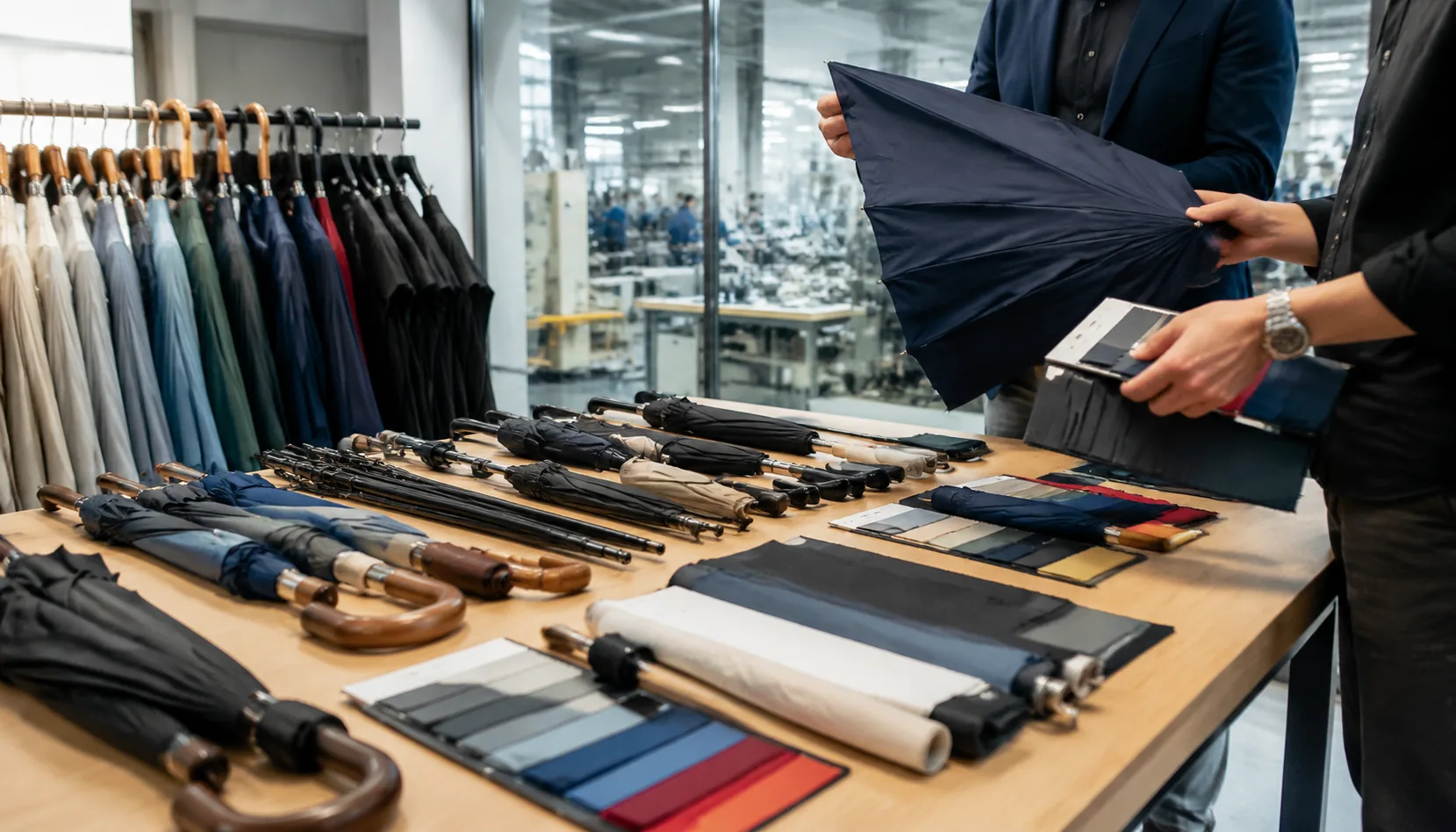
Retail buyers do not lose margin on umbrellas because the canopy looks wrong in a sample; they lose it when rib strength, fabric coating, carton packing, and delivery terms were never locked before production. As a private label umbrella manufacturer on the Songxia factory floor, we see programs succeed when specs, MOQ breaks, packaging, QC checkpoints, and FOB or DDP routing are planned as one system—not negotiated piecemeal after orders are placed.
Define the Retail Line Before Requesting Quotes
Retail buyers should define the price ladder before asking any private label umbrella manufacturer for FOB or DDP quotes, because the same 23" umbrella can land in three very different cost structures. Start with opening price point, mid-tier, and premium SKUs, then assign each one a target retail, target gross margin, and acceptable landed cost. For example, an opening 21" 3-fold manual umbrella with 190T pongee, steel shaft, 8K steel ribs, and one-color logo may work for supermarket or travel-bin programs. A mid-tier 23" auto-open model can move to 190T or 210T pongee, fiberglass tips, better runner, and branded sleeve. Premium should justify the shelf price with 10K or 16K fiberglass ribs, Teflon coating, UPF 50+ option, double-canopy venting, or auto-open-close mechanics. If the buyer only sends a logo and asks for “best price,” the factory will quote the cheapest build that passes basic inspection, not the line architecture retail needs.
Map umbrella type to the selling occasion, not just to diameter. Stick umbrellas fit department stores, hotel retail, and heritage fashion lines because the handle, tip cup, and shaft finish are visible value cues; a 23" or 27" stick with wood-look crook handle and 190T pongee can look more premium than its BOM suggests. Compact 3-fold umbrellas are better for checkout, luggage, campus, and commuter assortments, where closed length, sleeve quality, and auto-open reliability matter more than dramatic canopy size. Golf umbrellas, usually 27" to 30" with 8K fiberglass or 10K fiberglass frames, belong in outdoor, corporate gift, and sports retail programs where wind performance and print area drive perceived value. For branded rain umbrellas, do not mix all four types into one quote request without volume by SKU; frame tooling, fabric cutting markers, and packaging cartons change enough that pricing becomes messy.
For retail umbrella sourcing, give the factory a SKU grid with type, canopy arc or diameter, rib count, mechanism, canopy fabric, coating, print method, packaging, order quantity, and required AQL level. A realistic OEM umbrella program might start at 1,200 to 3,000 pieces per color for custom canopy fabric, while lower umbrella MOQ is possible when using stock 190T pongee colors and standard black frames. Target margins should decide the engineering choices: steel ribs save cost but bend after hard gusts, while fiberglass ribs cost more but help a windproof model survive 50+ mph lab testing when paired with a proper runner and vented canopy. Lead time also belongs in the line plan. Sampling usually takes 7 to 12 days after artwork approval, bulk production runs 30 to 45 days depending on printing load, and retail packaging can add another week if barcodes, hangtags, or inner cartons need buyer approval.
Set Core Specifications Buyers Can Compare
Quote-ready specs start with the canopy and frame because those two items drive both cost and customer complaints. For retail umbrella sourcing, I ask buyers to lock fabric first: 190T pongee is the practical baseline for promotional and mid-market branded rain umbrellas, while 210T pongee gives a tighter hand feel, better print sharpness, and stronger perceived retail value. If the program needs clear domes or fashion rainwear matching, POE, PVC, or EVA should be called out separately because the tooling, welding, and packing methods are different from stitched pongee. Add coating requirements at the RFQ stage: standard water-repellent, Teflon finish, black UV backing, or UPF 50+ treatment. A private label umbrella manufacturer cannot quote cleanly if the buyer only says “waterproof fabric” because coating grade can change the FOB price by several percent and affect production lead time.
Rib count and frame material should be written as measurable construction, not marketing words like “premium” or “windproof.” A compact 21" or 23" umbrella commonly uses 8K ribs, while 27" and 30" golf umbrellas may use 8K, 10K, or 16K depending on the stability target and price point. Steel ribs are cheaper and feel solid, but they bend permanently under side gusts; fiberglass ribs cost more but recover better and are the right choice for double-canopy vented windproof models rated around 50+ mph in practical wind-tunnel checks. Buyers should also specify shaft material: black painted steel, chrome steel, aluminum, or fiberglass. For an OEM umbrella program, mismatching fiberglass ribs with a weak steel shaft is a common false economy because returns usually happen at the runner, stretcher, or shaft joint, not only at the rib tips.
The final comparison points are size, handle, and mechanism, because these define the shopper experience on the shelf. Canopy diameter should be stated in inches or centimeters after opening, not just “23 inch umbrella,” since some factories quote by rib length and others by arc. Handle options need exact wording: straight EVA foam for golf umbrellas, J-handle plastic for classic stick umbrellas, rubberized crook handle for retail fashion lines, or wooden handle for higher perceived value. Mechanism must be manual, auto-open, or auto-open-close; auto-open-close needs stronger springs, better runner tolerances, and more cycle testing, so it should not be treated as a small add-on. Our standard practice at ZheBrella is to put these specs into one comparison sheet with umbrella MOQ, packaging, AQL 2.5 inspection level, FOB/DDP terms, and sample and bulk lead times in days, so buyers can compare factories on the same construction instead of comparing vague descriptions.
Plan MOQ, Colorways, and Packaging by SKU
MOQ is not one number; it is a bill-of-materials decision by SKU. For a stock 23" auto-open straight umbrella using an existing steel shaft, fiberglass ribs, black plastic handle, and 190T pongee from our running colors, a practical umbrella MOQ can be 300–500 pieces per color because the frame, tips, runner, and sleeve patterns are already in production. Once the buyer asks for Pantone-dyed 190T/210T pongee, matching sleeve fabric, contrast binding, custom woven labels, or a specific handle color, the MOQ usually moves to 1,000–3,000 pieces because dye lots and trim suppliers have their own minimums. A private label umbrella manufacturer should separate frame MOQ from fabric MOQ; otherwise buyers get confused when a 4-color retail umbrella sourcing plan looks simple on paper but fails at the fabric mill.
Custom molds change the math faster than printing does. A one-color screen logo on branded rain umbrellas may only need a film charge and 500 pieces to run cleanly, but a custom crook handle, rubberized grip, metal badge, unique ferrule, or proprietary 8K/10K rib structure normally requires tooling and 3,000–10,000 pieces to amortize the mold. For compact 21" auto-open-close umbrellas, tolerances are tighter than on 27" golf umbrellas, so changing the runner, spring, or shaft diameter should be treated as a real engineering project, not a cosmetic request. In an OEM umbrella program, I prefer to lock the frame first, then approve canopy color, then finalize logo placement; reversing that order causes rework when the printed panel does not match the cutting template or seam allowance.
Retail packaging deserves its own SKU plan because cartons, hangtags, barcode labels, and inner packs can create hidden minimums. A basic polybag with warning text and export carton is easy at 300–500 pieces, but printed sleeves, peggable hangtags, EAN/UPC barcode stickers, color-coded carton marks, PDQ trays, or retail gift boxes often push the practical MOQ to 1,000 pieces per SKU or at least 3,000 pieces across mixed colorways. At ZheBrella, our standard practice is to build a SKU matrix listing size, rib count, canopy material, Pantone color, logo method, sleeve, hangtag, barcode, inner pack, and master carton before quoting FOB Ningbo or DDP. That matrix prevents a buyer from approving six attractive colorways at 400 pieces each, then discovering too late that the carton factory needs 2,000 printed boxes per artwork.
Build Quality Control Into the Program
Quality control has to be written into the purchase order, not discussed after cartons are packed. For a retail buyer running an OEM umbrella program, I would specify AQL 2.5 final inspection for major defects and define critical defects as automatic shipment holds: broken ribs, failed open/close function, sharp exposed metal, wrong barcode, or mixed SKU cartons. A practical inspection plan pulls samples across all colors and print versions, not just the easiest master carton near the loading door. For branded rain umbrellas, the QC file should include approved pre-production sample photos, Pantone references, canopy fabric weight such as 190T or 210T pongee, rib count such as 8K or 10K, handle material, sleeve construction, hangtag placement, and carton marks. ZheBrella’s standard practice is to lock these points before bulk cutting, because once 30,000 panels are printed or sublimated, correcting a logo position or color drift becomes expensive.
Opening and closing cycle checks catch problems that a visual inspection will miss. For manual, auto-open, and auto-open-close models, inspectors should test spring response, runner lock, shaft wobble, button force, and whether the canopy seats cleanly when closed. I like to see at least 20 to 30 cycles on sampled units, with extra attention on compact 21 inch models because telescopic shafts and multi-fold ribs fail faster than straight 23 inch or 27 inch golf umbrellas. Seam and tip inspection should confirm even stitch density, no skipped threads, no loose rib-tip pockets, and no sharp wire ends under the cap. For fiberglass ribs, check resin splintering and joint alignment; for steel ribs, check plating scratches and rust marks. A private label umbrella manufacturer should also inspect print adhesion by tape rub or light abrasion, especially on heat-transfer logos placed near fold lines.
Water repellency review should be more than waving a spray bottle at one umbrella. Inspectors need to open sampled units fully, wet the canopy evenly, and confirm beading performance on coated pongee, POE, PVC, or EVA panels before packing. If the program claims Teflon treatment or UPF 50+ UV protection, those claims need supplier test reports tied to the production lot, not generic fabric certificates. Carton drop checks matter for retail umbrella sourcing because long cartons and mixed inner packs get abused in DDP delivery, warehouse handling, and store replenishment. I recommend edge, corner, and face drops based on packed carton weight, followed by checking broken tips, cracked handles, bent ribs, and crushed gift boxes. Barcode scan verification is equally important: every UPC, EAN, inner carton label, and master carton label should scan against the buyer’s SKU sheet before release. A clear umbrella MOQ is useful, but without these QC gates, low unit cost can turn into chargebacks.
Choose FOB or DDP Based on Retail Timelines
FOB Ningbo or Shanghai is the better structure when your team already controls freight contracts, customs brokerage, duty classification, and delivery into your DC network. For an experienced retail umbrella sourcing team, FOB keeps the unit price clean: we finish production, pass AQL 2.5 inspection, carton-mark the goods, and deliver to the nominated forwarder at port. A typical OEM umbrella program runs 35 to 45 days for bulk after PP sample approval, longer if you need custom 190T/210T pongee dyeing, molded handles, retail hangtags, or printed sleeves. Ocean freight to the U.S. West Coast can add roughly 18 to 25 days port-to-port, while East Coast routing often needs 30 to 40 days before inland trucking. For Europe, Ningbo or Shanghai to Hamburg/Rotterdam is commonly 32 to 38 days on the water. FOB works best when your calendar has enough slack to absorb vessel rollovers, customs exams, and DC appointment delays without blaming the factory for logistics you control.
DDP is the safer choice when the buyer needs landed-cost clarity before issuing a PO, especially for first-time importers, regional chains, event retailers, and promotional distributors selling branded rain umbrellas into fixed delivery windows. Under DDP, the private label umbrella manufacturer quotes product, export handling, ocean or air freight, duty, customs clearance, and final delivery to your warehouse or 3PL. The unit price looks higher than FOB, but finance can compare it directly against domestic replenishment costs because there are fewer surprise accessorials. For standard 23 inch auto-open umbrellas with steel shaft, fiberglass ribs, 190T pongee canopy, and one-color logo print, DDP ocean delivery to a U.S. warehouse may require 55 to 75 days from approved sample to arrival. Air DDP can cut transit to 7 to 12 days after production, but it only makes sense for urgent replenishment, influencer drops, or high-margin capsule launches because umbrellas are bulky by carton volume.
Peak rain-season orders need buffer, not optimism. For spring retail sets, I tell buyers to lock construction, artwork, umbrella MOQ, and packaging at least 90 to 120 days before the floor date if shipping by sea. If your assortment includes 8K compact umbrellas, 16K golf umbrellas, POE dome umbrellas, UPF 50+ sun umbrellas, and mixed colorways, add another 7 to 10 days for material staging and line balancing. Our standard practice at ZheBrella is to reserve capacity only after deposit and approved pre-production sample, because March-May and August-October orders collide with domestic China demand and overseas replenishment. A practical timeline is 5 to 7 days for quote and spec confirmation, 7 to 12 days for sampling, 35 to 50 days for bulk, 3 to 5 days for inspection and port delivery, then transit based on FOB or DDP mode. If the retail launch cannot move, choose DDP earlier or split shipment: air 10-20% for launch inventory and sea ship the balance.
Frequently Asked Questions
What is the usual MOQ for a private label umbrella line?
MOQ depends on customization depth. Stock frame models may start lower, while custom Pantone fabric, molded handles, or retail packaging often require higher per-SKU quantities.
Should retail buyers approve a pre-production sample?
Yes. A pre-production sample should confirm canopy fabric, logo placement, handle, sleeve, hangtag, barcode, and carton marks before bulk cutting begins.
What MOQ should a retail buyer expect for a private label umbrella program?
Typical MOQ starts around 500-1,000 pieces per style for in-stock frames with custom logo printing. Fully customized fabric, handle, packaging, or frame colors often require 2,000-3,000 pieces per SKU.
What specs should be confirmed before sampling branded rain umbrellas?
Confirm canopy size, rib count, frame material, opening type, fabric weight, coating, logo method, handle style, sleeve design, hangtag, barcode, and carton marks. These details should be locked before pre-production samples to avoid delays.
Can a supplier deliver private label umbrellas by FOB or DDP?
Yes. FOB is common for importers managing their own freight, while DDP can be quoted for buyers who want landed delivery to a warehouse. DDP pricing needs destination address, carton quantity, product value, and required delivery timeline.
Looking to Launch Your Custom Umbrella Line?
ZheBrella is a Zhejiang-based OEM/ODM umbrella manufacturer with 17 years of export experience. Free design, low MOQ from 100 pieces, windproof construction, full-color print.
Get Free Quote Now »People Also Search For
Related Articles
Private Label Umbrella Programs for Retail Buyers and Chains
Plan a private label umbrella line with realistic MOQ, fabric, frame, packaging, AQL, and FOB/DDP details for retail pro...
Read More »
Private Label Umbrella Assortment Planning for Retail Buyers
Build a balanced private label umbrella range with clear SKUs, fabric specs, MOQ planning, AQL targets, and retail-ready...
Read More »
Private Label Umbrella Programs for Retail Brand Owners
Build a retail-ready private label umbrella line with the right SKUs, fabrics, frame specs, packaging, MOQ, and inspecti...
Read More »