Private Label Umbrellas for Retail: Barcodes, Labels, and Cartons

Retail umbrella launches often stall on small packaging misses: a UPC placed under the hang tag fold, a carton mark that doesn’t match the PO, or inner-pack counts that confuse DC receiving. At our Songxia lines, private label umbrellas for retail are checked against barcode grade, label position, carton dimensions, and master-mark consistency before sealing, because those details decide whether product moves cleanly into stores or gets held at the dock.
What Retail-Ready Means for an Umbrella SKU
Retail-ready starts where bulk promo packing stops. A basic event order might be 500 units of a 23-inch auto-open umbrella in one color, packed 24 or 36 pieces per export carton with only a logo on 190T pongee and no unit barcode. Private label umbrellas for retail turn each color into its own SKU, with the style number, color code, size, opening mechanism, rib construction, and country-of-origin marking fixed before production. That structure supports receiving, shelf stocking, replenishment, and returns without manual relabeling at the retailer’s DC. It also changes what must appear at unit level: consumer-facing material specs such as 190T or 210T pongee, manual open vs. auto-open or auto-open-close, care instructions, safety warnings, and the buyer’s item code or PO reference. Once approved, those fields need to match across the ERP record, print files, and packing SOP; if the factory changes a handle, rib frame, or canopy fabric after signoff, the SKU data and packaging are no longer accurate.
For retail-ready umbrella packaging, barcode labeling umbrellas usually fail first. A UPC or EAN should not be placed across a seam, fold, or glossy strap where scan rates drop after bagging. Many retailers therefore specify a paper wrap, belly band, or hangtag instead of printing directly on a wrinkled polybag. Hangtag compliance is also tighter than in promo programs: front branding, back-side legal text, barcode, and approved claim language must all line up with the SKU file. If the product claims UPF 50+, a Teflon water-repellent finish, or windproof construction on a fiberglass-ribbed 27-inch golf umbrella, the same wording should appear on the hangtag, inner pack, and carton records. Polybag rules vary by chain, but common requirements include vent holes, suffocation warnings, or recyclable PE when the bag is consumer-facing rather than transit-only. At carton level, master carton marks typically need the PO or ASN-linked shipping marks: vendor code, department or class, item number, color breakdown, carton sequence, gross and net weight, carton dimensions, and destination DC. One mismatched item code or missing origin line can trigger a chargeback even if the umbrellas pass AQL 2.5 inspection.
Label and Barcode Details That Commonly Cause Chargebacks
Most chargebacks start with barcode setup, not canopy print quality. For private label umbrellas for retail, freeze the barcode standard before samples are made: UPC-A for most U.S. programs, EAN-13 for Europe, and ITF-14 or GS1-128 when the retailer requires carton-level labeling. Confirm the full human-readable number, who owns the GTIN, who validates the check digit, and whether each color or size needs a separate code. A 21-inch kids' POE umbrella should not share a GTIN with a 23-inch auto-open 190T pongee style, even if the handle uses the same mold. Also match label size to the actual hangtag or belly-band area. A retail sticker may be about 1.5 x 2 inches, but many umbrella tags only leave roughly 38 x 25 mm for the barcode panel, including quiet zones. If the printable area is too small or contrast is weak, receiving teams get misreads and the vendor gets billed for manual relabeling.
Barcode placement causes just as many deductions as bad data. Do not place the code across a fold, over a seam, or around a curved hook-handle sleeve; those positions fail handheld scans at distributor warehouses and retail DCs. The safest placement is usually a flat hangtag or a belly band on the closed canopy, with barcode orientation approved before bulk packing. Country-of-origin marking also needs to be fixed at both unit and carton level. "Made in China" must stay visible through transit and store handling, not hide under a removable price label. For retail-ready umbrella packaging, confirm whether origin belongs on the sewn label, hangtag, or both, and whether warning copy is required for PVC, EVA, wrist straps, or auto open-close mechanisms. Then lock pack-out details early: inner pack quantity, master carton quantity, carton size, net and gross weight, and whether mixed-color or mixed-size cartons are allowed. Many retailers want one SKU per carton because their WMS receives by carton mark; if mixed assortments are allowed, the carton should show SKU, color mix, quantity by color, PO number, and carton count such as 3 of 24. Clear master carton marks reduce recounts, receipt delays, and relabel fees, especially on FOB or DDP shipments, and they should be checked again during final AQL 2.5 inspection.
Packaging Choices by Channel: E-commerce, Chain Retail, and Events
For e-commerce, private label umbrellas for retail should be packed to survive parcel handling with the lowest possible DIM exposure. For 21 inch and 23 inch folding umbrellas, a loose OPP sleeve is usually inadequate unless the unit already has a heavier EVA or pongee case. Conveyor drops and sortation impact can scuff handles, deform ferrules, and damage low-grade auto-open-close buttons, so the baseline is a fitted sleeve or compact individual box sized with minimal void. Keeping extra space within about 10 to 15 mm per unit matters: that empty volume raises freight cube and DIM charges across large parcel programs. Insert cards earn their keep only when they reduce support contacts by carrying care instructions, UPC data, or clear brand information. On low-cost 8K steel-frame compacts, packaging can consume too much of landed cost, so every added component needs a clear return in damage reduction or customer communication.
For chain retail, retail-ready umbrella packaging must do three jobs at once: scan fast, present cleanly, and pass DC receiving without chargebacks. That usually means barcode labeling umbrellas at unit, inner, and master-carton level, with placement that lets store staff scan without removing closure straps. A hangtag or belly band should cover the details shoppers and compliance teams both need: size, opening mechanism, canopy fabric such as 190T pongee, and country of origin. Packaging format should match the product and fixture. A 27 inch auto-open golf umbrella with fiberglass ribs may justify a peggable hangtag in sporting goods, while a 16K city umbrella often works better with a simple paper wrap and strong color ID. Insert cards add value only when they explain premium features such as double-canopy venting, Teflon coating, or UPF 50+ treatment; otherwise they add labor and paper cost. For event distribution, shelf appeal matters less than handout speed. A basic poly sleeve, sometimes paired with a one-color sticker or small QR insert, is usually the fastest format for 2,000-unit runs at marathons, hotel openings, or golf outings. Display cartons help only when units must be staged at registration tables or temporary sales points; on 30 inch golf umbrellas, those cartons also increase freight cube and reduce stack density. In that channel, master carton marks should prioritize PO, color, quantity, and destination zone over retail graphics because sorting accuracy drives labor cost.
How Product Specs Should Align With Packaging Claims
Packaging copy must be pulled from the final BOM and sealed pre-production sample, not from a sales rendering. If the umbrella is manual open with a safety runner, every customer-facing and logistics-facing field must match: hangtag, sewn label, UPC description, inner pack, and master carton marks should all state manual open, not auto-open. The same discipline applies to frame construction and rib count. An 8K, 10K, or 16K frame changes canopy geometry, closed diameter, unit weight, and carton fit, so rib count is a specification, not a styling phrase. If a front card says “16-rib windproof” but production is changed to an 8K fiberglass-and-steel frame to meet target cost, the result is predictable: higher “not as described” returns, retailer chargebacks, and avoidable rework. For private label umbrellas for retail, barcode labeling umbrellas should be the last packaging step, after item specs, packout, and UPC-linked descriptions are frozen, because retailer system corrections after shipment are slow and expensive.
Performance claims need the same control. “Teflon coated” should appear on retail-ready umbrella packaging only when that finish is applied to the approved 190T or 210T canopy fabric and documented in the spec file. “UPF 50+” belongs on pack only when the actual canopy construction, color, and coating have test support, whether the material is treated pongee, silver UV backing, or POE/PVC. “Windproof” and any mph claim also have to match the production frame; an 8-rib compact with an aluminum shaft and fiberglass ribs will not perform like a vented 27-inch or 30-inch golf umbrella. For private label umbrellas for retail, inaccurate packaging copy creates compliance risk across channels: returns, failed audits, and chargebacks. Hangtag compliance also includes country-of-origin placement, warning text, and material wording, while master carton marks must match size, opening method, quantity, and packout. The safest control is one locked specification file that governs artwork, labels, and carton marks through mass-print approval and final AQL 2.5 inspection.
Production Planning for Multi-SKU Retail Orders
Multi-SKU orders break down when a buyer manages one PO as if it were one SKU. On the factory side, 4 colors split across 21-inch auto-open and 27-inch golf styles, each with its own UPC, hangtag, and inner-pack count, is effectively 8 production streams. For private label umbrellas for retail, MOQ usually starts at the component level, not the finished-unit total. A 190T or 210T pongee color may need a minimum dye lot, woven labels often require thousands of pieces per artwork, and printed retail-ready umbrella packaging can carry a higher MOQ than the 8K fiberglass or steel frame. Assortments also change lead time and packing cost. A 12-piece master carton packed 3 units per color is slower and less accurate than a single-SKU carton, increases pick-and-pack errors, and often adds 5 to 10 days to final packing. Lock assortments, UPC assignment, inner-pack logic, and carton consolidation before material booking; otherwise umbrellas can be fully sewn while sleeves, labels, or cartons are still short, which is one of the most common causes of missed ship dates.
The lowest-risk checkpoint is a sealed pre-production sample approved before bulk cutting starts. It should freeze three items: umbrella specification, decoration placement, and exact pack-out. The sample needs to show the approved canopy material, such as 190T or 210T pongee, frame construction such as 8K fiberglass ribs or steel, and the final barcode labeling umbrellas location on sleeve, hangtag, or color box. Check hangtag compliance before any print run: country of origin, polybag suffocation warning, FSC statement if required, and EAN or UPC scan readability. Approve carton dimensions, inner-pack counts, and master carton marks early so the factory can order corrugate, calculate pallet layout, and avoid repacking after sewing. Final packing approval should happen before more than 10% of units are packed, using a full assortment mock-up in an export carton, a basic drop check, and barcode scans at every label point. Final inspection under AQL 2.5 should cover both the umbrella and the packaging: opening function, stitching, print alignment, rust, wrong UPC, missing insert, crushed box, and incorrect carton marks. Under FOB, reserve about 3 to 5 days for final packing and 1 to 2 days for trucking to port; under DDP, add buffer for booking, customs documents, and carton-data verification because one barcode or carton-mark error can hold the entire shipment.
Frequently Asked Questions
Can one umbrella style use different barcodes for different retailers in the same production run?
Yes, but it must be planned early because artwork, labels, inner packs, and carton marks all need to be split correctly. Multi-barcode runs usually add packing complexity and should be confirmed before mass production starts.
What packaging files should I send a factory for a private label order?
Send barcode artwork, hangtag dielines, carton mark layout, item code list, and any retailer routing or labeling manual. If you have multiple SKUs, also provide a packing matrix showing colors, quantities, and carton configuration.
Should the UPC go on the umbrella handle, sleeve, or hangtag?
For most retail programs, the UPC is placed on the individual sleeve or hangtag rather than directly on the handle, because the barcode must stay flat and scannable. A common standard is one consumer barcode per sellable unit and one outer carton label per case pack.
What carton details help distribution centers receive umbrella shipments faster?
At minimum, master cartons should show PO number, item number, color, quantity, country of origin, gross/net weight, and carton dimensions. If a retailer uses routing guides, adding carton sequence numbers like 1 of 12 and scannable case labels can reduce check-in errors at the DC.
When should retail packaging artwork and barcode data be finalized before production?
For OEM umbrella orders, artwork, barcode numbers, and carton marks are best locked 7-10 days before mass production starts. Last-minute changes after printing begins can delay packing by 3-7 days, especially if hangtags, color stickers, and export cartons all need to be reissued.
Looking to Launch Your Custom Umbrella Line?
ZheBrella is a Zhejiang-based OEM/ODM umbrella manufacturer with 17 years of export experience. Free design, low MOQ from 100 pieces, windproof construction, full-color print.
Get Free Quote Now »People Also Search For
Related Articles
Retail-Ready Private Label Umbrellas: Labels to Cartons
Plan retail-ready umbrella orders with barcode labels, care tags, carton marks, AQL checks, and FOB/DDP details that pre...
Read More »Private Label Umbrellas: Hangtag, Label, and Carton Spec Guide
Plan private label umbrella details from woven labels to export cartons so retail and promo buyers reduce relabeling, pa...
Read More »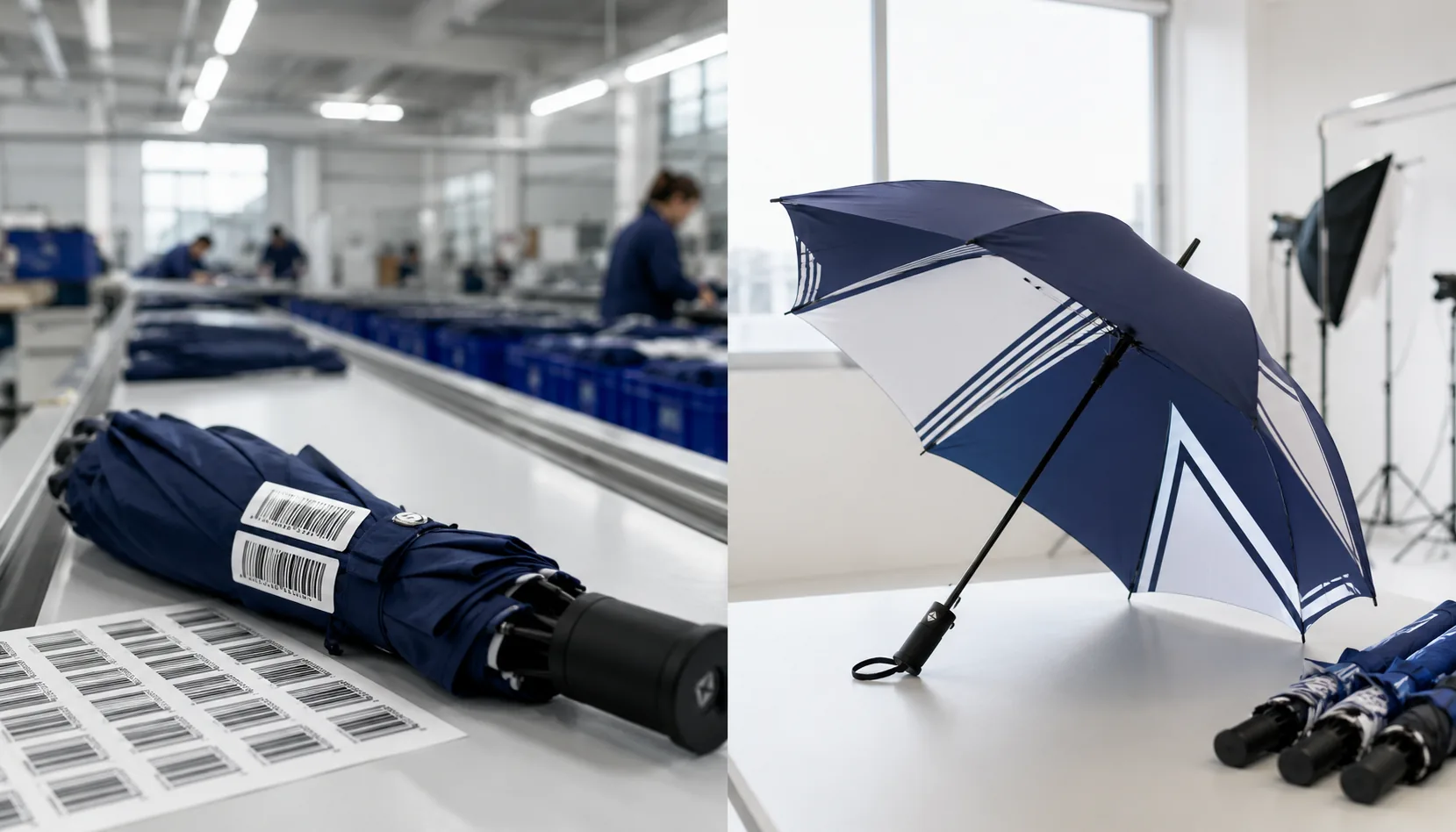
Retail Barcode and Compliance Labels for Branded Umbrellas
Specify barcode, warning, and care labels for retail umbrellas so buyers get compliant, shelf-ready packs with fewer rel...
Read More »