QR Code and Small-Text Printing on Promotional Umbrellas
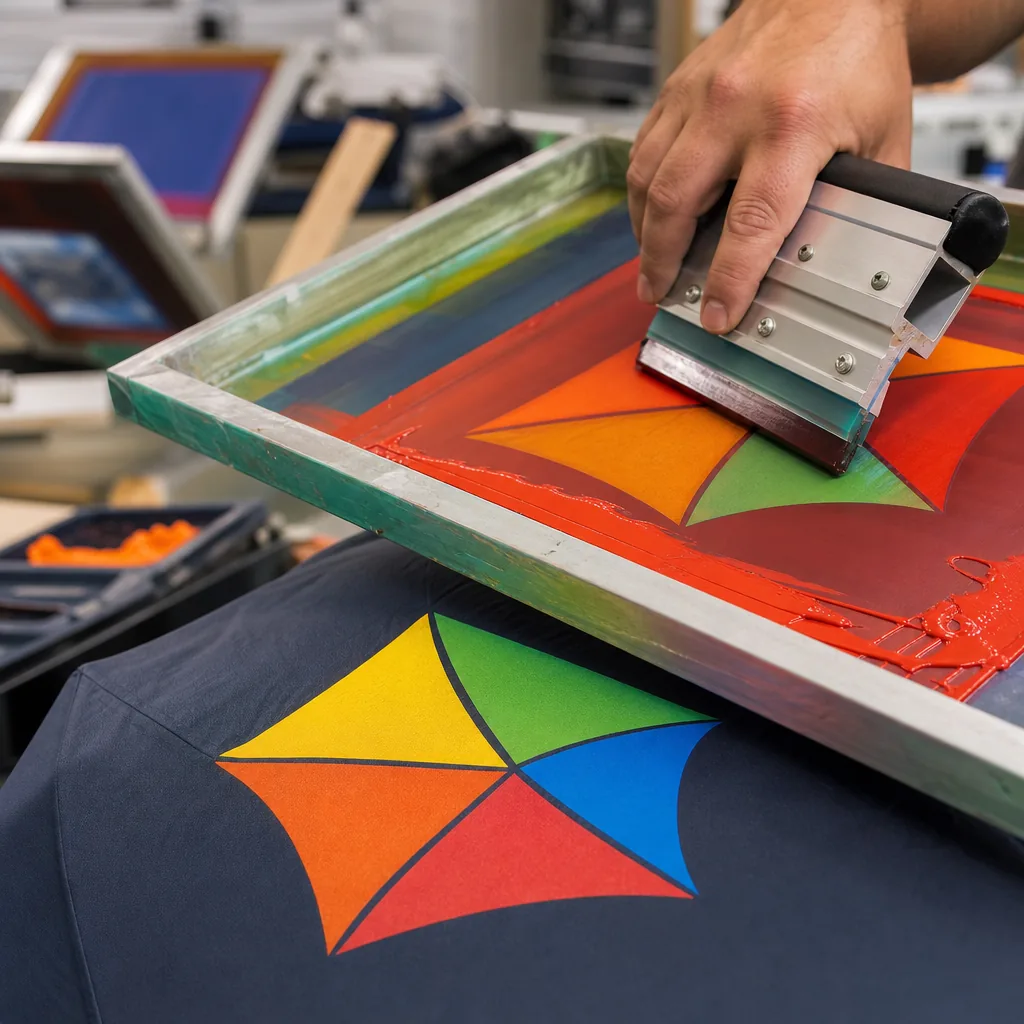
A QR code or 6-point disclaimer that looks sharp on a PDF can fail quickly once it is printed across woven polyester, panel seams, water-repellent coating, and curved canopy tension. In production, QR code umbrella printing depends less on the code itself and more on minimum size, ink holdout, placement, contrast, and scan checks before bulk packing. For promotional buyers, the goal is not just readable artwork at approval, but scannable, repeatable results across thousands of umbrellas.
Why QR Codes and Fine Text Need Different Print Rules
QR codes, URLs, legal marks, and sponsor lines cannot be treated like a normal 80 mm chest-style logo moved onto an umbrella panel. A simple logo can survive a little ink gain, panel distortion, or a 1–2 mm registration shift and still look acceptable from five meters away. QR code umbrella printing is different because the phone camera reads square modules, edge contrast, and the blank quiet zone around the code. If one rib seam pulls the pongee 190T fabric slightly during sewing, or if a screen-print squeegee deposits too much white ink under a black code, the modules can close up and scanning becomes inconsistent. For a scannable umbrella QR code, I prefer at least 35–45 mm finished code size for close hand scanning and 60–80 mm if users may scan while the umbrella is open above shoulder height. On dark canopies, the best result is usually a white underbase plus black code, not a reversed-out code.
Fine text has its own rules because woven umbrella fabric is not coated paper. A small text umbrella logo printed on 190T or 210T pongee has to bridge yarn texture, water-repellent coating, curved panel tension, and sometimes a Teflon or UV UPF 50+ finish. In production, I do not like text below 5 pt for heat transfer, 6 pt for sharp screen printing, or 8 pt for direct printing on rougher polyester, especially if the font is condensed or has thin strokes. URLs should be simplified, with enough spacing between letters and no decorative typefaces. Sponsor lines and legal marks also need to avoid rib fold areas because repeated folding on 8K or 10K frames can break ink edges over time. Our standard practice at ZheBrella is to print fine text at 100% scale on actual canopy fabric before bulk approval, then check readability after drying, folding, and a light rub test.
The biggest mistake in promotional umbrella branding is approving artwork on a flat PDF without considering scan distance, contrast ratio, and panel geometry. QR codes need a quiet zone of at least four modules on all sides, and that blank area should not be cut off by the panel seam, a color block, or a nearby sponsor logo. For better umbrella print accuracy, the code should sit in the central printable area of one panel, normally 120–180 mm away from the edge depending on whether the umbrella is 21 inch, 23 inch, 27 inch, or 30 inch. Black-on-white gives the safest scan result; metallic inks, low-contrast navy-on-black, and heavy gradients are risky. Before mass production, we test with both iPhone and Android cameras at realistic angles, usually 0.5–1.5 meters from the open canopy. If the code only scans under factory lighting at 20 cm, it is not production-ready.
Choosing the Best Decoration Method
Our standard practice at ZheBrella is to test the actual fabric roll, not just approve artwork on a computer screen, because a scannable umbrella QR code depends on contrast, module size, coating behavior, and panel tension after sewing. For screen printing, I prefer high-contrast black-on-white or dark-on-light layouts, with simplified QR data and no decorative logo placed inside the code unless the code is enlarged. For digital printing, ICC control and curing temperature matter; too much heat can distort thin pongee or make coated panels slightly wavy. For heat transfer, the adhesive layer must bond well through folding tests, wet rub tests, and open-close cycling, otherwise sharp artwork may peel at the corners after shipment. Before bulk production, buyers should request a printed panel sample, scan it under indoor light and daylight, then approve an AQL 2.5 inspection standard that includes scanability, registration, edge clarity, and missing print checks.
Placement That Protects Readability
The best pre-production decision is to mark a no-print map before sampling: seams, rib pockets, cap area, fold memory lines, and the last 40–60 mm near the edge should all be treated as risk zones for small graphics. On 190T or 210T pongee, screen printing can hold solid QR blocks well if registration is controlled, while heat transfer gives cleaner edges for small type but can feel heavier if oversized. On POE, PVC, or EVA clear umbrellas, curvature and glare are bigger problems than fabric texture, so the code should face outward on a flatter lower panel and use strong black-white contrast. For QR code umbrella printing, I prefer testing with three phones under indoor light, cloudy daylight, and angled reflection before approving mass production. Our standard practice at ZheBrella is to print the sample, open it on the actual frame, scan it from 0.5–1.2 meters, and only then lock the placement for bulk production. Artwork that scans on a PDF is not proof that it will scan on a stretched canopy.
Frame and Product Choices for Campaign Use
For QR code umbrella printing, the product choice matters as much as the ink system because the canopy becomes the scanning surface. A 27" or 30" golf umbrella gives the cleanest result for trade shows, bank promotions, auto dealers, and outdoor events because each panel has enough uninterrupted area to hold a 45–70 mm QR code plus a small text umbrella logo without crowding the seam allowance. I prefer 190T or 210T pongee on golf umbrellas because it sits flatter under screen printing and heat transfer than lower-density polyester. Fiberglass ribs are usually the better frame choice here; they flex without permanently bending, so the printed panel stays under more even tension after repeated opening. Steel ribs can be acceptable for budget campaigns, but when a rib takes a set, the canopy develops a slight trough, and that distortion is not friendly to a scannable umbrella QR code.
Compact auto-open umbrellas work well for retail giveaways, commuter campaigns, and membership gifts, but the artwork must be scaled more conservatively. On a 21" or 23" folding umbrella, the usable print zone is smaller, and the canopy curvature is tighter, so I normally keep QR codes in the 35–50 mm range only if the code density is low and the quiet zone is protected. Auto-open and auto-open-close frames introduce more movement during use than straight golf frames, especially when consumers snap them open quickly, so umbrella print accuracy depends on stable panel sewing and correct rib alignment. A 3-fold steel shaft with steel ribs is common for low-cost volume orders, while fiberglass ribs improve recovery after wind gusts. For promotional umbrella branding that includes a web link, coupon code, or WeChat-style scan action, the QR should sit near the outer third of one panel, not close to the crown where wrinkles gather.
Clear bubble umbrellas and UPF 50+ sun umbrellas solve different campaign problems. A POE or PVC bubble umbrella gives excellent user visibility in rain and is popular for beauty, real estate, and city events, but QR printing on clear film needs careful contrast planning; black ink over transparent POE scans poorly unless backed by a white underbase or placed on a frosted patch. Bubble shapes also have a deeper curve, so the QR should be larger and less dense than on pongee. UPF 50+ sun umbrellas, usually with silver, black, or coated polyester layers, are stronger for parks, sports, tourism, and outdoor staff uniforms because the user keeps them open longer. Double-canopy windproof structures help on 27"–30" models when the top vent reduces inversion and keeps the printed panel more visible in 30–50 mph gust conditions. Our standard practice at ZheBrella is to test the printed QR on an opened production sample at arm’s length and again from 1–2 meters before approving bulk production.
Pre-Production Testing and Bulk Inspection
For QR code umbrella printing, the first rule is simple: never approve artwork only from a PDF proof. We print a physical pre-production sample on the actual canopy fabric, usually 190T or 210T pongee, POE, PVC, or EVA depending on the order, then scan it with several phones under factory light, outdoor shade, and direct sun. A scannable umbrella QR code needs enough quiet zone, clean edge definition, and strong contrast; a dark navy logo on black pongee may look premium but fail in real use. For small text umbrella logo work, we also check stroke thickness after heat-transfer, screen printing, or sublimation because letters under 5 mm often close up on textured fabric. Approval samples normally take 5–7 days after artwork confirmation, longer if Pantone matching or UV coating is involved.
Rub testing catches many failures before bulk production. We do dry rub and wet rub checks on the printed canopy, especially around fold lines where umbrellas are repeatedly handled, wrapped, and compressed. A QR code that scans on day one but breaks after 20 wet rubs is not acceptable for promotional umbrella branding, because the user may open it in rain before scanning. We also review ink penetration, ghosting, pinholes, and registration drift across panels, since an 8-panel umbrella can expose slight print angle errors more clearly than a flat tote bag. Our standard practice at ZheBrella is to record the approved QR destination URL, landing page screenshot, artwork version, Pantone values, print method, and sample photos before releasing the production order, so nobody changes the link or artwork after sampling.
Bulk inspection should include AQL 2.5 for major print defects, with QR readability treated as a functional checkpoint rather than only a cosmetic issue. Inspectors randomly open finished umbrellas, scan the QR from typical hand distance, and check color contrast, missing dots, ink smears, double images, panel misalignment, and text clarity. For umbrella print accuracy, we define acceptable placement tolerance before production, often plus or minus 5 mm for common 23-inch models, tighter only when the artwork is simple and the MOQ justifies extra setup control. Practical MOQ depends on material and print method: digital heat-transfer can start lower, while custom sublimation panels or exact Pantone screen printing usually make sense from 500–1,000 pieces. Mass production normally takes 20–35 days after sample approval, but buyers should add time for scan testing and destination confirmation before booking FOB or DDP shipment.
Frequently Asked Questions
What size should a QR code be on an umbrella canopy?
For reliable scanning, many buyers use a QR code of at least 40 to 60 mm, depending on viewing distance and print method. The code should also include a clear quiet zone around it.
Can a QR code be printed on every panel of the umbrella?
Yes, but it increases print cost and inspection work. For most promotional campaigns, one or two well-placed codes are easier to scan and keep the design cleaner.
What is the minimum recommended QR code size for a promotional umbrella panel?
For reliable scanning on woven polyester, most buyers should keep the printed QR code at 25-30 mm square minimum, with a quiet zone of at least 4 modules around the code. If the umbrella uses dark fabric or textured pongee, increasing to 35 mm improves scan performance.
What file setup helps prevent small text from filling in during umbrella printing?
Convert text to outlines, submit vector AI or PDF files, and keep positive text at roughly 2.0-2.5 mm cap height minimum for screen printing. For reversed white text on dark panels, many factories recommend 2.5-3.0 mm minimum because ink spread and fabric texture reduce legibility.
How do factories quality-check scannable codes before mass production?
A practical QC process includes a pre-production strike-off, scan testing from multiple phone models, and verification on both open-canopy and curved-panel positions. Many B2B orders also approve a golden sample first, then inspect 5-10 pieces per batch during production to confirm repeatability.
Looking to Launch Your Custom Umbrella Line?
ZheBrella is a Zhejiang-based OEM/ODM umbrella manufacturer with 17 years of export experience. Free design, low MOQ from 100 pieces, windproof construction, full-color print.
Get Free Quote Now »People Also Search For
Related Articles
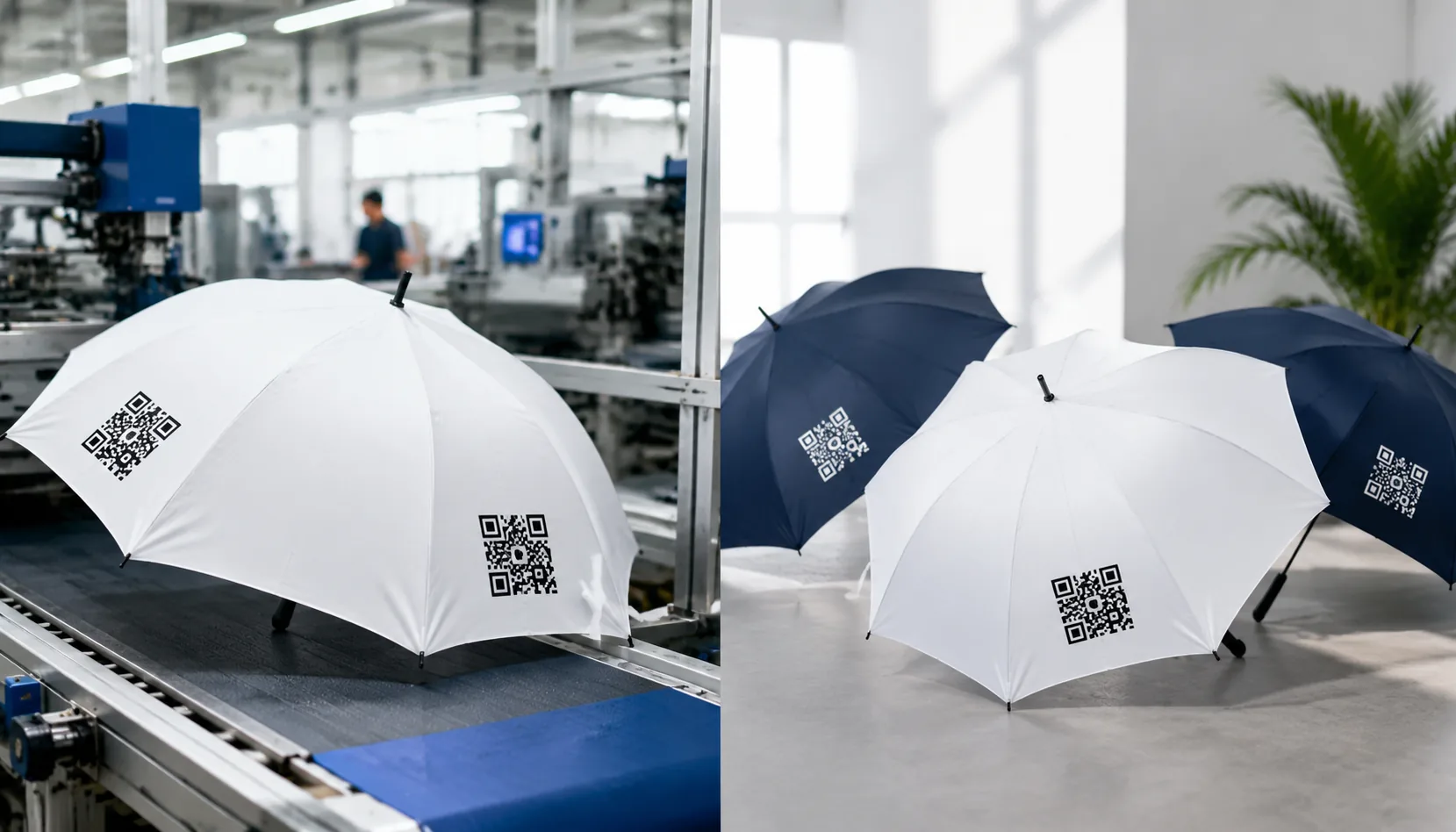
QR Code Printing on Branded Umbrellas for Event Tracking
Create scannable QR code umbrellas with the right logo size, contrast, print method, fabric choice, proofing steps, and ...
Read More »QR Code Printing on Umbrellas for Trackable Campaigns
Plan scannable QR code umbrellas with the right print size, contrast, panel placement, coating tests, and approval proce...
Read More »
Logo Size Standards for Branded Umbrella Production Runs
Set practical logo sizes by umbrella style, panel count, and print method so procurement teams can approve branded umbre...
Read More »