QR Code Printing on Branded Umbrellas for Event Campaigns
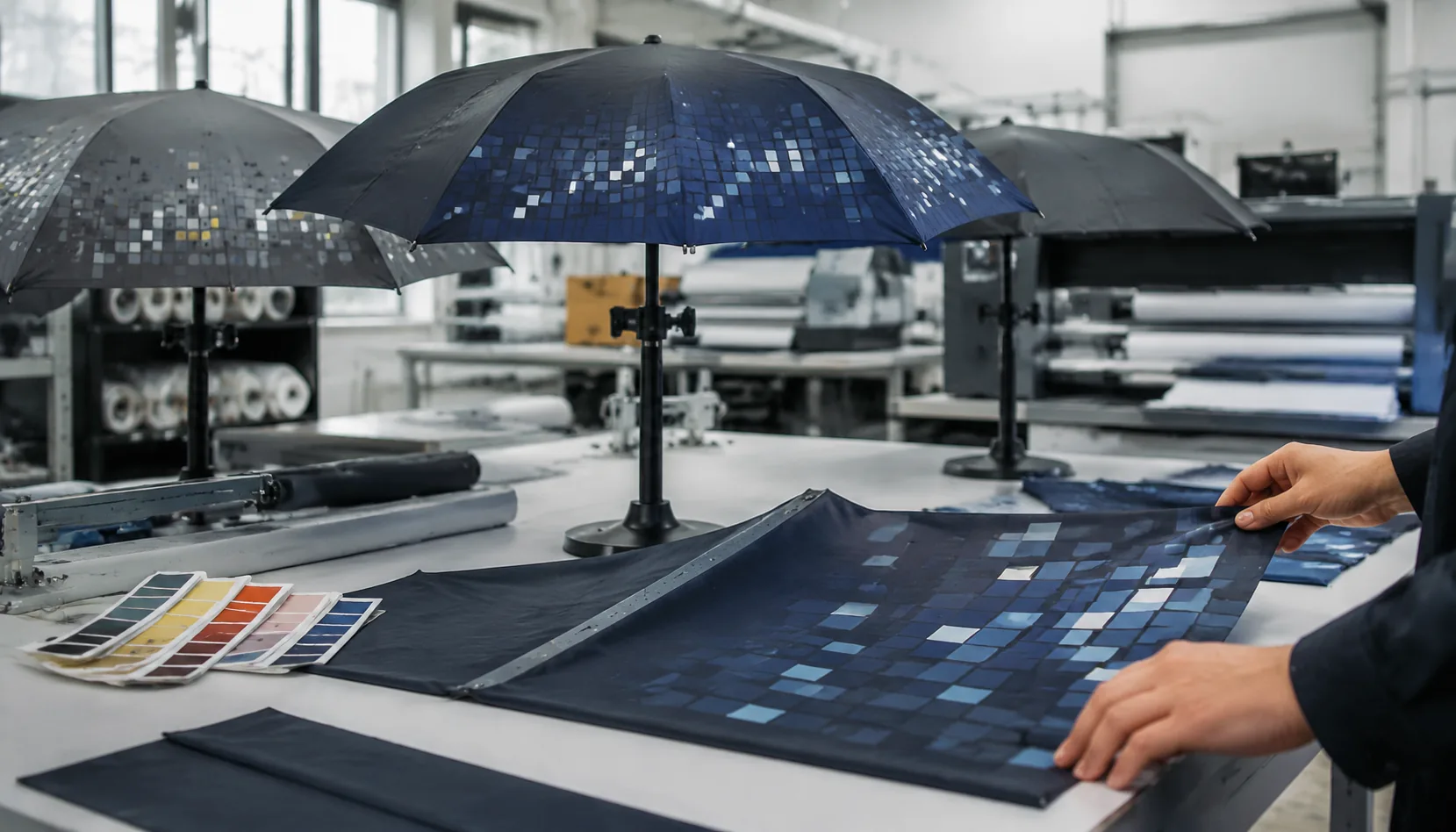
Event buyers often approve a clean digital mockup, then discover on delivery that the code wrinkles across a panel seam, loses contrast on wet polyester, or scans only under perfect light. On our Songxia production floor, QR code umbrella printing starts with panel layout, ink behavior, and scan testing—not just artwork placement—because a campaign umbrella has to work in a crowded venue, in rain, and after repeated opening cycles.
Best Use Cases for QR Code Umbrellas
QR code umbrella printing works best when the umbrella has time in the customer’s hand and enough visual distance for the code to be noticed: outdoor festivals, golf days, trade shows, city runs, food fairs, and music events. For these branded event umbrellas, I usually recommend a 23" auto-open straight umbrella or a 21" compact auto-open-close model, depending on whether staff hand them out at an entrance or pack them into a welcome bag. A promotional umbrella QR code can send guests to a landing page for schedules, venue maps, prize draws, sponsor offers, or post-event surveys. The print position matters more than buyers expect: a code on one lower canopy panel scans better than one wrapped near a seam, especially on 190T or 210T pongee with water-repellent coating. Keep the QR block at least 55-70 mm wide for normal phone scanning, and avoid placing it across rib folds where fabric tension changes after opening and closing.
Tourism campaigns are another strong fit because umbrellas naturally travel through streets, hotels, cruise ports, scenic areas, and shuttle queues. A city tourism bureau can put a scannable umbrella logo on one or two panels linking to a multilingual guide, restaurant map, museum route, or weather-based itinerary. For coastal or mountain destinations, I would spec fiberglass ribs over thin steel ribs because visitors keep umbrellas longer when they survive gusts; an 8K fiberglass frame with a vented double canopy is a practical baseline, and 50+ mph wind-tunnel survival is realistic when the frame and runner are properly matched. Retail launches and pop-up stores use the same logic, but the QR should drive to product registration, limited coupons, AR try-ons, or store-locator pages. If the campaign runs outdoors for several weeks, UV ink stability and contrast testing are worth adding to the pre-production sample approval, especially on dark navy, black, red, or digitally printed canopy panels.
The mistake I see from buyers is making the QR code the hero and shrinking the actual brand mark until nobody recognizes the sponsor from five meters away. The umbrella still has to work as clear brand media: logo, campaign line, and color block should read first; the code should support the call-to-action. On loyalty programs and campus activations, this balance is critical because users may scan once, but they carry the umbrella many times. A university welcome-week umbrella might link to a student app, dining plan, or club registration page, while the school crest stays large on an opposite panel. A retailer can link to loyalty enrollment, but the brand name should remain readable on at least two panels. As a custom event umbrella supplier, our standard practice is to check QR scannability from printed strike-off fabric before bulk sewing, then inspect finished goods under AQL 2.5 so distorted panels, ink bleeding, or low-contrast codes do not reach the campaign site.
Minimum Size, Contrast, and Placement
The safest rule for QR code umbrella printing is to size the code for the curve, not for the flat artwork proof. On a 23" stick umbrella, I do not like going below 80 mm x 80 mm for a functional code, and 100-120 mm is better if people will scan from 3-6 feet away at an event gate or outdoor booth. For golf umbrellas in 27" or 30" sizes, a 120-150 mm code gives more margin because the canopy panel is larger and the viewer is often farther away. Keep the quiet zone around the code at least 4 modules wide; if the designer crops that white border to make the layout look tighter, scan failure goes up quickly. A branded event umbrella can carry a logo, slogan, and QR, but the code must be treated as functional packaging, not decoration.
Contrast matters more than buyers expect, especially on 190T or 210T pongee with water-repellent or Teflon coating that can add surface shine. Black code on white or very light canopy is the most reliable; navy on white can work, but gray, gold, tone-on-tone, and reversed white-on-dark codes need live testing before mass production. For screen printing, ink spread can close small modules, so we usually ask for vector QR artwork and print a sample before confirming bulk plates. Heat transfer gives sharper edges on small batches, while sublimation can be good on white polyester but may soften edges if the fabric moves under heat. If a client wants a scannable umbrella logo with a brand mark in the center, keep error correction at level H and avoid covering more than about 15-20% of the QR matrix.
Placement should avoid seam lines, rib pressure points, and the fold valleys where the canopy bends every time the umbrella closes. Put the promotional umbrella QR code in the center area of one panel, not crossing the stitched seam, and keep at least 25-35 mm away from the rib line on common 8K frames. On 10K or 16K umbrellas, panels are narrower, so the code may need to be smaller or moved lower, but not so low that the hem curve distorts it. For double-canopy vented windproof models, never place the code where the upper vent overlaps or shadows the lower panel. Our standard practice at ZheBrella is to test scans on an open umbrella, then again with the canopy tilted 30-45 degrees, because event users rarely hold branded umbrellas perfectly flat to the scanner. A custom event umbrella supplier should check both iPhone and Android cameras at practical distances before approving production.
Print Methods and Fabric Compatibility
Screen printing is still the safest method for a simple, high-contrast QR code on umbrellas, especially when the code is black, navy, or dark green on a white or light canopy panel. For QR code umbrella printing, I prefer screen print when the code is at least 80–100 mm wide, the quiet zone is preserved, and the artwork is pure vector with no anti-aliasing. On 190T pongee, ink sits cleanly if the fabric is tightly woven and properly tensioned on the printing table; on cheaper loose-weave polyester, the square modules can feather and reduce scan reliability. A promotional umbrella QR code should not be placed across a seam, rib pocket, or curved panel edge because distortion after sewing is worse than most buyers expect. For branded event umbrellas, we usually print the QR code on one main panel, then run a phone scan test at 0.5 m, 1 m, and 2 m under indoor and outdoor light before bulk approval.
Digital printing is better when the QR code is part of a larger campaign visual: event map, sponsor wall, full-panel artwork, gradient background, or retail-style pattern. Sublimation on white polyester gives excellent color integration, but the QR code must remain high contrast; a pale gray code over a busy image is a common designer mistake. Digital direct printing can handle complex graphics on 190T or 210T pongee, yet coated UPF 50+ fabrics need more care because UV coatings and water-repellent finishes can change ink absorption and slightly soften the module edges. If a scannable umbrella logo shares space with a QR code, keep them separate: the logo can be decorative, but the QR code needs a clean quiet zone around all four sides. For auto-open 23 inch and 27 inch event umbrellas, panel curvature also matters, so the code should be sized larger than it would be on a flat tote bag or banner.
Heat transfer is useful for small runs, urgent event orders, and codes that need very sharp edges without making a screen for each color. It works well for 50–300 pieces when the buyer needs several URLs, city-specific campaign codes, or different sponsor marks across the same umbrella model. The transfer film gives a crisp square boundary on both 190T and 210T pongee, but operators must control temperature, dwell time, and pressure; too much heat can glaze the fabric, weaken a Teflon-style water-repellent finish, or leave a visible patch under angled light. I do not recommend very large transfers on vented double-canopy golf umbrellas because the hand feel becomes stiff and the panel may not fold cleanly. A custom event umbrella supplier should confirm scan performance after sewing, not just after printing, because rib tension, canopy stretch, and packing wrinkles can affect the final readable shape.
Frame and User Experience Choices
For event campaigns, the frame choice decides whether the umbrella actually gets opened in public or stays in a hotel room. I recommend auto-open mechanisms for most branded event umbrellas because one-hand deployment matters when attendees are carrying badges, coffee, tote bags, or phones. A 23" stick umbrella with an auto-open shaft gives enough canopy area for logo visibility without feeling oversized in a crowd, while a 21" auto-open folding umbrella is better for conference kits and air travel. For QR code umbrella printing, we also care about canopy stability: if the panel shakes or collapses in gusts, the printed code becomes harder to scan. Our standard practice at ZheBrella is to test spring force, runner lock, and shaft straightness before print approval, because a premium canopy on a weak frame still creates a poor user experience.
Fiberglass ribs are the safer specification for outdoor venues, stadium exits, golf events, and rainy street activations. Compared with steel ribs, fiberglass flexes and returns better under wind load, especially in 8K or 10K frames with a reinforced stretcher joint. A double-canopy vented windproof build is worth the extra cost when the umbrella will be used in open areas; the vent lets wind escape instead of turning the canopy inside out. On a 190T or 210T pongee canopy with water-repellent coating, that construction can survive practical wind-tunnel checks around 50+ mph when the shaft, tips, and runner are correctly matched. For a promotional umbrella QR code, I prefer printing the code on one stable outer panel and keeping nearby artwork uncluttered, so users can scan from 2 to 4 feet without hunting for contrast.
Steel ribs still have a place in budget programs, especially high-volume indoor conferences, short-term giveaways, or MOQ-driven distributor orders where the landed cost matters more than long service life. The tradeoff is weight and hand feel: a steel 8K frame can make a 23" umbrella feel less premium, and once a rib bends, it usually stays bent. If the buyer wants a scannable umbrella logo on a retail-style gift, fiberglass ribs, an auto-open mechanism, and a straight EVA or rubberized handle feel more aligned with the perceived value. A custom event umbrella supplier should quote both versions clearly: steel-frame economy for cost-sensitive campaigns, and fiberglass double-canopy windproof for outdoor brand exposure where failure in bad weather would damage the campaign more than the small unit-cost saving helps.
Quality Control Before Campaign Launch
Quality control for QR code umbrella printing has to start before bulk fabric is cut, because a QR code that looks sharp on a PDF can fail after ink gain, heat-transfer pressure, or canopy curvature. I always ask for a pre-production sample with the final URL, final artwork size, and final canopy material, whether it is 190T pongee, 210T pongee, POE, PVC, or EVA. Test the live URL, not a placeholder, and scan from 12–36 inches under daylight, warehouse LED, and low indoor event lighting. Use at least five phone types: recent iPhone, older iPhone, Samsung Android, lower-cost Android, and a phone with a scratched camera lens. A scannable umbrella logo should still read after the canopy is opened, tilted, and slightly wrinkled around the rib line. For branded event umbrellas, I prefer QR blocks of at least 35–45 mm on panels and larger for golf sizes like 27 inch or 30 inch.
Bulk inspection should treat the code as a functional component, not decoration. Under AQL 2.5, inspection points should include code position tolerance, color density, edge sharpness, missing modules, smearing, pinholes, panel distortion, and whether the promotional umbrella QR code still scans after opening and closing the frame 10–20 times. On dark canopies, a white quiet zone around the code is not optional; without it, scan reliability drops fast. For screen printing, check mesh marks and ink buildup at corners. For heat transfer, check peeling after rub testing and heat marks on coated pongee. For sublimation, check whether black modules shift toward brown or gray. Our standard practice at ZheBrella is to keep a signed golden sample beside the inspection table and compare every carton pull against it, including handle logo, sleeve print, hangtag URL, and carton label.
Campaign timing is where many event umbrella orders fail. Confirm MOQ early: many factories can start at 300–500 pieces for simple print, but custom panel layout, special handle color, or double-canopy vented windproof frames may push MOQ to 1,000 pieces. Normal lead time is often 20–35 days after artwork approval, plus 3–7 days for sampling and 5–10 days for revision if the QR code needs resizing. Packaging matters too: separate printed canopies with tissue or individual polybags so stacked umbrellas do not abrade the QR print during ocean or truck movement. For fixed event dates, plan FOB if your forwarder controls consolidation, but use DDP when the buyer needs one landed cost and fewer customs surprises. A custom event umbrella supplier should lock the delivery buffer in writing, especially before trade shows, stadium activations, campus campaigns, or rainy-season launches.
Frequently Asked Questions
How large should a QR code be on an umbrella canopy?
For reliable scanning, buyers should avoid very small QR codes and test the final printed size on a curved sample. Larger, high-contrast codes placed away from seams perform best.
Can QR codes be printed on dark umbrella fabric?
Yes, but the code needs strong contrast, often with a white backing block or light panel. Always test the printed sample with multiple phone cameras before mass production.
What QR code size is usually needed for an umbrella canopy to scan reliably?
For most event umbrellas, the QR code should usually be at least 4 to 6 inches wide on a single panel, depending on viewing distance and canopy curvature. If the code will be scanned from farther away, increase the size and keep a clear quiet zone around it.
Which printing method is better for a scannable umbrella logo and QR code?
Screen printing is often preferred for bold, high-contrast QR graphics, while digital printing works well for complex layouts and multi-color branding. For best scan performance, the final art should use solid blacks or dark colors on a light background and avoid gradients.
What QC checks should a buyer request before bulk production?
Ask for a pre-production sample, a scan test on the actual fabric, and a contrast check under indoor and daylight conditions. Many buyers also require 100% artwork proof approval and a production tolerance review before a bulk run.
Looking to Launch Your Custom Umbrella Line?
ZheBrella is a Zhejiang-based OEM/ODM umbrella manufacturer with 17 years of export experience. Free design, low MOQ from 100 pieces, windproof construction, full-color print.
Get Free Quote Now »People Also Search For
Related Articles
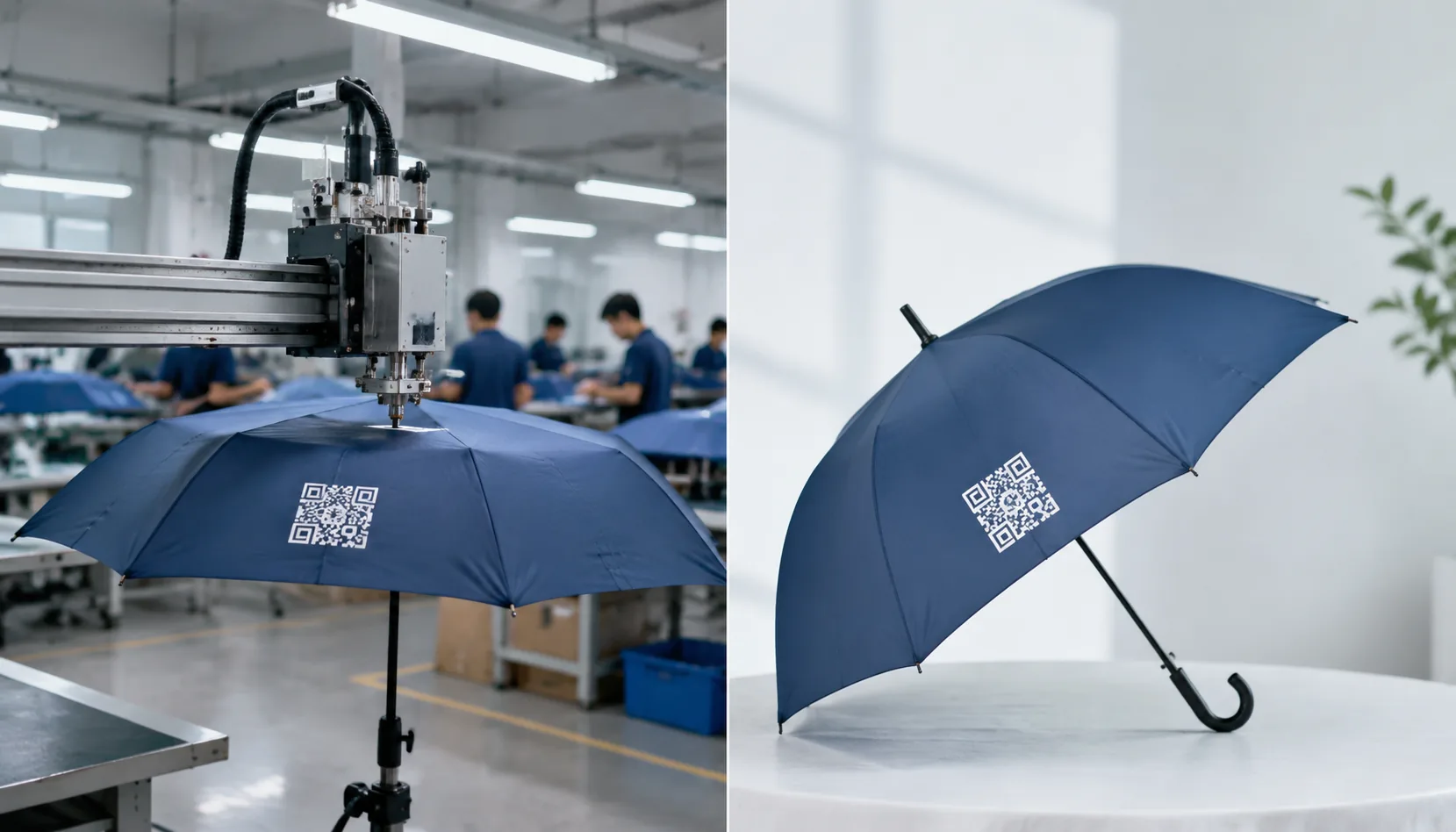
QR Code Printing on Umbrellas for Campaign Tracking
Use QR code umbrella printing with readable sizing, durable placement, and QC checks so event and retail campaigns can d...
Read More »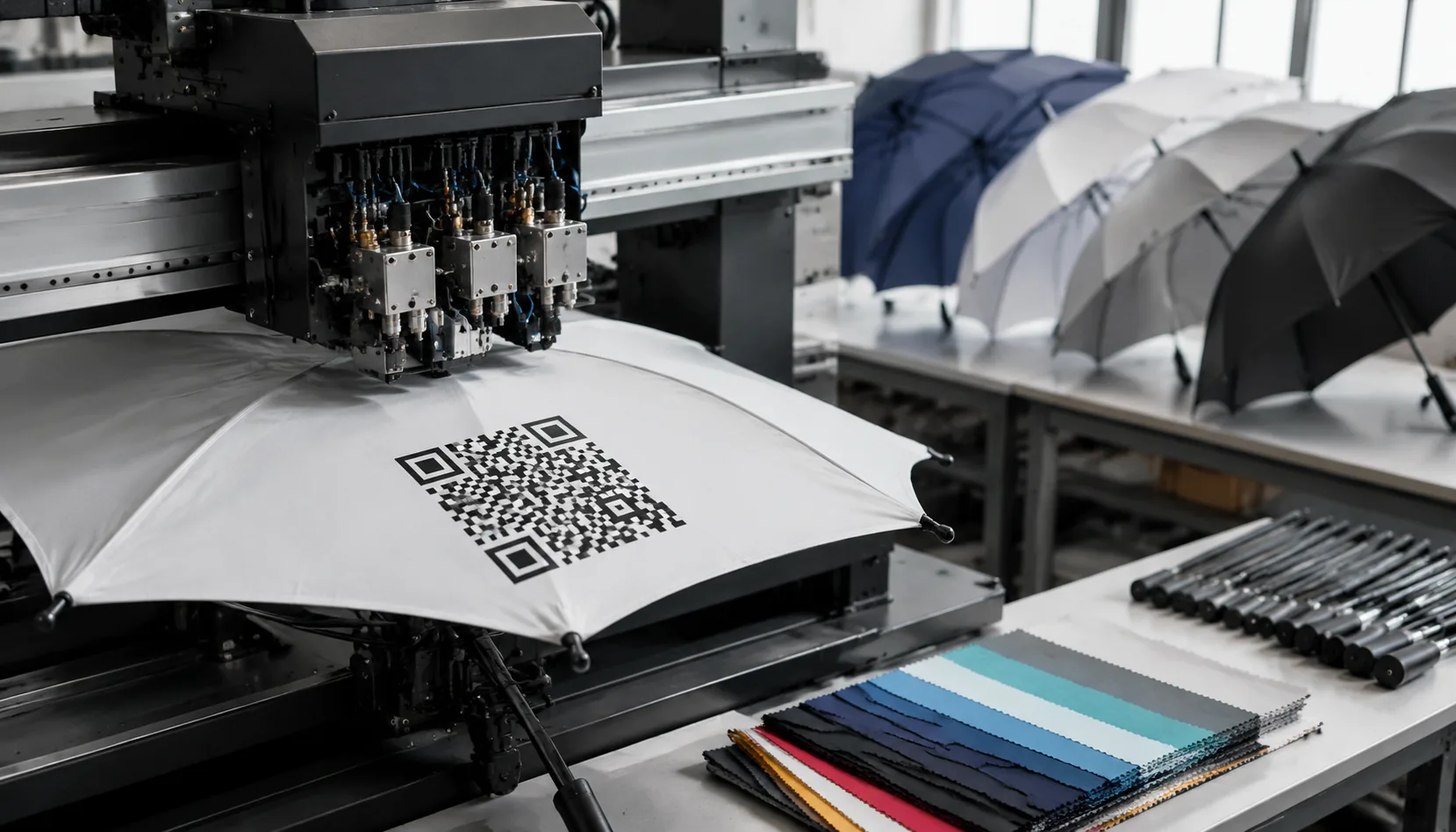
QR Code Printing on Promotional Umbrellas for Campaigns
Plan scannable QR code umbrella printing with the right panel size, contrast, fabric, testing, MOQ, and delivery terms f...
Read More »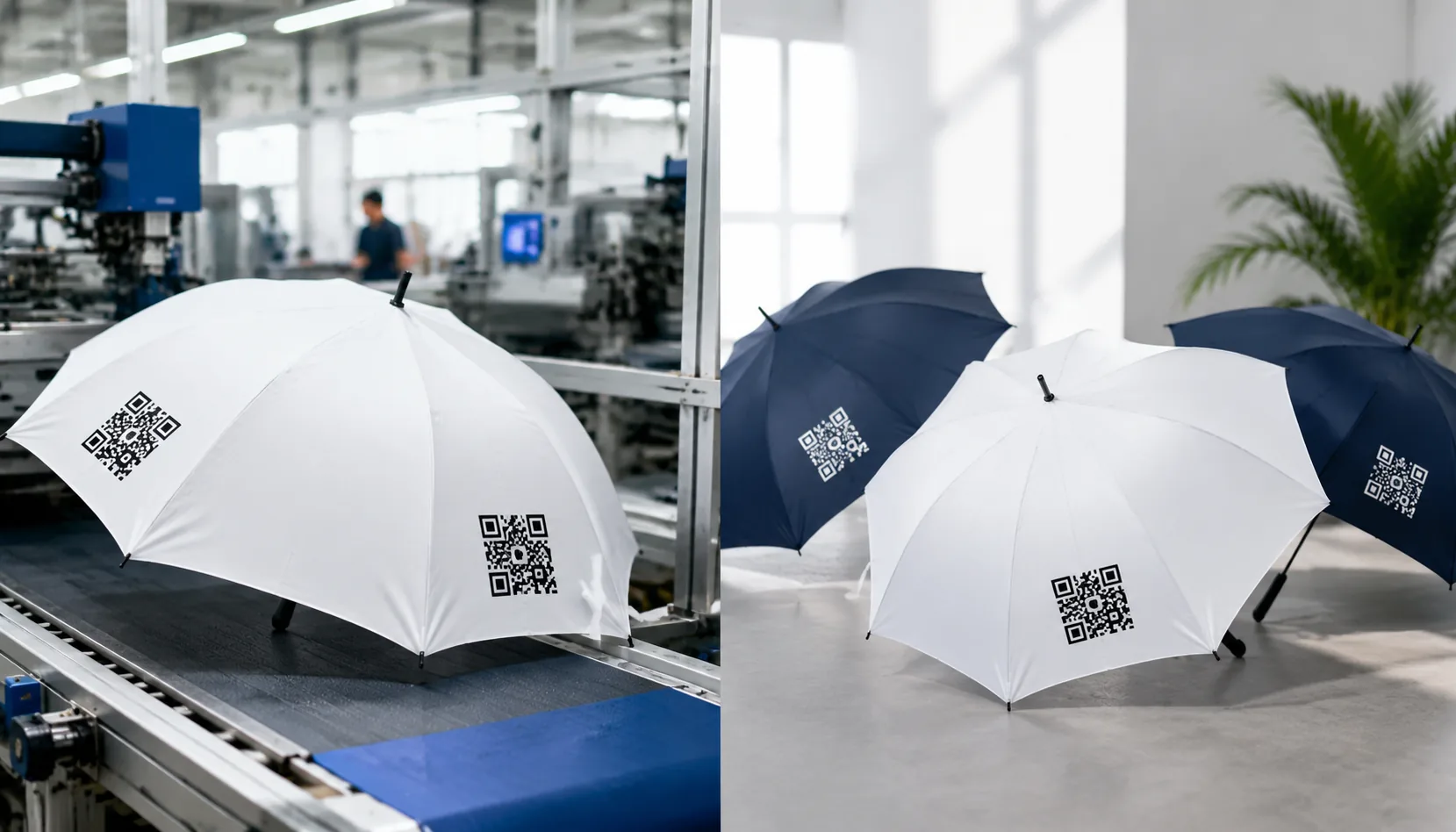
QR Code Printing on Branded Umbrellas for Event Tracking
Create scannable QR code umbrellas with the right logo size, contrast, print method, fabric choice, proofing steps, and ...
Read More »