QR Code Printing on Umbrellas for Event Brand Tracking
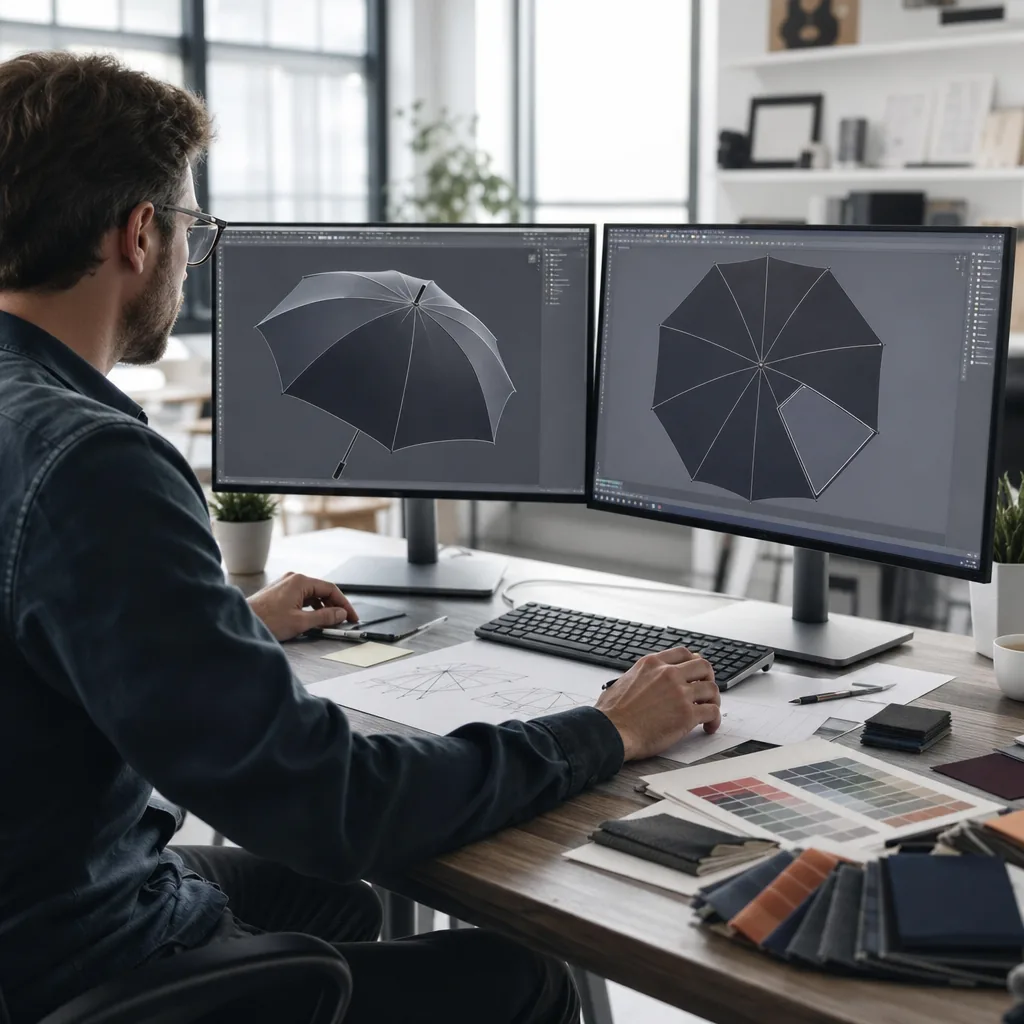
Event buyers often discover too late that a QR code that scans on a flat proof can fail on curved polyester, dark panels, or glossy coatings in rainy light. On our umbrella production floor in Songxia, QR code umbrella printing starts with panel layout, ink contrast, code size, and sample scanning before bulk cutting, because one weak decision can turn a tracking campaign into decoration. The right process protects scan rates, brand appearance, and delivery schedules from sample approval through carton QC.
When QR Codes Add Value to Branded Umbrella Campaigns
QR codes earn their place on event branded umbrellas when the scan has a job to do, not when it is added as decoration. For outdoor conferences, music festivals, golf days, and city marathons, a code on one canopy panel can connect guests to check-in pages, digital schedules, booth maps, emergency updates, or shuttle locations. Tourism boards use scannable umbrella logos to open walking maps, restaurant offers, museum routes, or multilingual guides. For product launches, the umbrella can link to a landing page, warranty registration, AR demo, or limited-time coupon. The best results come when the printed code is paired with a short instruction line such as “Scan for today’s route” or “Scan to claim your gift,” because people rarely scan a blank square without context.
QR code umbrella printing also makes sense for campaigns that need tracking after the event ends. A charity walk can print different codes by sponsor, city, or team color, then measure which group drove donations after the umbrellas left the venue. A distributor handling promotional umbrella printing for a beverage brand can assign unique URLs to regions or retailers and compare scan activity over several rainy weeks. Compared with flyers, wristbands, or thin plastic ponchos, a 23 inch or 27 inch umbrella has a longer working life and more public surface area. A decent 190T pongee canopy with fiberglass ribs may be carried to commuting stations, school pickups, outdoor cafés, and sports sidelines for months, giving the campaign repeated impressions instead of one afternoon of visibility.
From the factory side, the critical point is that a QR code must be designed for umbrella conditions, not copied from a business card. We normally keep codes away from seam lines, heavy canopy curvature, and fold creases, especially on 8K and 10K panels where tension changes after sewing. For reliable scanning, I prefer a high-contrast black code on a white or light solid patch, with enough quiet zone around the square and a finished size usually no smaller than 35 to 50 mm depending on viewing distance. Umbrella print testing matters: we check sample scans before and after opening cycles, water spray, rubbing, and packing compression. For QR code umbrella printing on dark pongee, heat transfer or sublimation on a light panel often scans better than direct screen printing over a textured or coated surface.
Sizing and Placement Rules for Reliable Scanning
Reliable scanning starts with size, not artwork taste. For QR code umbrella printing, I do not approve codes smaller than 35 x 35 mm on a canopy panel, and 45 x 45 mm is safer for event traffic where people scan while walking. On sleeves or hangtags, 25 x 25 mm can work because the surface is flat and held close to the phone. Keep a quiet zone equal to at least four QR modules on all sides; if the code is 40 mm, that usually means 3 to 5 mm of clear white or light background around it. Do not let a logo, slogan, seam, piping, or panel edge enter that area. Contrast should be strong: black code on white, silver-gray, or pale yellow reads better than navy on red or tone-on-tone brand colors. For dye-sublimation on 190T or 210T pongee, we still run umbrella print testing because ink spread can soften small modules, especially after water-repellent finishing.
The worst location is near the rib line or lower curved edge where the canopy wrinkles when opened. A QR code is a grid, and scanners dislike distortion; even a good print can fail if the fabric is under uneven tension. Place scannable umbrella logos in the center third of one outer panel, about 80 to 120 mm below the top seam on a 23-inch umbrella, and keep at least 25 mm away from stitched seams and rib pockets. On larger 27-inch and 30-inch golf umbrellas, one panel gives enough flat reading area, but on compact 21-inch folding umbrellas the panel curvature is tighter, so I recommend increasing the code size to 45 to 55 mm. Avoid printing the code across two panels, across a double-canopy vent overlap, or over heavy coatings. Teflon, PU, and UV UPF 50+ finishes are fine, but glossy PVC or POE domes can create reflection, so contrast and scan-angle testing matter more.
Choose the placement based on how the umbrella will be used at the event. If the goal is mass visibility in a queue, one outer canopy panel is best for event branded umbrellas because people can scan from 1 to 2 meters when the code is 50 mm or larger. If the scan is meant to happen during handout, registration, or retail redemption, the sleeve gives higher conversion because the user naturally holds it flat at phone distance. Hangtags are the most reliable for tracking because they are printed on coated paper with AQL 2.5 inspection, but they often get discarded before the umbrella is seen outdoors. Our standard practice at ZheBrella is to test three phones, iOS and Android, under indoor light and daylight after canopy assembly, not just on a flat fabric swatch. For QR code umbrella printing tied to campaign analytics, print a short URL backup below the code in 6 to 8 pt type, because even good promotional umbrella printing can be defeated by rain glare, motion, or a wrinkled panel.
Print Method, Fabric, and Color Choices for Code Accuracy
Code accuracy starts with contrast, not the print machine. A QR code needs clean separation between the dark modules and the quiet zone around it, so black-on-white, navy-on-white, or dark gray-on-silver scans much more reliably than tone-on-tone brand palettes. I have seen beautiful event branded umbrellas fail at registration because the client insisted on light blue code blocks over a medium blue canopy; the phone camera could not lock the finder patterns under outdoor glare. For QR code umbrella printing, we normally keep the code on a white or very light rectangular patch, with at least a 4-module quiet zone and no logo, seam, or rib tip crossing the code area. On 190T and 210T pongee, the weave is tight enough for detailed promotional umbrella printing, but the fabric still moves during sewing and canopy tensioning, so a 25–35 mm code that works on paper is too small. For field use, I prefer 60–90 mm codes on folding umbrellas and 90–120 mm on 27" or 30" golf umbrellas.
Screen printing is the most stable choice when the design is one or two solid colors and the order quantity justifies proper screens. On 190T pongee, a well-controlled screen print gives strong opacity and durable wash resistance, but edge sharpness depends on mesh count, ink viscosity, squeegee pressure, and how tightly the fabric panel is fixed before printing. Too much ink causes slight bleeding into the yarn texture, which can close small QR modules; too little ink gives pinholes that break the data pattern. Heat transfer produces sharper edges because the code is printed on a transfer film first, then pressed onto the canopy, making it useful for scannable umbrella logos with fine squares or integrated brand icons. The trade-off is hand feel and flexibility: a large transfer patch on a compact 21" umbrella can feel heavier, and poor pressing temperature may crack after repeated folding. Our standard practice at ZheBrella is to test heat transfers after folding, wet rubbing, and 24-hour recovery before approving bulk.
Digital printing, including direct-to-fabric or sublimation depending on fabric and coating, is best when the umbrella carries gradients, photos, or multiple campaign colors around the code. It is weaker for pure QR precision if the printer profile is not controlled, because anti-aliasing and color mixing can soften the square edges. Sublimation on polyester pongee can look clean, especially on white 190T or 210T panels, but a black QR may print as a composite dark tone rather than a dense neutral black unless the ICC profile is corrected. For serious umbrella print testing, we scan samples with both iPhone and Android cameras at 0.5 m, 1 m, and under direct sunlight, then repeat after water-repellent finishing such as Teflon coating. Matte light backgrounds beat glossy dark panels because reflections confuse the camera. If brand guidelines require red, green, or gold codes, I recommend increasing code size by 30–50%, using error correction level Q or H, and keeping the destination URL short before generating the final QR code umbrella printing artwork.
Testing QR Codes Before Bulk Production
The first filter is the digital proof, and it should be stricter than the customer’s eye test. For QR code umbrella printing, I check the artwork as a true vector QR, not a flattened PNG, and I verify the quiet zone, module sharpness, and contrast before anyone burns a screen or sets up heat transfer. If the code is too small, the logo background too busy, or the white margin cropped, it may look fine on a monitor and fail on fabric. At ZheBrella, we treat that proof as a production gate: no approval until the code scans cleanly in the exact print color, fabric color, and panel shape planned for the event branded umbrellas. For promotional umbrella printing, that means checking the code at the final canopy size, not at a generic artwork scale, because a 21-inch compact umbrella and a 30-inch golf model do not behave the same on a curved panel.
After the proof, the strike-off has to be scanned on multiple phone models, not just one flagship iPhone. We test scannable umbrella logos with older Android units, different camera apps, and both bright indoor light and daylight, because QR code umbrella printing that only works on a designer phone is useless at an event desk. I want scans from 30 cm, 1 m, and 2 m, plus a quick walk-up test to see whether the code still reads when the canopy is angled. Then we do wet-canopy checks: a light spray, a full dry, and another scan, because ink spread and surface sheen can blur the modules. The last failure point is folding. After the umbrella is closed and creased, the code must still scan from the opened canopy, or the umbrella print testing is not finished; small codes often distort at panel folds, stitched seams, and near the vent or tip area.
Event Order Planning, QC, and Delivery Terms
For event branded umbrellas, the first planning mistake is choosing the umbrella before confirming the scan behavior. A QR code that works on a flat PDF may fail once printed across a curved 23" canopy panel, especially on dark 190T pongee or glossy POE. For QR code umbrella printing, I normally recommend a minimum 25–30 mm code for close-range scanning and larger if the umbrella will be scanned from a booth line or outdoor queue. MOQ depends on the model and print method: 500 pieces is realistic for a standard manual 21" or 23" straight umbrella with one-panel screen print, while auto-open frames, custom canopy colors, heat-transfer logos, or mixed carton labeling often push practical MOQ to 1,000 pieces. Sample approval should not be rushed; a digital mockup takes 1–2 days, but a physical printed sample usually needs 5–7 days after artwork confirmation, plus courier time if the buyer wants to scan it in hand.
Manual umbrellas cost less and have fewer moving parts, which is why they are still the safest giveaway choice for conferences, sports days, and campus events where price and carton volume matter. Auto-open models feel better in retail-style promotions, but the spring mechanism adds cost, weight, and another QC point; I would not use a cheap auto-open frame just to make the giveaway look premium. For scannable umbrella logos, the print position matters as much as the mechanism: one clean outer panel is better than splitting the QR code across seams or placing it near the tip where fabric tension distorts the grid. Our standard practice at ZheBrella is to run umbrella print testing on production fabric, not just white paper, checking contrast, edge sharpness, ink bleeding, and phone scans under indoor light and outdoor shade before bulk printing starts.
For fixed event dates, work backward from the delivery deadline and add a buffer instead of trusting the fastest lead time on a quotation sheet. A common timeline is 7 days for sample approval, 18–25 days for bulk production after deposit and artwork lock, 2–4 days for final inspection and packing, then freight time depending on FOB or DDP terms. AQL 2.5 inspection should include frame opening tests, canopy seam checks, print registration, carton marks, and random scan checks pulled from finished cartons, not only from the top samples on the packing table. Under FOB Ningbo or Shanghai, the buyer controls the forwarder but must watch vessel cutoffs and customs documents. Under DDP, the factory or trading partner carries more logistics responsibility, but event planners still need to allow customs and last-mile delays, especially before peak seasons or large trade shows.
Frequently Asked Questions
What is the safest place to print a QR code on an umbrella?
A flat outer canopy panel is usually the most visible, but a sleeve or hangtag can scan more reliably because the surface is flatter. For lead tracking, many buyers use both a canopy logo and a scannable sleeve or tag.
Can QR codes be printed in brand colors instead of black?
Yes, but contrast must remain high and the background must be clean. Low-contrast tone-on-tone codes or busy patterned backgrounds should be avoided unless a physical sample scans reliably.
What QR code size usually scans reliably on a standard event umbrella?
For most 21 to 23 inch umbrellas, buyers usually approve a printed QR code between 35 and 50 mm wide on one outer panel. Below about 30 mm, scan rates often drop on curved fabric, especially if the code is placed near seams or the panel edge.
Should the QR code be tested on a pre-production umbrella or is a flat print proof enough?
A flat artwork proof is not enough for event use. Ask for at least one physical pre-production sample with the final fabric, ink, and panel placement, then test scanning under indoor lighting and outdoor daylight from 1 to 3 feet away.
What carton-level QC checks matter most for QR code umbrellas before shipment?
Require random carton checks for scan readability, print position tolerance, and color contrast consistency. A practical standard is to verify at least 3 to 5 umbrellas per sampled carton and confirm the code scans on multiple phone models before release.
Looking to Launch Your Custom Umbrella Line?
ZheBrella is a Zhejiang-based OEM/ODM umbrella manufacturer with 17 years of export experience. Free design, low MOQ from 100 pieces, windproof construction, full-color print.
Get Free Quote Now »People Also Search For
Related Articles
QR Code Printing on Branded Umbrellas for Campaign Tracking
Design scannable QR codes on branded umbrellas with the right size, contrast, placement, fabric choice, and QC checks fo...
Read More »
QR Code Printing on Branded Umbrellas That Scans Reliably
Plan QR code printing on umbrellas with right size, contrast, placement, testing, and QC checks so promotional campaigns...
Read More »
QR Code Printing on Umbrellas for Campaign Tracking
Use QR code umbrella printing with readable sizing, durable placement, and QC checks so event and retail campaigns can d...
Read More »