Reflective Logo Printing on Umbrellas for Safety Campaigns
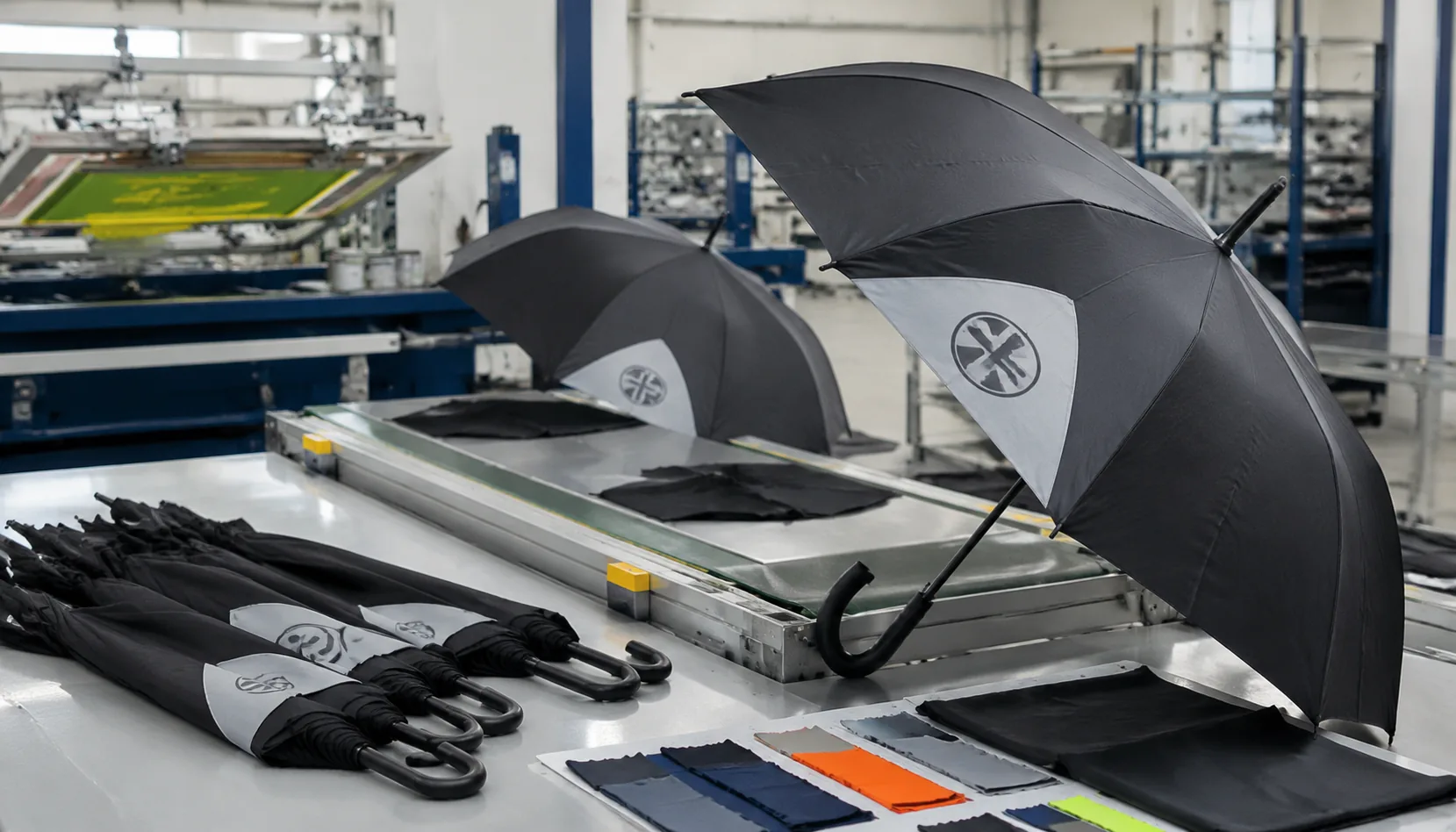
When a safety campaign needs umbrellas that are visible in traffic, survive outdoor use, and still carry a clean brand mark, the real challenge is balancing placement, print durability, and inspection standards at scale. From our production floor in Songxia, Shangyu, we see how reflective logo umbrella printing can fail if the logo area, ink system, or panel tension is chosen without thinking through how the umbrella will be used and checked in bulk.
Best Campaign Uses for Reflective Umbrella Branding
The best use of reflective logo umbrella printing is not fashion; it is controlled visibility in rainy, low-light movement corridors. Road safety programs can issue 23" auto-open stick umbrellas with 190T pongee canopies and reflective logos placed on two opposite panels, so a pedestrian is still visible when the umbrella rotates in hand. For municipal crosswalk campaigns, school-zone awareness, and night-market traffic control, I prefer silver-gray reflective heat transfer over standard white ink because it catches headlights at sharper angles. On dark navy, black, or charcoal canopies, the effect is strongest; on yellow or orange safety campaign umbrellas, the contrast is useful in daylight but less dramatic at night. The logo should be kept above the lower seam line, not buried near the valance, because drivers see the upper canopy first. Reflective branding helps visibility, but it is not a substitute for EN ISO 20471 vests, ANSI-rated jackets, or other certified PPE.
University and transit campaigns are strong fits because umbrellas move through exactly the environments where visibility problems happen: bus stops, bike racks, dorm paths, subway exits, and parking lots. For commuter promotion umbrellas, a 21" or 23" compact auto-open-close model works better than a large golf umbrella because people actually carry it daily in a backpack or tote. A reflective branded umbrella can carry the university crest, transit authority mark, or safety slogan on alternating panels, while a small instruction line such as “Look Both Ways” or “Be Seen in Rain” can be printed in standard screen ink on the opposite panel. For campus police or orientation teams, we usually recommend fiberglass ribs over thin steel ribs, since repeated opening in wind around buildings is hard on cheap frames. A double-canopy vented 27" model is better for staff stationed outdoors, but for student giveaways, compact size and reliable auto-open-close mechanics matter more than maximum canopy width.
Outdoor staff kits and insurance giveaways need a more practical specification than most promotional buyers first request. If the umbrella will be used by parking attendants, event marshals, warehouse gate staff, or roadside assistance teams, choose a 27" or 30" golf umbrella with fiberglass shaft, 8K or 10K fiberglass ribs, and a vented double canopy rated around 50+ mph in wind-tunnel testing. High visibility umbrella logos should be large enough to reflect from 30-50 meters under headlights, but not so large that the transfer film stiffens the canopy and causes fold marks after packing. For insurance companies, reflective logo umbrella printing works well as a risk-prevention giveaway because the message is relevant, durable, and used in bad weather instead of sitting in a drawer. Our standard practice at ZheBrella is to confirm reflective transfer adhesion after wet rub, folding, and 24-hour humidity exposure before bulk production, then inspect finished goods under AQL 2.5 so the reflective panels are aligned and clean.
Reflective Ink, Transfer, and Trim Options
Reflective screen ink is the cleanest option when you want reflective logo umbrella printing on flat canopy panels without adding bulk. It works best on 210T pongee because the tighter weave holds the ink edge better and gives a more stable hand feel after curing; 190T pongee can take it too, but the surface texture is looser and small details may look softer. The upside is flexibility: the print moves with the fabric, so it is better than a stiff patch when the umbrella folds and opens all day. The downside is abrasion. If the canopy rubs against straps, bags, or repeated stacking in a carton, reflective ink will slowly lose brightness faster than film. For safety campaign umbrellas used in giveaways and commuter promotion umbrellas, I only trust screen ink when the logo is medium-size and the buyer accepts a more muted reflectivity than a true high-build film.
Heat-transfer film gives sharper edges and stronger night visibility, which is why it is usually the better choice for high visibility umbrella logos and reflective branded umbrellas. A good reflective film can carry small text, thin outlines, and clean vector shapes that screen ink often cannot hold on a curved panel. It also handles 190T pongee well because the adhesive layer bridges minor weave irregularities. The trade-off is feel and durability: film is less breathable, a little stiffer, and can crack or lift if the adhesive is cheap or the press temperature is wrong. On umbrellas that are folded wet and stuffed into sleeves, the corners are the first place to fail. For ZheBrella production, the practical rule is simple: use film when the logo needs crisp detail and stronger return reflection, but keep the art generous and avoid tiny serif fonts or hairline strokes.
Reflective piping and logo panels solve different problems, so buyers should not treat them like direct substitutes for print. Reflective piping is best as a trim line on ribs, vents, or edge seams; it improves perimeter visibility but does not give much logo space, and it adds sewing labor because the seam allowance must stay consistent. Logo panels are the most durable option for large safety campaign umbrellas because the reflective material becomes part of the canopy layout, so the mark survives better under rubbing and repeated opening than ink or film. The trade-off is cost and flexibility: panel construction limits artwork placement and usually works better on 8K or 10K frames with enough canopy real estate, especially in 210T pongee. If the brief is commuter promotion umbrellas with large, readable branding, I would choose panels for maximum impact, then use piping only when the client wants an extra safety cue around the umbrella edge.
Logo Placement for Night Visibility
For night visibility, put the mark where headlights actually hit it: along the outer panel edge, just above the seam, and again as a lower-canopy logo near the hem. That gives you a partial read whether the umbrella is open, tilted, or being carried by a pedestrian. On commuter promotion umbrellas, I would also print the same graphic on the strap or sleeve, because folded umbrellas disappear in bags and on transit platforms. For safety campaign umbrellas, a single centered chest-height logo is weak; a lower band, panel-edge stripe, and a compact reflective logo umbrella printing treatment near the tip line perform better because they stay visible when the canopy is moving. Keep the artwork simple. Thin text, tiny icons, and gradient fills fail fast at dusk; a thick outline or block logo with reflective ink or film survives real-world motion and dirty rainwater better.
Alternating panels help because a driver rarely sees the umbrella straight-on for more than a second. If you place the same mark on every other panel, the graphic reappears at multiple angles as the canopy rotates, which is why reflective branded umbrellas do better in traffic-heavy environments than a single front-panel hit. This is also where high visibility umbrella logos need more discipline in production: the art must stay outside the seam allowance, away from vent windows, and clear of the ferrule area so the print does not distort when the ribs flex. In practice, panel-edge marks are the easiest to see at distance, while lower canopy logos are better for pedestrian-to-pedestrian recognition. That combination works well for safety campaign umbrellas because the message reads both from cars and from the sidewalk.
Rib count changes how you place repeat graphics. On an 8K frame, each panel is wider, so you have more real estate for a full-size logo or a repeated edge mark, and the inspection is simpler because the repeat only needs to land on eight larger panels. On a 16K layout, the panels are narrower and the repeats multiply, so reflective logo umbrella printing has tighter registration risk and more chances for drift between stations. The factory issue is not just artwork alignment; it is consistency across every rib pocket, seam, and panel tip when the canopy opens under tension. A 16K umbrella can still carry strong visibility, but I would shorten the logo, simplify the repeat, and inspect each alternate panel under open-frame tension instead of only checking a flat canopy. That is the difference between a clean commuter promotion umbrella and one that looks fine on the table but breaks apart visually at night.
Umbrella Construction Specs for Outdoor Use
For outdoor safety campaign umbrellas, the frame spec matters more than the logo size. A reflective print on a weak 8K steel-rib umbrella looks good in a sample room but fails when commuters meet crosswind at a bus stop. For stick models, I usually specify a 23" or 27" auto-open frame with a steel center shaft, fiberglass ribs, and fiberglass stretchers; that combination keeps cost controlled while giving better rebound than all-steel ribs. For exposed campuses, road-work events, and municipal programs, a double-canopy vented windproof design is worth the extra sewing cost because it releases pressure instead of inverting. A well-built 8K or 10K frame should survive repeated gusts around 50+ mph in a controlled wind test, but only if the runner, tips, and rib joints are matched properly rather than mixed from low-grade stock.
Reflective logo umbrella printing works best on 190T or 210T pongee because the surface is stable enough for heat-transfer reflective film, screen-printed reflective ink, or segmented reflective trim. POE and PVC clear umbrellas can carry reflective decals, but adhesion and cold-crack testing need more attention, especially for winter commuter promotion umbrellas. If the campaign needs UPF 50+ protection, black-coated pongee with a reflective outer logo is practical, but do not place large reflective panels directly across high-tension fold lines. Reflective branded umbrellas often fail at the edges first: thick film can lift near rib pockets, interfere with seam stitching, or create bulky fold points that prevent compact models from closing cleanly. Our standard practice at ZheBrella is to keep reflective graphics at least 12–15 mm away from stitched seams and crown reinforcement patches.
Compact commuter models need a different construction rule than full-size stick umbrellas. A 21" 3-fold auto-open-close umbrella can carry high visibility umbrella logos, but reflective trim must be narrow, flexible, and aligned between fold valleys; otherwise the canopy stacks unevenly and stresses the spring mechanism. For safety campaign umbrellas handed out at transit stations, I prefer fiberglass ribs with a steel or aluminum shaft depending on the target price, plus a 190T pongee canopy with Teflon water-repellent finishing so the umbrella dries quickly before going into a bag. Full-length auto-open stick umbrellas give more printable area and better nighttime visibility, while compact models win on daily carry rate. Before mass production, buyers should approve one opened sample and one folded sample, then require AQL 2.5 inspection for reflective adhesion, logo position, runner smoothness, rib alignment, and packed-fold diameter.
Testing, Lead Times, and Export Planning
Reflective brightness has to be checked before bulk cutting, not after the umbrellas are packed. For reflective logo umbrella printing, we normally compare the printed mark under a fixed-angle flashlight and a retroreflective reference film, then confirm visibility at 20-30 meters in a dark aisle or outdoor loading area. It is not a laboratory EN 20471 garment test, but it catches the common failures: gray ink that looks reflective in daylight but goes dead at night, logos placed too low on a 23" canopy panel, and transfer films that lose reflectivity after heat pressing. For safety campaign umbrellas and commuter promotion umbrellas, I prefer logos on two opposite panels so a driver or cyclist can catch at least one mark from the side.
Adhesion and folding damage are the two biggest production risks with reflective branded umbrellas. We run a cross-hatch tape pull on heat-transfer logos, a wet rub check after 24 hours, and repeated open-close cycling to see whether the reflective layer cracks over rib contact points. Fold-abrasion testing is simple but useful: close the umbrella tightly, strap it, open it again, and inspect the logo edge after 30-50 cycles. On 190T or 210T pongee with Teflon coating, the film and adhesive recipe must be matched because water-repellent finishing can reduce bonding. During AQL 2.5 inspection, key points include logo position tolerance, missing ink, reflective dull spots, canopy stains, seam puckering, rib alignment, runner function, tip security, and carton labeling.
Planning numbers should be realistic because high visibility umbrella logos add one more approval step than ordinary screen printing. MOQ is usually 500-1,000 pcs depending on frame, canopy color, and whether the buyer needs manual, auto-open, or auto-open-close mechanisms. Samples take 7-12 days when the reflective film or ink is in stock; custom color matching or a special 27" golf umbrella frame can push that longer. Bulk production is typically 35-50 days after artwork, sample, deposit, and packaging files are approved. FOB Ningbo or Shanghai keeps the unit price cleaner because the buyer controls freight and duty. DDP is convenient for campaign deadlines, but it builds in courier or sea freight, customs clearance, duty, delivery risk, and exchange-rate buffer, so the quoted umbrella cost can look 15-35% higher even when the factory price is unchanged.
Frequently Asked Questions
Can reflective printing be used on every umbrella panel?
It can, but full-panel reflective coverage may stiffen the canopy and affect folding. Many safety campaigns use smaller repeated marks, reflective piping, or alternating panels for a better cost-performance balance.
Will reflective logos look bright in normal daylight?
Most reflective inks look gray or silver in daylight and become brighter under direct light at night. Buyers should approve both daylight appearance and flashlight or headlight photos before production.
Where should reflective logos be placed for maximum night visibility on umbrellas used in safety campaigns?
For the best visibility, place the logo on a panel that faces traffic or pedestrian flow, usually one or two contrasting panels near the canopy edge. Many buyers also add a small repeat mark on the strap or sleeve so the branding is visible when the umbrella is closed.
Which printing method is usually better for reflective branded umbrellas: screen print or heat transfer?
Screen print is common for large, simple logos because it is cost-effective on bulk orders and can be paired with reflective ink. Heat transfer is better when you need finer detail or multiple colors, but it usually adds cost and may not be as durable on heavily flexed canopy fabric.
What AQL inspection checks matter most for commuter promotion umbrellas?
For bulk commuter promotions, buyers usually focus on canopy alignment, logo placement accuracy, reflective effect consistency, opening and closing function, and rib/frame defects. AQL terms often used in umbrella sourcing are 2.5 for major defects and 4.0 for minor defects, but the final standard should match the retailer’s QC spec.
Looking to Launch Your Custom Umbrella Line?
ZheBrella is a Zhejiang-based OEM/ODM umbrella manufacturer with 17 years of export experience. Free design, low MOQ from 100 pieces, windproof construction, full-color print.
Get Free Quote Now »People Also Search For
Related Articles
Reflective Umbrella Logos for Safety Brand Campaigns
Specify reflective logo films, panel locations, and AQL checks for promotional umbrellas used in night events, campuses,...
Read More »
Reflective Logo Printing for Branded Umbrella Safety Campaigns
Plan reflective logo umbrellas with the right fabric, ink, rib structure, testing, MOQ, and lead time for safety campaig...
Read More »
Reflective Umbrella Logos for Night Events and Safety Brands
Use reflective umbrella logos for night events, campuses, and safety brands while balancing visibility, durability, fram...
Read More »