Reflective Safety Umbrellas: Specs for Commuter Brands
For commuter brands, campuses, night events, and road teams, an umbrella has to do more than keep rain off a logo—it must stay visible, open reliably, and survive daily handling in crowded transit. On our factory floor in Shangyu, reflective safety umbrellas are specified from the edge inward: piping placement, UPF-coated fabric, rib strength, frame balance, and QC checks that catch weak stitching or poor reflective performance before shipment.
Reflective Materials and Placement Options
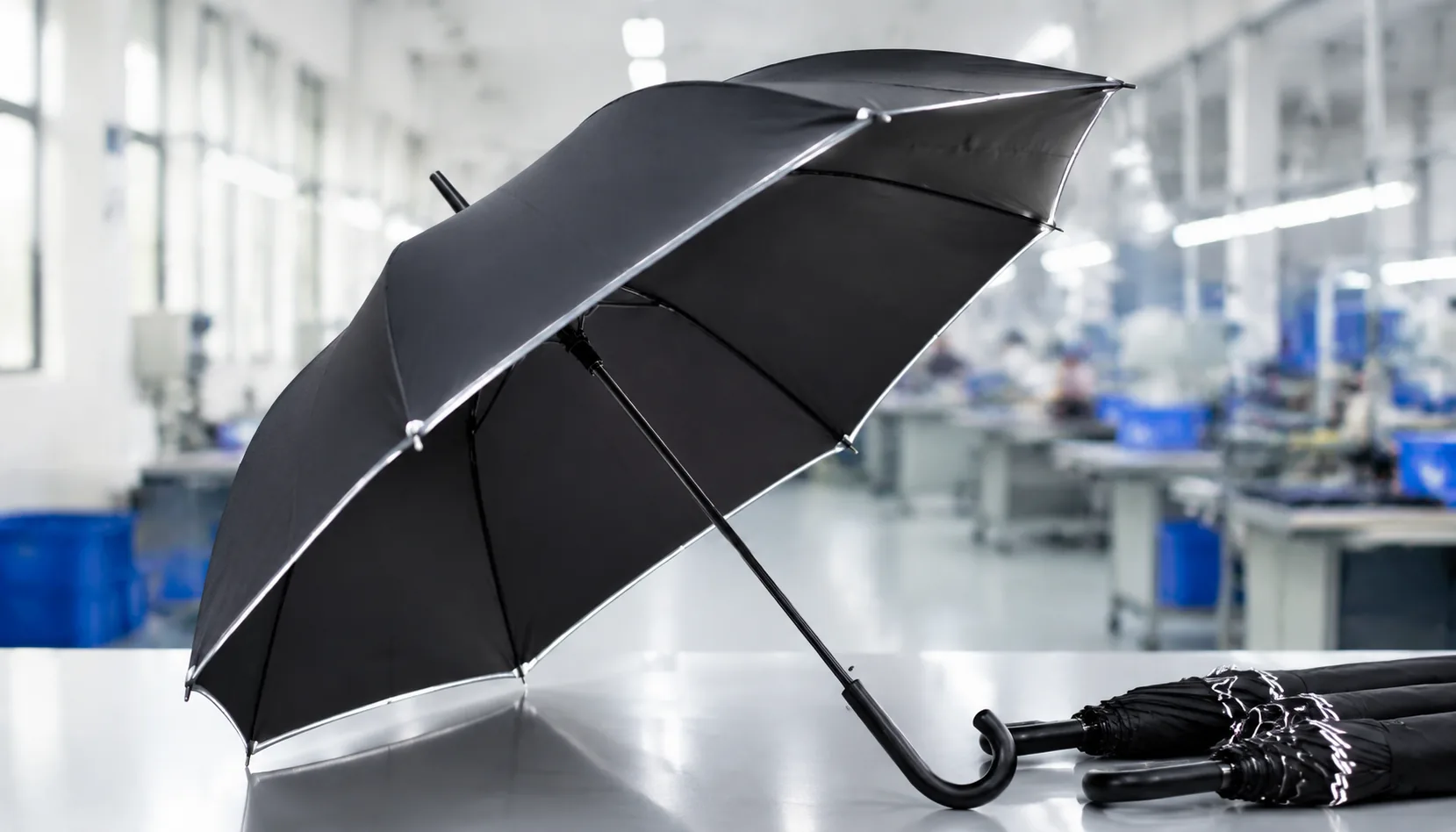
The most reliable visibility upgrade for reflective safety umbrellas is reflective piping sewn into the canopy perimeter, because it gives a clean 360-degree outline when headlights hit from the side, rear, or front. On a 23" or 27" commuter umbrella, we usually specify 5–8 mm reflective piping along all eight panel edges or around the bottom canopy hem; wider looks brighter but can stiffen the seam and affect closing if the fabric stack is already thick, such as 210T pongee with Teflon coating. For storm umbrellas, the piping must be checked after windproof frame cycling, especially on double-canopy vented designs, because repeated flexing at the rib tips can crack cheap reflective film. In production, I prefer glass-bead or micro-prismatic tape laminated to polyester backing rather than low-grade silver trim that turns dull after 300–500 open-close cycles.
Heat-transfer reflective strips give more layout freedom than piping, especially for branded safety umbrellas where the buyer wants visible safety value without making the product look like roadwork gear. Common placements are 10–20 mm strips near the lower canopy edge, short vertical marks on alternating panels, or a broken ring around the valance area. The tradeoff is durability: heat-transfer reflective umbrella tape must match the canopy material and coating. It bonds well to 190T/210T pongee after controlled pressure and dwell time, but PVC, POE, and EVA transparent canopies need different films and lower temperatures to avoid distortion. We test adhesion with cross-hatch tape pull, wet rub, and folding at the rib line, because a strip that looks fine after pressing can peel once the umbrella is packed tightly in a sleeve for 30 days.
Segmented reflective logos are useful for commuter umbrellas and night event umbrellas when the brand mark itself needs to catch light. Instead of one large reflective print across a panel, I recommend dividing the logo into smaller zones placed near the canopy edge, on two opposite panels, and sometimes on the sleeve for visibility while carried closed. A 360-degree reflective edge gives the best safety profile, but it uses more material, adds sewing time, and can compete visually with retail graphics. Smaller branded reflective zones are cheaper and cleaner, yet they only work from certain angles; a driver may see the logo on one side and miss the umbrella from the other. Our standard practice at ZheBrella is to mock up both layouts under low-angle LED light and vehicle-headlamp distance before approving bulk production, because daylight artwork approval does not prove night visibility.
Canopy Fabric, Coatings, and Color Choices
For reflective safety umbrellas, 190T and 210T pongee behave differently in ways buyers notice immediately. 190T has a slightly softer hand and drapes easier, so it feels lighter in commuter umbrellas and packs down better for daily carry. 210T is denser, with a tighter weave that gives cleaner print edges for logos, icons, and small text, which matters on branded safety umbrellas where the artwork has to read from a distance. Water repellency is also a little stronger on 210T because the surface is less open, especially after DWR or Teflon treatment. In our standard practice at ZheBrella, 190T is fine for lower-cost promo programs, but 210T is the better choice when the umbrella is expected to take repeated rain cycles and still look sharp after folding and opening every day.
Color choice is not just branding; it changes visibility and performance. Dark canopies like black, navy, and charcoal hide dirt well and make reflective umbrella tape stand out hard at night, which is why they are common for night event umbrellas and commuter umbrellas used after dark. If you choose a dark canopy without reflective trim, you lose most of the safety value, because the body disappears in traffic and only the frame outline remains. Light colors such as silver, pale gray, or white work better when you want daytime visibility and a cleaner print field, and they pair well with UPF 50+ black coating for sun and rain use. That black coating blocks UV while the outer color keeps the product looking less aggressive than a fully dark shell, which is useful for retail and corporate programs that want reflective safety umbrellas to work in both bad weather and bright sun.
Frame Specs for Daily Commuter Use
For daily commuter umbrellas, I would not build the frame around price alone; I’d build it around how often the user has to force it open in bad weather and how it recovers after a gust. Fiberglass ribs are the right choice for wind recovery because they flex and return instead of taking a permanent set, which matters on subway exits and street corners where people turn a canopy inside out and keep walking. A steel shaft is still the best way to control cost on branded safety umbrellas, especially in 23" and 27" formats where buyers want a stable feel without moving to a full premium frame. For reflective safety umbrellas, that balance is important because the reflective umbrella tape adds visible value, but the frame still has to survive real commuting abuse. Our standard practice is auto-open for one-hand use at transit stops; auto-open-close is useful for higher retail tiers, but auto-open is usually the better mix of speed, durability, and price for commuter umbrellas.
The rib count should follow the price point, not the other way around. An 8K structure is the sensible entry spec for mass-market commuter umbrellas: fewer parts, lower assembly time, and enough rigidity for light-to-moderate wind when paired with fiberglass ribs and a steel shaft. A 10K build makes more sense when the buyer wants a cleaner open shape, better canopy tension, and a stronger retail story for reflective safety umbrellas sold through urban mobility or corporate channels. In my experience, 10K is also easier to position for night event umbrellas because the frame looks and feels more substantial under dense reflective trim. If the target is a sharp promo price, 8K keeps FOB cost under control; if the target is a branded safety umbrella with higher margin, 10K gives you a more premium hand feel without jumping to a heavy 16K construction. For commuters, the mechanism should stay simple: fast auto-open, no sluggish springs, no flimsy runner, and a frame that opens cleanly with one hand when the platform is crowded.
Printing, Branding, and MOQ Considerations
For reflective safety umbrellas, the safest branding sequence is to print the canopy panels before sewing the reflective trim, because reflective umbrella tape does not like excessive heat, platen pressure, or solvent migration. On 190T or 210T pongee, we usually recommend screen printing for one- to three-color logos placed at least 20–25 mm away from the reflective edge band. Heat transfer can work for small, sharp logos, but the press temperature must be controlled around 130–145°C, and it should not overlap stitched reflective tape or seam binding. Sublimation is only practical on white polyester panels before assembly; it is not a good choice for black commuter umbrellas with silver reflective trim because color matching and tape alignment become unstable after sewing.
Panel logo placement matters more than many buyers expect. A 23-inch 8K auto-open umbrella has eight curved panels, and each panel stretches slightly during sewing, so a logo too close to the rib seam may look crooked after assembly. For branded safety umbrellas, I prefer one large logo on one or two opposite panels, or a repeating small logo kept inside a safe print zone, rather than trying to chase the reflective border. Sleeves are easier: screen print, woven label, or heat-transfer logos all work because the sleeve is sewn separately and has no spring tension. Night event umbrellas often use a high-contrast white or silver logo on navy, black, or fluorescent yellow canopy fabric, with reflective piping or edge tape kept as the functional visibility element.
MOQ depends on which part is customized. A standard stock reflective trim with a custom panel logo can usually start around 300–500 pieces per color, while custom-width reflective tape, printed reflective tape, or a nonstandard trim color often pushes MOQ to 1,000–3,000 pieces because the tape supplier has its own coating and slitting minimums. Mixed-color production runs are possible, but every canopy color change affects cutting, thread, binding, inspection, and carton marking, so factories normally set 300 pieces per colorway even when the total order is larger. At ZheBrella, our standard practice is to confirm a pre-production sample with actual reflective tape, logo print, sleeve, barcode label, and carton mark before bulk production; for normal commuter umbrellas, plan 25–35 days after sample approval, or longer if custom reflective materials must be procured.
Quality Checks for Safety-Focused Orders
For reflective safety umbrellas, the first inspection point is not brightness; it is whether the reflective material stays bonded after real use. We test reflective umbrella tape and printed reflective film with a cross-hatch adhesion cut, 3M tape pull, and wet-rub check after the canopy has been opened under tension. On 190T or 210T pongee, poor heat-transfer settings show up as edge lifting near panel seams, while PVC or POE canopies may crack if the reflective film is too stiff for folding. We also check trim alignment panel by panel because a 5 mm offset looks minor on the table but becomes very visible under headlights. For branded safety umbrellas, logos must not overlap the reflective zone unless the artwork has been approved for retroreflective contrast.
Seam strength is checked before appearance approval because commuter umbrellas fail at stress points first: tips, top notch, runner, and the seam where reflective trim is caught into the canopy. We pull-test stitched seams, inspect skipped stitches, and open the canopy to confirm the tape does not pucker the fabric. Open-close cycling should match the mechanism: 300 cycles for basic manual and auto-open models, 500 cycles for better auto-open-close commuter umbrellas. Each cycle test should include locking stability, runner smoothness, spring return, and shaft wobble. Water repellency is checked by spray rating and short soak testing; a Teflon-coated pongee canopy should bead cleanly, while reflective trim should not absorb water or leave gray residue after wiping.
Wind resistance has to be tested with the actual frame, not just claimed from a catalog. An 8K steel frame may pass normal rain use but deform in gusts, while fiberglass ribs and a double-canopy vented construction are better choices for orders claiming 50+ mph performance. We check rib recovery after inversion, ferrule tightness, stretcher rivets, and whether reflective strips delaminate after the canopy flexes under load. Final inspection should be tied to AQL 2.5 for major defects, with cracked reflective film, misaligned trim, failed open-close action, leaking seams, and broken tips treated seriously. For night event umbrellas, I also recommend a dark-room flashlight check on every carton sample because reflective defects are often missed under bright factory lighting.
Frequently Asked Questions
Can reflective tape be added to any umbrella style?
Yes, but it works best on straight, golf, and 3-fold umbrellas with enough edge space for clean stitching or heat transfer. Very small 5-fold umbrellas may limit reflective width and logo placement.
Does reflective trim increase lead time?
Usually by 3 to 7 days if custom tape width, color, or placement is required. Standard silver reflective piping is faster and often available within normal bulk lead times.
What reflective tape width works best on a commuter umbrella without overpowering the branding?
For most commuter models, 10-15 mm reflective tape or piping gives clear night visibility while leaving enough canopy area for logos. Wider 20 mm tape is more common on road-team or event safety umbrellas where visibility matters more than design subtlety.
Which rib material is usually preferred for branded safety umbrellas used in windy city commutes?
Fiberglass ribs are typically the safest B2B choice because they flex under gusts and resist corrosion better than standard steel. For urban commuter programs, buyers often specify fiberglass ribs with a steel shaft to balance durability, cost, and lead time.
What QC checks should importers ask for before shipping reflective umbrellas for night events or campus programs?
Ask for canopy opening/closing cycle tests, seam and tip pull tests, reflective trim placement checks, and basic wet-surface colorfastness review. Many buyers also request a wind test target such as 8-10 m/s for commuter styles and pre-shipment AQL inspection on logo placement and trim alignment.
Looking to Launch Your Custom Umbrella Line?
ZheBrella is a Zhejiang-based OEM/ODM umbrella manufacturer with 17 years of export experience. Free design, low MOQ from 100 pieces, windproof construction, full-color print.
Get Free Quote Now »People Also Search For
Related Articles
Reflective Trim Umbrellas: Safety Specs for OEM Buyers
Specify reflective umbrellas for commuter, campus, and event programs with trim placement, fabric, frame, MOQ, QC, and p...
Read More »
Reflective Safety Umbrellas for Corporate and Event Buyers
Specify reflective safety umbrellas with 190T pongee, fiberglass ribs, and compliant logo placement for night events, ut...
Read More »
Reflective Safety Umbrellas: Buyer Specs for Night Use
Specify reflective safety umbrellas with trim placement, frame options, fabric weight, print limits, QC checks, MOQ, and...
Read More »