Reflective Umbrellas for Commuter and Event Safety Programs
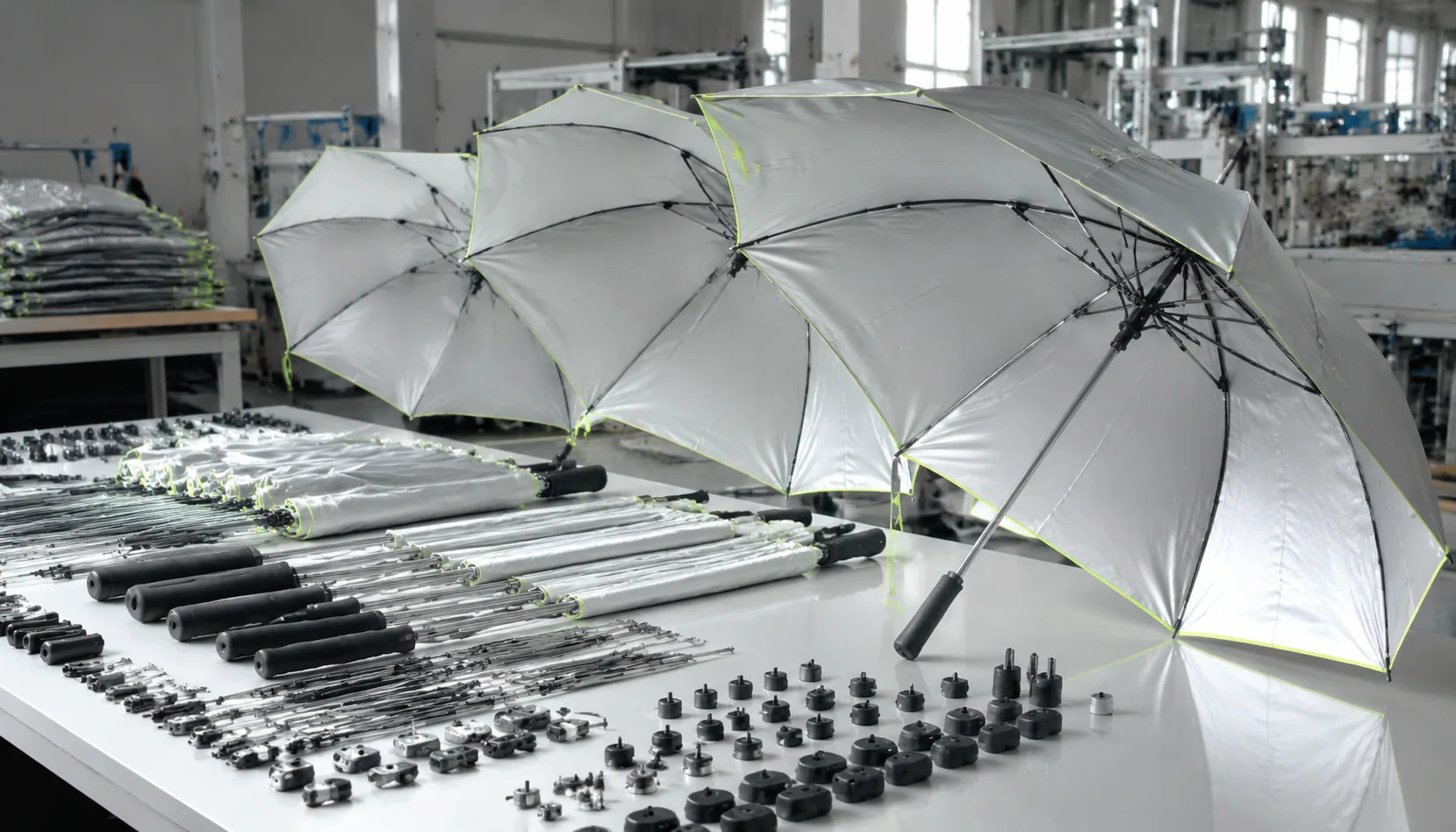
For commuter and event safety programs, the problem is not just adding a shiny strip—it is keeping visibility, wind resistance, fabric hand feel, and inspection standards consistent across thousands of units. When buyers source reflective safety umbrellas wholesale, I look first at reflective piping placement, 190T or 210T pongee performance, fiberglass rib recovery, and whether AQL 2.5 checks catch the small defects that become complaints in real use.
Visibility Features Buyers Should Specify
For reflective safety umbrellas wholesale programs, the first specification should be 360-degree visibility, not just a shiny logo on one panel. I recommend reflective piping along all canopy edges, because the umbrella’s perimeter is what drivers see first when a commuter steps off a curb. On a 23" or 27" straight umbrella, 10 mm to 15 mm sewn reflective edge tape gives a clear moving outline from front, side, and rear angles. For folding commuter umbrellas, narrower 8 mm piping keeps the canopy from looking bulky while still catching headlights. Panel placement matters: use reflective trim on every gore, or at minimum alternate panels on an 8K frame so the umbrella does not disappear when rotated in the user’s hand. For event safety umbrellas, add a reflective band 80 mm to 120 mm above the hem where it remains visible even when staff carry radios, signage, or bags close to the body.
Reflective ink and sewn reflective trim behave very differently in production and in the field. Reflective ink is cheaper, lighter, and works well for large logo prints or directional graphics on 190T or 210T pongee, especially when the buyer wants brand visibility under flash photography. The weak point is abrasion: repeated folding, wet storage, and hand rubbing can dull the glass-bead surface after months of daily commuting. Sewn reflective tape costs more because it adds cutting, alignment, and sewing time, but it holds up better on umbrellas that will be opened 300+ times during a rainy season. On PVC, POE, or EVA canopies, heat-transfer reflective film may be cleaner than screen printing, but temperature control is critical; too much heat warps transparent panels, while too little causes edge lifting during AQL 2.5 inspection.
Logo placement should support safety before decoration. A small reflective logo printed on only one panel is acceptable for a retail premium, but it is not enough for municipal night-walk programs, factory shift changes, or parking-lot marshal teams. For reflective umbrellas, place the main logo on two opposite panels and use reflective piping or tape around the full canopy edge so visibility remains consistent when the user changes direction. If you are buying from an OEM umbrella manufacturer, ask for a pre-production sample photographed under low beam headlights at 10 m, 20 m, and 30 m rather than judging reflectivity under office lighting. Our standard practice at ZheBrella is to confirm trim width, stitch line distance, ink wash resistance, and panel symmetry before bulk cutting, because once 5,000 event safety umbrellas are printed, fixing poor nighttime visibility is no longer a cheap adjustment.
Frame Builds for Daily Urban Use
For commuter umbrellas, the frame decision is usually a trade between low landed cost, bend recovery, and return risk. An 8K steel frame with a steel shaft is still the workhorse for reflective safety umbrellas wholesale programs where the buyer needs a sharp FOB price and predictable assembly quality. Steel ribs hold shape well in normal rain, but once a rib is kinked in a subway door or gust-loaded above 35–40 mph, it usually stays bent. I prefer 8K steel on 23 inch straight umbrellas or basic 21 inch folding commuter umbrellas when the order is for controlled urban use, not coastal wind. If the canopy is 190T pongee with reflective piping or a silver reflective print panel, the extra fabric weight is modest, so steel can still pass AQL 2.5 inspection without too many rib alignment rejects.
Fiberglass ribs are the better choice when reflective umbrellas are expected to survive rough daily handling, especially for office commuters walking between bus stops, parking lots, and train stations. Fiberglass does not permanently deform as easily as steel, so it absorbs inversion better and springs back after side gusts. On a 23 inch or 27 inch umbrella, an 8K fiberglass rib set with a steel or aluminum shaft can usually survive 45–50 mph wind-tunnel cycling if the runner, tips, and stretchers are correctly matched. A full fiberglass frame costs more and needs tighter riveting control; loose rivets make the umbrella feel soft, while over-tightened rivets cause rib cracking during open-close fatigue tests. For event safety umbrellas used by volunteers, parking attendants, and night marshals, I would specify fiberglass ribs before upgrading the fabric, because broken frames create more complaints than a slightly lighter canopy.
The most balanced build is often a steel shaft with fiberglass ribs: the steel center pole gives the umbrella stiffness, while the fiberglass ribs handle gust recovery. This mixed structure works well for OEM umbrella manufacturer projects with reflective logos, UPF 50+ coating, or 210T pongee canopies because the frame has enough backbone without becoming too expensive for MOQ runs of 1,000–3,000 pieces. Auto-open is suitable for 23 inch straight commuter umbrellas where one-hand operation matters, but the spring, runner, and button must be tested through at least 500 cycles before shipment. For compact umbrellas, especially auto-open-close models, I am more cautious; more moving parts mean higher return risk if users force the shaft closed incorrectly. For public safety giveaways or rental-style commuter umbrellas, manual open is less glamorous but more durable, easier to inspect, and less likely to fail after repeated wet storage.
Canopy Fabric, Coating, and Color Choices
For commuter umbrellas, 190T pongee is usually the practical baseline: tight enough for reliable rain shedding, smooth enough for screen print or heat-transfer logos, and not so dense that a 23" or 27" canopy feels heavy in the hand. On the cutting table, 190T has a little more forgiveness, so it sews cleanly around tips and reinforced reflective binding without puckering. 210T pongee gives a denser hand feel and slightly sharper print edges, especially on small sponsor marks or municipal safety icons, but it also adds cost and a bit of folded bulk. For reflective safety umbrellas wholesale programs, I recommend 190T for large transit giveaways and 210T for retail-grade commuter umbrellas or executive event kits where the buyer will notice the fabric touch immediately.
Dark canopies remain the best choice when visibility trim is the main safety feature. Black, navy, charcoal, and forest green make 10 mm to 25 mm reflective tape read much brighter under headlights than the same tape on yellow or white fabric. For event safety umbrellas, we often place reflective piping along all 8K panel seams or use a continuous reflective band around the lower canopy edge; the second option is more visible from car height but needs careful tension control during sewing. If the umbrella also needs sun protection, a silver or black UV coating can bring the canopy to UPF 50+, but it changes the inside appearance and can slightly stiffen the fabric. Buyers should confirm whether they want rain-first softness or sun-first opacity before approving samples.
Colorfastness is where cheap reflective umbrellas often fail after the first season. For solid-dyed pongee, a serious OEM umbrella manufacturer should target grade 4 or better for rubbing and water fastness, with darker shades checked after wet folding because dye transfer can mark reflective trim or white logos. Sublimation works well on light 190T or 210T polyester panels, but it is not ideal for deep black canopies; for dark commuter umbrellas, screen printing or heat transfer is more predictable. Our standard practice at ZheBrella is to test production fabric against the approved strike-off, then inspect finished lots under AQL 2.5 for shade variation, coating scratches, reflective tape adhesion, and print registration before FOB or DDP shipment.
Branding, Packaging, and Program Fit
Branding on reflective umbrellas should be planned around visibility first, not just logo size. On a 23" commuter umbrella, I usually keep a corporate logo between 18 and 24 cm wide on one canopy panel; larger than that, the print starts fighting the reflective border or piping. For 27" and 30" event safety umbrellas, 25 to 32 cm works if the artwork has clean vector edges. Screen printing is still the most stable choice for 190T or 210T pongee because the ink sits cleanly and passes rubbing tests better than cheap transfer film. Heat transfer is useful for gradients or small sponsor marks, but it needs controlled temperature so reflective tape does not curl or lose brightness. Sublimation only makes sense on white polyester panels before assembly, not on finished dark canopies. For reflective umbrellas used in commuter programs, I prefer logo placement opposite the reflective strip so headlights catch the safety feature before the brand mark.
Sleeve branding is often more practical than buyers expect, especially for commuter umbrellas that live in backpacks, office drawers, or car doors. A single-color logo on the matching sleeve keeps cost down, while woven labels or PVC patches make sense for retail or municipal programs where the umbrella will be reused for several seasons. Event safety umbrellas often need fast identification, so we add sleeve color coding, department names, or QR codes for asset tracking. Retail hangtags should include canopy material, rib count, open diameter, mechanism type, and safety claims that can be supported: for example, 190T pongee, fiberglass ribs, auto-open, reflective piping, and UPF 50+ coating if tested. Avoid vague claims like “stormproof” unless the frame has passed a defined wind test, such as repeated inversion recovery or 50+ mph tunnel testing. For boxed programs, inner cartons should separate manual, auto-open, and auto-open-close mechanisms to reduce picking errors during distribution.
Typical MOQ for OEM reflective umbrellas starts around 500 pieces per color for a basic 23" 8K auto-open style with reflective piping, but custom canopy colors, molded handles, private hangtags, or special POE/PVC/EVA panels usually push the practical MOQ to 1,000–3,000 pieces. For reflective safety umbrellas wholesale programs, buyers should budget 7–10 days for artwork confirmation, 5–7 days for a physical sample after materials are ready, and 25–40 days for bulk production depending on rib count, printing coverage, and packaging complexity. Our standard practice at ZheBrella is to approve reflective tape width, logo position, sleeve print, and carton marking before cutting bulk fabric, because fixing a wrong panel orientation after sewing is expensive. Sampling should include one daylight photo, one low-light flash photo, and a folded-packaging photo, not just a beauty shot. For FOB Ningbo or Shanghai orders, AQL 2.5 inspection should check print adhesion, reflective alignment, frame opening force, sleeve fit, and hangtag barcode readability.
QC Points Before Mass Shipment
For reflective safety umbrellas wholesale orders, the first QC point is the reflective area itself, because a bright sample is useless if the tape peels after two rainy commutes. We check whether the reflective trim is sewn, heat-bonded, or laminated, then test adhesion at the tip, seam crossing, and folded edge where stress is highest. On sewn reflective umbrellas, skipped stitches and loose thread tails are not cosmetic issues; they become peel points after 500–1,000 open-close cycles. On heat-transfer reflective strips, we run a fingernail lift check and a wet rub check before packing. The canopy is also inspected for seam leakage using a 190T or 210T pongee water spray test, especially around panel joints, top cap, and Velcro strap position. For commuter umbrellas, I prefer reflective piping stitched into the seam allowance rather than only surface-applied film, because folding abrasion is more predictable over repeated use.
Frame inspection should happen before cartons are sealed, not after the buyer finds crooked ribs in the field. Rib alignment is checked with the umbrella fully opened on a flat table: 8K and 10K frames should sit evenly without one rib pulling the canopy into a twist, while 16K event safety umbrellas need closer attention at runner height because small assembly errors multiply around the full circle. We test manual, auto-open, and auto-open-close mechanisms for smooth release, lock engagement, and no finger-pinch at the runner. Basic sampling includes 20–30 open-close cycles per inspected unit, a handle drop test from about 80–100 cm, and a shaft shake check to catch loose rivets or weak runner springs. For windproof models, we sample double-canopy vented structures and fiberglass ribs under controlled gust testing; a serious commuter specification should survive 50+ mph without rib inversion or canopy detachment.
Final inspection should follow AQL 2.5 for major defects, with clear limits for reflective failure, broken ribs, leaking seams, printing defects, and mechanism jams. At ZheBrella, our standard practice is to pull cartons from the packed lot, not from a “clean” inspection pile, because carton compression, strap pressure, and folding memory can expose problems missed on the sewing floor. For reflective safety umbrellas wholesale programs, the final report should include photos of reflective trim under normal light and flash, open and closed measurements, canopy diameter for 21", 23", 27", or 30" sizes, and carton markings tied to the PO. If the buyer is sourcing through an OEM umbrella manufacturer, they should also confirm retained samples, batch fabric records, and replacement policy before FOB or DDP shipment. QC is not only pass or fail; it is the last chance to prevent a safety product from becoming a complaint file.
Frequently Asked Questions
Is reflective printing enough for safety umbrellas?
Reflective printing can work for logos or accents, but sewn reflective piping gives more consistent edge visibility. For commuter programs, many buyers combine reflective trim with a standard screen-printed logo.
What lead time should buyers expect for reflective umbrella orders?
Sampling usually takes 7-12 days after artwork approval. Bulk production often runs 30-45 days depending on MOQ, reflective trim availability, and FOB or DDP delivery terms.
What should be included in an OEM spec for a reflective commuter umbrella?
A practical OEM spec should list canopy fabric, reflective piping width and placement, rib material, shaft type, open size, handle style, and packaging. For commuter programs, many buyers also require wind tests, logo method, and AQL 2.5 inspection before shipment.
Is 210T pongee better than 190T pongee for safety umbrellas?
210T pongee is denser and usually feels smoother and slightly more premium, while 190T pongee is a cost-effective option for large programs. For commuter or event safety umbrellas, the final choice often depends on target price, print quality, and the durability level required.
What MOQ is typical for reflective umbrellas with custom branding?
MOQ commonly starts around 500 to 1,000 pieces per color or design, but it depends on canopy style, reflective trim, and print complexity. Larger importers often negotiate lower unit cost with higher volumes or repeat order schedules.
Looking to Launch Your Custom Umbrella Line?
ZheBrella is a Zhejiang-based OEM/ODM umbrella manufacturer with 17 years of export experience. Free design, low MOQ from 100 pieces, windproof construction, full-color print.
Get Free Quote Now »People Also Search For
Related Articles
Reflective Safety Umbrellas: OEM Specs for Urban Programs
Specify reflective safety umbrellas with piping, panels, frames, and QC checks for commuter, campus, and corporate safet...
Read More »
Reflective Safety Umbrellas: Spec Guide for Event Buyers
Learn how to specify reflective safety umbrellas with durable frames, visible trims, print zones, AQL checks, and realis...
Read More »
Wedding Umbrellas for Event Rental and Venue Programs
Source wedding umbrellas for venues and planners with white canopy specs, fiberglass frames, print options, AQL 2.5 chec...
Read More »