Custom Reflective Umbrellas for Safety Campaigns
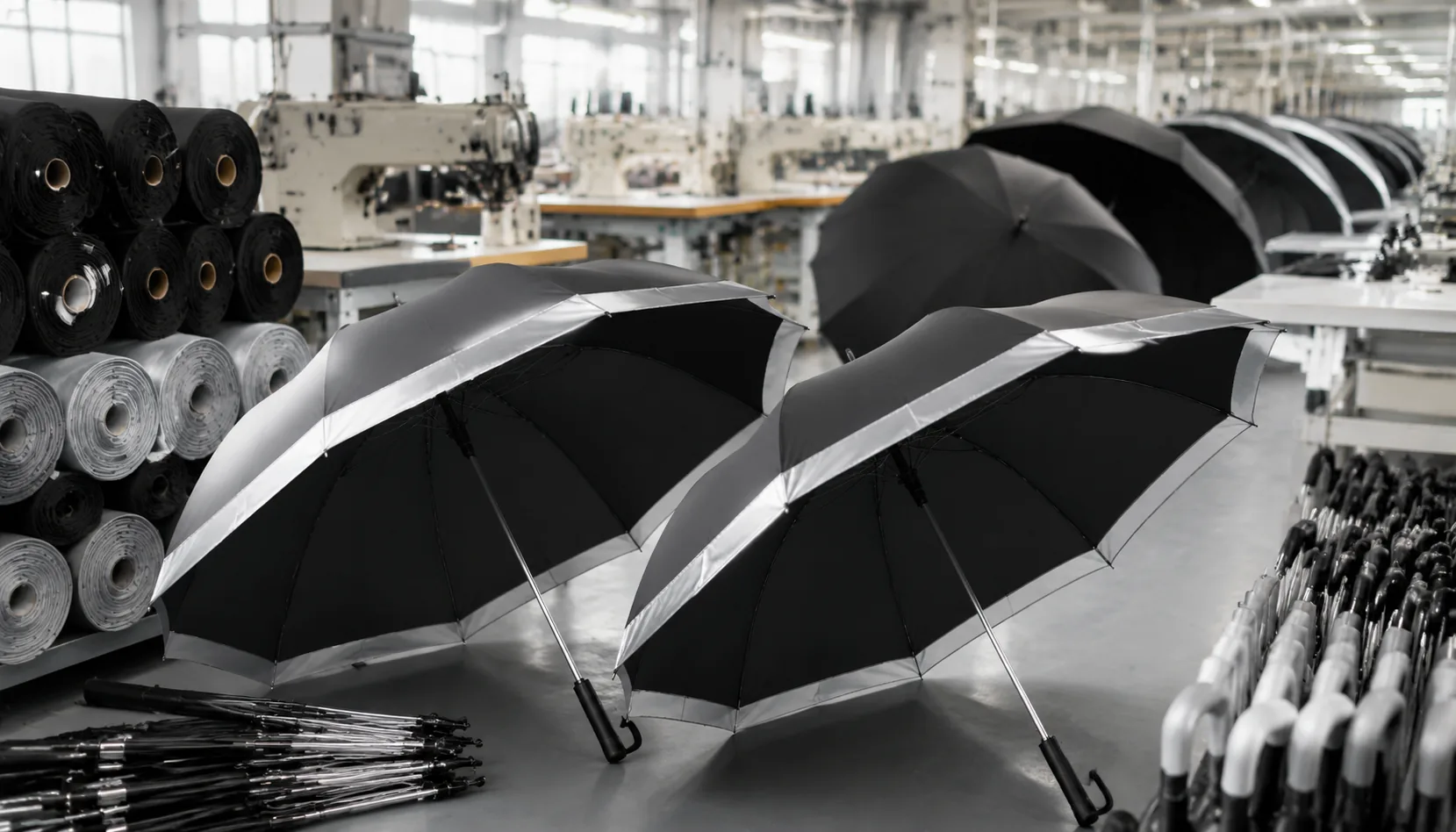
Safety campaign umbrellas fail when the reflective print looks good on a mockup but peels, dulls, or twists out of alignment after frame assembly. On our Songxia factory floor, we specify reflective panels around 210T pongee, check coating compatibility before bulk cutting, and match windproof ribs to the commuter conditions the program will face. For custom reflective umbrellas bulk orders, that early engineering is what keeps inspection clean and branding visible in real weather.
Reflective Umbrella Use Cases for B2B Buyers
For road-safety campaigns, the umbrella has to work after the poster is forgotten. Reflective piping on the canopy edge, reflective panels between ribs, or a reflective logo facing traffic gives pedestrians a moving visibility marker at night, especially in rain when drivers are dealing with glare from headlights and wet pavement. I usually recommend 23" auto-open straight umbrellas for city programs because they open fast at crossings and give enough surface for messaging without becoming awkward on buses. For school-zone, police, and municipal giveaways, 190T or 210T pongee with silver reflective binding is more durable than cheap polyester, and fiberglass ribs perform better than thin steel when gusts hit at intersections. Buyers sourcing custom reflective umbrellas bulk should confirm the reflective tape width, stitch density, and whether the logo reflection is printed film, heat-transfer material, or sewn reflective fabric.
Campus security teams, night-shift staff, and delivery teams need umbrellas that identify the user while improving low-light visibility. Standard promotional printing only works when light hits the ink directly; reflective logo umbrellas bounce back vehicle headlights, bicycle lamps, and parking-lot lighting from a wider range of angles. For universities and corporate parks, 8K or 10K fiberglass frames with black 210T pongee and reflective edge piping keep the look professional while still being practical for patrol routes, dorm escorts, and shuttle stops. Delivery teams often need windproof reflective umbrellas with double-canopy venting because riders and walkers face gusts around building corners. A 23" or 27" auto-open model is usually the sweet spot; 30" golf sizes give more coverage but are harder to carry in dense sidewalks or restaurant pick-up areas.
Transit promotions and insurance giveaways are where reflective details justify the higher unit cost. A commuter receiving a plain printed umbrella may use it only occasionally, but branded commuter umbrellas with reflective trim become part of a daily safety kit for train stations, bus transfers, parking lots, and evening walks home. For insurance brands, that utility supports the message: risk reduction, preparedness, and practical care. When ordering custom reflective umbrellas bulk, specify AQL 2.5 inspection for open-close function, rib alignment, reflective tape adhesion, and logo placement, not just canopy color. Typical campaign production runs start around 500 to 1,000 pieces depending on frame and print method, with 25 to 35 days for production after artwork approval. FOB Ningbo or Shanghai is common, while DDP works better for distributors who need cartons delivered directly to multiple campaign sites.
Where Reflective Materials Can Be Applied
The most reliable reflective placement is not a large shiny panel; it is a controlled line that catches headlights from multiple angles. For custom reflective umbrellas bulk orders, we usually put 10–15 mm reflective tape along canopy seams, around the outer edge piping, or on selected gores opposite the main logo. Seam tape works well on 8K and 10K umbrellas because the ribs already create natural sight lines, while edge piping gives a clean 360-degree outline when the umbrella is open. On 23" and 27" branded commuter umbrellas, I prefer reflective edge piping plus two vertical seam strips, because it improves side visibility without making the canopy look like roadwork gear. For windproof reflective umbrellas with double-canopy vents, reflective material should stay on the lower canopy or reinforced seam areas; putting stiff tape across the vent opening can affect airflow and create puckering after rain cycles.
Sleeves, tie straps, and strap loops are underrated locations for reflective logo umbrellas because the umbrella is often seen closed while the user is walking to a train station, school gate, or parking lot. A reflective strip on the sleeve mouth, a 10 mm reflective tape on the closure strap, or a small loop near the handle can remain visible when the canopy is folded. This matters for safety campaign umbrellas where the item is carried more often than it is opened. For retail-style sets, we can match the sleeve tape position to the canopy seam layout so the closed umbrella still looks intentional, not patched together. On auto-open-close 21" folding umbrellas, keep reflective additions light; too much tape near fold lines makes rolling bulky and can interfere with the strap length. On 30" golf umbrellas, there is more tolerance, but tape still needs bartack or reinforced stitching at stress points.
Reflective ink is possible on 190T and 210T pongee, but buyers should understand its limits before approving custom reflective umbrellas bulk production. Screen-printed reflective ink is heavier and less elastic than standard logo ink, so fine lines under about 1.5–2.0 mm can break, and big solid blocks may feel rubbery or show cracking after repeated folding. Heat-transfer reflective logos give sharper artwork, but adhesion depends on coating: Teflon water-repellent finishes and some UV UPF 50+ coatings require pre-test panels before mass production. Our standard practice at ZheBrella is to run a wash/rub, fold, and tape-peel check before confirming placement. Reflective decoration improves low-light visibility for pedestrians and event staff, but it should not be sold as certified PPE unless the finished umbrella has been tested to the relevant reflective-performance standard. For procurement, write the claim as “enhanced visibility” rather than “safety certified” unless lab reports support it.
Frame Specs That Match Outdoor Safety Programs
For budget safety campaign umbrellas, steel ribs still make sense when the buyer needs volume, predictable cost, and a firm hand feel. A typical 23" or 27" straight umbrella with an 8K steel frame, 190T pongee canopy, and auto-open shaft is the workhorse spec for city awareness events, school crossing programs, utility crews, and police-community giveaways. Steel ribs are heavier than fiberglass and can take a set if the umbrella is forced backward in a gust, but they keep unit pricing tight for custom reflective umbrellas bulk orders where the main job is visibility, not storm performance. I usually recommend 8K steel when the umbrella will be handed out at one-day events or used as a branded commuter umbrella for light rain. The critical inspection points are rivet tightness, runner smoothness, spring force on the auto-open mechanism, and reflective tape alignment; a cheap frame with loose rivets will fail faster than a slightly thinner canopy.
Fiberglass ribs are the better choice when the program claims real outdoor safety value, especially for transit staff, road crews, university security, and late-night commuter campaigns. Fiberglass flexes and recovers instead of bending permanently, so an 8K fiberglass frame with a steel shaft gives a good balance of cost, weight, and wind resistance. For premium safety campaign umbrellas, 16K construction looks stronger on the table and performs better in gusty streets because the canopy load is spread across more ribs; the tradeoff is extra sewing time, more tips, more rib joints, and a higher defect risk if assembly is rushed. Reflective logo umbrellas on 210T pongee with silver reflective piping or segmented reflective panels should be checked under low-angle light, not only normal factory lighting, because uneven tape heat-pressing shows up at night. For bulk export orders, I would put rib pull, open-close cycling, and canopy seam tension into the pre-shipment checklist before AQL 2.5 inspection.
For commuter use, double-canopy windproof reflective umbrellas are worth the added cost because the vent lets pressure escape instead of turning the frame inside out. A 27" or 30" golf-style model with 8K or 16K fiberglass ribs, vented 190T/210T pongee, auto-open function, and reflective edge binding can usually survive 50+ mph wind-tunnel testing when the runner, notch, and rib geometry are matched correctly. Auto-open straight umbrellas are easier for pedestrians carrying bags or wearing gloves, while auto-open-close is more common on 21" folding models but less durable under repeated campaign use. For custom reflective umbrellas bulk procurement, the best spec is not always the most expensive one: use steel 8K for controlled giveaways, fiberglass 8K for daily commuters, and 16K double-canopy windproof reflective umbrellas when the umbrella itself represents the safety message. That decision keeps MOQ, FOB/DDP freight weight, and lead time realistic while still delivering a product people will actually carry after the campaign ends.
Printing, Color, and Night Visibility Tradeoffs
Dark canopy colors make reflective trim work harder at night because the eye reads contrast before it reads color. On a black, navy, charcoal, or deep green 190T/210T pongee canopy, 10–15 mm silver reflective piping along the panel seams or outer edge gives a clean outline when hit by headlights. That is why many windproof reflective umbrellas for road-safety, school-crossing, and transit campaigns use dark panels with reflective borders instead of trying to make the whole umbrella bright. The tradeoff is daytime visibility: a black canopy with reflective tape looks serious and premium, but it does not stand out in a crowd at noon the way safety yellow, orange 021C, lime green, or bright red Pantone panels do. For custom reflective umbrellas bulk orders, I usually push buyers to decide first whether the umbrella must be seen mainly by drivers at night, pedestrians in daylight, or both.
Bright Pantone canopy colors improve daytime recognition, but they can reduce the apparent punch of reflective trim if the trim is too narrow or placed only near the hem. On fluorescent yellow or orange POE/PVC/EVA canopies, the umbrella already looks “safety,” so the reflective material should be positioned as functional geometry: seam piping on 8K ribs, a reflective band around the lower canopy, or reflective print on alternating panels. Logo printing also needs discipline. A large reflective logo on every panel can look messy, especially on 23" or 27" branded commuter umbrellas where the canopy curves sharply when open. A better layout is logo placement on alternating panels, with one or two high-contrast screen-printed brand panels and reflective striping on the others. Sleeve branding is worth adding because the sleeve is visible at registration desks, subway entrances, and employee handout points before the umbrella is opened.
Sample approval should always happen under daylight and low-light conditions, not just on a factory table under LED tubes. Our standard practice at ZheBrella is to check the strike-off for Pantone match, ink opacity, reflective alignment, and logo distortion on a fully opened frame, then repeat the review with a phone flashlight or vehicle headlight distance test in a dark corridor. For reflective logo umbrellas, heat-transfer reflective film gives sharper edges than basic silver tape, but it adds cost and can stiffen the panel if oversized. Screen printing is cheaper for solid logos, while sublimation works well on white polyester but is not suitable for true reflective performance. For safety campaign umbrellas with AQL 2.5 inspection, lock the approved sample before mass cutting; small changes in trim width, panel color, or logo position can noticeably change visibility across 1,000–5,000 pcs of custom reflective umbrellas bulk production.
Quality Control, MOQ, and Delivery Planning
Reflective material is the first thing I lock down on safety campaign umbrellas, because a bright logo that peels after two wet commutes is worse than no reflector at all. For reflective logo umbrellas, QC starts with incoming tape or heat-transfer film: we check width tolerance, surface brightness under angled LED light, and backing condition before it reaches sewing or pressing. On production pieces, we run cross-hatch adhesion tests after heat transfer, edge-pick checks around curved canopy panels, and wet-rub checks after 24 hours. If the reflective strip is sewn, stitch density must stay even, usually 8–10 stitches per inch, without puckering the 190T or 210T pongee canopy. For printed reflective ink, we inspect opacity and cracking after folding, especially on 21 inch and 23 inch compact umbrellas where the canopy is stressed more tightly.
Frame QC matters just as much as the reflective surface, especially for branded commuter umbrellas used around transit stations, school crossings, and parking lots. We check rib alignment by opening each umbrella on a flat inspection table; an 8K steel frame can tolerate less abuse than fiberglass, so I prefer fiberglass ribs or mixed steel shaft/fiberglass rib construction for windproof reflective umbrellas. Runner smoothness is tested through repeated open-close cycles, with attention to auto-open and auto-open-close buttons because sticky runners cause field complaints fast. For double-canopy vented models, we check that the upper canopy vents sit evenly and do not cover reflective panels from side visibility. Final inspection should be AQL 2.5 for major defects, with critical defects set to zero tolerance: broken tips, exposed sharp wire, failed lock, detached reflective strip, wrong logo color, or cartons missing campaign labeling.
For custom reflective umbrellas bulk orders, practical MOQ depends on how the reflective element is applied. A stock black or navy 23 inch umbrella with one reflective logo panel can often start around 500–1,000 pieces; full perimeter reflective piping, custom canopy colors, or molded handles usually push MOQ to 1,500–3,000 pieces. Pre-production samples normally take 5–7 days for heat-transfer reflective logos and 10–14 days if the canopy, handle, sleeve, or carton artwork is customized. Bulk production is typically 25–35 days after sample approval, longer before rainy-season peaks. Our standard practice at ZheBrella is to plan FOB Ningbo or Shanghai for buyers with their own forwarder, while DDP works better for event planners who need cartons delivered to multiple U.S. or EU locations. For campaign deadlines, build in 7 days for sample revisions, 3–5 days for final QC and packing, and realistic ocean or air freight time before announcing distribution dates.
Frequently Asked Questions
Can reflective umbrellas be certified as high-visibility safety gear?
Usually no, unless the reflective material and finished product are tested to the relevant standard. Most promotional reflective umbrellas should be positioned as visibility-enhanced giveaways, not PPE.
Does reflective tape affect umbrella folding or waterproofing?
It can if tape is too stiff or poorly stitched. A factory should test fold cycles, seam leakage, and sleeve fit before mass production.
What reflective areas can be customized on safety campaign umbrellas?
Common options include reflective piping around the canopy edge, reflective tape on selected panels, or full reflective panel inserts. For inspection consistency, buyers should confirm reflective material width, placement drawings, and nighttime visibility samples before bulk production.
Is 210T pongee suitable for branded commuter umbrellas?
Yes. 210T pongee is widely used for mid- to higher-grade commuter umbrellas because it has a smooth surface for logo printing, good water repellency, and better hand feel than basic polyester.
What specifications should be checked before ordering windproof reflective umbrellas in bulk?
Check frame material, rib count, shaft strength, wind vent design, reflective tape adhesion, and logo print durability. A typical OEM order should include a pre-production sample, carton drop test requirements, and agreed AQL inspection standards.
Looking to Launch Your Custom Umbrella Line?
ZheBrella is a Zhejiang-based OEM/ODM umbrella manufacturer with 17 years of export experience. Free design, low MOQ from 100 pieces, windproof construction, full-color print.
Get Free Quote Now »People Also Search For
Related Articles
Reflective Logo Printing on Umbrellas for Safety Campaigns
Compare reflective logo placements, ink options, and AQL checks for umbrellas used in safety campaigns, outdoor events, ...
Read More »
Reflective Umbrella Logos for Safety Brand Campaigns
Specify reflective logo films, panel locations, and AQL checks for promotional umbrellas used in night events, campuses,...
Read More »
Reflective Safety Umbrellas for Corporate Commuter Programs
Plan reflective umbrellas with 190T pongee, reflective piping, fiberglass ribs, and AQL checks for safer commuter gifts ...
Read More »