Reflective Umbrellas for Commuters: OEM Buyer Spec Guide
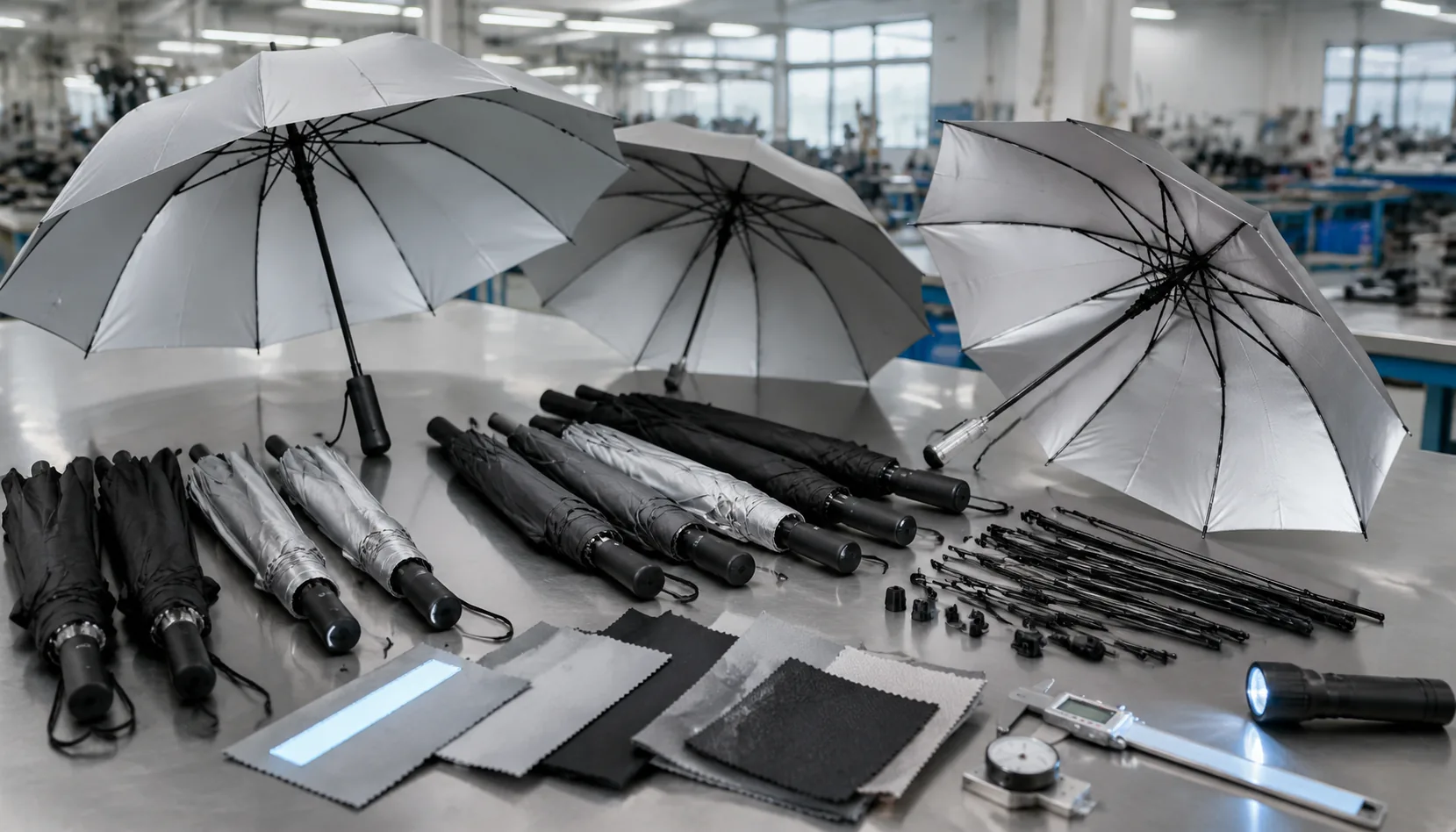
For OEM buyers, reflective commuter umbrellas can fail in small details: trim that cracks after folding, reflective tape that peels at seams, or fabric that looks bright in a sample room but dulls after rain and abrasion. On our factory floor in Songxia, we treat visibility, frame strength, canopy coating, and packing tolerance as one specification, because a commuter umbrella has to survive repeated wet use while still passing retail, transit, or promo QC.
Where Reflective Umbrellas Fit in Buyer Programs
Reflective commuter umbrellas work best when the buyer’s goal is low-light movement safety, not only rain coverage. For commuter retail, start with a 21" or 23" auto-open stick umbrella using 190T pongee, fiberglass ribs, and reflective piping around the canopy edge; this adds a 360-degree headlight outline without making the product look like safety equipment. Transport campaigns usually need 23" or 27" models with larger logo panels, because bus, rail, and subway operators care about brand readability across a platform. School programs should prioritize manual-open frames, rounded tips, POE clear viewing panels, and reflective strips on alternating panels so children keep forward visibility while walking. Insurance promotions need a lower freight profile and a clear safety message, so a 3-fold auto-open-close umbrella with reflective border tape and sleeve printing often gives the best balance of perceived value, carton efficiency, and landed cost.
Reflective placement changes both visibility and unit price, so specify it before artwork approval. Reflective piping is the lowest-cost upgrade because it is sewn into the canopy perimeter; it gives a clean outline under headlights, but the reflective surface is narrow. Panel strips cost more because each strip needs controlled placement during sewing, especially on 8K and 10K frames where the strip follows rib lines and must avoid wrinkling. Full reflective printing gives the highest visibility for custom reflective umbrellas used in road-safety, utility, or transport programs, but it adds ink, curing controls, and a stiffer hand feel on 190T or 210T pongee. On POE, PVC, or EVA canopies, require adhesion testing before bulk production because low-grade reflective ink can crack or flake after fold cycling.
A qualified reflective umbrella supplier should quote the base umbrella and reflective treatment as separate line items so buyers can compare safety value against MOQ, FOB or DDP landed cost, and lead time. For OEM commuter umbrellas, lock the rib count, frame material, canopy fabric, reflective width, logo method, sleeve design, and packing before sampling; otherwise a good-looking sample can fail repeatability in bulk production. For wind-exposed 23" and 27" safety umbrellas, fiberglass ribs and a vented double canopy are worth the added cost, with 50+ mph wind-tunnel survival as a practical benchmark. ZheBrella checks reflective alignment, seam tension, open-close function, and print adhesion under AQL 2.5 before shipment. Standard lead time is 25-35 days after sample approval, with longer schedules for full reflective printing or DDP orders requiring extra compliance documents.
Canopy Fabric, Coating, and Reflective Trim Choices
For daily rain use, 190T pongee is the cost-efficient baseline for reflective commuter umbrellas: it dries fast, packs cleanly, and keeps 21 inch and 23 inch folding models from feeling bulky in the sleeve. Move to 210T pongee when the buyer needs a tighter hand feel, sharper sublimation print, or a more retail-grade canopy on OEM commuter umbrellas. The tradeoff is weight and closing performance: 210T can bunch on auto-open-close frames if the spring, runner, and rib geometry are not matched. For city rain, both fabrics work when the PU or Teflon-style water-repellent finish is applied evenly and seam tension is controlled during sewing. Do not treat fabric density as a substitute for workmanship; loose stitching on 190T will leak sooner than a well-sewn 210T canopy. Density still matters for commuters who fold a wet umbrella twice a day and carry it in a backpack or laptop bag.
Add UPF 50+ only when the product will be sold as a rain-and-sun commuter umbrella, especially for Japan, Australia, the Middle East, and southern U.S. programs. For reflective commuter umbrellas with a UV claim, a dark outer pongee, silver reflective trim, and black or silver UV inner coating gives a clearer retail position and better heat-reduction story. The coating should be tested after flexing, not only on flat fabric, because low-grade UV layers can micro-crack at panel creases after repeated folding. At ZheBrella, we check coating adhesion, water repellency, and color transfer before bulk cutting, then inspect finished goods under AQL 2.5. If the order is a rainy-season giveaway, skip UPF 50+ and put the budget into fiberglass ribs, better reflective tape, tighter print registration, and cleaner sewing.
Reflective trim is a safety component, not decoration. For custom reflective umbrellas, 10 mm tape is the lowest practical width, 15 mm is stronger for retail, and 20 mm suits 27 inch or 30 inch golf umbrellas but can look heavy on compact folders. Sewing tape along every panel seam gives the best 360 degree visibility; alternating seams reduces cost but weakens the safety positioning. Reflective edge binding costs less, yet it is less visible from side angles and wears faster at the tips where folding stress is highest. A serious reflective umbrella supplier should fold-test trim for at least 500 cycles and check cracking, delamination, and stitch pullout before shipment. Heat-transfer reflective film looks clean on flat panels, but sewn reflective tape usually survives daily folding better on safety umbrellas used in buses, trains, and office bags.
Frame Builds for Daily Urban Use
Specify an 8K frame as the default for reflective commuter umbrellas unless the purchase brief requires a heavier windproof position. A practical OEM commuter build is a 23 inch auto-open stick umbrella with 8 fiberglass ribs, a steel shaft, and a 190T pongee canopy. That spec is durable enough for subway exits, office parks, and roadside walking, while still light enough for daily carry. It also keeps panel tension easier to control, which is critical when reflective tape, reflective piping, or silver transfer printing must line up across seams. For corporate gifting and retail programs targeting USD 8-12 FOB, 8K usually gives the best balance of opening speed, landed cost, carton efficiency, and margin protection.
Move to 10K or 16K only when the buyer is paying for premium, windproof, or safety umbrellas for harsher routes. A 10K frame adds support points around a 23 inch or 27 inch canopy and cuts flutter; 16K creates a rounder profile and spreads load more evenly, but it raises frame weight, assembly time, and carton volume. For custom reflective umbrellas, extra ribs make commercial sense only when paired with a double-canopy vent, reinforced runner, and a controlled wind-tunnel claim such as 50+ mph gust resistance. Without those upgrades, rib count becomes cosmetic because failures still occur at the runner, stretcher joint, or shaft connection.
Use fiberglass ribs for daily urban builds because they flex and recover better than painted steel ribs when wind flips the canopy. Steel ribs reduce unit cost and feel rigid during incoming inspection, but once bent they usually stay bent, causing canopy sag and uneven closing. A steel shaft remains the practical choice for many mid-market OEM programs because it stabilizes the handle and protects the target price. Full fiberglass shafts reduce weight, but on larger 27 inch or 30 inch models they can feel too flexible unless the buyer accepts a higher unit cost and MOQ. As a reflective umbrella supplier, ZheBrella typically pairs fiberglass ribs with a steel shaft for mid-market reflective commuter umbrellas, reserving full fiberglass or aluminum-fiberglass frames for lighter retail builds.
Mechanisms, Size, and Packaging Specs
Lock the mechanism before quoting price because it controls return risk, inspection time, and carton volume. Manual open is the lowest-risk build for reflective commuter umbrellas: no trigger spring, fewer latch failures, and faster AQL 2.5 checks on runner travel, rib lock engagement, shaft straightness, tip alignment, and canopy tension. Auto-open suits most 21 inch and 23 inch 3-fold OEM commuter umbrellas where one-hand opening matters at subway exits, parking lots, and bus stops. During sampling, test the button cap, spring preload, runner latch, and middle-section joint rivets; these are the first parts to loosen or bind. Auto-open/close requires a tougher approval plan: run 300-500 open/close cycles per approved sample group, then inspect shaft rebound, rib inversion, canopy folding, and button release. Reject samples that grind, stick, rebound unevenly, or leave the canopy under tension after closing.
For commuter retail programs, 21 inch and 23 inch folding frames cover most use cases. A 21 inch 3-fold fits easily in a work bag but gives limited shoulder coverage for taller users; 23 inch is the safer default for transit, university, corporate wellness, and safety umbrellas. Use 8K steel ribs for cost-driven orders, and specify fiberglass-reinforced ribs when durability or wind positioning affects the sell-in. If reflective tape is used, define the width and placement in the tech pack: 10-20 mm tape on every panel or alternating panels is typical. For custom reflective umbrellas in 190T or 210T pongee, approve bulk only after the reflective print or tape passes folding, wet rubbing, heat aging, and 24 hours of wet storage inside the sleeve.
Quote packaging as a controlled spec, not a late-stage accessory. The sleeve must accept the folded umbrella without forcing a sharp crease through reflective tape; for 21 inch and 23 inch folding models, specify matching pongee fabric, reinforced side seam, drainage tolerance, and barcode or woven-label position for retail stock. Hang tags should state canopy size, mechanism, rib count, fabric, reflective feature, and any UPF 50+ or water-repellent coating only when test reports support the claim. Ask the reflective umbrella supplier for packed carton dimensions and gross weight before PO approval. Retail plans commonly use 12 pieces per inner carton and 48 or 60 pieces per master carton, but auto-open/close handles and thicker sleeves can increase carton volume enough to change FOB and DDP costs.
MOQ, Lead Time, and QC Points to Confirm
For reflective commuter umbrellas, confirm MOQ by construction level, not by a single headline number. Stock 23" auto-open units with black, navy, or gray pongee canopies and standard reflective trim often start at 500-1,000 pcs. Custom 190T or 210T pongee canopy colors usually move to 1,000-3,000 pcs, and MOQ rises again when the reflective strip needs a nonstandard width, segmented layout, special dyeing, or heat-applied process. Before deposit, require one pre-production sample built with the exact rib count, shaft material, reflective trim placement, logo method, sleeve, carton, and carton marks. A showroom sample is not enough for OEM commuter umbrellas because reflective brightness, tape flatness, and seam alignment can change once bulk cutting and sewing begin.
Quote lead time from approved sample date, not inquiry date. Stock canopies with existing reflective trim are commonly 25-35 days after deposit; custom canopy dyeing, PMS-matched printing, heat-transfer logos, sublimation panels, or new reflective binding tape often extends production to 40-55 days. Double-canopy vented frames, 10K fiberglass ribs, auto-open-close mechanisms, UPF 50+ fabric, or Teflon coating add approval points because the frame, fabric, coating, and sewing line must be matched before bulk production. Lock the golden sample, bill of materials, logo size, trim position, and packaging files before cutting fabric. For quotation terms, FOB Ningbo or Shanghai should separate unit price, inland trucking, and export documents. DDP must state duty and VAT handling, final delivery address type, and whether Amazon FBA or retail routing labels are included.
QC for custom reflective umbrellas should focus on the added safety process, not only frame function. Inspect reflective trim width, brightness consistency, stitch distance from the trim edge, missed stitches at canopy tips, and whether the strip stays flat after wetting and drying. On a 23" model, trim placed around the canopy edge or on selected panels must be checked for symmetry because crooked tape is obvious under headlights. Use AQL 2.5 for major defects at final inspection, with a tighter internal screen for logo defects on promotional safety umbrellas. Test samples should cover auto-open force, runner lock, rib end cap security, water repellency, colorfastness, and carton drop resistance. Also confirm who owns the golden sample, who pays for failed re-inspection, and whether replacement parts or overproduction units ship with the bulk order.
Frequently Asked Questions
Can reflective umbrellas still use full-panel logo printing?
Yes, but the logo layout must leave reflective tape or piping unobstructed. Buyers should approve a panel mockup before sampling to avoid reducing the visibility effect.
Is reflective tape more durable than reflective ink on umbrellas?
Reflective tape or piping is usually more consistent for repeated folding and rain exposure. Reflective ink can work for larger graphic areas but should be tested for cracking on folded panels.
What reflective options can be specified for commuter umbrellas?
Common options include reflective piping around the canopy edge, reflective tape on one or more panels, reflective sleeve printing, and reflective logo details. For retail programs, 360-degree edge piping is usually the most visible and easiest to standardize.
What MOQ should buyers expect for custom reflective commuter umbrellas?
Typical MOQ is 500-1,000 pieces per design for stock fabric colors with custom logo printing. Fully custom canopy colors, special reflective trims, or private mold handles may require 1,000-3,000 pieces depending on the specification.
Which QC checks matter most for reflective safety umbrellas?
Buyers should check reflective brightness after wet testing, seam alignment of reflective trim, canopy leakage, open-close cycling, frame strength, and logo adhesion. For commuter umbrellas, a practical inspection should include at least 24-hour drying review and repeated open-close testing.
Looking to Launch Your Custom Umbrella Line?
ZheBrella is a Zhejiang-based OEM/ODM umbrella manufacturer with 17 years of export experience. Free design, low MOQ from 100 pieces, windproof construction, full-color print.
Get Free Quote Now »People Also Search For
Related Articles
Reflective Umbrellas for Commuters: Buyer Spec Guide
Specify reflective commuter umbrellas with the right fabric, rib count, print placement, and QC checks for safer retail ...
Read More »
Reflective Umbrellas for Commuter Safety: Buyer Spec Guide
Learn how to specify reflective umbrellas with safe trim placement, 190T/210T canopies, windproof frames, print areas, a...
Read More »Reflective Safety Umbrellas: OEM Buyer Spec Guide
Source reflective safety umbrellas with the right tape, print layout, pongee fabric, ribs, and QC specs for commuter, sc...
Read More »