Reflective Umbrellas for Corporate Commuter Safety Programs
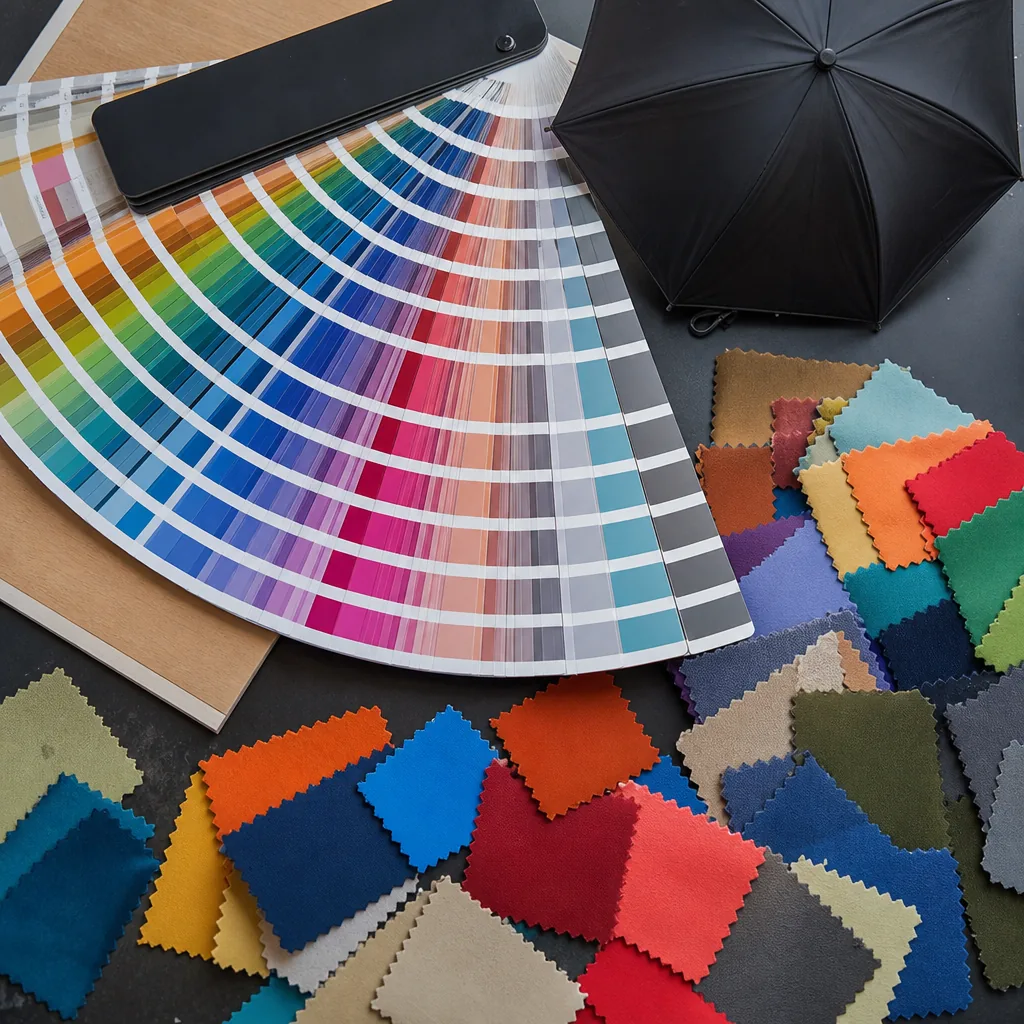
For a commuter safety program, the risk is not just whether an umbrella reflects light, but whether the reflective tape stays visible after printing, folding, rain, and daily use at transit stops. When buyers ask for reflective safety umbrellas bulk, we check tape width and position against panel seams, fabric coating, rib strength, and inspection points on the line so the finished branded umbrella performs consistently, not just looks compliant in a sample photo.
Why Reflective Umbrellas Fit Safety and Commuter Programs
Reflective umbrellas fit commuter programs because they solve a real visibility gap: people carry umbrellas exactly when drivers have the worst sight lines. Rain cuts contrast, headlights scatter on wet asphalt, and a dark 23" or 27" canopy can disappear at a crosswalk during the 5–7 p.m. commute. Adding 360-degree reflective piping, reflective edge tape, or panel-level reflective printing gives the user a moving visibility marker above shoulder height, which is more useful than a small bag charm hidden by a coat. For commuter safety umbrellas, I usually push buyers toward 190T or 210T pongee with a black, navy, or charcoal base plus silver reflective trim, because the contrast is sharper and the canopy still looks acceptable for office use. For reflective safety umbrellas bulk orders, the key is not just brightness in a sample room; it is whether the reflective material stays bonded after rain exposure, folding friction, and 500–1,000 open-close cycles.
Corporate safety campaigns, transit promotions, schools, and insurance brands all use umbrellas differently, so the build should match the distribution channel. A transit authority handing out high visibility umbrellas at a rail station may want a 23" auto-open stick umbrella with fiberglass ribs because it opens quickly when passengers exit into rain. A school district may prefer a 21" compact auto-open-close model that fits inside a backpack, with rounded tips and a POE window panel if staff need better forward sight lines while supervising crossings. Insurance brands and corporate EHS teams often choose reflective logo umbrellas because they carry a safety message without feeling like a cheap warning vest. For executive commuter gifts, a double-canopy vented windproof model with 8K or 10K fiberglass ribs is worth the extra cost, especially if the buyer wants the umbrella to survive 40–50 mph gusts instead of inverting at the first subway exit.
The branding has to respect the safety function. Large reflective logos can work, but if the ink film is too heavy or placed across seam lines, it can crack or reduce water runoff; screen printing on pongee and heat-transfer reflective film each need different curing and adhesion checks. Our standard practice at ZheBrella is to test reflective tape alignment after sewing, inspect canopy tension on the frame, and use AQL 2.5 for bulk visual defects before packing. For corporate safety gifts, I recommend keeping the logo on one or two panels and reserving the perimeter for uninterrupted reflective trim, because drivers recognize continuous outlines faster than scattered decoration. MOQ often starts around 500–1,000 pieces depending on the mechanism and reflective material, with typical production lead times of 25–40 days after artwork approval. If the program has a fixed launch date, confirm FOB or DDP routing early, because rainy-season congestion can erase a week faster than any sewing line delay.
Reflective Material Options and Placement Rules
Reflective piping is the cleanest choice for commuter safety umbrellas because it adds visibility without changing the fold pattern. On a 23" auto-open stick umbrella or a 21" auto-open-close folding umbrella, we usually sew 3–5 mm reflective cord into the outer canopy seam, then keep the stitch line outside the rib tips so the fabric still rolls flat. It works well with 190T or 210T pongee and does not fight Teflon water-repellent coating if the coating is applied before sewing. Segmented reflective tape gives stronger flash under headlights, but it must be broken into short 60–90 mm sections between the ribs, especially on 8K and 10K frames. Continuous tape across rib valleys looks good on a drawing and performs badly in real folding; it creases, lifts at the adhesive edge, and creates bulky corners after 300–500 open-close cycles.
Full-panel reflective accents are more visible but need tighter engineering. A silver or gray reflective wedge on every other panel can turn a standard black corporate umbrella into a high visibility umbrella without making it look like roadwork equipment. For bulk corporate safety gifts, I prefer two opposite reflective panels on 8K frames or four narrow accents on 16K golf umbrellas, because the stress is balanced when the canopy is stretched. Placement should stop 20–30 mm short of the cap and 15–20 mm before the edge binding, leaving room for sewing tolerance and avoiding hard spots at the rib tips. For reflective safety umbrellas bulk orders, we also check whether the reflective film tolerates heat pressing, because some low-cost PET-based films curl when paired with large screen-printed logos or sublimation panels.
Printed reflective ink gives the most design freedom for reflective logo umbrellas, but buyers should treat it as a visibility feature, not a replacement for certified tape. It can be screen printed as a logo outline, border stripe, or directional pattern on dark pongee, but the ink layer must stay away from the main fold lines on compact 3-fold umbrellas. A safe rule is to keep reflective ink within panel centers or along the lower canopy arc, not across rib seams. Sleeves and straps are underrated placement areas: a 10–15 mm reflective strip on the storage sleeve and a reflective hook-and-loop strap remain visible in a backpack side pocket or office lobby. At ZheBrella, our standard practice is to test folding bulk at pre-production stage, then inspect reflective adhesion and alignment under AQL 2.5 before FOB or DDP shipment.
Frame, Fabric, and Wind Specs to Require
For commuter safety umbrellas, I would not approve anything below 190T pongee unless the program is purely disposable event stock. A good corporate commuter model should use 190T or 210T pongee with a water-repellent finish, preferably a Teflon-type coating if the buyer wants faster shake-dry performance after subway or parking-lot use. 210T feels tighter, prints cleaner, and resists pinhole leakage better after panel sewing, so it is the safer choice for executive programs and reflective logo umbrellas. For reflective safety umbrellas bulk orders, specify reflective tape at the panel edge or alternating panel seams, not just a small reflective logo, because side visibility matters when drivers see the user from an angle. If UV protection is part of the brief, add UPF 50+ coating, but confirm it does not dull the reflective strip or cause heat-transfer logos to lift during wet rub testing.
For folding umbrellas, 8K fiberglass ribs are the practical baseline because they flex back better than painted steel ribs when a commuter steps out of a train station into a wind gust. A 21" or 23" 3-fold auto-open-close umbrella with fiberglass ribs and a steel shaft is a good cost-balanced spec for corporate safety gifts, but do not confuse fiberglass ribs with a full fiberglass frame. Steel center shafts keep pricing down and feel stable in compact models, while fiberglass shafts reduce rust risk and absorb shock better, especially on higher-end 27" and 30" straight umbrellas. Our standard practice at ZheBrella is to test rib rebound, runner locking, and shaft wobble before print approval, because reflective umbrellas often look acceptable on a desk but fail when opened 200 to 300 times in a real commuter cycle.
For larger high visibility umbrellas, require a double-canopy vented construction rather than simply adding more ribs. A 27" or 30" straight umbrella with 8K or 10K fiberglass ribs, fiberglass shaft, and vented double canopy can realistically survive 50+ mph wind-tunnel conditions when the canopy tension and rib length are properly matched. If the buyer wants a premium safety-program piece, 16K looks impressive and gives a rounder canopy, but it adds weight and cost, so I usually reserve it for retail brand owners rather than HR giveaways. Put the important specs directly on the PO: 190T or 210T pongee, reflective tape width, logo method, manual or auto-open mechanism, AQL 2.5 inspection, and packed carton drop-test requirement. For reflective safety umbrellas bulk procurement, MOQ usually starts around 500 to 1,000 pieces per color, with typical production lead times of 25 to 40 days after artwork approval depending on printing and reflective material availability.
Branding, MOQ, and Sampling Considerations
Reflective placement has to be locked before artwork, because a logo that looks good on a flat template can kill visibility once the canopy is tensioned over 8K or 10K ribs. For commuter safety umbrellas, we normally keep reflective tape or reflective piping on the outer radius, rib seams, or alternating panels, then place the corporate mark beside—not on top of—the reflective zone. Screen printing works well for one- to three-color logos on 190T or 210T pongee, while heat transfer gives cleaner edges on small text and reflective logo umbrellas with gradients. On black, navy, and charcoal canopies, Pantone matching is not absolute; ink opacity, coating, and fabric absorption can shift colors by 5–10% visually. If a buyer needs a strict brand red or blue, I ask for a physical Pantone chip and recommend a white underbase, especially on dark UPF 50+ or Teflon-coated fabric.
MOQ changes quickly when reflective material stops being standard. For reflective safety umbrellas bulk orders using stock silver reflective tape, a practical MOQ is often 500–1,000 pieces per style, depending on whether the umbrella is 21-inch folding, 23-inch stick, or 27-inch golf size. Custom tape colors such as fluorescent yellow, orange, or black reflective usually push MOQ to 1,500–3,000 pieces because the tape supplier has its own minimum roll quantity. A custom reflective layout—such as a chevron pattern, segmented rib-line strips, or a 360-degree perimeter band—adds cutting dies, sewing jigs, and extra inline inspection. High visibility umbrellas for transit agencies or night-shift staff also need layout approval against real open-canopy photos, not only AI mockups or vector proofs. Our standard practice at ZheBrella is to quote separate MOQ levels for stock reflective, custom color tape, and fully custom reflective panel engineering.
Sampling should test the umbrella as a moving mechanical product, not as a static gift item. For corporate safety gifts, I want the pre-production sample opened and closed at least 30–50 cycles before approval, especially on auto-open-close folding models where tape can scrape against ribs or stretchers. The sample check should include reflective adhesion after folding, seam puckering around tape edges, logo alignment beside reflective zones, and whether transfer film cracks along canopy folds. On stick umbrellas, inspect the tips and ferrule area because perimeter reflective tape can twist if the sewing tension is uneven. For bulk orders, add AQL 2.5 visual inspection points for reflective tape continuity, logo registration, and open-canopy symmetry. If the program requires retail packaging or DDP delivery deadlines, approve both the umbrella sample and packed carton sample early, since reflective tape thickness can affect folding diameter, sleeve fit, carton count, and final freight cost.
Quality Inspection Points Before Shipment
For commuter safety umbrellas, inspection has to start with visibility, not just general appearance. Use AQL 2.5 for finished-goods checks, and pull samples after final packing so the inspector sees the same condition the buyer will receive. Reflective tape should be checked for alignment on every panel edge or rib line specified in the artwork sheet; a 3-5 mm drift may look small on the sewing table but becomes obvious when eight panels meet at the crown. I would also test tape adhesion and stitching by rubbing, flexing, and opening the canopy repeatedly, because reflective trims can peel or wrinkle if the operator used the wrong heat setting or stitch tension. For reflective safety umbrellas bulk orders, require clear pass/fail photos under normal light and direct flash so the buyer can confirm the high visibility effect before shipment.
Stitching strength, logo placement, and mechanism function need separate checkpoints because one good sample does not prove the batch is stable. On 190T or 210T pongee canopies, inspectors should look for skipped stitches, loose thread ends, panel puckering, and seam leakage around reflective tape. Logo position on reflective logo umbrellas should match the approved proof within a tight tolerance, especially if the print sits near a reflective strip; crooked branding makes corporate safety gifts look cheap even when the frame is strong. Auto-open units should be opened and closed at least 5-10 cycles per inspected umbrella, checking spring response, runner lock, shaft straightness, and handle fit. Water repellency should be verified with a spray or bead test, especially after printing, because silicone, Teflon-style, or PU coatings can be weakened by poor curing.
Carton inspection matters as much as umbrella inspection when shipping high visibility umbrellas for a dated safety campaign. Confirm inner polybags, warning labels, master carton marks, barcodes, quantity per carton, gross weight, and carton compression condition before release; wet or soft cartons are a red flag for FOB container loading and DDP courier handling. Documentation should match the purchase order exactly: HS code, packing list, commercial invoice, shipping marks, carton dimensions, and any DDP consignee details must be checked before the truck leaves the factory. For realistic lead time planning, allow about 7-10 days for sample approval, 20-35 days for bulk production depending on rib count and print complexity, plus 3-7 days for inspection, rework, and export paperwork. Our standard practice at ZheBrella is to block shipment until AQL results, carton photos, and FOB/DDP documents all match the approved order file.
Frequently Asked Questions
Can reflective umbrellas use full-color logos?
Yes, but full-color logos are usually printed on the pongee canopy, sleeve, or handle tag rather than on the reflective strip. Reflective tape works best as a separate safety element.
Do reflective strips change the umbrella MOQ?
Standard silver reflective piping may keep MOQ close to normal production. Custom tape colors, wider tape, or special panel layouts can raise MOQ because materials must be ordered separately.
Where should reflective tape be placed on commuter umbrellas for better visibility?
For corporate commuter programs, common placements include the outer canopy edge, alternating panel seams, and a band near the lower canopy perimeter. A 1-2 cm reflective strip around the canopy edge gives 360-degree visibility while leaving enough clear space for a printed logo.
What specifications should buyers request for bulk reflective safety umbrellas?
Ask for pongee or polyester canopy fabric, fiberglass ribs for wind resistance, reflective tape width and certification details, logo print method, and open/close mechanism. For commuting use, a 23-inch straight umbrella or 21-23 inch folding umbrella is usually practical.
What is the typical MOQ and lead time for custom reflective logo umbrellas?
Typical OEM orders start around 500-1,000 pieces per design, depending on frame type and reflective tape placement. Sampling usually takes 5-10 days, and bulk production often takes 25-45 days after artwork and sample approval.
Looking to Launch Your Custom Umbrella Line?
ZheBrella is a Zhejiang-based OEM/ODM umbrella manufacturer with 17 years of export experience. Free design, low MOQ from 100 pieces, windproof construction, full-color print.
Get Free Quote Now »People Also Search For
Related Articles
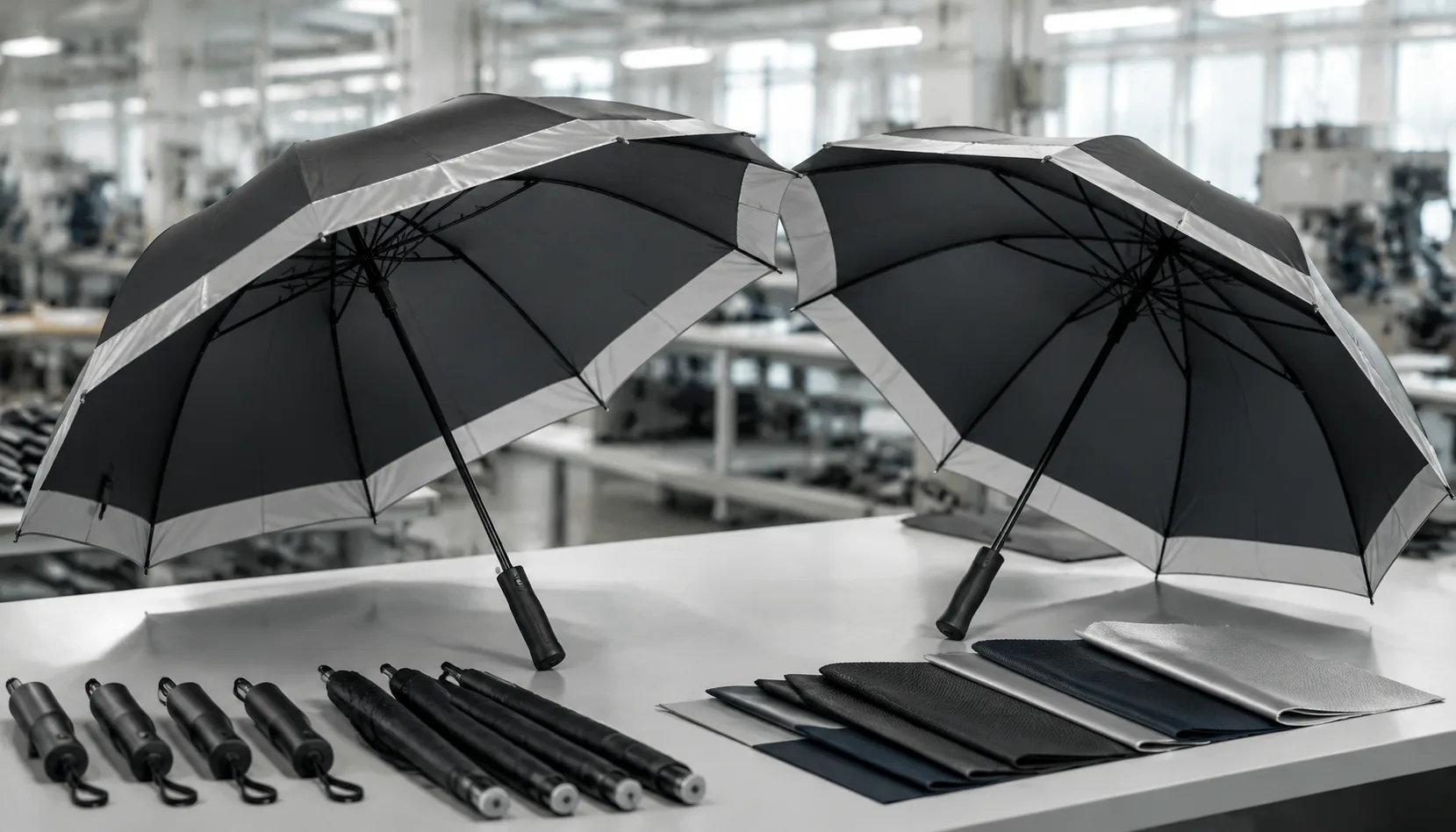
Reflective Safety Umbrellas for Corporate Commuter Programs
Plan reflective umbrellas with 190T pongee, reflective piping, fiberglass ribs, and AQL checks for safer commuter gifts ...
Read More »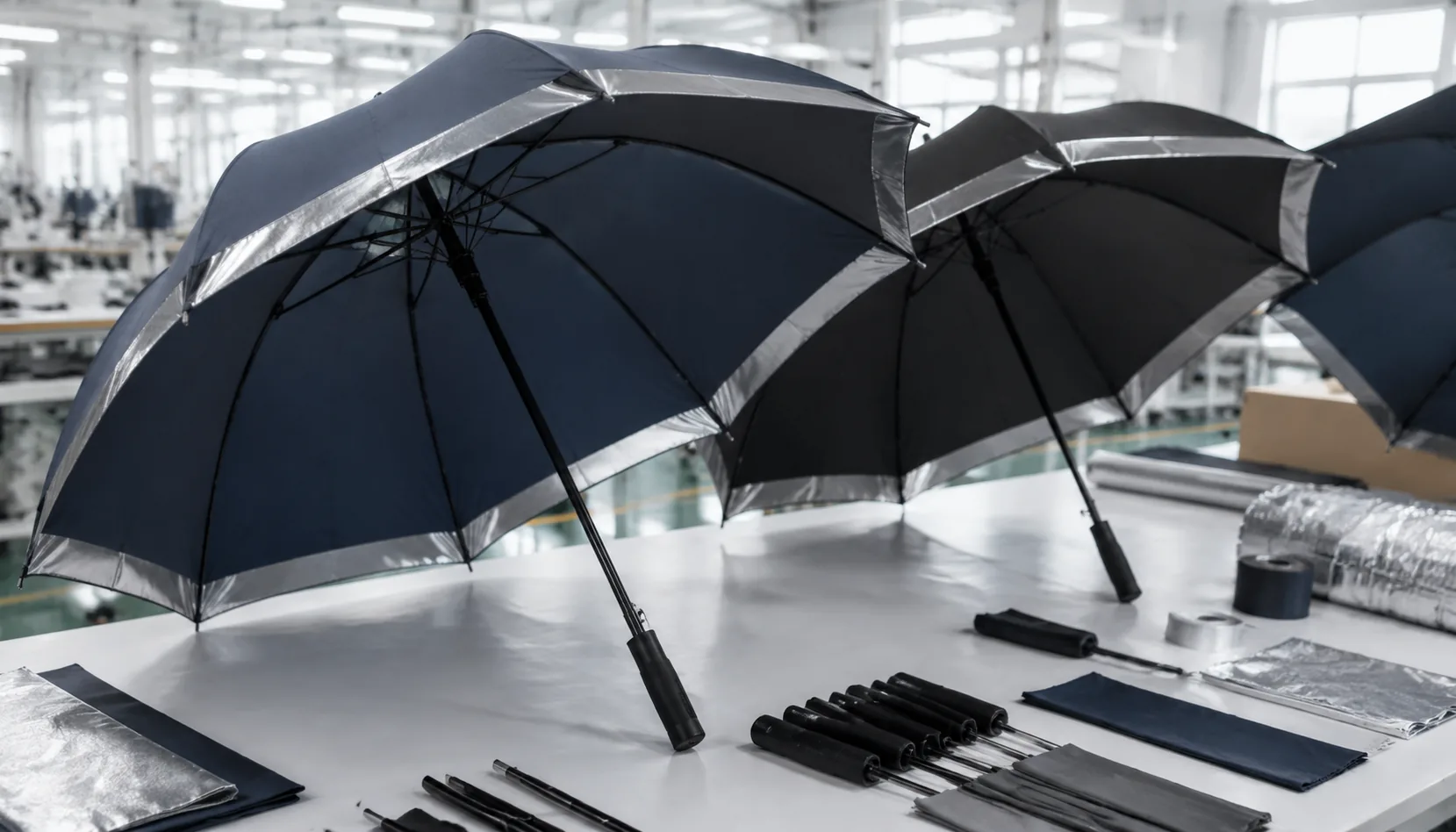
Reflective Safety Umbrellas for Corporate and Event Programs
Specify reflective umbrellas for safety campaigns with the right fabric, rib strength, print areas, visibility details, ...
Read More »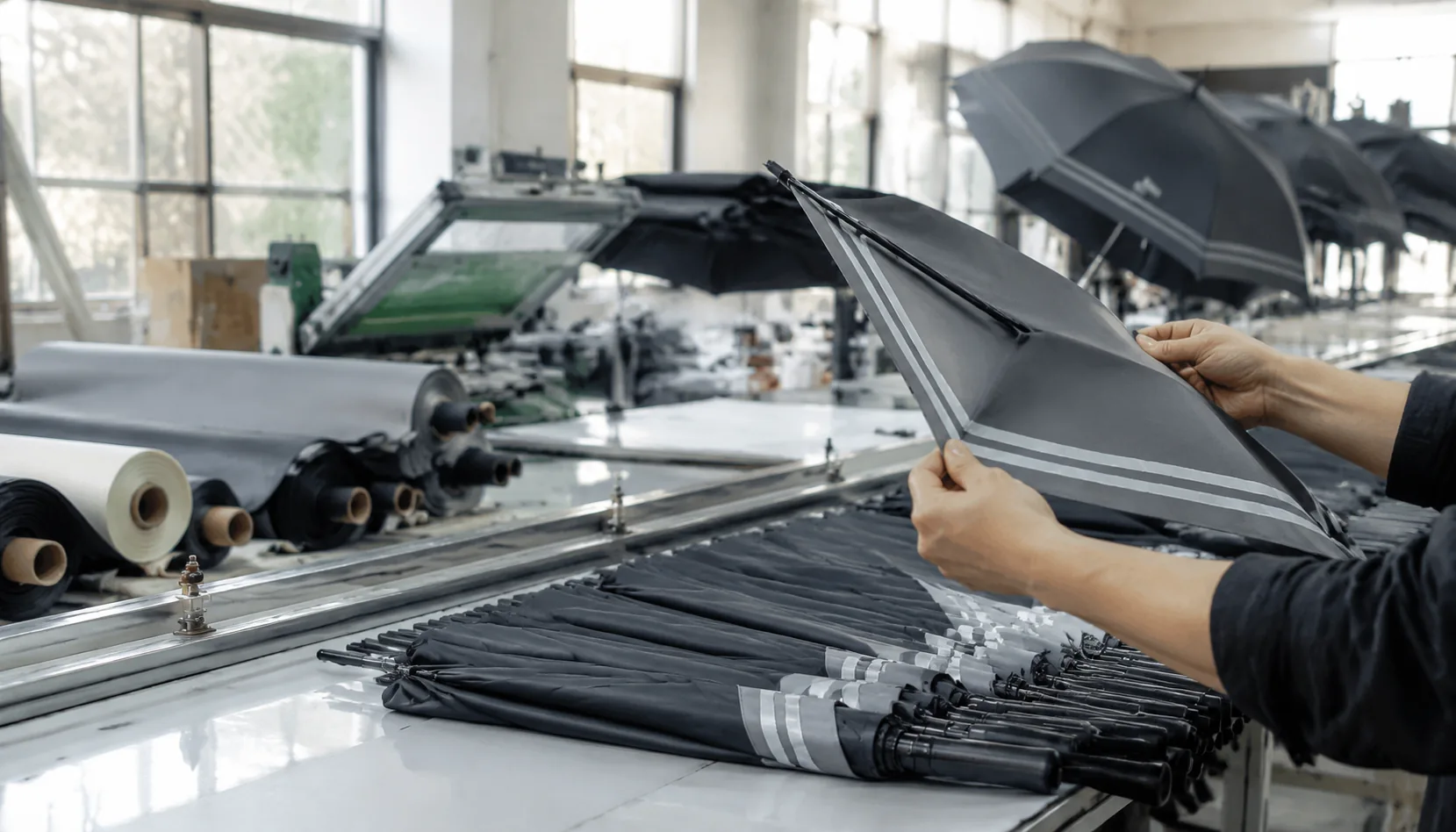
Reflective Logo Printing for Branded Umbrella Safety Campaigns
Plan reflective logo umbrellas with the right fabric, ink, rib structure, testing, MOQ, and lead time for safety campaig...
Read More »