Reflective Safety Umbrellas for Corporate and Event Programs
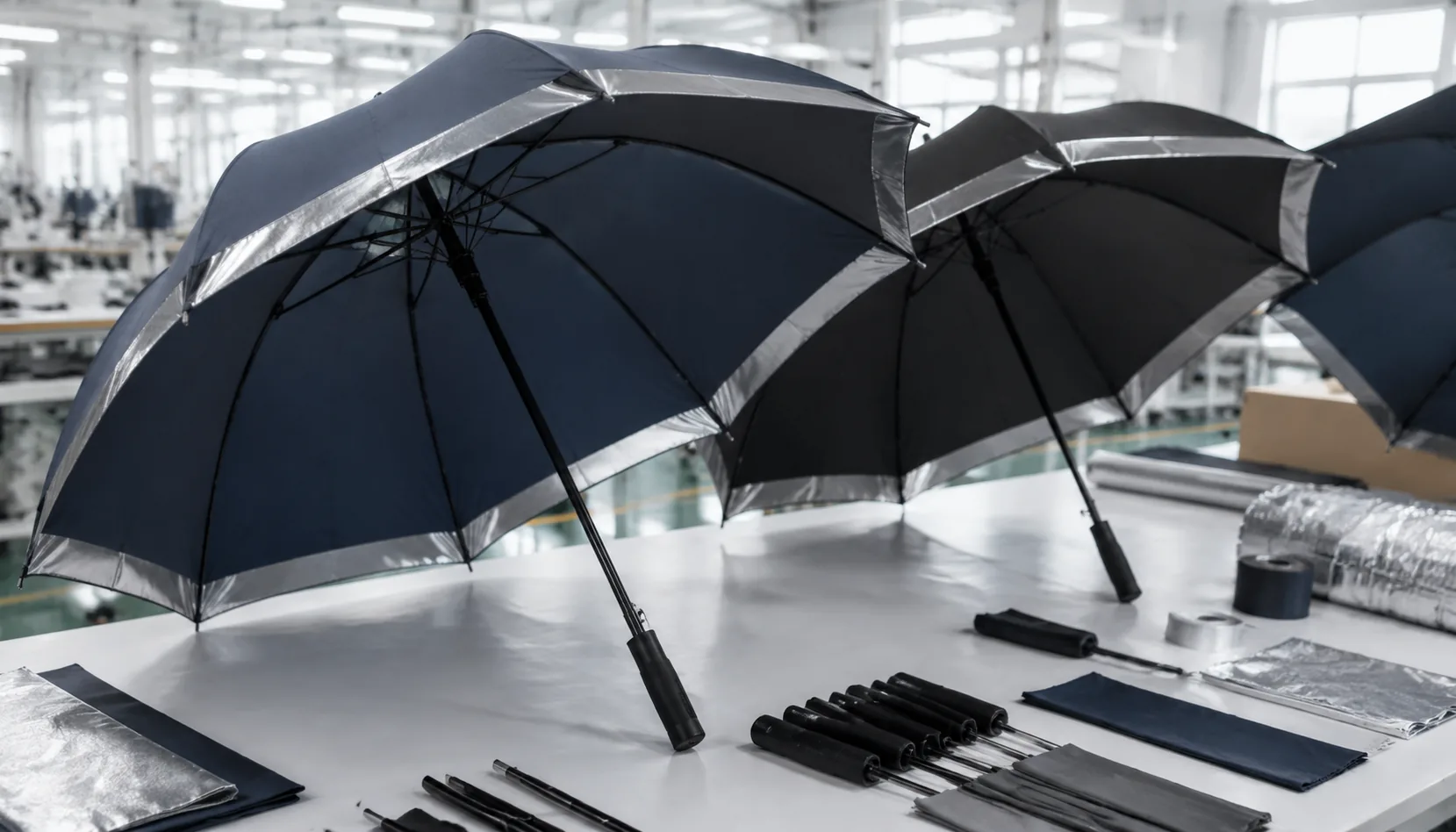
When buyers source reflective safety umbrellas bulk for a corporate campaign or nighttime event program, the risk is not just late delivery—it is weak reflectivity, distorted logos, ribs that fold in wind, or mixed cartons that fail on-site distribution. On our Songxia factory floor, the right specification starts with reflective tape placement, pongee or polyester coating, rib gauge, print tolerance, and inspection points that can be checked before the shipment leaves Zhejiang.
Define the Safety Use Case First
Define the use case before choosing fabric, because “visible” means different things on a rainy sidewalk than it does beside a jobsite gate. For commuter programs, I usually specify a 23" auto-open stick umbrella or a 21" compact auto-open-close with 190T or 210T pongee in fluorescent yellow, orange, or lime, plus reflective piping on all eight ribs. The logo should sit on two opposing panels, not on the edge tape, so it remains readable when the canopy is tilted into rain. For parking-lot escorts, transit staff, hotel valet teams, and security patrols, a 27" or 30" golf umbrella with fiberglass ribs and a double-canopy vent is more practical because one umbrella often covers two people and must survive wind gusts around 40–50 mph. Reflective safety umbrellas bulk orders for these users should prioritize 360-degree edge visibility over large artwork, because drivers see the rim first, not the center panel.
Construction-adjacent programs need a tougher spec than most event buyers expect, even if the umbrella is not used inside an active work zone. Steel shafts are economical, but fiberglass ribs reduce breakage when workers toss umbrellas into vans or storage cages. For utility contractors, road crews, warehouse yards, and plant tours, I prefer 8K or 10K fiberglass frames, POE clear-view safety windows if supervisors need sightlines, and reflective panels on alternating canopy sections. High visibility umbrellas in this category should avoid dark navy or black main panels unless the reflective area is wide enough to compensate, usually 10–15 mm piping plus one or two full reflective wedges. Logos should be printed below eye level on the lower half of the panel, not across the reflective strip, because ink can reduce reflectivity and fail a night-visibility check. Our standard practice at ZheBrella is to review the logo layout together with the canopy cutting marker before sampling, especially for branded safety umbrellas that combine fluorescent fabric with reflective tape.
Campus, school, and night-event applications need more attention to crowd movement than industrial durability. A university walking escort program may want 23" manual-open umbrellas to control cost and reduce mechanism failures, while a night race, concert, or outdoor festival may need 27" vented golf umbrellas for staff, ushers, medical volunteers, and VIP shuttle points. Event safety giveaways can use lighter 190T pongee and an 8K frame if the umbrella is mostly a take-home item, but staff-use umbrellas should move to 210T pongee, fiberglass ribs, and a windproof runner so they do not invert at the first gust. Reflective logo umbrellas work best when the brand mark is printed on a normal colored panel and the reflective treatment stays on piping, ribs, or dedicated side panels. For reflective safety umbrellas bulk procurement, lock the application first, then set MOQ, artwork count, AQL 2.5 inspection points, and lead time; otherwise buyers overpay for rugged frames or under-spec visibility where it matters most.
Choose Frames That Survive Daily Field Use
Frame choice matters more than canopy artwork when reflective safety umbrellas bulk are handed to crews who use them every week, not once at a trade show. Fiberglass ribs are the safer default for field programs because they flex under gust load and spring back instead of bending permanently. A 23" or 27" umbrella with 8K fiberglass ribs and a steel shaft usually lands in the practical middle: strong enough for parking teams, security staff, and outdoor supervisors, but not so heavy that people leave it in the van. Full steel ribs cost less and feel rigid on first inspection, but after repeated opening cycles and wet storage they are more likely to rust at rivets, deform at tips, and fail AQL 2.5 appearance checks due to orange staining on light-colored canopies. For high visibility umbrellas, I would rather reduce failure risk with fiberglass ribs than chase the lowest frame price.
Rib count changes both strength and customer perception. Standard 8K construction is enough for most branded safety umbrellas if the rib gauge, runner, and stretchers are properly matched; weak 8K umbrellas usually fail because factories use thin stretchers or loose rivets, not because 8 ribs are automatically poor. A 16K frame spreads wind load across more points and gives the canopy a rounder shape, which looks better for reflective logo umbrellas, but it adds cost, weight, and more sewing alignment work. On 190T or 210T pongee canopies with reflective binding or reflective print panels, a 16K layout also means more seams to control during cutting and stitching. For event safety giveaways, 8K fiberglass is usually the smarter buy; for premium staff kits, municipal contracts, or roadside-service programs, 16K fiberglass gives a stronger hand feel and longer service life.
Double-canopy vented windproof construction is worth specifying when umbrellas will be used in open lots, stadium entrances, campuses, or construction access points where crosswind is common. The upper vent lets pressure escape before the frame inverts, and paired with fiberglass ribs it can realistically survive repeated 35–45 mph gusts; stronger builds can be wind-tunnel rated at 50+ mph, but only if the shaft, runner, tips, and rib joints are upgraded together. Auto-open is also not a luxury in staff programs. Security guards, shuttle coordinators, and event marshals often carry radios, clipboards, scanners, or traffic wands, so one-button opening increases actual use. For reflective safety umbrellas bulk orders, our standard practice at ZheBrella is to test auto-open cycling, rib recovery, shaft straightness, and canopy tension before packing, because a reflective umbrella that jams after two rainy shifts becomes warehouse waste instead of safety equipment.
Select Canopy Fabric and Reflective Materials
For reflective safety umbrellas bulk orders, canopy fabric is where most buyers either save money correctly or create returns later. 190T pongee is the practical baseline for branded safety umbrellas because it folds cleanly, accepts screen print or heat-transfer logos, and has enough density for a smooth water-repellent finish. 210T pongee costs more, but the tighter weave gives better hand feel, cleaner panel shape, and less color show-through on fluorescent yellow, orange, or lime green canopies. For event safety giveaways that must be noticed in parking lots, road races, campuses, or construction visitor areas, fluorescent polyester is usually worth specifying over standard navy or black pongee. I would pair it with a 23" or 27" auto-open frame, 8K fiberglass ribs, and a black shaft so the high-visibility canopy remains the main visual surface.
Silver reflective tape is not decoration; it is a functional material that must survive folding, rain, and repeated rib contact. Common widths are 10 mm, 15 mm, and 20 mm, with 15 mm giving the best balance between visibility and sewing control on umbrella panel seams. Tape can be sewn around the lower canopy edge, inserted on alternating panels, or placed as radial strips from tip to vent, but edge trim is the most durable because it flexes less sharply when the umbrella closes. For reflective logo umbrellas, avoid placing heat-transfer logos directly across reflective tape unless the tape supplier confirms temperature resistance around 140–160°C. Our standard practice at ZheBrella is to test tape samples on the actual canopy lot before bulk cutting, because reflective film from different suppliers can look identical but behave very differently after 500 open-close cycles.
The coating stack matters as much as the fabric. A normal water-repellent finish is acceptable for short-term promotional use, while Teflon-coated 190T or 210T pongee sheds water faster and dries cleaner after outdoor event duty. If the umbrella also needs sun protection, specify UPF 50+ coating, but confirm it does not dull fluorescent color or weaken reflective adhesion. Reflective trim should be tested three ways before reflective safety umbrellas bulk production: peel adhesion after sewing, folding wear after repeated closing, and print compatibility with screen ink, sublimation, or heat-transfer film. For AQL 2.5 inspection, I would add a custom checkpoint for tape lifting, cracked reflective film, skipped stitches along trim, and logo distortion near reflective areas, because these defects are easy to miss in a normal umbrella inspection but obvious to the end user at night.
Place Logos Without Reducing Visibility
Logo placement on safety umbrellas should start with a visibility map, not with the artwork file. On dark navy, black, or charcoal 190T pongee canopies, a white or silver print reads well in daylight but can disappear at night if it sits inside the reflective strip area. On neon yellow, orange, or lime canopies, the problem flips: low-contrast brand colors like pale blue or light gray look weak from 20 meters away. For reflective safety umbrellas bulk orders, I usually keep the outer canopy edge, rib-to-rib reflective piping, and any 360-degree reflective band completely clear of normal branding. Put the main logo on alternating panels between reflective zones, sized around 120–180 mm wide on a 23 inch umbrella and 180–240 mm on a 27 inch golf umbrella. That keeps the umbrella recognizable without blocking the high visibility function that procurement teams are actually buying.
Screen printing is still the cleanest choice for simple one- or two-color logos on pongee, especially when the canopy is dark and the brand color needs opacity. Use a white underbase when printing red, blue, or green over black fabric; otherwise the color sinks into the weave after curing. Heat transfer works better for gradients, sponsor stacks, QR codes, or small text on branded safety umbrellas, but the transfer film must be tested for flexing because umbrella panels fold sharply along the ribs. I do not like placing thick transfers near the top cap or along the rib seam because repeated opening creates edge lift. For high visibility umbrellas, reflective logo umbrellas can use silver reflective heat-transfer film, but treat it as a visibility element first and a decoration second. A reflective logo should be large, simple, and placed on one or two panels, not scattered across every segment where it competes with the safety band.
For corporate events, road crews, utilities, campuses, and night parking programs, the best layout is usually a hierarchy: reflective tape or piping for safety, high-contrast brand color for recognition, and smaller sponsor marks in non-critical zones. Event safety giveaways often get overdesigned because every department wants a logo, slogan, website, and QR code on the same 8K canopy. That creates visual noise and can reduce the perceived brightness from drivers or pedestrians. On 10K and 16K frames, there are more panel seams, so artwork needs extra clearance to avoid distortion during sewing; keep at least 15–20 mm from seams and 25 mm from reflective bands. Before mass production, request a real printed pre-production sample and inspect it open, closed, wet, and under flashlight at 30–50 feet. AQL 2.5 inspection should include logo registration, reflective adhesion, color contrast, and whether any print overlaps the agreed safety zones.
Inspect Bulk Orders for Safety and Durability
Water repellency and packing checks protect the buyer from the expensive part of a bad order: complaints after distribution. For 190T or 210T pongee, inspectors should spray the canopy and confirm beading after Teflon or standard water-repellent coating, then look for wet-through along needle holes where reflective tape was sewn. Carton labeling must match PO, SKU, color, logo version, quantity, gross weight, net weight, carton size, and destination marks for FOB or DDP shipments; mixed cartons are a common cause of event-site chaos. Custom reflective materials also affect lead time more than buyers expect. Stock silver tape may keep production near 25–35 days after artwork approval, but custom colored reflective film, segmented tape, or certified high-visibility trim can add 7–15 days for sourcing and lamination trials. Our standard practice at ZheBrella is to freeze reflective material specs before mass cutting, because late changes can create shade variation across reflective safety umbrellas bulk orders.
Frequently Asked Questions
Do reflective umbrellas meet the same standards as high-visibility apparel?
Usually no. Umbrellas can improve visibility, but they are not a replacement for certified PPE unless tested and labeled to a specific standard requested by the buyer.
What MOQ should buyers expect for reflective safety umbrellas?
MOQ depends on whether reflective tape, fluorescent fabric, or custom panels are used. Stock-frame programs may start lower, while custom reflective layouts often require higher fabric and trim minimums.
What canopy materials are best for reflective safety umbrellas used in campaigns?
For most bulk programs, 190T or 210T pongee is common because it balances print quality, water resistance, and cost. If the umbrella will be used outdoors frequently, ask for a water-repellent coating and a darker canopy color that improves reflective contrast.
How should I evaluate rib strength for branded safety umbrellas?
For standard promotion use, 8-rib fiberglass or a fiberglass/metal hybrid frame is often the best value. If the umbrellas will be opened in windier conditions, specify wind-resistant ribs and request a sample flex test before mass production.
What inspection checks matter most for bulk reflective logo umbrellas?
Confirm reflection brightness, print alignment, stitching consistency, opening and closing function, and frame straightness on each production lot. Many buyers also require carton drop testing and an AQL-based final inspection before shipment.
Looking to Launch Your Custom Umbrella Line?
ZheBrella is a Zhejiang-based OEM/ODM umbrella manufacturer with 17 years of export experience. Free design, low MOQ from 100 pieces, windproof construction, full-color print.
Get Free Quote Now »People Also Search For
Related Articles
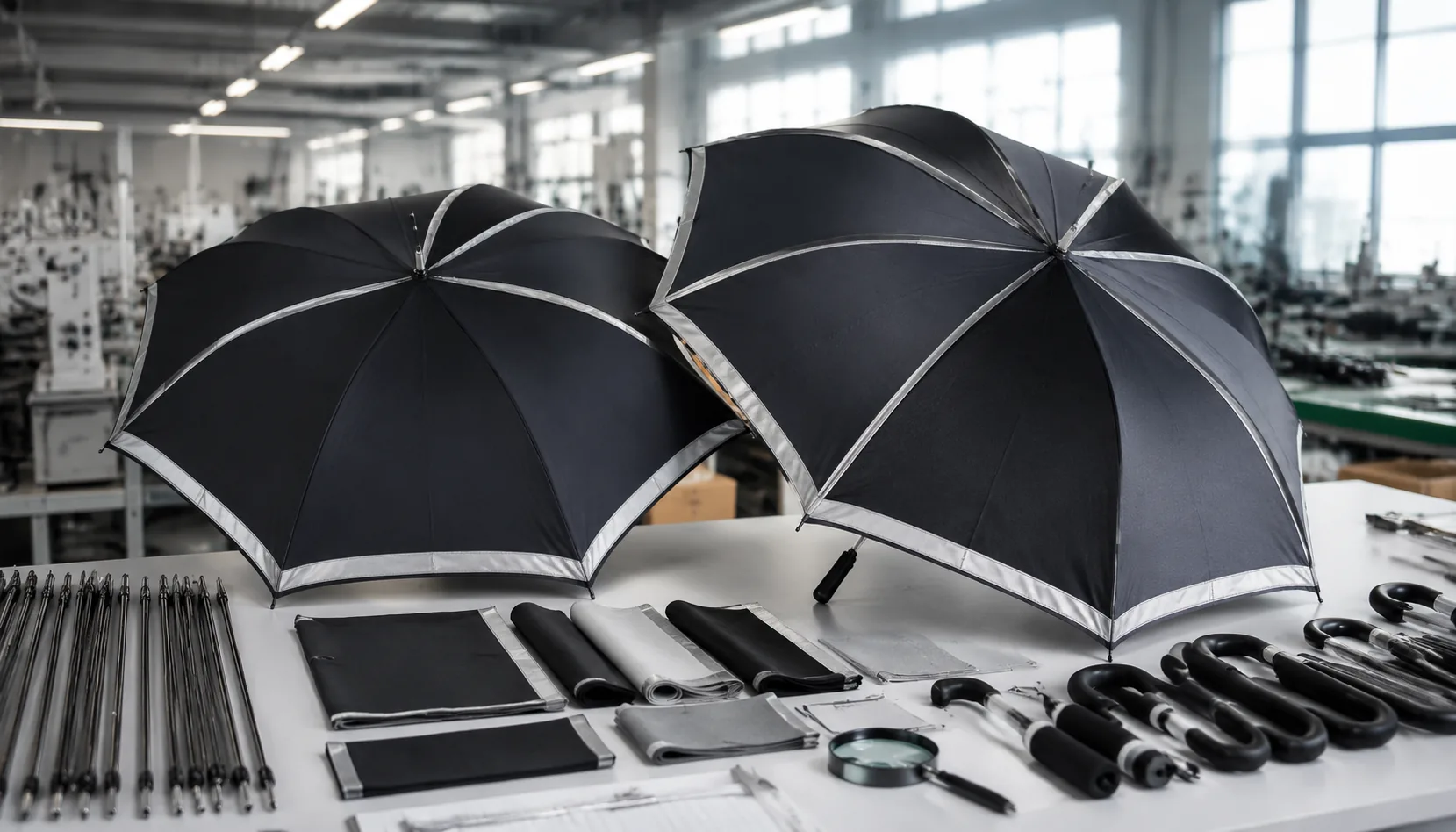
Reflective Safety Umbrellas for Corporate and Event Buyers
Specify reflective safety umbrellas with 190T pongee, fiberglass ribs, and compliant logo placement for night events, ut...
Read More »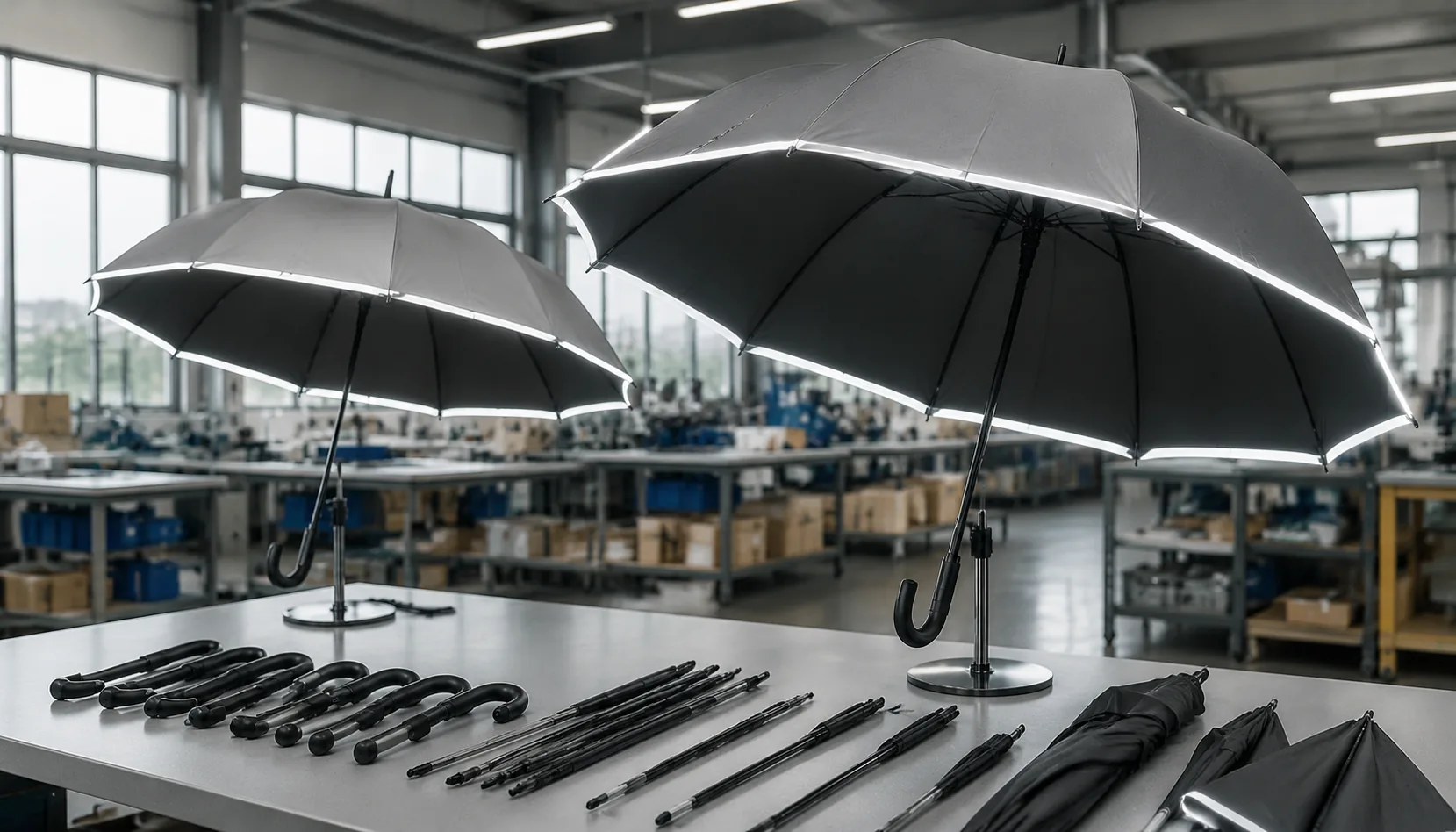
Reflective Safety Umbrellas for Corporate and Campus Programs
Specify reflective safety umbrellas with strip placement, canopy fabric, rib materials, print methods, and inspection ch...
Read More »
Reflective Umbrellas for Corporate Safety Programs
Specify reflective umbrellas for safety campaigns with 190T pongee, reflective tape placement, windproof frames, MOQ, le...
Read More »