Reflective Safety Umbrellas for Corporate and Campus Programs
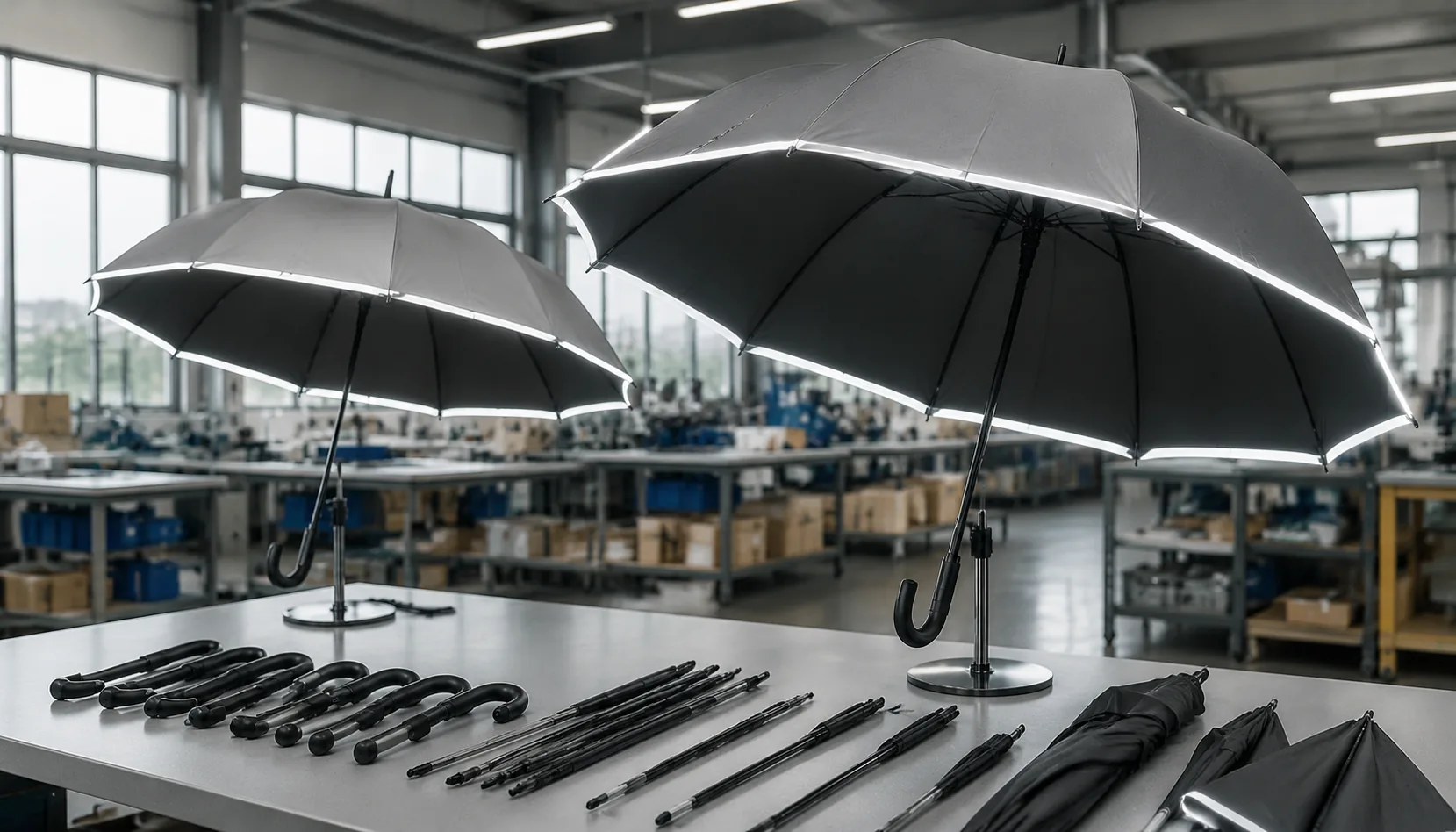
When a campus or corporate safety program orders reflective safety umbrellas bulk, the risk is not just late delivery—it is reflective tape peeling after rain, logos distorting over seams, or ribs failing during the first windy commute. On our Songxia production floor, we treat visibility, canopy tension, frame strength, and print durability as connected specs, because one weak choice can turn a useful safety item into a complaint case.
Identify Where Visibility Matters Most
Start by mapping where people are exposed to vehicle movement, poor lighting, or crowd confusion; those are the places where reflective safety umbrellas bulk orders make sense. On a university campus, the risk points are not the classroom doors but the shuttle stops, crosswalks, security patrol routes, stadium exits, and late-night residence hall paths. For factories and logistics yards, I look at dock doors, forklift lanes, truck gates, outdoor smoking areas, and shift-change walkways. A black 23" auto-open umbrella may look clean in daylight, but in rain at 7 p.m. it disappears against asphalt. Adding 10–15 mm reflective edge tape around the canopy perimeter gives drivers a moving outline, while reflective panel graphics help identify the user as staff, security, visitor support, or event crew. For campus rain gear sourcing, I usually recommend 190T or 210T pongee with fiberglass ribs in 8K or 10K layouts because the umbrella must survive repeated handout use, not just look good in a procurement photo.
Corporate safety umbrellas should be specified by job function, not just by logo size. A hotel valet team working under portico lighting needs a different product than a warehouse safety marshal crossing an open yard in side rain. For hotels and parking teams, a 27" or 30" golf umbrella with a double-canopy vented windproof frame gives better shoulder coverage and remains controllable in gusts; fiberglass ribs are worth the extra cost over painted steel because bent steel ribs create early failures after one bad storm. For plant visitors or training groups, a 23" auto-open stick umbrella is easier to issue and recover, with POE or 190T pongee depending on whether transparency or branding matters more. If the program involves reflective umbrella printing, keep reflective ink and tape away from heavy seam tension areas; poor placement cracks after folding cycles. Our standard practice at ZheBrella is to test printed reflective panels after wet folding and drying, not only under a light box.
Night events, roadshows, outdoor concerts, and emergency response drills benefit from high visibility umbrellas because umbrellas become overhead markers in a crowd. A reflective rim can help staff locate a first-aid point, registration line, VIP escort, or parking lane captain when rain reduces sightlines. For these programs, I prefer bold panel blocking with one or two fluorescent colors plus silver reflective tape, rather than a full dark canopy with a small logo. UPF 50+ coatings are useful for daytime events, but they do not replace reflective material after sunset. If the umbrella must handle wind, use a 10K fiberglass frame or a 16K premium golf frame and ask for a wind-tunnel target such as 50+ mph instead of accepting the vague word “windproof.” For reflective safety umbrellas bulk production, confirm MOQ by construction: printed 23" auto-open models may start around 500–1,000 pieces, while custom reflective tape placement, PMS canopy dyeing, or DDP delivery schedules can push lead time from 25 days to 40–50 days.
Select the Right Umbrella Structure
For reflective safety umbrellas bulk orders, structure matters more than the logo area. Straight umbrellas in 23" or 27" sizes are the workhorse for corporate safety umbrellas because they open quickly, carry well at guard stations, and give enough canopy depth for reflective edge tape or alternating high-visibility panels. A standard 8K frame is acceptable for office parking lots and visitor escorts, but I prefer fiberglass ribs over painted steel because fiberglass flexes instead of taking a permanent bend after one bad gust. Steel shafts are still fine for cost control, especially on 23" manual-open models, but exposed sites should use fiberglass ribs with reinforced tips and a secure runner. For reflective umbrella printing, a straight umbrella also keeps the canopy panels flatter than compact models, so screen printing and heat-transfer reflective marks stay cleaner around the seams.
Golf umbrellas are the better choice for campuses, factories, utility crews, and event teams that move through open ground. A 30" or 32" golf umbrella with 8K or 16K fiberglass ribs gives real coverage for one person with equipment or two people walking between buildings. The 16K build is heavier, but the load spreads better across the canopy, which helps when adding reflective binding, silver-gray safety strips, or large department logos. For high visibility umbrellas used at construction entrances, stadium gates, or campus security posts, I recommend a double-canopy vented windproof design rated around 50+ mph in controlled wind-tunnel checks. The vent releases upward pressure instead of forcing the frame inside out, and fiberglass ribs recover much better than steel after inversion. Our standard practice at ZheBrella is to pair these frames with 190T or 210T pongee plus a water-repellent coating, then inspect opening force, rib alignment, and seam tension under AQL 2.5.
Compact reflective umbrellas have a place, but they should not be treated as the main safety umbrella for exposed outdoor programs. A 21" auto-open-close compact is convenient for employee welcome kits, campus rain gear sourcing, and commuter giveaways, yet its folding ribs contain more joints, pins, and stress points than a straight or golf frame. If the buyer needs compact models, I would specify 8K fiberglass-and-steel hybrid ribs, a metal shaft with a stable telescopic lock, and reflective tape placed along the canopy edge rather than across fold lines. Full-panel reflective umbrella printing on compact canopies can crack or crease if the transfer film is too stiff, especially after repeated closing. For large programs, split the order by use case: compact models for personal carry, 23" straight umbrellas for visitor control, and 30" double-canopy golf umbrellas for security, facilities, athletics, and outdoor event staff.
Specify Fabric, Coating, and Reflective Details
For reflective safety umbrellas bulk orders, I start the specification with canopy cloth because it controls both print quality and field durability. 190T pongee is the practical baseline for corporate safety umbrellas: tight enough for clean screen printing, flexible enough for folding models, and less noisy than PVC in heavy rain. 210T pongee costs more, but it gives a smoother hand feel, better color depth on dark navy or black, and tighter registration for reflective umbrella printing when the logo sits near a seam. For high visibility umbrellas, I avoid cheap polyester taffeta unless the program is a one-day giveaway; it frays faster at the tips and looks tired after a few wet-dry cycles. Standard water repellency should be a C6 or fluorine-free WR finish depending on the buyer’s compliance policy, with beading checked after opening and closing cycles, not only on flat fabric swatches.
Coating choice should match the use case, not just the procurement spreadsheet. A Teflon-style water-repellent finish is enough for most campus rain gear sourcing, especially 23 inch auto-open and 27 inch golf umbrellas used between parking lots, dorms, and stadium entrances. If the same umbrella is used for summer security teams, outdoor admissions tours, or road crews, specify black or silver UV coating with UPF 50+ performance; this reduces heat load and turns the umbrella into year-round equipment instead of seasonal merchandise. POE, PVC, and EVA canopies are possible when a transparent umbrella is needed for security visibility, but reflective tape bonding must be tested carefully because some films wrinkle under heat transfer pressure. Our standard practice at ZheBrella is to confirm coating, print ink, and reflective material together before bulk cutting, because a good reflective strip on the wrong coating can peel during AQL 2.5 inspection.
Reflective details need measurable dimensions, not vague language like “safety trim.” For practical visibility, specify reflective piping or strip width at 10 mm minimum, with 15 mm preferred on 27 inch and 30 inch golf umbrellas because the larger canopy visually swallows narrow trim. Reflective piping along all eight panels works well on 8K frames, while 10K or 16K frames may need segmented application to keep seam tension even. For reflective logo panels, keep artwork away from rib tips and seam intersections; a 60 to 120 mm logo mark in silver reflective film usually reads better than a huge low-contrast graphic. When buying reflective safety umbrellas bulk for campuses or corporate EHS programs, I recommend one full perimeter reflective band plus a secondary reflective logo or panel mark. That layout gives drivers a moving outline in rain, while still leaving clean space for brand colors, department names, or emergency contact messaging.
Match Decoration Method to the Design
Decoration choice should start with the artwork, not the cheapest unit price. For corporate safety umbrellas with a one- or two-color logo, screen printing is still the cleanest and most durable method on 190T or 210T pongee. We normally use mesh counts matched to ink viscosity, then cure the ink so it survives wet folding without blocking. A 23" auto-open stick umbrella usually gives each panel roughly 8–10 inches of printable width, but that shrinks fast near the rib lines and seam allowance. On 8K frames the panels are wider and easier to print; on 16K frames the narrower gore shape makes large horizontal logos look chopped unless the artwork is redesigned. For reflective safety umbrellas bulk orders, I tell buyers to approve a real printed canopy sample, not only a digital mockup, because rib curvature changes the visual spacing once the umbrella is opened.
Reflective marks are better handled by heat transfer film or reflective transfer printing, especially when the buyer wants high visibility umbrellas for night commuting, parking-lot staff, school security, or event volunteers. Screen printing reflective ink can work, but the brightness is usually weaker and less consistent than certified reflective film. Heat transfer gives sharper edges on arrows, safety bands, campus names, or emergency-response icons, but the press temperature, dwell time, and pressure must be controlled so the pongee coating does not glaze or pucker. On POE or PVC clear canopies, adhesion testing matters even more because some films lift after repeated flexing. Our standard practice at ZheBrella is to run a tape test, wet rub test, and open-close cycling before confirming reflective umbrella printing for production, especially on auto-open-close folders where the canopy folds tightly around the ribs.
Placement is where many otherwise good programs fail. Keep logos and reflective strips at least 15–20 mm away from sewn seams, rib pockets, tips, and the top notch area, because ink buildup or transfer film over those stress points cracks first. On double-canopy vented windproof umbrellas, avoid printing across the vent overlap; the upper canopy moves independently in wind and can rub the decoration below. A 27" golf umbrella has enough panel depth for a wide reflective arc near the lower edge, while a 21" folding umbrella may only support small badges or vertical marks between ribs. For campus rain gear sourcing, I prefer repeating smaller reflective elements on alternating panels instead of one oversized graphic, because students carry umbrellas at mixed angles and visibility from side traffic matters. For reflective safety umbrellas bulk projects, lock the placement drawing with panel numbers, distance from tips, and logo orientation before cutting fabric, then inspect production under AQL 2.5 with both daylight and low-light checks.
Inspect Safety and Durability Before Shipment
AQL 2.5 inspection for reflective safety umbrellas bulk should start with the reflective material, not the logo. We pull samples from finished cartons and test reflective adhesion by cross-hatch tape pull, edge lifting after repeated folding, and rubbing at the panel seams where stress is highest. For reflective umbrella printing, I also check registration against the rib lines because a 3 mm shift may look acceptable flat on the table but becomes crooked when the canopy is tensioned. If the order uses silver reflective tape, segmented heat-transfer film, or reflective ink over 190T/210T pongee, the inspector should compare brightness under angled light, not only normal warehouse lighting. Weak adhesion often comes from low platen temperature, short dwell time, or moisture in coated fabric, and it will fail first after the buyer distributes the umbrellas.
Mechanical checks matter just as much as visibility, especially for corporate safety umbrellas used by construction teams, utilities, security staff, and parking crews. We measure rib opening force so the umbrella does not feel stiff or half-locked, then cycle manual, auto-open, and auto-open-close frames to catch spring fatigue, runner sticking, and latch misfire. For 23 inch and 27 inch umbrellas, steel ribs can pass basic use but add weight; fiberglass ribs or fiberglass-reinforced tips are better when buyers want wind resistance around 40–50 mph. Double-canopy vented builds need extra review at the vent stitching because loose binding can flap apart in gusts. Seam strength is checked by pulling panel joints and inspecting needle holes, skipped stitches, and thread tension, especially on coated UPF 50+ or Teflon-finished fabrics.
Before release, the shipment inspection should match the purchase order line by line: carton labeling, packed quantity, SKU color, handle type, sleeve, hangtag, barcode, and inner polybag requirements. For campus rain gear sourcing, mixed-size or mixed-logo packing causes more trouble than a small cosmetic defect because facilities teams and bookstore distributors often allocate cartons by department or event date. Our standard practice at ZheBrella is to verify master carton marks against the packing list and photograph one opened carton per SKU before sealing. High visibility umbrellas also need carton compression sense: oversized cartons let frames rub and scratch reflective panels during trucking, while over-tight cartons bend ribs and deform tips. For FOB or DDP orders, I prefer inspection after final packing but before pallet wrapping, so failed lots can still be reworked without delaying vessel cutoff.
Frequently Asked Questions
Can reflective umbrellas still carry full-color corporate logos?
Yes. The reflective element can be limited to piping or safety strips while the main logo is screen printed or heat transferred on selected panels.
Are reflective umbrellas usually more expensive than standard promotional umbrellas?
Usually yes, because reflective tape, added labor, and extra inspection steps increase cost. The difference depends on strip length, placement, canopy size, and order quantity.
Where should reflective strips be placed on safety umbrellas for better visibility?
For bulk safety programs, reflective strips are usually placed around the canopy edge, on alternating panels, or along 4 to 8 ribs. Edge placement gives 360-degree visibility, while panel strips provide larger reflective areas for pedestrians and campus users.
What fabric and frame specifications are recommended for reflective safety umbrellas?
Most B2B programs use 190T pongee or polyester canopy fabric with waterproof coating, fiberglass ribs, and a metal or fiberglass shaft. For stronger wind resistance, specify 8 or 10 fiberglass ribs and reinforced tips before production.
Can logos be printed on high visibility umbrellas without reducing the reflective effect?
Yes, logos are typically printed on non-reflective canopy panels using screen printing, heat transfer, or digital printing. Buyers should keep artwork away from reflective tape areas and request a pre-production sample to confirm brightness, logo position, and adhesion.
Looking to Launch Your Custom Umbrella Line?
ZheBrella is a Zhejiang-based OEM/ODM umbrella manufacturer with 17 years of export experience. Free design, low MOQ from 100 pieces, windproof construction, full-color print.
Get Free Quote Now »People Also Search For
Related Articles
Reflective Safety Umbrellas for Utilities and Campuses
Specify reflective safety umbrellas with practical frame, fabric, trim, logo, and inspection details for utilities, camp...
Read More »
Reflective Safety Umbrellas for Corporate and Event Programs
Specify reflective umbrellas for safety campaigns with the right fabric, rib strength, print areas, visibility details, ...
Read More »
Reflective Umbrellas for Corporate Safety Programs
Specify reflective umbrellas for safety campaigns with 190T pongee, reflective tape placement, windproof frames, MOQ, le...
Read More »