Reflective Umbrellas for Safety Promotions: Buyer Spec Guide
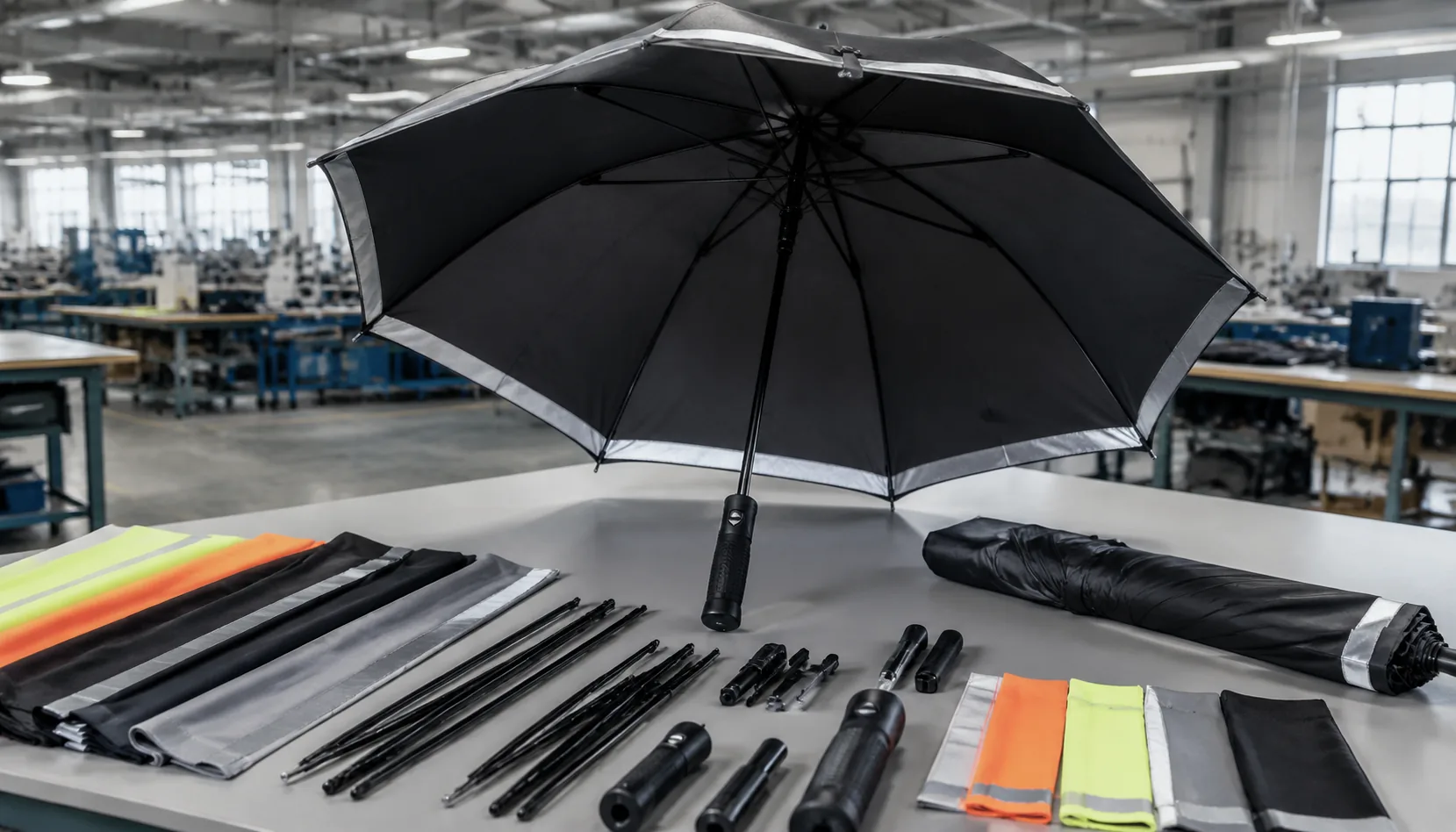
When buyers specify reflective umbrellas for promotions, the risk is not just a dull logo but weak night visibility, peeling tape, or frames that fail after a few windy uses. On our Songxia factory floor, we check reflective tape placement, pongee density, rib strength, and print adhesion before bulk packing because safety campaigns for roads, campuses, and events need umbrellas that perform in rain, traffic light, and repeated handling.
Visibility Goals and Buyer Use Cases
The first buying decision is not color or handle shape; it is the distance at which a driver, security guard, or event marshal needs to notice the umbrella. Reflective umbrellas for promotions work best when the reflective element sits on moving edges: the outer canopy perimeter, rib lines, or alternating panel seams. For road safety campaigns, nighttime charity walks, parking-lot staff, school crossings, and campus security patrols, I usually recommend a 23" or 27" umbrella with 10–20 mm reflective trim around the canopy edge. Ten millimeters is enough for a clean retail look, while 15–20 mm reads more clearly under headlights. On compact 21" auto-open-close models, too much tape can stiffen the canopy fold, so placement has to respect the rib geometry and closing mechanism.
Functional visibility trim is different from decorative silver printing. A decorative reflective print may look bright in a product photo, but if the ink layer is thin, poorly cured, or placed only as a small logo, it will not provide dependable nighttime recognition. Reflective umbrella tape is normally sewn into the canopy edge or applied along panel seams, where it catches light from multiple angles. For safety promotional umbrellas, the logo should not compete with the safety feature. Put the sponsor mark on one or two panels using screen print or heat transfer, then keep the reflective band continuous around the perimeter. Breaking the tape every panel for artwork may save a few cents, but it reduces the 360-degree visibility buyers usually expect.
Use case should also drive the base umbrella spec. For staff uniforms at transport hubs, construction entrances, stadiums, or university security teams, a 27" or 30" stick umbrella with fiberglass ribs, 8K or 10K frame, and double-canopy venting is more practical than a small folding gift umbrella. If the campaign involves volunteers carrying bags or radios, auto-open is worth specifying; for commuters, auto-open-close is easier but needs tighter QC on runner strength and spring return. Our standard practice at ZheBrella is to match reflective trim with windproof umbrella specs such as fiberglass ribs, reinforced tips, 190T or 210T pongee, and AQL 2.5 inspection, because visibility loses value if the frame fails in the first storm.
Canopy Fabric, Color, and Reflective Materials
For safety promotional umbrellas, I usually push buyers toward 190T pongee when the budget is tight and the order is for event giveaways, schools, utilities, or municipal campaigns. It sheds rain well after a standard waterproof coating, accepts screen printing cleanly, and keeps the landed cost under control on 23" and 27" stick umbrellas. The trade-off is hand feel and density: 190T has a slightly looser weave, so large solid logo blocks can show more ink absorption variation, especially on yellow or lime panels. 210T pongee costs more, but the tighter fabric gives better color uniformity, smoother heat-transfer results, and a more premium canopy surface. For custom logo umbrellas going to retail, insurance clients, construction safety programs, or police/fire outreach, 210T is usually worth the upgrade because it looks less like a disposable giveaway and holds coating more evenly after folding cycles.
Visibility is not just “make it neon.” Fluorescent yellow, orange, and lime canopies are excellent in daylight, fog, and gray rain, but they need contrast to work at night. A full fluorescent canopy with silver reflective umbrella tape on the perimeter is good; a fluorescent canopy with dark navy or black contrast panels and reflective tape is better because the reflective strip reads more clearly against the darker field when hit by headlights. For reflective umbrellas for promotions, I recommend 15–25 mm silver tape sewn along the lower edge or rib lines, not just a small reflective logo patch. Tape placement matters: perimeter tape gives a 360-degree signal for pedestrians, while vertical rib tape improves recognition from side angles. Cheap reflective film can crack after repeated closing, so specify sew-on reflective fabric tape with washing/flex test data when the umbrella will be used by commuters or field crews.
Waterproof coatings change both rain performance and print behavior. A basic PU or acrylic coating is enough for most promotional runs, but Teflon-style water-repellent finishing improves beading and reduces dirty water staining on fluorescent fabrics. For sun-and-rain programs, especially road crews or outdoor staff, specify UV coating with UPF 50+ and confirm whether the underside is silver-coated or black-coated; silver improves heat reflection but can affect the look of translucent bright colors. Our standard practice at ZheBrella is to test coated fluorescent panels before bulk cutting because some inks shift on neon orange and lime after heat transfer. If the project also includes windproof umbrella specs, pair the canopy choice with the frame: 210T pongee plus fiberglass ribs, a vented double canopy, and 8K or 10K construction is more durable than heavy coated fabric on a weak steel frame.
Frame Specs for Promotional and Field Use
For reflective umbrellas for promotions, the frame choice should start with the actual user: commuter, road crew, campus security, delivery team, or event staff. A 21" folding umbrella is easy to issue in bulk and fits in a backpack, but the shorter shaft and compact ribs take more stress in gusty rain. A 23" folding model gives better shoulder coverage and still ships efficiently, usually 48–60 pieces per export carton depending on handle and case. For field teams standing outside for hours, a 23" or 27" stick umbrella is more stable, easier to open with gloves, and less likely to be abandoned after one season. In promotional procurement, I usually push buyers away from ultra-light 6K frames; an 8K frame is the minimum I would specify for safety promotional umbrellas, especially when adding reflective umbrella tape or a heavier printed canopy.
The 8K versus 10K decision is not just about strength; it affects canopy tension, print appearance, and repair claims. An 8K frame gives a clean panel layout for custom logo umbrellas and keeps the unit cost controlled for 1,000–5,000 piece campaigns. A 10K frame spreads the load better in wind and reduces panel flutter, which matters when you need the reflective band to stay visible rather than twisting around the canopy edge. Steel ribs are cheaper and acceptable for indoor-to-parking-lot use, but they bend and stay bent after side gusts. Fiberglass ribs cost more, yet they flex back and are the better choice for field use. A common balanced spec is steel shaft, fiberglass ribs, metal runner, and POM tips; for higher durability, use a fiberglass shaft as well, especially on 27" and 30" golf-style builds.
Auto-open is worth specifying on most promotional and field umbrellas because one-hand deployment is a real safety feature when a worker is carrying samples, a radio, or traffic-control gear. For 21" and 23" folding models, auto-open is more reliable than auto-open-close if the budget is tight; the extra springs and joints in auto-open-close increase failure risk unless you pay for better components. Our standard practice at ZheBrella is to cycle-test mechanisms before bulk packing and inspect to AQL 2.5 for runner lock, rib alignment, and canopy tension. Double-canopy vented windproof builds are worth the added cost when the umbrella will be used on open campuses, parking lots, construction access points, or coastal events. They add sewing labor and material, but a properly vented 8K or 10K fiberglass frame can survive 50+ mph wind-tunnel testing, which is a more meaningful benchmark than a vague “windproof umbrella specs” claim.
Logo Placement Without Reducing Reflectivity
The safest layout for reflective umbrellas for promotions is to treat reflectivity as a functional zone, not decoration. On a standard 8-panel 23" or 27" canopy, keep reflective umbrella tape on the outer perimeter band or on alternating panel ribs where headlights hit first, then place the logo in the upper-middle of one or two panels. I usually limit a single panel logo to about 180–220 mm wide on 190T or 210T pongee, leaving at least 25–35 mm clearance from stitched seams and 40–60 mm from reflective tape. For safety promotional umbrellas used by road crews, schools, parking staff, or night events, a small repeated logo on non-reflective panels performs better than one oversized print that breaks the reflective sight line. If the umbrella uses a double-canopy vented windproof construction, do not print across the vent overlap; the moving layer will distort the artwork and can hide reflective material when the canopy flexes in wind.
Sleeves, straps, and handles are good secondary branding positions because they do not compete with the reflective zone on the canopy. A woven label or heat-transfer mark on the sleeve can carry the buyer’s logo, model code, or safety message while keeping the open umbrella clean and visible. Strap printing works best at 60–90 mm long, especially on hook-and-loop closures, but avoid placing reflective tape directly under a tight strap because repeated compression can crack lower-grade reflective film. Handles are better for molded logos, laser marking on aluminum shafts, or one-color pad print on EVA, rubberized plastic, or wood-look grips. For custom logo umbrellas, I recommend using the handle or sleeve for detailed brand marks and reserving the canopy for high-contrast blocks of reflective material, especially when the buyer is asking for UPF 50+ coating, Teflon water repellency, or heavier 210T fabric that already adds cost.
Process choice matters because reflective material does not behave like normal ink. Screen print is durable and cost-efficient for one- or two-color logos, but registration tolerance on umbrella panels is usually ±2–3 mm after sewing, so do not design artwork that must touch reflective tape perfectly. Heat transfer can reproduce gradients and small text, but it needs controlled pressure and temperature; too much heat can flatten water-repellent coatings or leave press marks on darker pongee. Reflective tape alignment across panel seams is the biggest trap: even if cutting is accurate, rib tension, seam allowance, and canopy stretching during assembly can shift the line by 3–5 mm. Our standard practice at ZheBrella is to approve a pre-production sample opened under direct light before bulk cutting, then inspect to AQL 2.5 for tape adhesion, logo position, seam matching, and opening performance. These checks belong in the same spec sheet as windproof umbrella specs such as fiberglass ribs, 8K or 10K frame, auto-open mechanism, and 50+ mph wind-tunnel target.
MOQ, Lead Time, and QC Checks
For reflective umbrellas for promotions, a realistic MOQ is usually 500–1,000 units per design when the base umbrella uses standard components: 23" or 27" shaft, 190T or 210T pongee canopy, steel or fiberglass frame, and common black, navy, yellow, or safety orange fabric. If the buyer wants custom reflective umbrella tape width, a nonstandard tape color, special handle molding, or retail packaging with barcodes, the MOQ can move to 1,200–3,000 units because trims must be purchased in full rolls or cartons. Sampling normally takes 5–7 days for a stock-frame umbrella with logo printing and 10–15 days when reflective tape placement, PMS fabric matching, or a vented double-canopy windproof structure needs engineering approval. I do not recommend approving production from a flat artwork mockup only; buyers should check an actual pre-production sample under both daylight and low-beam headlight conditions.
Bulk lead time is typically 30–45 days after sample approval and deposit, but the spread depends on the process. A simple one-color screen print on custom logo umbrellas can stay near 30 days if fabric and frames are in stock. Heat transfer, full-panel sublimation, UPF 50+ coating, Teflon water-repellent finishing, or stitched reflective tape on all eight panels pushes production closer to 40–45 days because cutting, panel alignment, and curing cannot be rushed without creating visible defects. Safety promotional umbrellas also need tighter trim control than ordinary giveaways; reflective tape must follow the canopy curve cleanly, avoid needle puckering, and remain flat after repeated open-close cycles. Our standard practice at ZheBrella is to lock the approved tape width, stitch distance, fabric lot, and handle color in the production file before issuing materials to the sewing line.
QC should be written into the purchase order, not negotiated after cartons are packed. For reflective umbrellas for promotions, I would specify AQL 2.5 for major defects and define checkpoints for reflective tape adhesion, rib strength, opening function, color consistency, and waterproof testing. Tape adhesion is checked by rub and peel tests after the canopy is flexed; poor tape will lift at panel seams or crack when folded. Rib strength should match the intended windproof umbrella specs: 8K steel is acceptable for budget events, while fiberglass ribs or a double-canopy vented frame are better when the umbrella is advertised for 40–50+ mph gust resistance. Inspectors should open and close each sampled unit multiple times, verify auto-open or auto-open-close mechanisms, check logo position tolerance, compare fabric color against the approved sample, and run spray testing to confirm no leakage through stitch lines, top notch, or reflective trim seams.
Frequently Asked Questions
Can reflective tape be sewn on every umbrella panel?
Yes, but it increases labor cost and requires careful seam alignment. Many buyers choose alternating panels or a circular edge trim to balance visibility, price, and production consistency.
Are reflective umbrellas suitable for rain and sun use?
They can be, if specified with waterproof pongee and optional UV coating. For sun-focused programs, request UPF 50+ test data rather than assuming reflective trim provides UV protection.
Where should reflective tape be placed on a promotional umbrella for the best visibility?
For road safety use, the most effective placement is along the canopy edge and on selected panel seams so the umbrella stays visible from multiple angles. Many buyers also add a small strip on the sleeve or strap for extra identification when the umbrella is closed.
What canopy material is usually recommended for reflective safety umbrellas?
190T pongee is a common choice for cost-effective bulk orders, while 210T pongee offers a denser feel and a slightly more premium look. If the campaign needs better wind performance, pair the canopy with fiberglass ribs and a reinforced shaft.
What MOQ and lead time should a buyer expect for custom reflective umbrellas?
For OEM/ODM orders, MOQ is often 300 to 500 pieces per color or design, depending on printing and tape customization. Typical production lead time is about 25 to 35 days after sample approval, with longer timelines if the order includes special packaging or complex logo placement.
Looking to Launch Your Custom Umbrella Line?
ZheBrella is a Zhejiang-based OEM/ODM umbrella manufacturer with 17 years of export experience. Free design, low MOQ from 100 pieces, windproof construction, full-color print.
Get Free Quote Now »People Also Search For
Related Articles
Reflective Safety Umbrellas: Buyer Spec Guide for Brands
Specify reflective safety umbrellas with proper tape, print zones, frame strength, and QC tests for commuter, school, an...
Read More »Reflective Safety Umbrellas for Promo Buyer Spec Guide
Specify reflective safety umbrellas with 190T/210T pongee, fiberglass ribs, reflective piping, QC checks, MOQ, and shipp...
Read More »Reflective Safety Umbrellas: OEM Buyer Spec Guide
Source reflective safety umbrellas with the right tape, print layout, pongee fabric, ribs, and QC specs for commuter, sc...
Read More »