Repeat Logo Pattern Printing on Umbrellas for Retail Brands
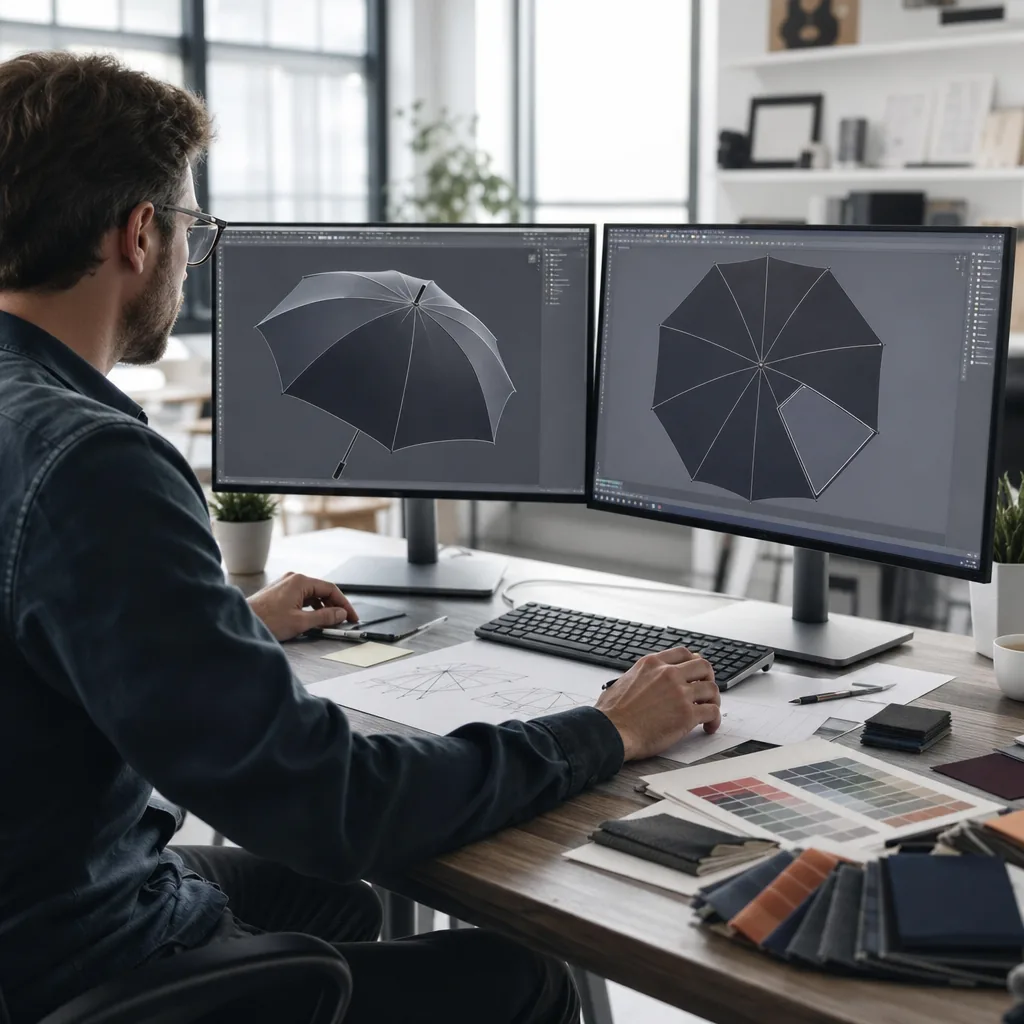
For retail brands, a repeat logo that looks sharp on a flat artwork file can become uneven once it is cut into umbrella panels, stretched over ribs, and sewn across seams. In our Songxia factory, repeat logo umbrella printing starts with checking logo scale, fabric behavior, panel layout, and color control before bulk production, because small mismatches multiply quickly across an eight-panel canopy and repeat orders.
When Repeat Logo Patterns Make Sense for Brand Programs
Repeat logo umbrella printing makes the most sense when the umbrella is part of a controlled brand program, not a one-off giveaway. Retail collections, private-label capsules, hotel lobby merchandise, museum shops, golf events, and seasonal promotional drops all benefit because the pattern turns the canopy into a recognizable SKU instead of just a logo placement. For retail umbrella branding, I usually steer buyers toward 190T or 210T pongee because it gives a smoother print face than cheaper polyester, folds cleaner, and holds color better after water-repellent finishing. On a 23" 8K stick umbrella or a 21" folding model, a repeat mark can be scaled so it remains visible when the umbrella is both open and carried closed. For hotel merchandise, black, navy, bottle green, and beige micro-patterns sell better than loud layouts because guests want something usable after checkout, not a walking billboard.
Micro-patterns and bold monogram layouts behave very differently on umbrella geometry. A subtle 8–15 mm logo repeat can hide seam shifts, which is useful on 8K canopies where each panel is wider and the eye naturally follows the rib lines. This is a safe choice for branded umbrella patterns used in fashion retail, financial services, universities, and premium corporate gifts. A bold 40–80 mm monogram repeat has more shelf impact, especially on all-over logo umbrellas, but it must be engineered around panel peaks, bottom hems, and the cap area so the pattern does not look broken at the crown. On 16K canopies, the narrower panels create a more rounded silhouette and a luxury feel, but they also multiply sewing seams, so artwork registration tolerance needs to be discussed before sampling. If the buyer expects perfect logo alignment across every rib, that must be priced as a higher-control cut-and-sew job, not standard promotional production.
For custom printed pongee umbrellas, the production method should match the pattern and order size. Screen printing is economical for simple one- or two-color repeats, but fine micro-patterns can clog if the logo strokes are too thin, especially after Teflon or UV coating is applied. Heat transfer works for crisp logos and smaller batches, while sublimation is better for complex all-over artwork on white or light fabric, provided the brand accepts polyester color behavior rather than Pantone ink sitting on top of the cloth. Our standard practice at ZheBrella is to request the open diameter, rib count, panel layout, Pantone references, logo repeat size, and whether the umbrella is manual, auto-open, or auto-open-close before making a strike-off. For retail programs, I recommend pre-production samples, AQL 2.5 inspection, and carton-level shade checks because repeat logo umbrella printing exposes small color and alignment problems faster than a single chest-style canopy logo.
Pattern Scale, Panel Shape, and Seam Interruption
The first mistake in repeat logo umbrella printing is designing the pattern as if the canopy were a flat rectangle. A standard 23" umbrella is usually built from 8 wedge-shaped panels, while golf umbrellas may use 8K or 10K layouts and larger 27" or 30" arcs. Each panel narrows sharply toward the top notch, so a perfect square repeat on screen becomes visually pinched after cutting and sewing. For retail umbrella branding, I normally ask for artwork built per panel, not only as a full circular mockup. The safe way is to place the dominant logo marks away from the top 80–120 mm and away from seam allowances, because those areas are affected by rib stitching, tip attachment, and fabric tension after the canopy is mounted.
Practical spacing matters more than most brand teams expect. For all-over logo umbrellas, a 35–60 mm logo height works well on 190T or 210T pongee when the logo has clean shapes and limited small text. For luxury-style branded umbrella patterns, 70–100 mm spacing between marks usually reads cleaner from 2–3 meters away and avoids looking like dirt or print noise in rain. Very small marks under 12–15 mm, especially thin serif letters or registered trademark symbols, can blur on 190T pongee because the woven texture, water-repellent coating, and ink spread all reduce edge sharpness. Heat transfer gives a harder edge than screen printing, while sublimation can hold fine detail better on white polyester, but none of these processes can make a tiny logo behave like it does on coated paper.
Seams will interrupt the pattern, and the buyer should decide whether that interruption is acceptable or whether panel-by-panel matching is required. True seam matching on custom printed pongee umbrellas adds labor because each wedge must be cut with registration marks, then sewn in a controlled sequence; even then, a 2–4 mm tolerance is realistic after hemming and rib assembly. Our standard practice at ZheBrella is to show a panel template with seam allowance, rib line, top cap zone, and tip zone before sampling repeat logo umbrella printing. If the design uses diagonal stripes, monograms, or checker repeats, we recommend adding intentional breaks or offset repeats so small sewing variation looks designed instead of defective. For mass retail orders under AQL 2.5 inspection, that choice prevents unnecessary rejection over normal textile movement.
Choosing Fabric and Print Method for Pattern Clarity
Pattern clarity starts with fabric density, not the artwork file. For custom printed pongee umbrellas, 190T pongee is the common promotional-grade choice because it is light, folds cleanly, and accepts screen ink well when the repeat is a one- or two-color mark. But the weave is slightly more open, so very small logos, thin serif type, and tight spacing can look soft after the canopy is cut, sewn, and tensioned on 8K or 10K frames. 210T pongee gives a smoother face and better edge definition, especially for retail umbrella branding where the logo repeats across every panel and the buyer expects shelf-ready consistency. Plain polyester is cheaper, but I only recommend it for larger motifs because the hand feel is rougher and ink can sit unevenly on lower-grade yarns. Our standard practice at ZheBrella is to test the repeat at actual panel size before bulk cutting, because a pattern that looks sharp on a flat strike-off may distort near the rib seams and ferrule point.
Screen printing is still the most stable method for simple branded umbrella patterns: single-color repeats, two-color monograms, checker layouts, or evenly spaced icons. A proper screen print with the right mesh count and squeegee pressure gives strong opacity on navy, black, forest green, and other dark 190T or 210T pongee colors. It is also efficient for 1,000 to 5,000 pieces because setup cost is spread across the run. The limitation is registration. On all-over logo umbrellas, every color needs its own screen, and alignment across curved umbrella panels is less forgiving than on T-shirts or flat bags. If the design uses hairline outlines, overprints, or logos crossing panel seams, I would simplify the repeat or keep each logo fully inside the panel cut line with at least 10 to 15 mm seam allowance. That avoids broken marks after sewing and reduces AQL 2.5 rejection risk for misregistration.
Digital printing is the better route for repeat logo umbrella printing when the artwork includes gradients, photographic textures, three or more colors, or tone-on-tone luxury patterns. Sublimation on white polyester or white pongee gives the cleanest color transition because dye penetrates the fibers instead of sitting heavily on top. For dark fabric, heat-transfer or digital film methods can work, but the hand feel is thicker and large coverage may affect folding. Coated UPF 50+ fabrics need special attention: silver, black glue, or UV-coated backs can change heat behavior, and too much temperature may cause coating marks or panel shrinkage. For retail programs, I prefer printing first, then applying compatible water-repellent finishing such as Teflon-type treatment when the process allows. The buyer should approve a lab dip, print strike-off, and one fully assembled pre-production umbrella, not just a fabric swatch, because canopy tension, light transmission, and wet-rub performance all influence final pattern sharpness.
Sampling, Color Control, and Bulk Production Checks
Strike-off samples are where repeat logo umbrella printing is either controlled or allowed to drift. Before cutting bulk fabric, we print a narrow run on the actual canopy material—usually 190T or 210T pongee for retail orders, sometimes POE or PVC when the buyer wants a transparent fashion umbrella. The strike-off must show the logo scale, repeat spacing, rotation direction, and edge bleed across a full panel width, not just a small swatch. For branded umbrella patterns, I always ask buyers to approve both a flat fabric sample and one finished umbrella, because a pattern that looks straight on the table can distort once stitched over 8K or 10K ribs. Pantone references should be listed for every logo color, but buyers need to understand that coated pongee, sublimation, screen printing, and heat transfer do not reflect color the same way. Our standard practice at ZheBrella is to set an acceptable color tolerance before production, usually Delta E 2.0–3.0 for retail branding work.
Print density checks matter more on all-over logo umbrellas than on a single-panel promotional print because small density changes repeat dozens of times across the canopy. On dark 210T pongee, white underbase thickness must be checked, especially with screen printing, or the logo becomes gray after curing. With sublimation, we check temperature, dwell time, and pressure so the ink penetrates evenly without ghosting or edge blur. For custom printed pongee umbrellas, the pre-production approval should include open-canopy photos, close-up logo photos, seam-crossing checks, and a folded-view check because retail umbrella branding is judged both open on the street and closed on the store shelf. I also recommend approving the handle, sleeve, woven label, hangtag, and carton mark at the same time. Many delays happen when the canopy is approved but the sleeve logo uses a different Pantone, or the barcode label conflicts with the retailer’s packing guide.
Bulk inspection should be written into the purchase order instead of negotiated after defects appear. Under AQL 2.5, inspectors should check print smudging, ink transfer, pinholes, color deviation, missing logo repeats, panel orientation, and whether the pattern lines up reasonably across sewn seams. Umbrella-specific checks are just as important: rib alignment, runner smoothness, top notch fixing, ferrule tightness, stitch density, strap position, and whether the canopy tension is balanced when opened. For repeat logo umbrella printing, one reversed panel can ruin the entire visual rhythm even if the fabric quality is acceptable, so panel direction needs to be checked before sewing and again after final assembly. We normally pull samples from early, middle, and late production cartons because color and density can shift when screens wear, transfer paper lots change, or operators adjust curing temperature. Final reports should include photos under consistent lighting, not only pass/fail notes.
MOQ, Lead Time, and Cost Drivers for Repeat Prints
MOQ for repeat logo umbrella printing is mainly driven by how much ink and setup risk you put on the canopy, not just the umbrella size. A small step-and-repeat on one or two panels may run at 500–1,000 pcs per design, while all-over logo umbrellas usually start closer to 1,000–3,000 pcs because every cut panel must match the approved print direction and density. Color count matters: a one-color screen print is cheaper and easier to control than a 4-color pattern with tight registration. For 8K or 10K 23-inch umbrellas, each canopy has 8 or 10 separate fabric panels, so the same logo pattern must be positioned consistently across more sewing seams. A 16K fashion umbrella looks premium, but it doubles the number of panel edges where misalignment can show, so labor and inspection time increase.
Fabric choice changes both the print method and the reject rate. Custom printed pongee umbrellas in 190T or 210T polyester are the standard for retail because the fabric cuts cleanly, accepts screen printing, heat transfer, and digital sublimation well, and works with Teflon or UV UPF 50+ coatings. POE, PVC, and EVA can carry branded umbrella patterns, but they need different ink systems and longer drying or curing time, especially if the logo repeats near folds. Dark canopies with light logos often require a white underbase, which adds one print pass and raises cost. Full-coverage repeat patterns also use more ink and more QC time because we inspect for pinholes, color variation, ghosting, and logo distortion after stitching, not only on flat fabric.
For B2B planning, treat 25–45 days after artwork, sample, and pre-production approval as a realistic production window for retail umbrella branding. Simple one-color repeat prints on stock 190T pongee and manual-open steel frames can be closer to 25–30 days; custom PMS colors, fiberglass ribs, auto-open-close mechanisms, double-canopy windproof structures, or retail packaging push the schedule toward 40–45 days. FOB Ningbo or Shanghai quotes are the cleanest for comparing factory cost, while DDP quotes should include duty, inland trucking, destination delivery, and carton dimensions. Our standard practice at ZheBrella is to confirm carton labeling before mass production: SKU, PO number, colorway, quantity, gross/net weight, carton size, country of origin, and any retailer barcode or FBA label requirements. Bad labeling does not change the umbrella, but it can delay warehouse receiving and chargebacks.
Frequently Asked Questions
Can the logo pattern align perfectly across every umbrella seam?
Not perfectly in most bulk production because umbrella panels are wedge-cut and sewn under tension. A good factory will design the repeat so minor seam movement is not noticeable.
Is 210T pongee better than 190T for repeat logo printing?
210T pongee usually gives a smoother hand feel and slightly cleaner print edge. 190T can still work well for larger repeats, especially when budgets or promotional MOQs are tight.
What repeat size works best for a retail umbrella canopy without making the logo look crowded?
For most 23 to 27 inch canopies, a logo repeat of about 3 to 6 inches usually balances visibility and spacing. Smaller repeats can blur at distance, while larger repeats may break awkwardly at panel seams unless the artwork is engineered panel by panel.
Can repeat-logo artwork be matched across every seam on all umbrella panels?
Yes, but it requires panel-specific layout files rather than a single generic repeat tile. Buyers should expect extra prepress time and should approve a panel map before sampling, especially for 8-panel or 10-panel fashion umbrellas.
What QC checkpoints should buyers request before approving bulk production for all-over printed umbrellas?
Ask for a strike-off, a full canopy sample, and close-up photos of seam joins, logo orientation, and color consistency under daylight. For repeat orders, it is also smart to lock a color standard and confirm fabric lot control, because shade variation between batches is one of the most common bulk issues.
Looking to Launch Your Custom Umbrella Line?
ZheBrella is a Zhejiang-based OEM/ODM umbrella manufacturer with 17 years of export experience. Free design, low MOQ from 100 pieces, windproof construction, full-color print.
Get Free Quote Now »People Also Search For
Related Articles
All-Over Pattern Printing for Retail Umbrella Collections
Build retail umbrella patterns with clean repeats, controlled panel alignment, and fabric choices that keep logos sharp ...
Read More »
Step-and-Repeat Umbrella Patterns for Retail Branding
Plan repeat-pattern umbrellas with the right logo scale, panel layout, fabric choice, and QC checks for clean retail bra...
Read More »
All-Over Logo Patterns for Retail Branded Umbrellas
Build all-over logo umbrella patterns with repeat sizing, panel registration, and fabric specs that reduce distortion, s...
Read More »