Step-and-Repeat Umbrella Patterns for Retail Branding
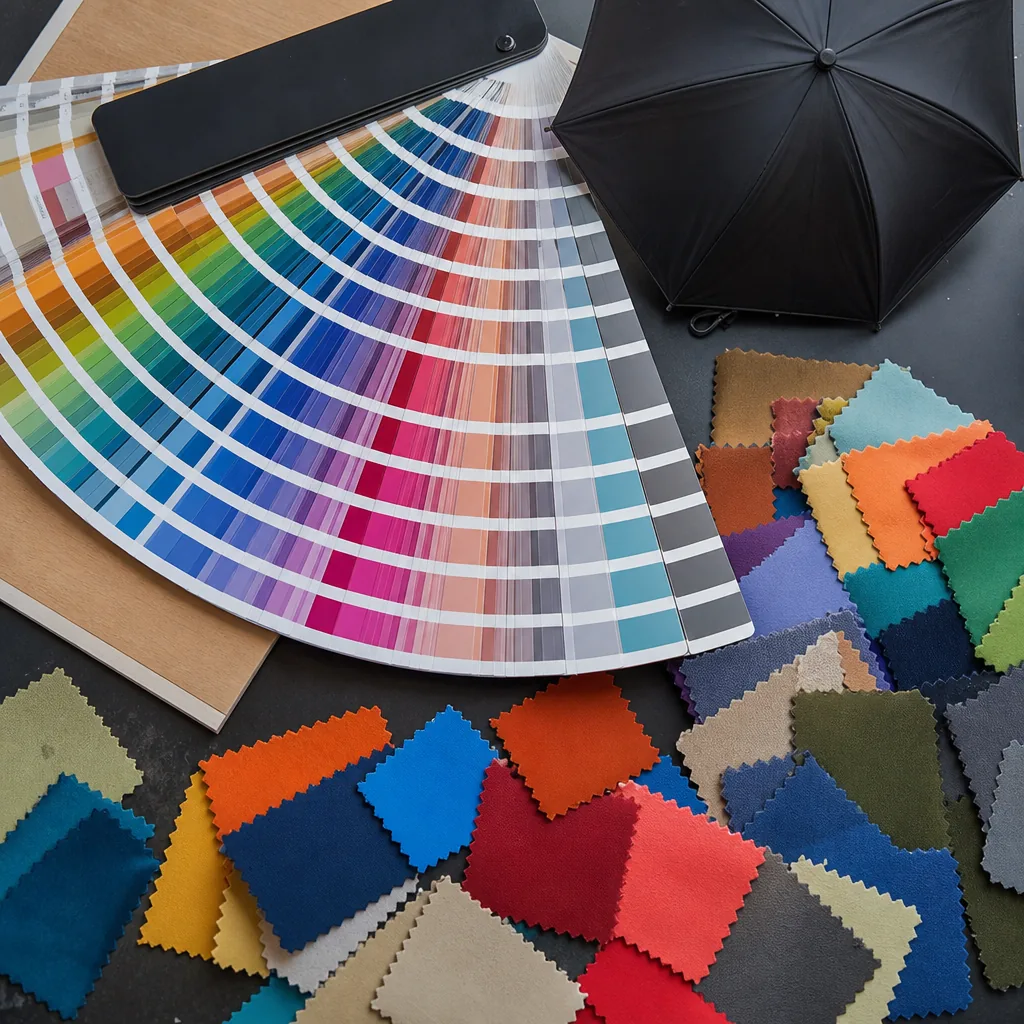
Retail buyers often approve a neat digital mockup, then discover at bulk production that the logo repeat breaks across seams, distorts on curved panels, or loses contrast after coating. On our Songxia factory floor, step and repeat umbrella printing starts with panel geometry, fabric behavior, ink system, and sewing tolerance—not just artwork placement. Getting those details right early keeps branded umbrellas consistent from sample to carton.
Map the Pattern to Umbrella Construction
Panel count decides whether a repeat looks intentional or chopped up. On a standard 8K umbrella, the canopy is eight triangular panels, so every logo repeat has to survive eight seam breaks and eight rib lines radiating from the top notch to the tips. A 23-inch stick umbrella gives roughly 46 inches of arc across the open canopy, but each panel narrows hard toward the cap, so a 2.5- to 3.5-inch logo usually reads better than a large mark repeated too close to the center. On 16K frames, the canopy has twice as many narrower panels, which makes branded umbrella patterns feel more continuous around the circumference, but it also doubles the number of seam interruptions. That matters for retail umbrella branding because a repeat logo umbrella viewed on a rack is usually seen from one or two front panels first, not from a perfect overhead angle.
Center-out planning is the safer way to build step and repeat umbrella printing artwork. We place the visual grid from the top cap outward, then check where each logo falls against stitch allowance, rib pockets, and panel joins before cutting the fabric. If the artwork is built as a flat rectangle and forced onto triangular panels later, small logos often drift into seams, while diagonal repeats can flip awkwardly between left and right panel halves. For printed pongee umbrellas, especially 190T or 210T pongee with screen print or heat-transfer logos, we normally keep critical logo details at least 10 to 15 mm away from cut lines and 20 mm away from the center cap area. The top center is not a clean display zone; it has fabric gathering, washer pressure, cap hardware, and visible distortion after tensioning.
Logo orientation should follow how the umbrella will be sold and photographed. For an 8K retail canopy, I usually recommend one hero orientation across the front two panels and a smaller repeat running around the remaining panels, so the brand reads clearly when the umbrella is closed, opened, and placed in a store bin. For 16K, radial orientation can work better because each wedge is narrow; alternating upright marks on every other panel prevents the canopy from looking like a spinning wheel. Step and repeat umbrella printing also needs a closure check: when the umbrella is folded, only a few panel strips remain visible, so at least one logo should land cleanly between ribs on the wrap-facing side. Our standard practice at ZheBrella is to approve a panel-by-panel layout proof, not just a full-circle mockup, before sublimation, screen printing, or heat-transfer production.
Choose Fabric and Print Method for Sharp Repeats
For sharp branded umbrella patterns, I usually start with 210T pongee when the repeat is small, tight, or typography-heavy. The yarn count gives a smoother face than 190T, so fine logo edges do not look as fuzzy after sewing tension and canopy stretching. A 190T pongee canopy is still a solid retail choice for 23" and 27" umbrellas, especially when the repeat logo umbrella layout uses larger marks spaced 80-120 mm apart. It has a slightly softer, lighter hand feel and can reduce cost on high-volume promotional runs. But when buyers ask for step and repeat umbrella printing with small icons, thin serif text, or tone-on-tone background marks, 210T holds registration better and looks more premium under store lighting. For rain performance, both fabrics can take water-repellent treatment, but 210T with Teflon coating gives better ink holdout because less pigment sinks into the weave before curing.
Screen printing is still the cleanest method for bold retail umbrella branding when the repeat uses 1-3 spot colors and the logo spacing is not too dense. On 190T or 210T pongee, a properly tensioned screen can print opaque white, metallic silver, or PMS-matched brand colors with strong durability, but every extra color means another screen, another alignment risk, and more setup cost. For a full 8-panel canopy, I avoid screen printing if the repeat crosses seam lines too aggressively, because even a 2-3 mm sewing variance becomes visible. Digital printing is more practical when the artwork has gradients, many colors, small marks, or photographic texture. It works especially well on printed pongee umbrellas for fashion retail, but color management must be checked by strike-off sample, not just a PDF proof.
Heat transfer is useful for short runs, event launches, and complex logos where MOQ cannot justify screens, but it is not my first choice for dense all-over repeats. Transfer film can feel slightly heavier on the hand, especially on compact 21" folding umbrellas where the canopy is folded tight around steel or fiberglass ribs. It performs better for panel logos, border repeats, or limited step and repeat umbrella printing than for a fully covered luxury pattern. Sublimation is excellent for polyester pongee when the design needs continuous color and soft hand feel, but the base fabric must be prepared correctly and dark grounds need careful testing. Our standard practice at ZheBrella is to run a pre-production canopy panel first, then check color fastness, seam distortion, water beading, and AQL 2.5 appearance defects before cutting bulk fabric. That sample step saves more money than arguing about artwork after 5,000 canopies are sewn.
Control Scale, Color, and Visual Distance
Logo scale decides whether a repeat looks premium or noisy. For close-up retail shelves, I usually keep each logo mark in the 35–60 mm range on 21" and 23" printed pongee umbrellas, with 80–120 mm spacing between repeats so the eye reads a pattern, not a wallpaper mistake. For a repeat logo umbrella meant to be recognized outdoors, especially on 27" or 30" golf sizes, push the mark to 90–140 mm with wider spacing, because a 40 mm logo disappears once the canopy is 10–15 feet from the shopper. On 8K and 10K frames, avoid placing key artwork across rib seams; a centered repeat inside each panel prints cleaner and survives sewing variation better. Step and repeat umbrella printing works best when the buyer approves both a flat layout and a mocked-up dome view, because the canopy curve visually compresses logos near the crown.
Color control should be specified before sampling, not argued after bulk production. For solid brand colors, provide Pantone Coated references plus Lab values under D65 lighting; our standard practice at ZheBrella is to target ΔE ≤ 2.0 for screen print and heat transfer, and ΔE ≤ 3.0 for sublimation on 190T or 210T pongee because fabric absorption and coating change the final read. If the umbrella uses Teflon water-repellent or UV UPF 50+ coating, test the print stack together, not separately, since some coatings dull reds, navy, and fluorescent tones. For retail umbrella branding, I recommend a strike-off on the actual canopy fabric, not a paper proof, with approval checked after drying, light rubbing, and a basic water-spray test. PVC, POE, and EVA clear canopies need separate ink systems, so do not assume the same Pantone match from pongee will transfer cleanly.
Contrast planning is where many branded umbrella patterns fail. On black, navy, forest green, or burgundy canopies, use white underbase for bright logos, or accept that yellow, red, and light blue will darken without it; for shelf impact, keep contrast at least 60% lightness difference in Lab terms when possible. On white, ivory, silver, or pastel canopies, thin gray and pale metallic repeats can look refined indoors but wash out outdoors, so increase logo weight by 10–15% or choose a darker ink. Tone-on-tone repeats are safest when the logo sits 6–12 Lab lightness points away from the canopy, enough to appear under store lighting without looking like a defect. For step and repeat umbrella printing on double-canopy vented windproof models, treat the outer and inner canopy separately, because shadow from the vent layer can shift the perceived color and make a subtle repeat look muddy.
Build Sampling Into the Approval Path
Do not approve step and repeat umbrella printing from a flat PDF only; the pattern changes once it crosses eight panels, curved ribs, and stitched seams. On a strike-off sample, first check repeat registration from panel to panel, especially across the two seams most visible when the umbrella is fully open. For a repeat logo umbrella, I normally allow minor tolerance inside one panel, but not a logo that jumps 5 mm across a seam or lands half-cut at the center cap. Confirm the artwork scale on the actual canopy size, whether it is a 21 inch folding umbrella, 23 inch stick umbrella, or 27 inch golf model, because a pattern that looks balanced on a 23 inch frame can look crowded on a 30 inch double-canopy vented umbrella. For printed pongee umbrellas, 190T and 210T fabric absorb ink differently, so color density and edge sharpness must be judged on the final fabric, not a substitute swatch.
Seam alignment is where many branded umbrella patterns fail in production. Ask the factory to open the strike-off fully, photograph it from above, then rotate it 45 degrees and photograph again under neutral light. That shows whether logos line up along the rib channels, whether the center tip distorts the pattern, and whether the opening appearance still reads clean from retail display distance. For retail umbrella branding, I also check the umbrella half-open, because stores often merchandise umbrellas in barrels or wall racks where only part of the canopy is visible. If the design includes a border, diagonal stripe, or dense monogram field, confirm how it behaves near the ferrule, runner, and panel tips. Our standard practice at ZheBrella is to mark one approved strike-off as the production control sample and keep it beside the cutting table during bulk canopy cutting.
Wet-rub resistance and accessory consistency should be approved before bulk fabric is released, not after 3,000 canopies are sewn. For screen print and heat-transfer work, rub the printed area with a damp white cotton cloth for 10 cycles and check for ink lift, smearing, or color transfer; for sublimation on white pongee, look for ghosting and edge blur after drying. Also confirm the sleeve uses the same repeat direction, logo scale, label placement, snap color, and drawstring or Velcro detail as the umbrella body. A sleeve cut from random printed fabric may technically match, but it can look careless in retail packaging. Typical strike-off lead time is 5-10 days after artwork, Pantone references, frame size, and fabric are confirmed. Bulk approval should only start after the buyer signs off on the physical sample, because correcting repeat registration after cutting usually means scrapping printed fabric, not making a small sewing adjustment.
Set Production QC and Shipping Terms
AQL 2.5 is the right default for retail umbrella branding because print placement problems are usually more expensive than frame defects once cartons are already in the warehouse. For step and repeat umbrella printing, I would set separate checkpoints for canopy artwork and mechanical function: logo repeat pitch measured against the approved strike-off, color checked under D65 light or a defined Pantone tolerance, and panel alignment checked from tip to tip after the canopy is tensioned on the frame. Missing panels, upside-down panels, or mixed left/right repeats should be treated as major defects, not minor cosmetic issues. On printed pongee umbrellas, especially 190T and 210T polyester, inspectors should look for ink bleeding at seam allowances, ghosting from heat transfer, registration drift over curved panels, and skewed repeats where the logo climbs more than 3-5 mm across one panel.
Frame function still needs to be inspected with the same discipline as the branded umbrella patterns, because a good print on a weak frame becomes a return. For a typical retail order, the inspection list should include manual, auto-open, or auto-open-close operation for 3-5 cycles; runner lock strength; rib tip security; seam pull at high-stress points; cap and ferrule tightness; and carton drop or compression checks if the umbrellas are going into club stores or e-commerce fulfillment. Steel ribs are cheaper but bend more easily in transit, while fiberglass ribs are better for windproof 8K or 10K models, especially if the repeat logo umbrella design wraps across a double-canopy vented construction. Our standard practice at ZheBrella is to approve a pre-production sample, then inspect bulk goods after final packing so AQL findings reflect the same folded, sleeved, and cartoned condition the buyer will receive.
MOQ and shipping terms should be fixed before artwork sampling, not after the factory has already separated fabric lots. Common MOQs are around 500-1,000 pieces per design for screen or heat-transfer work, higher if the buyer needs custom-dyed pongee, custom handles, or multiple SKU colorways. Bulk lead time is usually 30-45 days after deposit and artwork approval, but add 7-10 days if the buyer needs lab testing for UPF 50+, Teflon coating, REACH, Prop 65, or retailer packaging validation. FOB Ningbo or Shanghai works well for experienced importers who control consolidation and customs clearance; DDP is cleaner for retail buyers without a freight team, but the quote must define duty, last-mile delivery, appointment fees, and whether cartons ship by sea, air, or rail. Step and repeat umbrella printing looks simple on a mockup, but QC terms and Incoterms decide whether the order lands as a sellable retail program or a warehouse problem.
Frequently Asked Questions
What is the safest logo size for a repeat-pattern umbrella?
For most 8K umbrellas, small repeat logos often work best at 25-50 mm wide so the pattern reads cleanly across seams. Larger marks need a panel map to avoid partial logos at rib positions.
Can step-and-repeat printing work on windproof umbrellas?
Yes, but double-canopy windproof models require separate artwork planning for the outer and inner canopy layers. The vent overlap can hide part of the repeat, so sampling is important before bulk production.
What logo size works best for a step-and-repeat umbrella pattern?
For retail umbrellas, most repeat logos work well at 2 to 5 inches wide, depending on canopy size and viewing distance. Smaller logos create a cleaner fashion pattern, while larger repeats are better for high-visibility brand promotion.
Can the repeat pattern align across umbrella panels?
Exact alignment across all panels is difficult because each panel is cut and sewn individually, but artwork can be planned so the repeat looks balanced after assembly. A pre-production sample is recommended before mass production.
What QC checks are important for printed pongee umbrellas?
Key checks include print color matching, logo sharpness, panel orientation, seam placement, water-repellent finish, and opening/closing function. For bulk retail orders, AQL inspection is commonly done before shipment.
Looking to Launch Your Custom Umbrella Line?
ZheBrella is a Zhejiang-based OEM/ODM umbrella manufacturer with 17 years of export experience. Free design, low MOQ from 100 pieces, windproof construction, full-color print.
Get Free Quote Now »People Also Search For
Related Articles
Step-and-Repeat Logo Patterns for Promotional Umbrellas
Plan repeat-logo umbrella artwork with correct scale, panel breaks, 190T/210T fabric choices, proofs, MOQ, lead times, a...
Read More »
All-Over Pattern Printing for Retail Umbrella Collections
Build retail umbrella patterns with clean repeats, controlled panel alignment, and fabric choices that keep logos sharp ...
Read More »
Step-and-Repeat Umbrella Logo Patterns for Campaigns
Plan repeat-logo umbrella layouts across 8K or 16K panels with cleaner seams, better spacing, accurate samples, and smoo...
Read More »