Repeat Pattern Printing for Private-Label Umbrella Lines
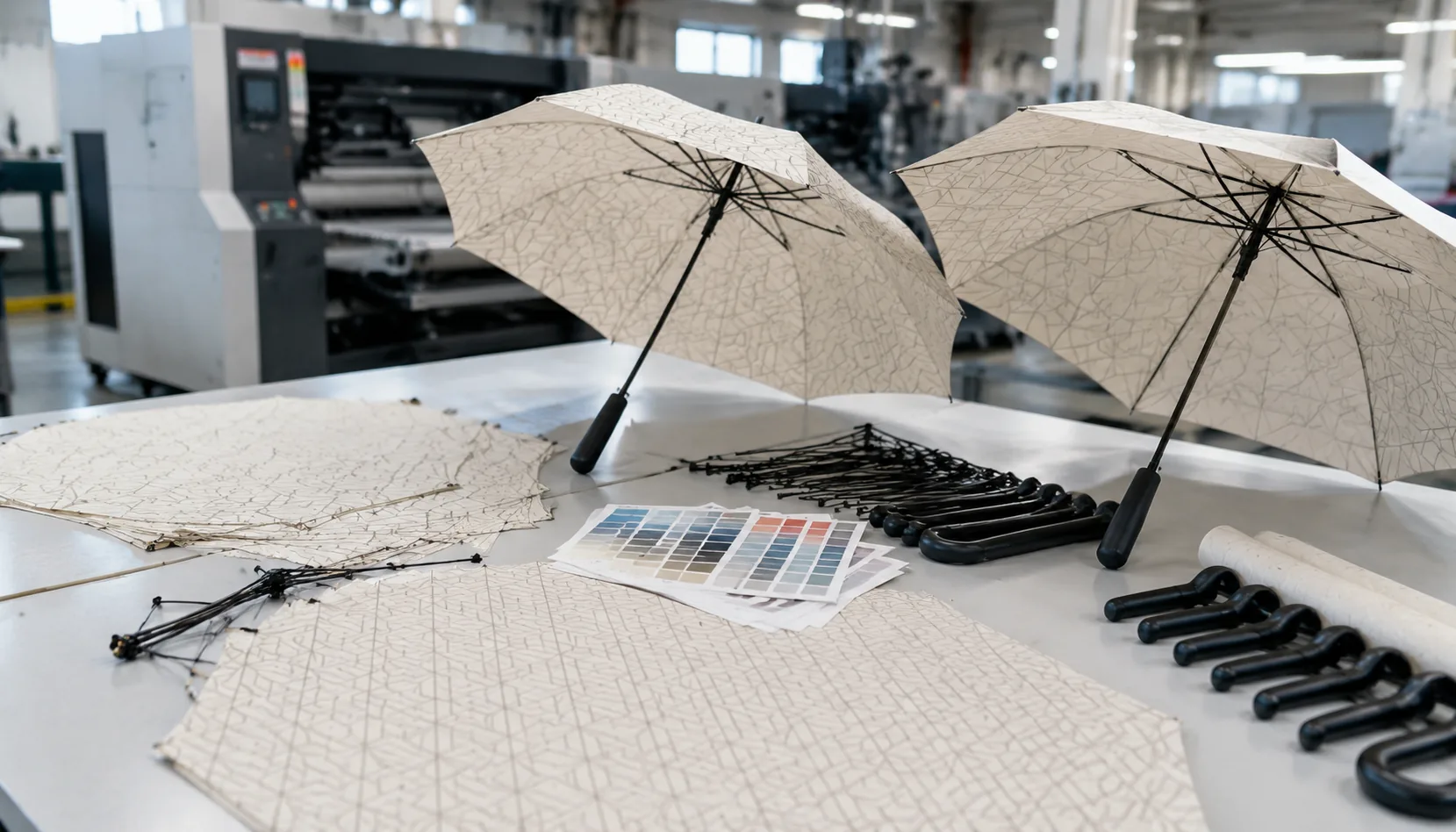
For private-label umbrella lines, a repeat print that looks clean on a flat proof can still drift across eight cut panels once fabric stretch, seam allowance, and canopy tension enter the line. In repeat pattern umbrella printing, buyers need to lock artwork scale, fabric behavior, cutting direction, and inspection limits before bulk production, or small mismatches become retail returns. On our Songxia floor, the difference is usually decided at panel nesting, first-piece matching, and final open-canopy checks.
When Repeat Patterns Fit a Brand Line
Repeat pattern umbrella printing fits best when the umbrella is treated as a retail product, not a giveaway with a logo slapped on one panel. Lifestyle stores, museum shops, boutique hotels, resort chains, and licensed character programs usually need an allover umbrella print because the buyer is selling a mood or collection story. A 23" auto-open stick umbrella in 190T pongee can carry a floral, toile, animal, or geometric repeat cleanly across 8K panels, while a 21" compact auto-open-close style may need smaller repeat scale because the folds break the artwork more aggressively. For private label umbrellas, I usually push clients to define the use case first: a museum shop wants faithful color and artifact detail, a hotel wants quiet brand recognition, and a seasonal retail line may care more about shelf impact than exact motif placement.
Repeat artwork behaves very differently from a simple logo because an umbrella is built from separate triangular panels, not one flat sheet. Umbrella panel artwork has to account for seam allowance, rib position, panel grain, and how the canopy looks when both open and closed. A stripe that looks perfect in a PDF can jump badly at the seam if the repeat is not mirrored or indexed panel by panel. On 8K umbrellas the pattern has eight visual breaks; on 10K or 16K frames the repeat becomes smoother but cutting and sewing control must be tighter. For an allover umbrella print, we normally ask for vector files or 300 dpi raster artwork at full scale, then create a panel template with bleed, usually 8-12 mm beyond the stitch line, so the finished canopy does not show white gaps after sewing.
Retail umbrella branding works when the repeat, frame, and fabric are specified together. Sublimation on white 190T or 210T pongee gives the best color range for seasonal collections and licensed patterns, while screen printing is better for limited-color repeats with sharp solids; heat transfer is rarely my first choice for full-canopy repeats because folded edges can feel stiff. PVC, POE, and EVA transparent canopies need different ink systems and are less forgiving when patterns cross seams. Our standard practice at ZheBrella is to approve one pre-production sample before bulk cutting, then inspect canopy alignment, color tolerance, rib attachment, and open-close function under AQL 2.5. For FOB orders, realistic lead time is usually 25-35 days after sample approval; DDP programs with retail packaging and carton marks should allow more time, especially when MOQ starts around 500-1,000 pieces per design.
Building Artwork for 8K and 16K Panels
Accurate repeat pattern umbrella printing starts with the rib count, not the artwork file. An 8K umbrella has eight triangular gores, so each panel is wider and gives the pattern more room to breathe; a 16K frame divides the canopy into sixteen narrower slices, which can make a floral, stripe, logo scatter, or geometric repeat look twice as busy after sewing. For private label umbrellas, I ask for umbrella panel artwork built on the actual finished canopy size: common 23" straight umbrellas, 27" golf umbrellas, and 30" oversized models all need different panel arcs and center-tip angles. Do not send only a square repeat tile and expect the factory to guess placement. The print engineer needs one full canopy layout, individual panel templates, and a repeat reference so the cutting table, sublimation press, or screen-print jig follows the same logic.
Seam allowance is where many allover umbrella print designs fail. On most 190T or 210T pongee canopies, we reserve about 8–10 mm per sewn edge, and the visible safe zone should stay at least 12–15 mm away from ribs, tips, and the top cap area. Text, QR codes, small retail marks, and fine outlines should not sit across panel seams unless the buyer accepts distortion. With heat-transfer and sublimation, fabric stretch and sewing tension can shift a repeat by 2–4 mm; with screen printing, registration tolerance depends heavily on whether we print flat panels before assembly or print a finished canopy. Our standard practice at ZheBrella is to mark seam allowance, visible area, rib line, top notch, and bottom hem separately on the template before approving retail umbrella branding artwork.
Orientation control matters more on 16K umbrellas because every narrow panel changes the visual rhythm. A logo pattern that looks balanced on an 8K canopy may become choppy on 16K unless the repeat scale is reduced and rotated deliberately. Directional designs—arrows, animals, monograms, diagonal stripes, city maps—need a clear top-to-bottom orientation for every panel, especially when alternating panels use mirrored artwork. For premium private label umbrellas, I prefer a numbered panel layout from P1 to P8 or P1 to P16, with a small thumbnail showing the assembled canopy view. That avoids upside-down logos at the back panel and prevents a half-drop repeat from breaking at the front seam. For 16K repeat pattern umbrella printing, test a 1:1 paper plot or digital canopy mockup before bulk cutting; fixing scale after 3,000 panels are printed is expensive and usually impossible without reprinting fabric.
Choosing Fabric and Print Method
Fabric choice decides whether repeat pattern umbrella printing looks like a retail program or a giveaway item. For cost-controlled private label umbrellas, 190T pongee is the practical baseline: tight enough for clean cutting, stable through panel sewing, and usually acceptable for 21" and 23" compact umbrellas where the buyer is watching unit cost. It takes digital, heat-transfer, and screen print reasonably well, but the hand feel is a little drier and the surface can show more texture under large light-color backgrounds. For retail umbrella branding, I push buyers toward 210T pongee when budget allows. The yarn density gives a smoother face, better color laydown, and a cleaner drape on 27" and 30" golf umbrellas, especially with an allover umbrella print where mismatched panels are easy to spot on the store rack.
Digital printing is the right choice when the umbrella panel artwork has gradients, watercolor effects, small icons, photographic elements, or repeats that must flow across 8K or 10K panels without obvious color breaks. Sublimation on polyester pongee gives strong wash and rub resistance because the dye bonds into the fiber, not just on the surface. For complex repeat pattern umbrella printing, we normally print panels before sewing, then control registration during cutting with marked grain direction and panel numbering. The tradeoff is cost and lead time: digital sampling is fast, often 5–7 days for strike-offs, but bulk output runs slower than screen printing and color control depends heavily on ICC profiling and fabric batch consistency. If the repeat has fine navy lines on a cream ground, approve a real printed panel, not just a paper proof.
Screen printing still wins when the pattern is simple, bold, and limited to 1–3 solid colors. A polka dot, stripe, checker, logo scatter, or geometric repeat on 190T pongee can be printed quickly with good opacity and a lower unit cost once the screen charge is absorbed. It is also more forgiving for promotional MOQs around 500–1,000 pieces, especially on manual or auto-open 23" umbrellas where the customer wants visible branding but not retail-grade artwork complexity. The limitation is registration and color count: every extra color adds a screen, a curing step, and more chance of edge movement on canopy fabric. Our standard practice at ZheBrella is to confirm Pantone targets, print direction, rib count, and seam allowance before bulk cutting, because a repeat that looks perfect on a flat file can break badly once eight triangular panels are sewn around the cap.
Managing Color Consistency Across SKUs
Color consistency across a private-label umbrella line has to be approved by SKU, not only by logo file. A navy 190T pongee canopy, a white 210T pongee canopy, and a clear POE canopy will not carry the same printed red even when the ink recipe is identical. For repeat pattern umbrella printing, we normally separate approvals into four physical targets: canopy panels, closure straps, sleeves, and retail packaging. The canopy is the hardest because each 21", 23", 27", or 30" umbrella uses multiple cut panels, and the allover umbrella print must match at seam direction, panel grain, and rib position. Straps often use narrower fabric with different tension during heat transfer or screen printing, so a brand color can look darker there. Sleeves are frequently sewn from the same pongee but printed on a flatter surface, while paper belly bands, kraft boxes, and polybags use completely different color behavior.
Do not rely on Pantone numbers alone once waterproof and UV coatings enter the order. A UPF 50+ black or silver UV layer can cool down warm colors and make yellows, oranges, and skin-tone artwork look slightly gray from the outside. Teflon-style waterproof treatment on 190T/210T pongee adds a smoother surface, which can increase gloss and make dark repeat patterns appear deeper after curing. PVC, EVA, and POE canopies are worse for visual drift because transparent or milky substrates let background light affect the print. For retail umbrella branding, I prefer a pre-production drawdown or printed fabric swatch under the same coating stack, then a finished umbrella sample under D65 light and outdoor daylight. ZheBrella’s standard practice is to keep signed color references beside the cutting and sewing line, not only in the printing room.
The practical approval system is a color tolerance ladder: master artwork first, printed fabric second, assembled umbrella third, packed retail unit last. Umbrella panel artwork should include repeat direction marks, seam allowance, rib-center references, and one small control patch with the key brand colors, because inspectors can then compare every SKU without guessing from a large floral or geometric layout. For allover umbrella print orders across 8K, 10K, and 16K frames, we also check whether rib shadow changes perceived density, especially on light beige, ivory, mint, and pastel canopies. AQL 2.5 inspection should include shade banding, panel-to-panel mismatch, sleeve-to-canopy mismatch, and packaging color drift, not just print defects. For a mixed private label umbrellas program, approve one golden sample per canopy color and one packaging proof per material, then lock those references before mass cutting.
Sampling, MOQ, and Production Control
For repeat pattern umbrella printing, I do not trust a PDF proof alone; the pattern has to be checked on fabric before bulk cutting. Our standard practice at ZheBrella is to make a strike-off first, usually 30 x 30 cm or one full 190T/210T pongee panel, depending on whether the artwork has small logos, diagonal repeats, or tight color registration. For private label umbrellas, this catches the problems buyers usually notice too late: a brand mark drifting into the seam allowance, a half-flower cut off at the ferrule, or a stripe that looks straight on screen but twists once sewn into an 8K or 10K canopy. If the allover umbrella print uses sublimation on white pongee, color is usually stable, but dark grounds and corporate Pantone colors still need daylight and indoor review. For screen printing or heat-transfer repeats, I also check hand feel, adhesion after rubbing, and whether the repeat edge leaves a visible line across adjacent panels.
After the strike-off is approved, order one fully assembled sample before bulk production, not just loose printed fabric. Umbrella panel artwork behaves differently once eight triangular panels are sewn around a shaft, especially on 23-inch and 27-inch models where the visual field is wider. The sample should confirm panel order, repeat direction, top-cap alignment, logo orientation when opened, and whether the pattern runs clockwise or counterclockwise as intended. I have seen good fabric wasted because alternate panels were sewn upside down, creating a subtle but obvious broken repeat at every rib. For retail umbrella branding, this is also the point to check handle logo, woven label, hangtag, sleeve print, carton mark, and barcode placement together. Typical MOQ depends on the print method: sublimation allover repeats often start around 300–500 pcs per design, while screen-printed repeats may need 500–1,000 pcs because screen setup and color cleaning take real line time.
Production control should focus on repeat direction before sewing, because after the canopy is closed on the frame, correction means rework or scrap. For repeat pattern umbrella printing, we run incoming fabric inspection, first-article panel cutting approval, inline sewing checks, and final inspection under AQL 2.5 for major visual defects. Inspectors should pull open umbrellas from each carton, rotate the canopy, and check for reversed panels, wrong panel sequence, misaligned repeats at seams, ink stains, skipped stitches, loose tips, crooked top notches, and sleeve mismatches. On a normal private-label order, lead time after final artwork and sample approval is about 25–35 days for 500–3,000 pcs, or 35–50 days if custom frames, UPF 50+ coating, Teflon water repellency, or special packaging are involved. FOB Ningbo or Shanghai is straightforward, while DDP schedules need extra buffer for customs data, carton dimensions, and destination labeling requirements.
Frequently Asked Questions
Can a repeat pattern match perfectly across every umbrella seam?
A perfect seam match is difficult because each canopy is cut and sewn from separate curved panels. The goal is controlled alignment within agreed tolerance, especially at the most visible front panels.
Is digital printing always required for allover umbrella patterns?
No. Digital printing is preferred for gradients, photos, and many-color artwork, but screen printing can be more cost-effective for simple repeated icons or two-color private-label patterns.
What artwork format is best for repeat pattern umbrella printing?
Vector files such as AI, PDF, or EPS are preferred, with the repeat tile, Pantone colors, and panel direction clearly marked. For allover prints, each umbrella panel should be laid out with bleed allowance, usually 5–10 mm depending on the cutting method.
Can the repeat pattern align perfectly across all umbrella panels?
A close visual match is possible, but exact seam-to-seam alignment is difficult because umbrella panels are cut and sewn individually. For retail programs, most factories control panel matching within an agreed tolerance and recommend smaller or non-directional repeats for better consistency.
What is the typical MOQ and lead time for private-label allover print umbrellas?
MOQ is commonly 500–1,000 pieces per design for polyester pongee or similar fabrics. Sampling usually takes 7–14 days after artwork approval, and bulk production often takes 30–45 days depending on order size, print method, and packaging requirements.
Looking to Launch Your Custom Umbrella Line?
ZheBrella is a Zhejiang-based OEM/ODM umbrella manufacturer with 17 years of export experience. Free design, low MOQ from 100 pieces, windproof construction, full-color print.
Get Free Quote Now »People Also Search For
Related Articles
Repeat Pattern Printing on Umbrellas for Retail Branding
Plan repeat pattern umbrella graphics with panel mapping, 190T/210T fabric choices, sampling steps, MOQ, and QC checks f...
Read More »
Repeat Pattern Umbrella Printing for Retail Collections
Plan repeat-pattern umbrella canopies for retail lines with panel layout, fabric choice, color control, sampling, MOQ, a...
Read More »
All-Over Repeat Pattern Umbrellas for Retail Branding
Plan repeat-pattern umbrella prints with cleaner panel joins, practical fabric choices, MOQ expectations, and approval s...
Read More »