Repeat Pattern Printing on Umbrellas for Retail Branding
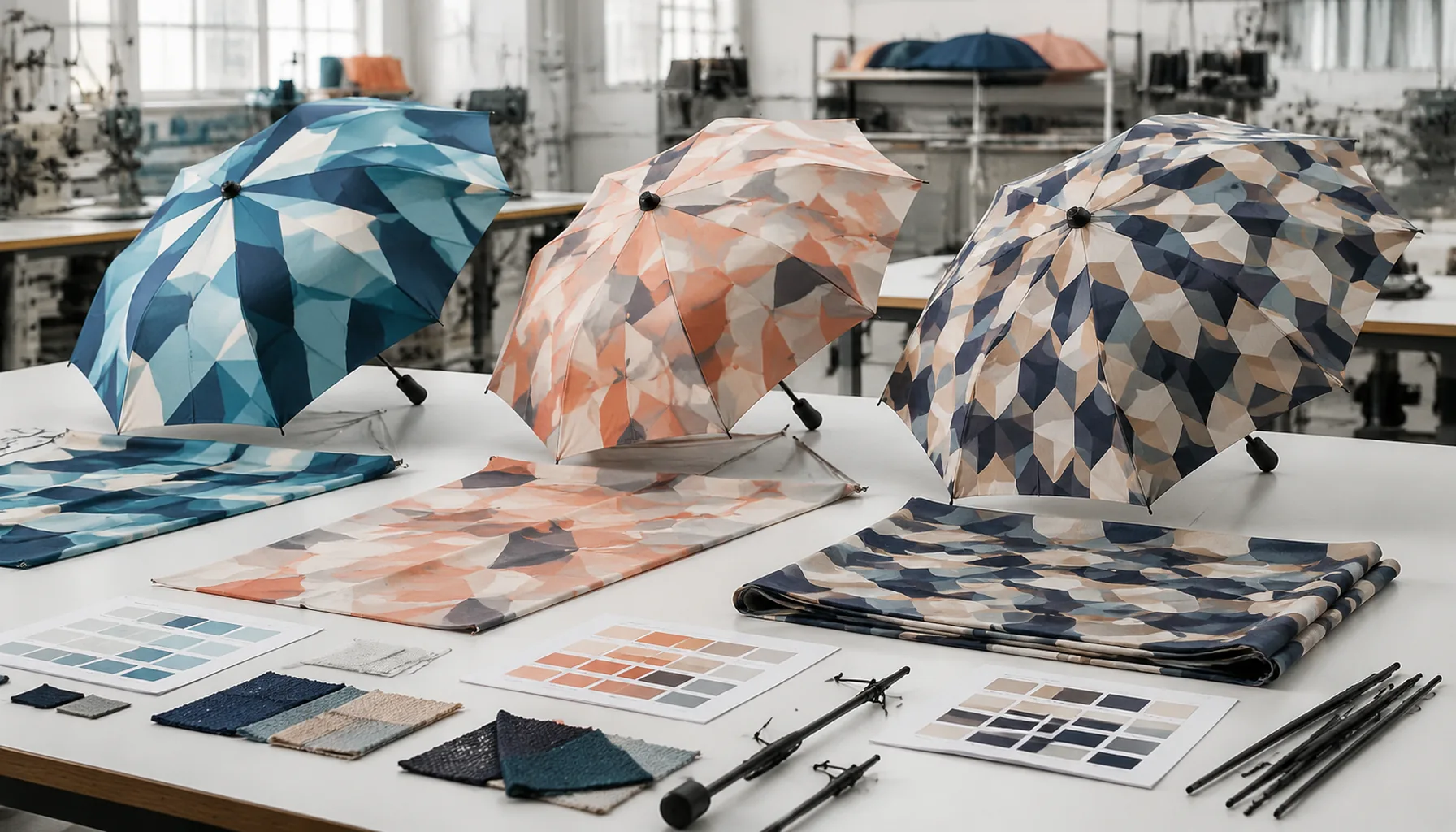
Retail buyers often approve a beautiful pattern on screen, then discover it breaks at the panel seams, shifts after cutting, or looks dull on coated pongee. For repeat pattern umbrella printing, the real work starts with mapping artwork to each gore, choosing the right 190T or 210T fabric, and controlling registration from sample table to bulk line. On our Songxia factory floor, those checks decide whether the finished umbrella looks retail-ready or simply printed.
Why Repeat Patterns Work for Retail Umbrella Branding
Repeat pattern umbrella printing usually gives a retail line stronger shelf identity than one large logo because the customer reads the product before they unfold it. A monogram, small mascot, fruit icon, floral mark, or seasonal snowflake can repeat across the canopy and still look intentional when only two or three panels are visible in a bin display. A single logo often lands on the wrong side after packing, or gets broken by a fold line. With branded pattern umbrellas, every visible slice carries the brand code, so the umbrella works harder in club stores, museum shops, resort boutiques, and fashion retail where products are stacked handle-out or canopy-up.
The panel count changes the rhythm more than many designers expect. On a standard 8K 23-inch stick umbrella, each panel is wide enough for larger motifs, diagonal repeats, and spaced monograms, especially on 190T or 210T pongee where screen printing or digital heat transfer holds clean edges. A 16K frame splits the same canopy circumference into narrower wedges, so small icons and tighter repeat spacing work better; oversized mascots can look chopped unless the umbrella panel artwork is redrawn panel by panel. Our standard practice at ZheBrella is to mark rib positions on the artwork proof, not just show a flat circle, because the ribs become visual dividers once the canopy is sewn.
For retail umbrella branding, I usually recommend 8K when the buyer wants a bold lifestyle look: resort palm icons, collegiate mascots, children’s characters, or a seasonal gift pattern that should read from 2–3 meters away. Choose 16K when the product needs a premium fashion feel, like micro-monograms, geometric repeats, or an allover umbrella print where the rib lines create a pleated textile effect. The key is to avoid forcing a wallpaper file onto umbrella panels without adjustment. Each triangular panel has bias stretch, seam allowance, and print registration tolerance, so repeats should be built with 5–8 mm safety at seam edges and checked on a sewn strike-off before bulk production.
Fabric and Canopy Construction Choices
For repeat pattern umbrella printing, fabric choice decides whether the artwork looks retail-ready or slightly muddy after sewing. 190T pongee is the common promotional grade: it is light, economical, and works well for simple two- or three-color repeats, but the yarn density leaves less surface stability for fine lines, small icons, and tight geometric spacing. 210T pongee has a tighter weave and smoother hand feel, so screen printing and heat-transfer edges hold cleaner, and sublimation gradients show less grain. On dark navy, black, or forest green base cloth, color saturation depends heavily on the print method; pigment screen inks need a white underbase for bright logos, while sublimation performs best on white or very light polyester. For branded pattern umbrellas sold at retail, I usually push buyers toward 210T when the repeat includes thin strokes under 1 mm, watercolor effects, or brand colors that must stay within a narrow Pantone tolerance.
Canopy construction also changes how umbrella panel artwork should be approved. A standard 8-panel 23 inch umbrella uses triangular panels, so an allover umbrella print must be nested with seam allowance, top cap loss, and panel rotation in mind. A repeat that looks perfect on a flat AI file can step awkwardly at the rib seam if the artwork is not mocked up panel by panel. Double-canopy vented windproof builds add another layer: the top vent panel overlaps the lower canopy, so any continuous repeat across that break will be interrupted by design. On 27 inch golf umbrellas, especially 8K or 10K fiberglass frames rated around 50+ mph in wind-tunnel testing, the extra canopy depth can stretch the visual field; large repeats usually read better than tiny patterns. Our standard practice at ZheBrella is to approve both a flat panel proof and a sewn sample photo before bulk cutting.
Coatings and base cloth color should be locked before final artwork approval, not treated as finishing details. UPF 50+ coatings, especially silver or black UV backing, can stiffen the hand feel and slightly dull color from the outside because the fabric reflects and blocks light differently. Teflon water-repellent finishing usually has less visual impact, but it can affect ink adhesion if the print is applied after coating rather than before. Darker base cloths are forgiving for dirt and retail handling, but they reduce the brightness of retail umbrella branding unless the artwork uses opaque inks or transfer films. For repeat pattern umbrella printing on 210T pongee, I like to run a strike-off with the exact coating stack: fabric color, print method, water-repellent finish, and UV backing. It adds about 5 to 7 days before mass production, but it prevents expensive disputes when bulk umbrellas arrive with muted reds, gray whites, or mismatched repeat alignment.
Artwork Mapping Across Panels and Seams
Motif scale should be decided before anyone starts splitting the file into umbrella panels, because a pattern that looks controlled on a flat 60-inch fabric width can look chopped once it is divided into 8K or 10K triangular gores. For repeat pattern umbrella printing, I prefer buyers to send the master repeat plus a mapped panel layout, not just a square seamless tile. On a standard 23-inch umbrella, each panel narrows sharply toward the top notch, so large logos, faces, animals, and geometric medallions need to be checked at both the wide hem edge and the crown. Small repeats of 20–40 mm usually hide seam interruption better, while 80–150 mm motifs need deliberate placement. Writers should tell buyers that umbrella panel artwork is not the same as T-shirt or tote artwork; the ribs create visible radial breaks, and every seam becomes part of the design.
Center alignment matters most at the top cap, the front viewing panel, and any brand-facing position when the umbrella is displayed closed in retail packaging. For branded pattern umbrellas, we normally mark one lead panel, then map the repeat clockwise across the remaining 7 or 9 panels so the motif does not drift around the frame. Seam breaks should be called out honestly: a continuous allover umbrella print can be visually balanced, but it will not match perfectly across stitched seams unless the factory uses slower panel-by-panel positioning and accepts more fabric waste. Keep critical artwork at least 10–15 mm away from cut lines, 20 mm from the ferrule area, and 15–25 mm from rib-tip pockets, because sewing tolerance, heat-transfer shrinkage, and canopy tension can pull details into the seam.
Strike-off samples are not optional for serious retail umbrella branding, especially with pongee 190T/210T, recycled polyester, POE, or coated fabrics where ink behavior changes by substrate. A proper strike-off should include at least two full adjacent panels, not only a flat A4 color swatch, so the buyer can judge repeat flow, seam interruption, logo scale, and color after stitching. For sublimation, check edge distortion and color density after heat pressing; for screen printing, check registration at panel edges and ink hand-feel; for digital printing, check banding and dark-color penetration. Our standard practice at ZheBrella is to approve a printed panel strike-off before bulk cutting, then run pre-production samples for AQL 2.5 inspection reference. This usually adds 5–7 days, but it prevents thousands of canopies with a misplaced center motif or broken repeat.
Print Methods, Color Control, and MOQ Planning
For repeat pattern umbrella printing, the method should be chosen before the artwork is finalized, not after. Screen printing is still the strongest option for high-volume branded pattern umbrellas when the repeat uses 1–4 solid Pantone colors, clean edges, and good spacing across 8K or 10K panels. It gives dense ink coverage on 190T or 210T pongee and holds up well after water-repellent finishing, but each color needs a separate screen and setup charge. Once the design moves into gradients, photo texture, watercolor effects, or 6+ colors, digital printing becomes more practical because there is no screen count penalty. Digital is also safer when the repeat must align across alternating panels, such as a logo lattice that continues from one umbrella panel artwork file to the next.
Heat transfer sits between screen and digital, and I use it carefully. It is useful for small to mid-size retail umbrella branding runs where the buyer wants sharp logos, metallic effects, or repeat icons on selected panels without committing to full canopy printing. It is less ideal for a true allover umbrella print because transfer film can change hand feel, especially on compact 21" or 23" folding umbrellas where the canopy is folded hard around the shaft. For full-surface repeat work, digital printing on white pongee or POE usually gives better registration and softer drape. Screen printing wins on cost once volume rises, often around 1,000–3,000 pcs depending on rib count, panel size, and number of colors.
Pantone control has to be written into the purchase order, not handled by email screenshots. For screen printing, we match coated Pantone references by ink mixing and confirm with a strike-off panel before bulk cutting. For digital repeat pattern umbrella printing, Pantone matching is approximate because fabric base, coating, and printer profile all shift color; we normally allow a small Delta E tolerance or approve by physical sample. MOQ also changes sharply by fabric choice: printing on stock white 190T pongee can start around 300–500 pcs per design, while custom-dyed canopy fabric usually pushes MOQ to 1,000–3,000 meters and adds 7–12 days. A normal printed umbrella lead time is about 25–35 days after artwork approval, but custom dyeing, Teflon coating, or UPF 50+ treatment can extend production to 40–50 days before FOB shipment.
Bulk QC for Consistent Branded Patterns
Packing inspection is not cosmetic; it prevents chargebacks when FOB or DDP shipments hit retail distribution centers. I verify barcode labels, hangtags, suffocation warnings, inner carton counts, master carton markings, PO numbers, SKU-color-size codes, and carton drop-test condition before release. For 21", 23", 27", and 30" programs, mixed packing errors are easy when one allover umbrella print has several close colorways, so cartons should be checked against the approved packing list and retail planogram requirements. Each umbrella should be closed with the pattern oriented consistently under the tie wrap or sleeve, because buyers notice crooked presentation before they notice rib specs. Moisture is another practical issue: printed pongee should be fully cured and dry before polybagging, especially for long DDP transit where containers may sit 30-45 days. I also check carton compression, desiccant use when required, and whether export cartons meet the forwarder’s palletization rules. Passing AQL 2.5 on the umbrella but failing retail packing is still a failed shipment in the buyer’s warehouse.
Frequently Asked Questions
Can a repeat pattern continue perfectly across umbrella seams?
A perfect match is difficult because each canopy panel is cut and sewn separately. Good panel mapping can make the pattern look continuous, but buyers should approve tolerances on a pre-production sample.
Is digital printing better for small repeat pattern orders?
Usually yes for multi-color or photographic patterns at lower MOQ. Screen printing can be more cost-efficient for large runs with limited colors and stable repeat artwork.
How should repeat artwork be prepared for umbrella panel production?
Provide vector artwork or a high-resolution seamless pattern, usually with each umbrella panel mapped separately because the canopy is made from triangular fabric pieces. Ask the factory for an 8-panel or 16-panel template before finalizing artwork to avoid misalignment at seams.
Which fabric is better for retail patterned umbrellas, 190T polyester or 210T pongee?
190T polyester is cost-effective for promotional and entry retail umbrellas, while 210T pongee has a softer hand feel and better perceived quality for mid-range retail programs. For allover prints, confirm color fastness, waterproof coating, and print sharpness during sampling.
What MOQ and sampling time should buyers expect for allover printed umbrellas?
For custom repeat prints, typical MOQ is around 500 to 1,000 pieces per design, depending on frame, fabric, and print method. Printed sample development usually takes 7 to 15 days after artwork approval, with bulk production often requiring 30 to 45 days.
Looking to Launch Your Custom Umbrella Line?
ZheBrella is a Zhejiang-based OEM/ODM umbrella manufacturer with 17 years of export experience. Free design, low MOQ from 100 pieces, windproof construction, full-color print.
Get Free Quote Now »People Also Search For
Related Articles
Repeat Pattern Printing for Private-Label Umbrella Lines
Plan repeat pattern umbrella printing with clean panel matching, fabric choices, and inspection standards for scalable p...
Read More »
Repeat Pattern Umbrella Printing for Retail Collections
Plan repeat-pattern umbrella canopies for retail lines with panel layout, fabric choice, color control, sampling, MOQ, a...
Read More »
All-Over Pattern Printing for Branded Umbrella Programs
Build repeat-pattern umbrella programs with print-ready artwork, panel planning, fabric choices, and QC steps that prote...
Read More »