Repeat Pattern Umbrella Printing for Private-Label Brands
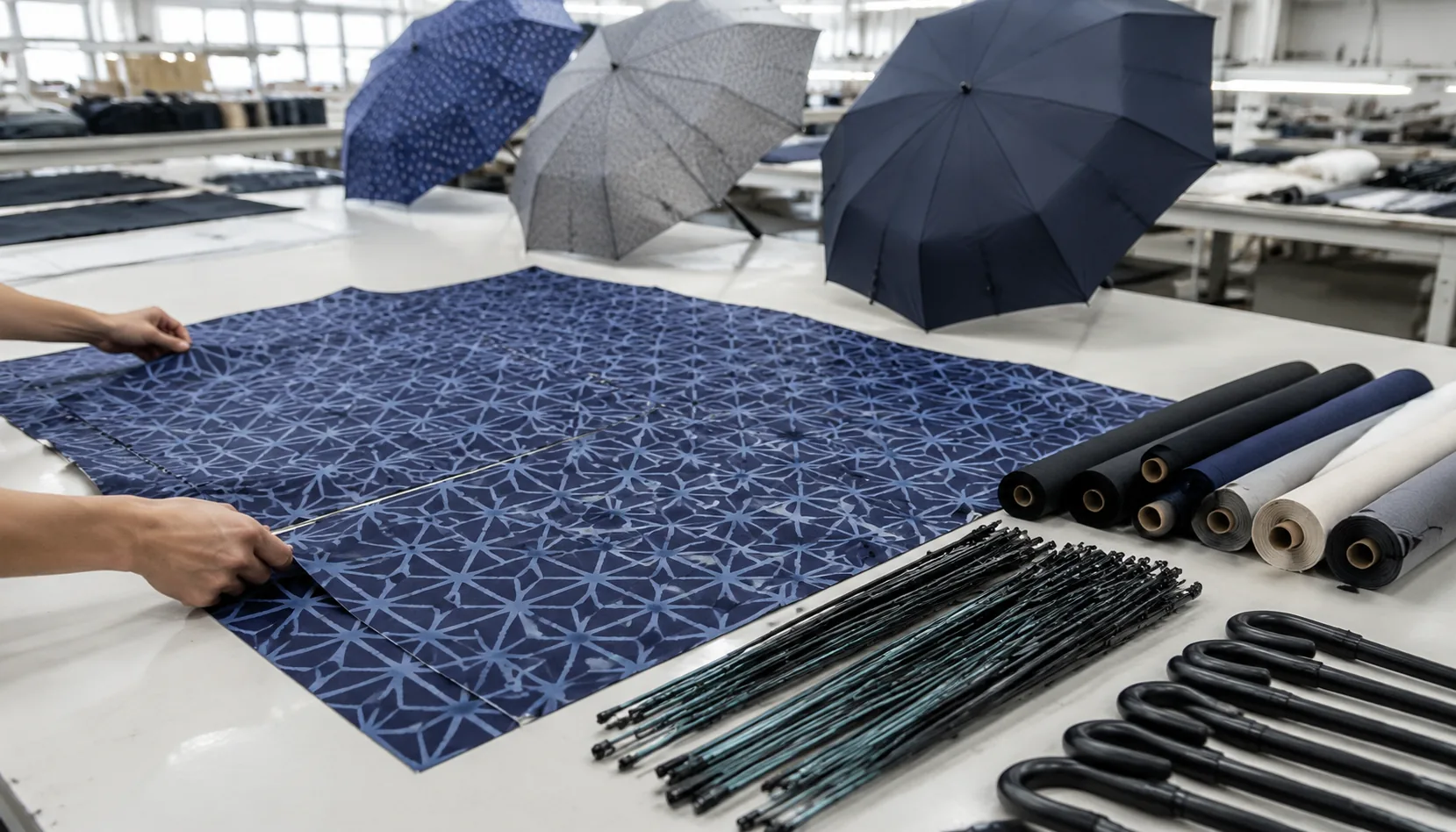
For private-label buyers, repeat pattern umbrella printing looks simple until the artwork crosses eight curved panels, seams shift under tension, and a small tolerance error turns into a visible mismatch on the shelf. On our Songxia factory floor, we control this from fabric shrinkage tests and panel cutting direction to print registration, strike-off approval, and bulk inspection specs, so the final canopy matches the retail design instead of just carrying the logo.
When Repeat Patterns Work Better Than Single Logos
Repeat pattern umbrella printing works best when the umbrella is treated as a retail product, not a handout with a badge slapped on one panel. Fashion retailers, museum shops, resorts, and lifestyle brands usually need shelf appeal from every angle: closed in a sleeve, half-open on a display rack, and fully open in a customer’s hand. A single logo on one branded umbrella panel disappears when the canopy is folded, and it can look too corporate for a $18 to $45 retail price point. Small repeats on 190T or 210T pongee give a cleaner private label umbrella design because the artwork still reads when cut into 8K or 10K panels. For museum stores, we often scale motifs from textile archives, tile patterns, or collection icons into 20 to 45 mm repeats so the umbrella feels like merchandise, not a souvenir afterthought.
The pattern type should match the buying channel. Small repeats are safest for fashion retail umbrella printing because they hide panel-to-panel registration drift and look consistent on 21" compact, 23" auto-open, and 27" stick umbrellas. Tossed icons are better for resorts, universities, and children’s collections because random placement feels relaxed and avoids obvious misalignment at the rib seams. Stripes are unforgiving: if the artwork is not engineered to the panel wedge, the stripe will step badly across an 8K canopy and look cheap even when the frame is solid. For higher-end lifestyle brands, an all-over umbrella pattern with controlled negative space usually sells better than dense coverage; too much ink can stiffen the hand-feel on pongee and make water beading less attractive unless the finishing is managed carefully.
Engineered panel layouts are the right choice when the pattern must align to the umbrella’s geometry instead of simply repeating across fabric. That includes border prints near the canopy edge, alternating color panels, radial artwork, skyline scenes, and museum illustrations that need to sit upright on each gore. The tradeoff is sampling discipline: panel templates must include seam allowance, rib pocket position, top notch, and expected sewing shrinkage, usually 2 to 4 mm per seam depending on fabric and operator. Our standard practice at ZheBrella is to confirm repeat scale on a paper panel map before sublimation, heat transfer, or screen setup, then check the first sample fully opened under inspection lights. For private-label brands, this prevents the common mistake of approving a flat artwork file that looks good on screen but breaks visually once stretched over fiberglass or steel ribs.
Panel Geometry, Rib Count, and Pattern Continuity
Panel geometry decides whether a repeat looks intentional or chopped up after sewing. On a standard 8K umbrella, each canopy panel is a wide isosceles wedge, usually cut for 23", 27", or 30" frames, so the print artwork has more horizontal room but fewer seam interruptions. That helps large florals, checkerboards, monograms, and logo repeats breathe. A 16K frame splits the same canopy circle into narrower wedges, which means the all-over umbrella pattern must be scaled down or simplified; otherwise, half the motif disappears into seam allowance every few inches. In repeat pattern umbrella printing, we usually build the artwork against the actual panel template, not a flat square textile repeat, because the top arc, lower hem, rib pocket, and center notch all distort how the eye reads spacing. If a buyer sends a fashion fabric file at 64 cm repeat width, we often have to re-scale it separately for 8K and 16K instead of using one universal layout.
Perfect cross-seam matching is difficult because umbrellas are cut-and-sewn products, not one-piece molded shells. Each pongee 190T or 210T panel is printed, stacked, knife-cut, and joined with about 5-7 mm seam allowance; then rib pockets, tips, top cap tension, and frame stretch pull the fabric into a shallow cone. Even with sublimation on white polyester, where registration is cleaner than screen printing, small movement during heat pressing, cutting tolerance of 1-2 mm, and sewing feed variation can shift the pattern enough to break a stripe or logo line. On PVC, POE, or EVA clear canopies, the problem changes: the material shows overlap and stitching more clearly, so seam breaks are visually sharper. For private label umbrella design, I tell brands to avoid hard geometric lines crossing every rib unless they accept a production tolerance. Soft repeats, scattered marks, diagonal textures, and non-directional branded umbrella panels hide seam movement much better.
The best workflow is to decide visual priority before sampling: should the pattern align at the front viewing panel, flow around the full canopy, or keep logos upright on every wedge? Those are different print files. For retail umbrella printing, we commonly mark one hero panel for shelf display and allow controlled drift on the rear seams, especially on auto-open 23" stick umbrellas and compact 21" auto-open-close styles where canopy tension varies more. A 16K umbrella can look premium with fine repeats because the ribs create a tailored rhythm, but it punishes large logos and border patterns. An 8K umbrella is more forgiving for brand marks, though each seam break is more obvious because the panels are wider. Our standard practice at ZheBrella is to proof the pattern on a full-size digital paper template, then cut a real pre-production canopy before bulk approval; AQL 2.5 inspection can catch print defects, but it cannot turn cut-and-sewn geometry into seamless wallpaper.
Fabric and Print Choices for Pattern Clarity
Pattern clarity starts with the cloth, not the printer. For repeat pattern umbrella printing, 190T pongee is the practical baseline for most promotional and mid-market retail umbrellas because it cuts cleanly, sews flat, and accepts disperse ink without looking fuzzy at normal viewing distance. But if the artwork has fine linework, small icons, tight geometric spacing, or a dark ground with light details, I push buyers toward 210T pongee. The denser weave gives better edge definition and less ink spread, especially across 8K and 10K branded umbrella panels where every seam can interrupt the repeat. On 23" and 27" stick umbrellas, 210T also feels more retail-grade in the hand, which matters for private label umbrella design. The tradeoff is cost: 210T fabric and coating usually add roughly 8–15% compared with standard 190T, depending on order volume, Teflon treatment, and whether UPF 50+ UV coating is required.
Digital printing is the right choice when the all-over umbrella pattern uses gradients, photo-style artwork, many spot colors, or repeat motifs that must flow across multiple panels. Sublimation on white 190T or 210T pongee gives the cleanest color range, while digital reactive-style workflows are less common for umbrella pongee because coated polyester is the dominant fabric in our category. For private-label retail umbrella printing, I always ask for the repeat file before quoting because panel geometry changes the result: an umbrella canopy is not a flat rectangle, and a straight stripe repeat can look slightly pinched near the top cap if the layout is not adjusted. Our standard practice at ZheBrella is to make a printed strike-off before bulk cutting, then check panel-to-panel color variance under D65 light. For darker ground patterns, digital printing usually needs more sampling time, around 5–7 days, because black density, water-repellent finish, and heat setting all affect the final shade.
Screen printing is still the more economical method for simple 1–2 color repeats, especially when the artwork is a small logo scatter, polka dot, checker, or single-color monogram repeated across panels. Once the screen is made, ink cost is low and production speed is high, so it works well for MOQ runs from 500 to 3,000 pieces where the buyer does not need photographic detail. The limitation is registration: if the repeat must align perfectly from one triangular panel to the next, screen printing needs careful jigging and extra QC, and each added color increases setup cost and rejection risk. For basic retail patterns on 190T pongee, screen printing can be 10–25% cheaper than digital, but for complex all-over artwork with four or more colors, digital usually wins after setup, sampling, and wastage are counted. Whichever route is chosen, I recommend AQL 2.5 inspection with specific checks for seam mismatch, ink pinholes, crocking, and water-drop performance after finishing.
Approvals, Tolerances, and AQL Checks
Approvals should start with a digital panel map, not a pretty umbrella rendering. For repeat pattern umbrella printing, I want to see the repeat size, rotation direction, rib position, seam allowance, and cut-line loss marked on every 8K or 10K panel before we touch bulk fabric. A proper strike-off is printed on the actual canopy material, usually 190T or 210T pongee for retail work, or POE/PVC/EVA if the brand wants transparent rainwear styling. Paper proofs are useful for layout, but they lie about ink gain, gloss, and how dark navy or deep red looks after waterproof coating. Our standard practice at ZheBrella is to approve one flat fabric strike-off, one stitched panel mockup, and one finished umbrella sample before mass cutting.
Color tolerance needs to be written into the PO because “close enough” causes arguments after shipment. For private label umbrella design, I normally hold solid brand colors to about Delta E 2.0–3.0 against the approved strike-off under D65 light, with looser tolerance for photographic sublimation or complex watercolor repeats. Seam alignment is just as important as color: on an all-over umbrella pattern, the buyer should define whether the repeat must flow across seams or simply stay upright and centered per panel. A realistic production tolerance is ±2 mm at panel seams for pongee and slightly more for slippery PVC or EVA, especially near the crown where eight or ten panels converge.
AQL 2.5 inspection should treat print defects as major defects when they are visible at normal viewing distance. Inspectors check branded umbrella panels for ink spots, missing print, stains, oil marks, ghosting, color banding, wrong panel orientation, upside-down logos, and mismatched left/right repeat direction. For retail umbrella printing, I also ask QC to open the umbrella fully, rotate it 360 degrees, and compare the canopy against the approved panel mockup, because flat-table inspection misses orientation errors after sewing. Minor defects might include a tiny speck under 1 mm near a seam, but a logo crossing a rib incorrectly, a dirty white panel, or one reversed panel should fail. Final cartons should be spot-checked again before FOB or DDP shipment, especially on mixed-SKU private-label orders.
Planning MOQ, Lead Time, and Retail Rollouts
For repeat pattern umbrella printing, MOQ is driven less by the umbrella frame and more by how the artwork is applied. Screen printing on branded umbrella panels can start around 300–500 pcs per design when the repeat is simple and color count stays at 1–3 spot colors, but all-over umbrella pattern work usually needs higher planning discipline because panel matching, registration, and wastage increase. Heat-transfer is workable from about 500 pcs per SKU for sharper logos or mixed artwork, while sublimation on white 190T or 210T pongee is usually best from 800–1,000 pcs per design because printed fabric must be batched before cutting. POE, PVC, and EVA clear canopies have different minimums again, especially if the repeat pattern is printed before panel welding or binding. For a private label umbrella design program, I prefer buyers separate MOQ into frame SKU, canopy artwork SKU, and handle/packaging SKU; otherwise one small change in shaft color or hangtag can quietly create a second production lot.
Lead time should be written into the rollout calendar before the buyer confirms retail launch dates. A proper sample for retail umbrella printing normally takes 7–12 days after artwork approval, longer if the factory must strike off sublimation fabric, make a new molded handle, or match Pantone colors across pongee and sleeve material. Bulk production is commonly 25–35 days for manual or auto-open 21 inch and 23 inch umbrellas, and 35–45 days for 27 inch golf umbrellas, double-canopy vented windproof constructions, 10K or 16K frames, or mixed private-label assortments. Our standard practice at ZheBrella is to run pre-production samples before cutting bulk cloth, because repeat alignment across 8K panels can look correct on a flat file but shift badly once sewn over rib tips. Buyers should also reserve 3–5 days for inline inspection, AQL 2.5 final inspection, moisture checks, and carton drop-test corrections before shipment booking.
Carton planning matters when a private-label launch has multiple SKUs going to retail DCs, Amazon prep centers, and event accounts at the same time. A 23 inch straight umbrella may pack 24–36 pcs per export carton, while compact 21 inch auto-open-close units often pack 48–60 pcs depending on sleeve, blister card, or gift box requirements. If one all-over umbrella pattern ships in four colors, carton marks should identify design code, color, mechanism, rib count, and barcode to avoid mixed inventory at the destination warehouse. FOB Ningbo or Shanghai is cleaner when the buyer already controls freight and customs; DDP is better for promotional distributors or retail brands that need landed cost certainty by SKU. For multi-SKU rollouts, I recommend locking the first wave at 60–70% core designs, keeping 30–40% capacity for replenishment or seasonal artwork, and avoiding last-minute changes to UPC labels, inner packs, or carton dimensions after the production order is released.
Frequently Asked Questions
Can a repeat pattern line up perfectly across every umbrella seam?
Not perfectly in most bulk production. Patterns should be designed with seam breaks in mind, and buyers should approve realistic tolerance on a pre-production sample.
Is digital printing better for repeat pattern umbrellas?
Digital printing is usually better for complex, multi-color, or photographic repeats. Screen printing can be more cost-effective for simple patterns with limited colors.
How accurate can panel matching be on repeat pattern umbrellas?
For most retail umbrellas, factories typically control panel matching within about 3–5 mm, depending on fabric stretch, cutting method, and print process. Exact seamless matching across all 8 panels is rarely guaranteed, so artwork should allow small alignment variation.
Which fabric is best for all-over umbrella pattern printing?
190T pongee polyester is commonly used for retail-grade printed umbrellas because it balances smooth print results, water resistance, and durability. Lower-cost polyester can work for promotions, while recycled RPET fabric is often selected for sustainability-focused retail programs.
What sample steps are needed before bulk repeat pattern umbrella production?
A buyer should approve a digital layout, printed fabric strike-off, and finished umbrella sample before mass production. Sampling usually takes 7–15 days, with bulk production commonly requiring 30–45 days after final approval and deposit.
Looking to Launch Your Custom Umbrella Line?
ZheBrella is a Zhejiang-based OEM/ODM umbrella manufacturer with 17 years of export experience. Free design, low MOQ from 100 pieces, windproof construction, full-color print.
Get Free Quote Now »People Also Search For
Related Articles
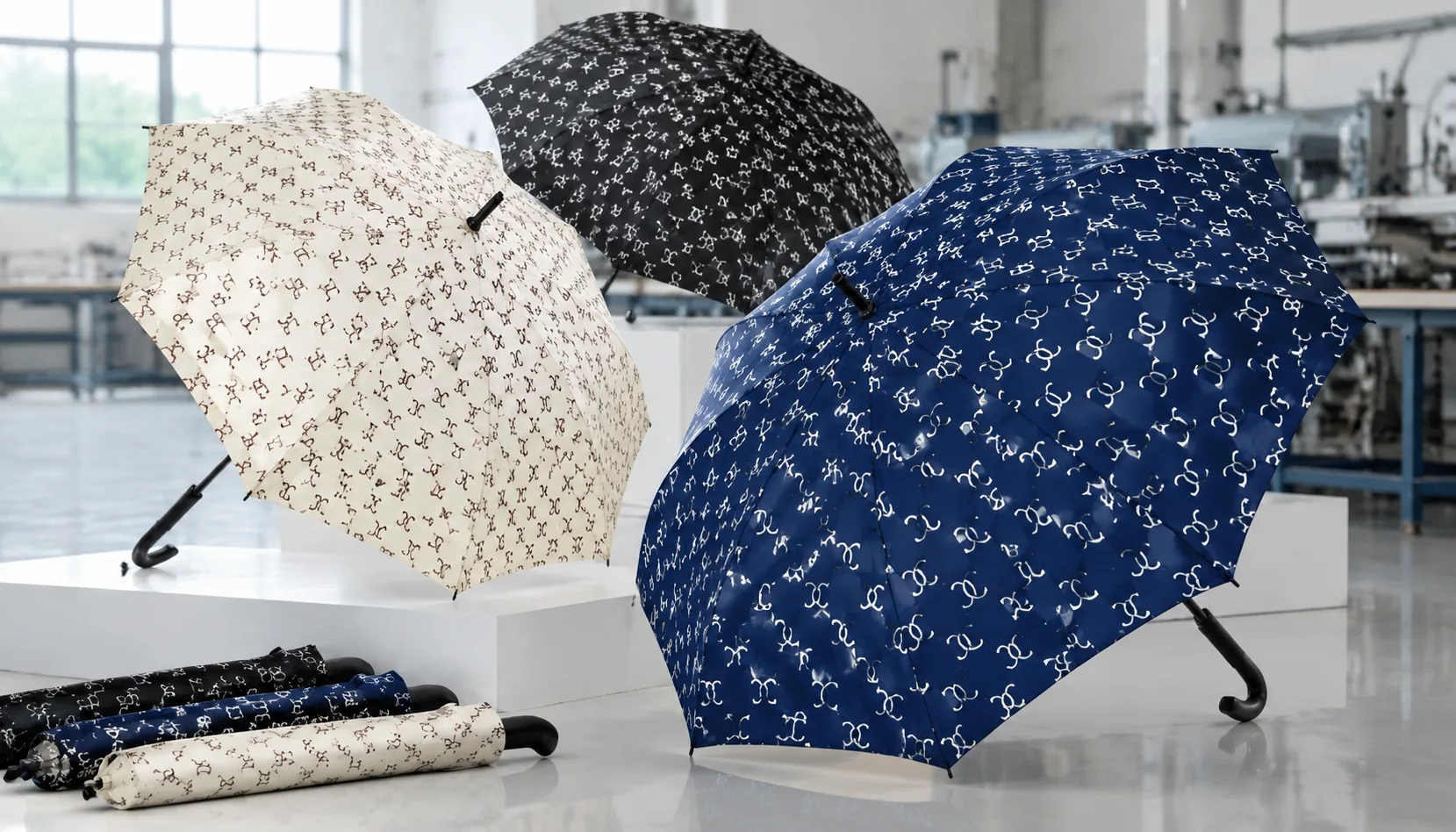
All-Over Logo Patterns for Retail Branded Umbrellas
Build all-over logo umbrella patterns with repeat sizing, panel registration, and fabric specs that reduce distortion, s...
Read More »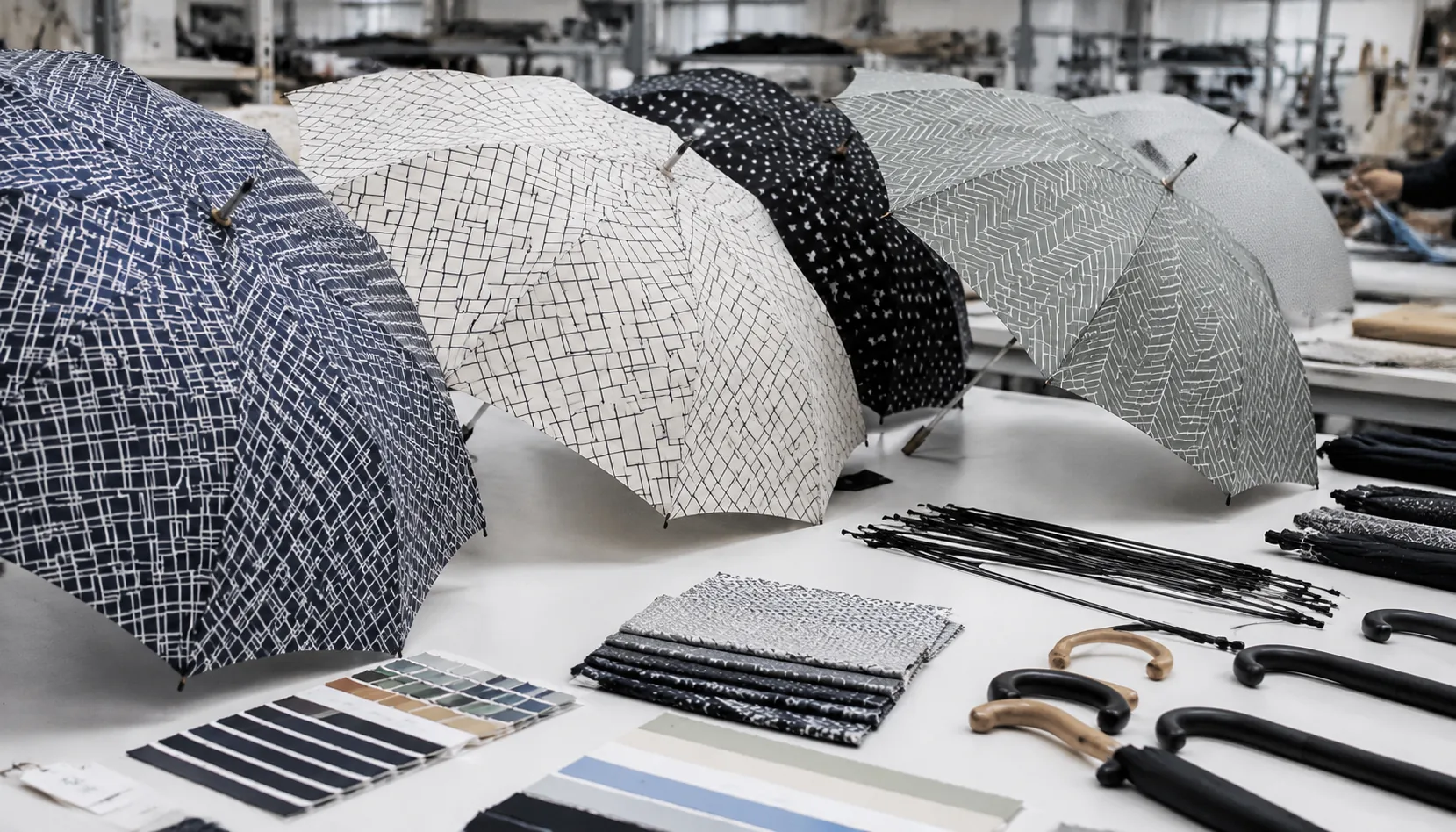
Repeat Pattern Umbrella Printing for Retail Collections
Plan repeat-pattern umbrella canopies for retail lines with panel layout, fabric choice, color control, sampling, MOQ, a...
Read More »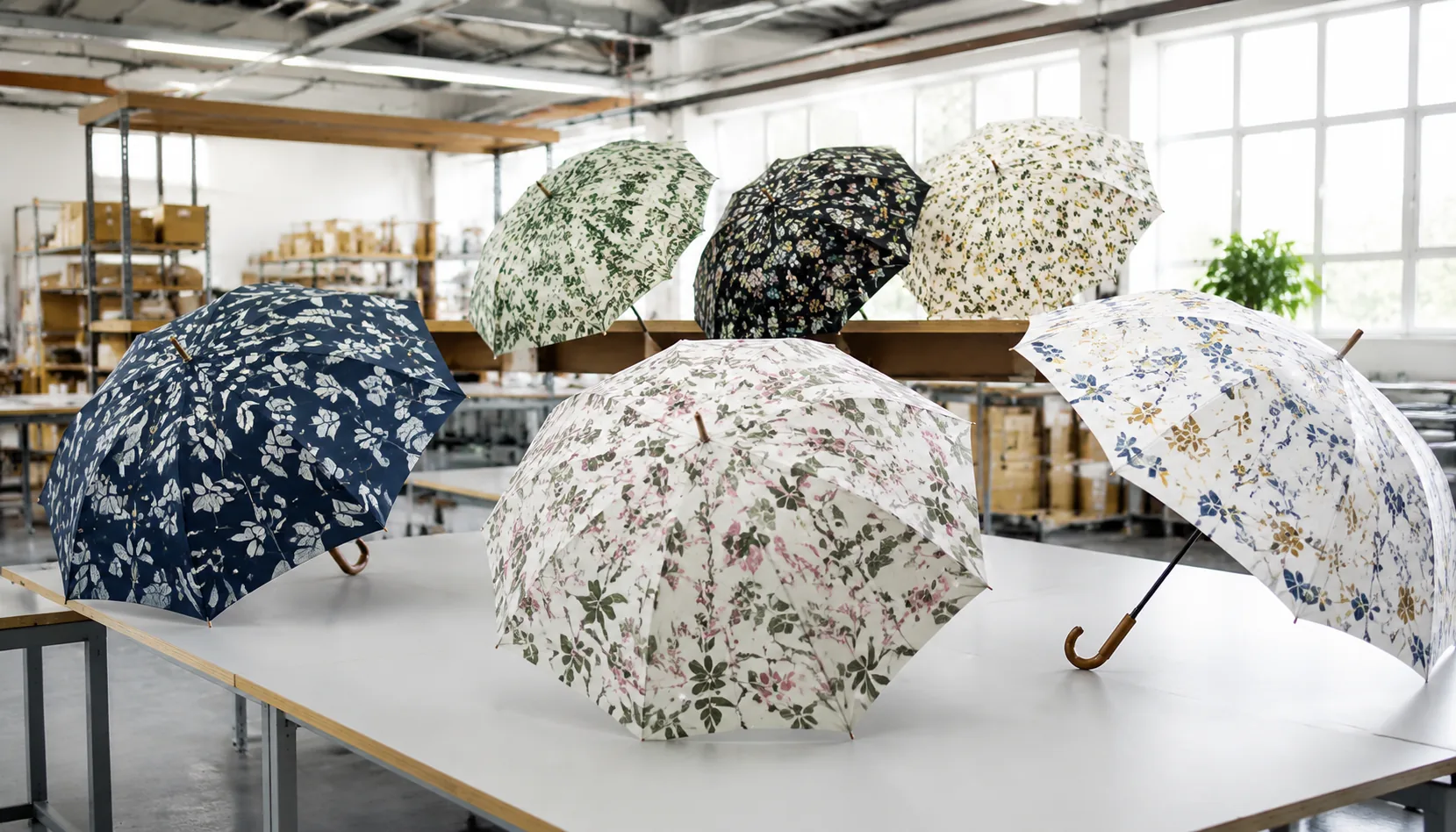
All-Over Repeat Pattern Umbrellas for Retail Branding
Plan repeat-pattern umbrella prints with cleaner panel joins, practical fabric choices, MOQ expectations, and approval s...
Read More »