Salt-Air Resistant Umbrellas for Coastal Hospitality Buyers
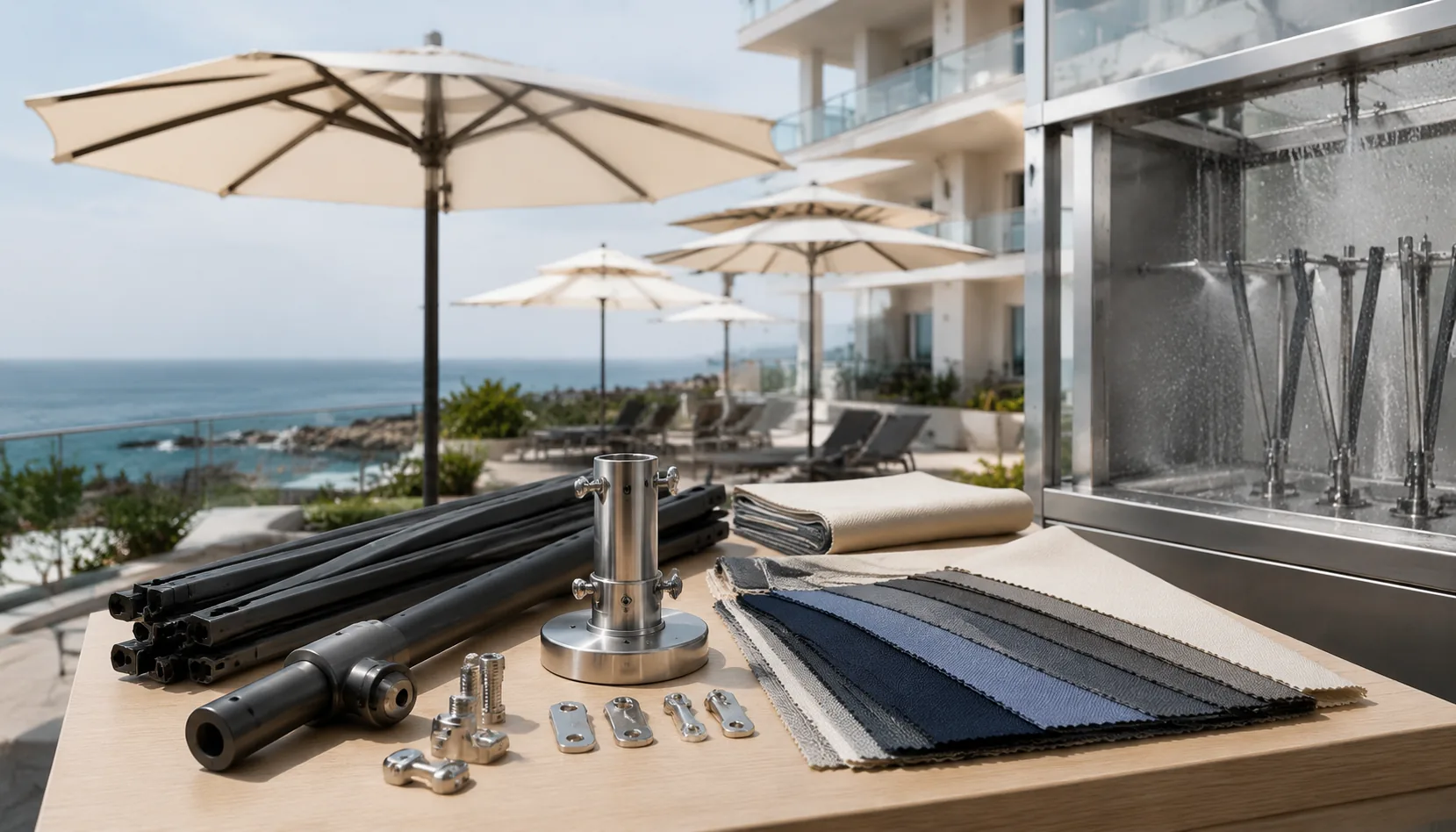
For coastal hotels and resorts, umbrella failures usually start before the guest sees them: salt air gets into rib joints, wet pongee is packed too soon, or wind vents are specified without matching the frame strength. When we build coastal hospitality umbrellas on the Songxia factory floor, we look first at corrosion points, canopy coating consistency, runner fit, and carton moisture control so buyers are not paying for replacements after one rough season.
Identify Where Coastal Umbrellas Fail First
Coastal umbrella failure usually starts in the metal hardware, not the canopy. I have opened too many returned umbrellas from beach hotels where the 190T or 210T pongee fabric was still usable, but the steel shaft had orange bleed at the runner, the spring button stuck halfway, and the top ferrule had corrosion under the plating. Salt air works into every small gap: rivet holes, spring slots, screw threads, plated handle collars, and the crimped area where ribs meet stretchers. Once that white or brown corrosion appears, guests feel it immediately as rough opening, crooked ribs, or a handle that looks dirty even after wiping. For true salt air resistant umbrellas, I would rather upgrade hidden parts first: fiberglass ribs, stainless or zinc-nickel rivets, aluminum or epoxy-coated shafts, plastic ferrules where possible, and better plating thickness on metal trim. A canopy with Teflon coating helps water roll off, but it will not save a cheap spring or thin chrome handle ring.
Different hotel use cases fail in different places, so coastal hospitality umbrellas should not all be specified the same way. Guest loaner umbrellas at the front desk are opened wet, returned sandy, and stored in buckets with no drying time; their common failures are rusted shafts, jammed auto-open buttons, and stained inner ribs. Concierge umbrellas used by bell staff need smoother manual or auto-open action, because staff may open 100 times during a rainy shift, so spring fatigue and runner wear matter more than canopy color. Golf umbrellas, usually 27 inch, 30 inch, or 32 inch arc styles with 8K or 16K frames, take more wind load near parking lots and beach walkways; double-canopy vented windproof construction and fiberglass ribs are worth the cost if you expect 50+ mph gust survival. Outdoor event stock fails fastest at rivets and tips because umbrellas are bundled, dragged, and packed wet after weddings, pool events, and terrace dinners.
For resort umbrella sourcing, I tell buyers to separate appearance requirements from corrosion requirements before asking for price. A black steel 23 inch auto-open hotel rain umbrella with chrome trim may look premium in a lobby, but in a humid oceanfront property the plated parts can pit before the logo print fades. If the umbrella is meant for two or three rainy seasons, specify corrosion resistant umbrellas with fiberglass ribs, stainless rivets, nickel-plated or coated springs, plastic or treated metal ferrules, and a handle design without unnecessary plated rings. Our standard practice at ZheBrella is to run salt-spray checks on exposed metal options and then confirm opening force, rib alignment, and fabric staining after wet storage, because corrosion is also a function problem, not just a cosmetic one. For bulk hotel programs, I would use AQL 2.5 inspection on spring action, rust marks, tip security, and shaft straightness, especially before FOB or DDP shipment to coastal properties.
Specify Frames and Hardware for Corrosion Control
For coastal hospitality umbrellas, frame choice is not a cosmetic decision; it decides whether the product still opens cleanly after one season of salt fog, wet storage, and housekeeping abuse. Painted steel is the cheapest frame material and still common on 23" hotel rain umbrellas, but once the paint film is scratched at the rib notch, runner, tip, or rivet hole, red rust starts fast. Powder coating buys more time than wet paint, but it does not solve exposed cut edges. Aluminum shafts and ribs remove red-rust risk and keep weight low, yet thin-wall aluminum can deform around the runner if the umbrella is repeatedly snapped open by guests. In my factory-floor view, aluminum is better for light promotional resort umbrella sourcing than for high-turnover front-desk loaner umbrellas unless the wall thickness and joint design are specified clearly.
Fiberglass ribs and shafts are the safest answer when the buyer’s real problem is corrosion, not just unit price. Fiberglass does not rust, flexes better than steel in gusts, and pairs well with 8K or 10K windproof frames for beachfront hotels where umbrellas get inverted near entrances and valet stands. The tradeoff is cost and feel: fiberglass ribs usually add roughly $0.25-$0.60 per umbrella versus basic painted steel on a 23" model, and a full fiberglass shaft can feel thicker or slightly heavier depending on diameter and handle balance. For salt air resistant umbrellas, I prefer fiberglass ribs with either an aluminum or fiberglass shaft, especially when the canopy is 190T or 210T pongee with Teflon coating; the frame will outlast the fabric more often than the other way around.
Hardware details matter as much as the rib material. Standard carbon-steel rivets, springs, washers, and top caps are small parts, but they are usually where corrosion resistant umbrellas fail first in coastal use. Stainless steel hardware, brass-plated eyelets, POM or nylon runners, ABS tips, and plastic ferrules reduce galvanic staining and prevent rusty water from bleeding onto light-colored canopies. I would specify stainless rivets at high-stress joints, plastic or coated end tips, and a salt-spray target such as 24-48 hours for economy hotel rain umbrellas or 72+ hours for premium resort programs. Our standard practice at ZheBrella is to check these details during pre-production sampling, because an AQL 2.5 final inspection can catch visible rust but cannot redesign a weak frame after 5,000 units are already packed for FOB or DDP shipment.
Choose Canopy Fabric and Windproof Construction
For coastal hospitality umbrellas, I would not start with frame color or handle shape; I would lock the canopy fabric first. 190T pongee is acceptable for guest-room hotel rain umbrellas when the buyer needs a sharp unit cost and the umbrella spends most of its life folded in a closet or valet stand. It has decent hand feel, takes screen printing cleanly, and works well with a standard DWR finish. For resort umbrella sourcing, especially poolside, beachfront, or golf-cart use, 210T pongee is the safer specification because the yarn density gives better tear resistance, tighter water shedding, and a more premium drape after repeated opening cycles. We usually test DWR by spray rating and post-drying appearance, because cheap coatings can look fine on day one but wet out after a few weeks of salt mist and sunscreen contact. If the umbrella will double as sun cover, specify UPF 50+ treatment on darker 210T pongee or a laminated option, and confirm the coating does not crack along fold lines after 500 open-close cycles.
Windproof construction matters more on beachfront properties than many procurement teams expect. A standard single-canopy 8K umbrella with steel ribs is fine for city hotels, covered entrances, and short guest walks from lobby to taxi, but it is not the build I would put near a marina or ocean-view terrace. For salt air resistant umbrellas, I prefer fiberglass ribs with a vented double canopy because the top layer releases uplift pressure instead of turning the umbrella into a sail. A properly sewn double canopy should have even vent gaps, reinforced bar-tacks at rib tips, and no loose fabric that flaps hard in 30 to 40 mph gusts. We have run wind-tunnel checks where good 23-inch and 27-inch vented models survive 50+ mph, but only when the shaft, runner, spring, and rib joints are matched as a system. Overspecifying fabric while leaving a weak zinc-plated steel frame is a common coastal failure point.
Rib count should follow usage, not marketing. An 8K frame is sufficient for compact guest umbrellas, lobby loaners, and standard 23-inch auto-open models when paired with fiberglass ribs, stainless or epoxy-coated hardware, and a canopy that is not oversized. It keeps weight reasonable for guests and helps control MOQ cost on large hotel programs. 10K or 12K can add stability, but the jump to 16K ribs makes sense mainly for executive-size 27-inch or 30-inch corrosion resistant umbrellas used by doormen, valet teams, wedding staff, and beach resort operations where wind load is higher and the umbrella may stay open for long periods. The tradeoff is real: 16K frames add weight, labor time, and inspection points, so AQL 2.5 checks should include rib symmetry, runner lock strength, and tip alignment. For coastal hospitality umbrellas, my standard practice at ZheBrella is to pair 210T pongee, DWR or UPF 50+ coating, fiberglass 8K or 16K construction, and corrosion-resistant metal parts based on the property’s actual exposure.
Brand the Umbrella for Guest Use and Loss Control
For guest-use umbrellas, branding should be visible enough to recover the asset but discreet enough that guests actually carry it. On 23" and 27" hotel rain umbrellas, I usually recommend a 90–130 mm wide logo on one or two canopy panels, not all eight panels unless the resort wants a promotional-product look. Screen printing works well on 190T or 210T pongee when the artwork is one or two solid colors; heat transfer is better for fine gradients but needs proper peel temperature or the edge will lift after repeated wet folding. For coastal hospitality umbrellas, darker navy, forest green, charcoal, sand beige, and off-white usually match resort identity better than bright giveaway colors, and they hide light dirt from lobby racks, golf carts, and beach shuttles.
Loss control should be designed into the umbrella before production, not solved later with stickers that fall off in humidity. A woven sleeve label with the hotel name, property address, and “Please return to room or front desk” lasts longer than a paper insert, especially when sleeves are made from matching pongee. Room-number tags can be sewn into the sleeve seam or attached to the handle with a non-rusting plastic or silicone loop; avoid zinc alloy key rings because they pit quickly in salt air. For resort umbrella sourcing, I like a small internal ID label under the runner or near the tie strap, because it helps housekeeping track inventory without turning the umbrella into a billboard. If the order is split by building, villa, or floor, use subtle color coding on the sleeve piping rather than changing the whole canopy color.
Avoid metallic trims on salt air resistant umbrellas unless the buyer accepts short cosmetic life. Gold-plated ferrules, shiny handle collars, metal button caps, and chrome sleeve snaps can look good in the showroom but discolor fast near sea spray, pool chlorine, and humid storage rooms. For corrosion resistant umbrellas, specify fiberglass ribs, powder-coated or electroplated steel shafts with a clean coating standard, plastic tips, POM or ABS runners, and matte rubberized handles instead of exposed metal decoration. Our standard practice at ZheBrella is to test branded samples after wet folding for ink transfer, sleeve staining, and trim oxidation before approving bulk production. For coastal hospitality umbrellas, the best branding package is usually a restrained canopy logo, permanent sleeve label, non-metal room tag, and resort-matched color palette that supports guest experience while keeping replacement rates under control.
Confirm Quality Before Shipping to the Property
For coastal hospitality umbrellas, final inspection has to be tougher than a normal promotional rain umbrella because salt air exposes weak plating fast. I use AQL 2.5 for major defects and check every carton lot against rust marks on shaft joints, rib tips, stretcher hinges, spring buttons, and runner slots. On steel frames, black electrophoretic coating or zinc plating must be continuous with no orange spotting after handling; on fiberglass ribs, we look harder at rivets and mixed-metal connection points. Opening force is measured by feel and gauge: manual models should not bind, auto-open hotel rain umbrellas should release cleanly without a violent snap, and auto-open-close mechanisms must reset without grinding. Rib alignment is checked open and half-open; one bent 8K rib can twist the canopy and create bad guest perception at the front desk.
Fabric inspection should be just as practical. For salt air resistant umbrellas, 190T or 210T pongee with Teflon water-repellent finish must bead water after spray testing, not darken immediately like untreated polyester. We inspect seam stitching for skipped stitches, loose back-tacks, uneven panel tension, and needle holes stretched around the rib pockets. A 23" or 27" hotel umbrella should close into its sleeve without forcing; if the sleeve fit is too tight, housekeeping staff will stop using it and the lobby bin becomes a mess. For resort umbrella sourcing, I also ask for a random open-close cycle test from production cartons, not just showroom samples. Corrosion resistant umbrellas are won or lost in small hardware: rivet burrs, exposed steel at cut tube ends, and wet cartons after packing are all reasons to hold shipment.
FOB versus DDP should be decided before the resort opening calendar gets tight. FOB Ningbo or Shanghai gives buyers more control if they already consolidate furniture, linens, and amenities, but DDP is often cleaner for coastal properties with limited import staff and fixed opening dates. Ocean freight needs a real buffer: production may take 25 to 35 days after artwork approval, vessel transit can run 18 to 35 days depending on destination, and customs or port congestion can easily add 7 to 14 days. Our standard practice at ZheBrella is to finish inspection before balance payment and photograph packed cartons, carton marks, and sampled defects so the buyer can approve release. For coastal hospitality umbrellas needed for a launch, I would not plan arrival closer than three weeks before staff training.
Frequently Asked Questions
Are fiberglass umbrellas completely rustproof in coastal use?
Fiberglass ribs do not rust, but umbrellas can still include metal springs, rivets, shafts, or tips. Coastal buyers should specify corrosion-resistant hardware and inspect mixed-material components closely.
What umbrella size works best for beachfront resorts?
For guest rain use, 23-inch straight or auto-open umbrellas are practical and easy to store. For concierge, valet, or outdoor event teams, 27-inch or 30-inch double-canopy umbrellas provide better coverage and wind stability.
Which frame materials hold up best for umbrellas used near salt air?
Fiberglass ribs with powder-coated steel or aluminum shafts are commonly used for coastal hospitality orders. Buyers should request anti-rust hardware, coated springs, and salt-spray or humidity test records when available.
What canopy fabric is recommended for resort guest rain umbrellas?
190T or 210T pongee is a practical choice for hotel rain umbrellas because it dries faster than polyester and supports logo printing. For higher-end resorts, buyers often specify high-density pongee with water-repellent coating and colorfastness testing.
What shipment checks should coastal hotels request before bulk umbrella delivery?
Ask for frame opening tests, rib alignment checks, fabric coating inspection, carton drop testing, and AQL inspection before shipment. For OEM orders, pre-production samples are usually approved first, with bulk lead times commonly around 30–45 days after sample confirmation.
Looking to Launch Your Custom Umbrella Line?
ZheBrella is a Zhejiang-based OEM/ODM umbrella manufacturer with 17 years of export experience. Free design, low MOQ from 100 pieces, windproof construction, full-color print.
Get Free Quote Now »People Also Search For
Related Articles
Wooden Stick Umbrellas for Retail and Hospitality Buyers
Plan wooden stick umbrella orders with shaft, rib, canopy, handle, MOQ, packaging, AQL, and FOB/DDP specs for retail and...
Read More »
Hotel Guest Umbrellas: Product Specs for Bulk Sourcing
Compare 23-25 inch hotel guest umbrellas by frame, canopy, handle, packaging, MOQ, and inspection points before placing ...
Read More »
Hotel Loaner Umbrellas: Durable Specs for Guest Programs
Build hotel loaner umbrellas with durable ribs, 190T or 210T pongee, practical branding, MOQ planning, and QC specs for ...
Read More »