Silicone Patch Branding for Premium Umbrella Programs
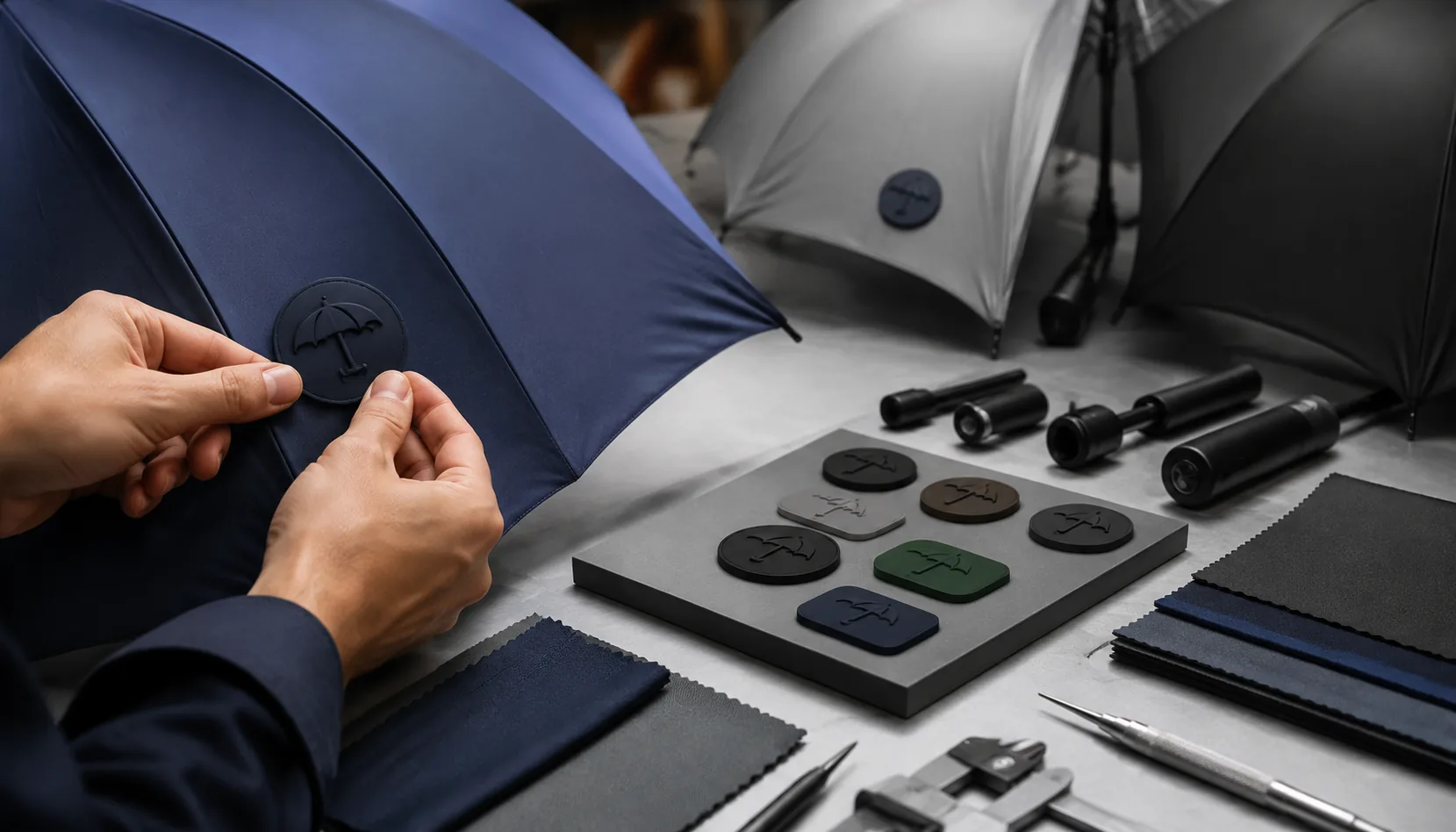
For premium umbrella programs, a logo patch can lift perceived value or create costly rework if the mold, stitching, and placement are not locked before bulk production. On our Songxia factory floor, silicone patch umbrellas usually require early decisions on patch thickness, strap or sleeve position, thread tension, color tolerance, and pull-test standards, because these details affect MOQ, lead time, and final QC pass rates.
Where Silicone Patches Fit in Umbrella Branding
Silicone patch umbrellas make the most sense when the umbrella is sold, gifted, or photographed as a premium object rather than treated as a throwaway rain item. Retail programs use them on 23" auto-open and 27" golf umbrellas with 190T or 210T pongee because the raised patch gives the buyer a tactile brand cue before they even open the canopy. Hotels like them for concierge umbrellas and in-room loaner programs because a sewn logo patch survives handling better than a low-cost heat transfer on a closure strap. Outdoor brands use patches on fiberglass 8K or 10K frames with double-canopy venting, where the product story is durability, not just logo exposure. For corporate gifts, the patch works best when paired with a matte rubberized handle, color-matched sleeve, and clean one- or two-color canopy printing; too many decoration methods make the umbrella look like a trade-show sample instead of a premium gift.
Placement decides whether the patch feels intentional or stuck on after production. A closure strap is the safest location for a rubber logo patch umbrella because it is visible when the umbrella is folded, easy to sew through, and does not affect canopy waterproofing if the operator keeps the needle holes inside the reinforced strap tape. Sleeves give more room for a larger patch, often 40–70 mm wide, and work well for private label umbrella trim because the sleeve can carry woven labels, zipper pulls, or snap colors in the same brand system. Canopy corners are visually strong for retail display, but they require backing reinforcement and careful seam sealing; I avoid them on thin 170T polyester because puckering around the patch is obvious after AQL 2.5 inspection. Handles can carry molded silicone badges, but that is a tooling decision, not a simple sewing operation.
For premium umbrella branding, silicone patches should be specified early with the frame, fabric, and packaging, not added after the sampling room has already locked the pattern. A 3D patch with debossed or embossed artwork usually needs a mold, PMS color matching, and enough edge thickness to hold stitches without tearing; very fine type under 1.2 mm often fills in and looks muddy. Our standard practice at ZheBrella is to test patch placement on a folded production sample, because a logo that looks centered on a flat CAD drawing may rotate out of sight once the 8K ribs compress around the shaft. If the umbrella needs a UPF 50+ coating, Teflon water-repellent finish, or windproof double canopy rated around 50+ mph, the patch should complement that technical positioning. Done well, silicone patch umbrellas feel closer to luggage, outerwear, or performance gear than ordinary promotional rainwear.
Patch Materials, Molds, and Color Matching
Silicone is the cleanest choice when the program needs a soft-touch, high-end logo that will not crack after folding, but soft PVC and rubber still have their place. For silicone patch umbrellas, we usually specify a 0.8–1.5 mm patch thickness with a raised logo of 0.3–0.6 mm, then sew it onto 190T or 210T pongee after panel printing and before final canopy assembly. Soft PVC gives sharper small lettering and lower cost, useful for a rubber logo patch umbrella where the buyer wants a sporty retail look. Rubber patches are firmer and can feel more industrial, which works on golf umbrellas, 27" auto-open models, and 30" double-canopy vented frames. Raised, recessed, and debossed logos are all practical, but I avoid ultra-thin strokes below 0.5 mm because they trap dirt in production and lose definition after bulk molding.
Pantone matching is possible, but buyers should understand the limits before approving artwork. Silicone and PVC pigments can hit most solid Pantone colors, but neon, metallic, transparent, and very dark colors have wider tolerance; a Delta E of 1.5–2.5 is realistic, while insisting on paper-perfect matching usually delays sampling. For premium umbrella branding, the patch color also needs to work against canopy fabric, binding tape, handle finish, sleeve trim, and the woven label, not just the Pantone book. A navy silicone patch on black pongee can disappear outdoors, while a slightly warmer gray often reads better on camera and retail shelves. Our standard practice at ZheBrella is to make a physical color chip or first-article patch before cutting bulk canopy fabric, especially for private label umbrella trim sets that include matching patches, snap straps, sleeve badges, and carton marks.
Mold cost depends on size, logo depth, and number of colors, not only order quantity. A simple one-color sewn logo patch around 35–50 mm wide typically needs a setup charge of about USD 80–150; a two- or three-color silicone mold with layered raised details is more often USD 150–300. Large patches, 3D relief, split-color cavities, and very tight logo registration can push tooling higher and add 3–5 days before sample molding. MOQ for custom patches is commonly 500–1,000 pieces, even when the umbrella MOQ is 300 pieces, because the molding line does not run efficiently below that. For production timing, I normally allow 5–7 days for mold and color approval, 3–5 days for patch sampling, and 25–35 days for umbrella bulk production after confirmed artwork, depending on whether the frame is 8K steel, fiberglass, or a custom 10K windproof build.
Attachment Methods and Durability Risks
For silicone patch umbrellas, the attachment method matters more than the patch itself. A silicone badge can look premium on the sample table, but if it is bonded to 190T or 210T pongee with the wrong process, it starts lifting after repeated wet-fold-dry cycles. Stitching is still the safest method for canopy panels, storage straps, and sleeve trims because the load is mechanical, not chemical. We normally specify a sewn logo patch with a border channel molded into the silicone, then lock it down with 6–8 stitches per inch using polyester thread. On canopy fabric, the patch should sit away from rib tips, fold creases, and high-tension seams; on straps, it should be centered between the bartack and hook-and-loop area so it does not fight the closing pressure every time the user wraps the umbrella.
Heat bonding can work on some synthetic trims, but it is risky on pongee canopies because temperature, dwell time, and pressure are hard to control across a curved umbrella panel. Too little heat gives weak peel strength; too much heat causes shine marks, coating damage, or slight puckering around the patch. Teflon-treated or water-repellent pongee is especially unfriendly to bonding because the finish is designed to reject surface adhesion. Rivets are strong on handles, leatherette tabs, or thick webbing, but I do not like them through canopy fabric unless the design accepts a reinforced washer and a visible penetration point. Every hole in the canopy is a potential leak path, and on auto-open or windproof frames, vibration around that hole can enlarge it over time.
Adhesive-backed patches are best treated as temporary positioning aids, not final construction, for premium umbrella branding. Rain, hand oils, UV exposure, and folding friction attack the adhesive edge first, so a rubber logo patch umbrella made this way may pass a showroom review but fail after 20–30 real uses. If a buyer wants private label umbrella trim with a raised silicone badge, I recommend stitching for pongee straps and canopy applications, rivets only on reinforced non-canopy parts, and heat bonding only after wash, rain, and peel testing on the exact fabric lot. For bulk orders, we test patch edges during AQL 2.5 inspection by flexing the strap, rubbing the patch face, and checking for corner lift after water exposure; small edge failures in production usually become large returns in retail.
Model Compatibility and Production Planning
Silicone patch umbrellas are most practical when the frame and canopy layout give the patch a flat, low-stress landing zone. On 21" and 23" auto-open folding umbrellas, I usually place a sewn logo patch on one outer panel away from the fold lines, because the canopy packs tightly and a thick rubber logo patch umbrella design can create pressure marks if it sits near a rib tip or strap wrap. For 27" and 30" golf umbrellas, the larger 190T or 210T pongee panels handle heavier trim better, and the patch can be scaled up without looking crowded. Double-canopy vented windproof models need more care: the patch should go on the top canopy, not across the vent overlap, so airflow still works and the umbrella keeps its 50+ mph wind-tunnel target. Fiberglass ribs are more forgiving than steel ribs under twisting loads, but the trim position still has to clear 8K, 10K, or 16K rib geometry during closing.
Production planning starts with the patch mold, not the umbrella sewing line. A simple 1-color debossed silicone badge can usually move from artwork confirmation to mold and sample in 10 to 15 days, while a 2D/3D raised logo, multi-color fill, or special matte/gloss surface needs more review because small letters under 1.5 mm often blur after molding. Our standard practice at ZheBrella is to approve the silicone patch together with the canopy fabric, thread color, and handle trim so premium umbrella branding stays consistent across the whole private label umbrella trim package. MOQ is normally higher than a printed umbrella because the mold and patch setup must be amortized; for most custom programs, buyers should plan around 500 to 1,000 pieces per style/color, with lower quantities only practical when the same patch mold is reused across folding, stick, or golf models.
Bulk lead time is typically 35 to 50 days after sample approval and deposit, depending on patch complexity, canopy material, and inspection requirements. A plain silicone badge sewn onto 210T pongee with Teflon coating is faster than a multi-color patch on POE, PVC, or EVA canopy material, where needle holes, patch edge lift, and transparency all need checking before mass production. For UPF 50+ umbrellas, the patch stitch line should not compromise the UV coating coverage in the main viewing area, so we test placement before cutting bulk fabric. I also recommend locking the AQL 2.5 inspection criteria early: check patch color tolerance, stitch density, edge adhesion, logo alignment within 2 to 3 mm, and opening/closing performance for manual, auto-open, and auto-open-close mechanisms. FOB schedules are easier to hold than DDP timelines, because customs and destination trucking can add several days beyond factory control.
Inspection Standards for Patch Branding
Patch branding fails most often from placement drift, weak stitching, or surface damage, not from the silicone material itself. For silicone patch umbrellas, we inspect under AQL 2.5 with a fixed tolerance sheet approved before bulk production: patch centerline usually within ±3 mm on a 23 inch or 27 inch panel, rotation within 2 degrees, and height matched to the artwork file or pre-production sample. Color is checked against Pantone or approved silicone swatch under D65 light; for retail private label umbrella trim, I do not accept “close enough” if the patch sits beside a printed canopy logo. Edge flashing is judged visually and by finger touch: minor trimming marks under 0.3 mm may pass on hidden edges, but raised burrs, torn corners, or oily mold-release residue are reject defects. A rubber logo patch umbrella should look molded clean, not like a promotional afterthought sewn on after final inspection.
Stitch strength needs a real pull test, because a sewn logo patch can look tidy and still fail after three rainy commutes. Our standard practice at ZheBrella is to check stitch density, thread match, knot security, and backing reinforcement before the canopy is mounted to the frame. For pongee 190T or 210T canopy panels, the operator should not over-tighten the seam, or the fabric puckers around the patch after Teflon or UV coating treatment. Random samples from each lot are pulled by hand and with a gauge where required; a practical benchmark is no stitch break, patch lift, or fabric tear after 20–30 N for 10 seconds, depending on patch size and fabric weight. On double-canopy vented windproof models, inspectors also open and close the umbrella repeatedly, because patch placement near vent seams can rub against ribs, especially on 8K fiberglass or 10K steel frame layouts.
Packing controls matter for premium umbrella branding because silicone scratches and compresses before the buyer ever sees the product. For FOB shipments, each umbrella should be folded with the patch facing away from rib tips, ferrules, metal tips, and sharp hook-and-loop edges; a PE sleeve alone is not enough if cartons are overpacked. For DDP shipments with parcel handling, we add tissue, OPP bag orientation control, carton drop-test review, and divider use when patches are thick or raised over 2 mm. Carton compression must be checked against the actual load plan, not a generic export carton spec, because 30 inch golf umbrellas and 21 inch folding umbrellas create very different pressure points. Final QC should include carton-opening inspection after 24 hours of stacking to catch crushed patches, shiny abrasion marks, silicone dust transfer, and logo deformation before the goods leave Ningbo or Shanghai port.
Frequently Asked Questions
Can silicone patches be sewn directly onto the umbrella canopy?
Yes, but placement should avoid rib stress points and heavy fold lines. Many buyers choose the closure strap or sleeve for better durability and cleaner sewing.
Do silicone logo patches require a custom mold?
Most raised or shaped logo patches require a mold, even for one-color branding. Reorders can usually reuse the same mold if the logo size and design stay unchanged.
What is the typical mold cost for a silicone logo patch on umbrellas?
For a simple 1-color silicone patch, mold cost usually starts around $80 to $200 depending on size, depth, and logo detail. Multi-layer or 3D designs can cost more because of extra tooling and artwork setup.
Where is the best placement for a logo patch on a premium umbrella?
The most common placements are the tie strap, canopy sleeve, and canopy edge trim. For premium programs, the strap is often the safest choice because it is visible, low-risk for waterproofing, and easier to control in QC.
What MOQ is normal for custom silicone patch umbrellas?
A typical MOQ is 500 to 1,000 pieces per design, especially if a new mold is required. If you use an existing patch shape or a standard blank umbrella, some factories may accept lower trial quantities, but unit pricing will be higher.
Looking to Launch Your Custom Umbrella Line?
ZheBrella is a Zhejiang-based OEM/ODM umbrella manufacturer with 17 years of export experience. Free design, low MOQ from 100 pieces, windproof construction, full-color print.
Get Free Quote Now »People Also Search For
Related Articles
Tone-on-Tone Umbrella Logos for Premium Retail Branding
Use tonal logo printing to create premium umbrellas with controlled contrast, fabric choices, QC checks, and repeatable ...
Read More »
Raised Silicone Logo Patches for Premium Umbrella Branding
Specify raised silicone logo patches for premium umbrellas, including placement, attachment methods, durability tests, M...
Read More »
Tone-on-Tone Umbrella Branding for Premium Retail Lines
Use tone-on-tone umbrella branding to create premium retail programs with controlled logo contrast, fabric choices, samp...
Read More »