Raised Silicone Logo Patches for Premium Umbrella Branding
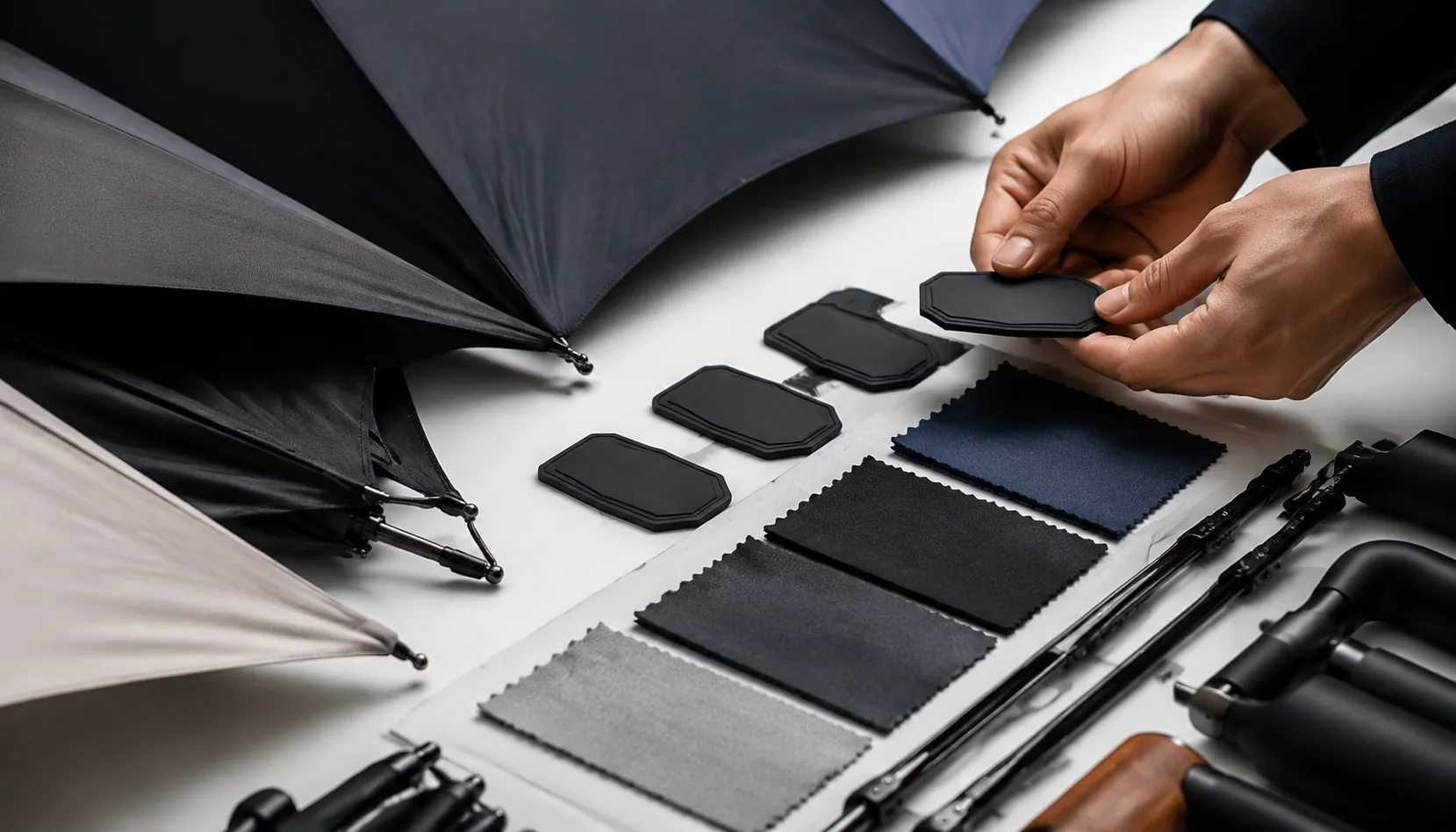
For premium umbrella programs, the logo patch is often the first detail buyers touch—and the first place weak specifications show up as peeling edges, color drift, or awkward placement after folding. On our Songxia production floor, silicone logo umbrella patches are treated like a trim-engineering item: position must clear ribs and seams, bonding must survive wet handling, and inspection has to catch height, adhesion, and finish issues before bulk packing.
Why Use Raised Silicone Patches
Raised silicone patches work when the umbrella needs to feel like merchandise, not a giveaway. A flat screen-printed logo on 190T pongee is fine for a one-day event, but on premium branded umbrellas for retail shelves, golf pro shops, hotels, and executive gifting, buyers notice the hand feel first. A molded patch gives a raised umbrella logo with edge definition, color depth, and a rubberized touch that survives handling better than cheap ink laid over a water-repellent canopy. We usually place silicone logo umbrella patches on the lower canopy panel, closure strap, sleeve, or molded handle insert, depending on whether the brand wants visibility when open, closed, or displayed in packaging.
The best applications are 23" and 27" straight umbrellas, 30" golf umbrellas, and higher-grade auto-open or auto-open-close models where the build already supports a premium story. I would not put a heavy patch on a thin 170T promotional canopy or a very compact 21" travel umbrella unless the patch is small, because weight and folding bulk matter. For 190T or 210T pongee with Teflon coating, we test patch adhesion after water-spray exposure, folding cycles, and packing compression. On double-canopy vented windproof golf umbrellas with fiberglass ribs, a custom umbrella logo badge can be sewn or heat-bonded to a reinforced area so the logo does not pucker the fabric.
Umbrella patch branding also gives procurement teams better brand control than embroidery on coated fabric, which can create needle holes, or heat transfer that may flatten after abrasion. Silicone can match Pantone colors closely, hold 2D or shallow 3D relief, and support matte, gloss, or debossed details, though very fine lettering under about 1 mm stroke width should be avoided. For corporate gifting, hotels, and golf tournaments, the patch makes the umbrella feel closer to luggage, outerwear, or performance gear. Our standard practice at ZheBrella is to confirm patch weight, bonding method, and AQL 2.5 inspection criteria before sampling, because a premium badge only works if it stays aligned, clean-edged, and firmly attached through real use.
Best Placement Areas on Umbrellas
Canopy panel placement gives the strongest retail visibility, but it is also the easiest place to create folding trouble if the patch is too heavy or too close to the frame. For silicone logo umbrella patches, I prefer a single patch on one lower canopy panel, centered 90–120 mm above the hem on a 23" umbrella and 120–160 mm on a 27" golf model. Keep at least 25–35 mm clearance from the nearest rib seam on 8K frames, and more like 35–45 mm on 16K frames because the rib spacing is tighter and the fabric stacks thicker when closed. A 190T or 210T pongee canopy can carry a 0.8–1.5 mm raised umbrella logo if the backing is flexible, but a thick molded badge on lightweight fabric will cause puckering after heat press or stitching. On double-canopy vented windproof umbrellas, avoid the vent overlap zone; the patch can block airflow and reduce the benefit of a frame rated for 50+ mph wind testing.
Sleeve patches are safer for premium branded umbrellas because they do not flex across the ribs during opening and closing. A sleeve can take a larger custom umbrella logo badge, often 45–70 mm wide, without affecting canopy tension, especially if the sleeve uses matching 210T pongee or a heavier oxford fabric. The tradeoff is visibility: the logo sells well at retail or in gift-box presentation, but it disappears during use unless the buyer keeps the sleeve attached. Strap badges sit between those two options. A small silicone badge on the closure strap is visible when the umbrella is folded, but the weight must stay low, normally under 5–8 g, or the strap will twist and the hook-and-loop or snap will not align cleanly. On auto-open-close compact umbrellas, the strap area also needs clearance from the runner and folded rib tips, so we check the closed diameter before approving mass production.
Handle badges and hangtag-style applications avoid canopy folding interference completely, but they solve different branding problems. A handle badge works well on EVA, rubberized, PP, ABS, or wooden handles when the mold has a flat or recessed logo area; otherwise the adhesive edge lifts after temperature cycling in export cartons. For umbrella patch branding on handles, we usually specify a shallow recess of 0.2–0.5 mm so the silicone sits flush and survives rubbing during DDP shipment and retail handling. Hangtag-style silicone pieces, attached by elastic cord or ball chain, give a premium feel for launches, golf events, and hotel programs, but they are not permanent branding unless the buyer accepts that end users may remove them. Our standard practice at ZheBrella is to test placement on opened, closed, and sleeved samples before AQL 2.5 inspection, because a logo that looks clean on a flat panel can fail once 8K or 16K ribs stack under real folding pressure.
Patch Materials, Colors, and Molding Details
PVC-free silicone is the cleanest choice when the buyer wants a soft-touch badge without the plasticizer smell we sometimes see in cheap PVC patches. For premium branded umbrellas, I normally specify molded silicone at 1.2–2.0 mm total thickness, with the logo raised 0.4–0.8 mm above the base so it reads clearly on 190T or 210T pongee without becoming a hard lump on the canopy. A custom umbrella logo badge can be heat-pressed onto a fabric panel before final canopy sewing, or stitched around the edge if the design brief wants a more outdoor-gear look. Heat pressing is cleaner for retail work, but the temperature window must be controlled; too much dwell time can flatten fine embossing or mark darker Teflon-coated fabrics.
Debossed artwork gives a quieter, more premium look, especially for black-on-black or navy-on-navy umbrella patch branding, while embossed artwork is better when the raised umbrella logo needs to be visible in event photos or on a golf umbrella at 10–15 feet. I do not recommend very tall embossing on folding umbrellas, because the patch area gets more bending stress when a 21 inch or 23 inch canopy is wrapped tight. For 27 inch and 30 inch stick umbrellas, there is more fabric area and less compression, so larger silicone logo umbrella patches hold shape better. Our standard practice at ZheBrella is to ask for vector artwork and then adjust the mold file for shrinkage, because silicone edges soften slightly after curing.
Pantone matching is possible, but buyers should expect a practical tolerance, not a laboratory-perfect hit. Silicone pigment behaves differently from printed ink on pongee, and bright fluorescent, metallic, and very deep navy colors are the hardest to control from batch to batch. Matte surfaces hide small molding flow marks and feel more technical; gloss surfaces make colors pop but show scratches and dust faster during AQL 2.5 inspection. For small brand marks, keep positive raised lines at least 0.35–0.45 mm wide, recessed grooves at least 0.5 mm, and letter height above 3 mm if the logo must survive mass production cleanly. Fine serif fonts, thin circles, and tiny registration symbols are where silicone logo umbrella patches usually fail, not at the big logo shape.
Attachment Methods and Durability Tests
Stitching is still the safest attachment method when the patch sits on 190T or 210T pongee canopy panels, especially for golf umbrellas and retail programs where the product may see two or three seasons outdoors. We normally specify a perimeter lockstitch with 8 to 10 stitches per inch, using bonded polyester thread and a backing film if the fabric is thin or has Teflon water-repellent coating. For a raised umbrella logo near the lower canopy edge, the patch should stay outside the main fold line; if it crosses a rib crease, even a soft silicone badge will start to show whitening or edge lift after repeated closing. On 21 inch folding umbrellas, the tolerance is tighter than on 27 inch or 30 inch straight umbrellas because the canopy wraps under more compression. For premium branded umbrellas, I prefer stitched silicone logo umbrella patches when the order quantity supports a sewing fixture and the buyer wants a visible, tactile badge rather than a flat screen print.
Heat bonding can look cleaner than stitching, but it must be matched to the fabric coating and frame type. A silicone patch with heat-activated TPU film can bond well to uncoated pongee, but it is less forgiving on heavy PU, UV black glue, or high-repellency Teflon finishes; the surface energy is simply not friendly to adhesives. In production, we run a press window around 130–150°C for 12–18 seconds, then check whether the fabric gloss, waterproof coating, or dye migration has changed. Adhesive-backed labels are acceptable for hangtag-style decoration, sample runs, event giveaways, or temporary umbrella patch branding, but I do not recommend them as the main logo method for AQL 2.5 retail inspection unless the buyer accepts a shorter service life. Molded handle inserts are a different category: a custom umbrella logo badge can be set into EVA, rubberized plastic, or ABS handles during assembly, avoiding canopy flex completely and giving excellent durability on auto-open and auto-open-close models.
Durability testing should copy how umbrellas actually fail, not just how a patch looks on a table. For fold-cycle checks, we open and close folding umbrellas 300–500 cycles and straight umbrellas 200–300 cycles, then inspect patch edges, stitch tension, fabric puckering, and logo deformation. Peel strength should be measured after 24 hours of curing for bonded patches, with a practical target of no edge lift under firm hand peel and, for lab programs, a 90-degree peel result agreed before bulk production. Wet rub testing matters because silicone surfaces can carry dust, pigment, or metallic ink; we use a damp white cotton cloth for 20–50 rubs and reject transfer that stains the cloth or dulls the logo face. Temperature aging at -10°C to 60°C, plus 24–48 hours of rain exposure or spray testing, catches most weak adhesive films. Our standard practice at ZheBrella is to approve silicone logo umbrella patches only after testing them on the actual canopy fabric, not on a supplier’s generic swatch.
MOQ, Lead Time, and QC for Bulk Orders
For silicone logo umbrella patches, separate the patch MOQ from the umbrella MOQ because they are not made on the same line. A raised umbrella logo normally needs a CNC aluminum or copper mold, and mold charges usually run USD 80–250 depending on patch size, number of color cavities, and whether the edge is flat, beveled, or recessed for stitching. Patch factories often quote 1,000–3,000 pcs MOQ per logo/color, while umbrella assembly MOQ may be 500–1,200 pcs for 23 inch auto-open straight umbrellas or 1,000–3,000 pcs for compact 21 inch auto-open-close models. If the buyer orders only 600 umbrellas, we still may need to produce 1,000 patches and hold the balance for repeat orders. That is normal for premium branded umbrellas, but it should be written clearly on the PI so nobody argues later about leftover badges.
Sampling should not be rushed because the patch affects both appearance and assembly method. A first silicone badge sample usually takes 5–7 days after vector artwork approval, with another 2–3 days if Pantone color matching is rejected and remade. A finished umbrella sample with the custom umbrella logo badge attached normally takes 10–15 days, depending on whether the base umbrella uses stock 190T pongee canopy, fiberglass ribs, or a custom frame. Bulk lead time is typically 25–35 days after sample approval for normal manual or auto-open umbrellas, and 35–45 days when the order includes custom dyed canopy fabric, 10K/16K reinforced frames, or gift-box packing. For FOB Ningbo or Shanghai, lock carton size and gross weight before booking; for DDP, add 7–12 days buffer for customs data, HS code review, and last-mile delivery windows.
Our standard practice at ZheBrella is to inspect silicone logo umbrella patches under AQL 2.5 together with the finished umbrella, not as a loose accessory only. Patch QC starts with color tolerance against Pantone or approved sample, clean raised edges, no bubbles, no oil stains, and no warped backing. On the umbrella, inspectors check logo position with a paper jig, usually allowing only ±2 mm on panel placement because a crooked badge is very visible on a solid black or navy canopy. Adhesion is tested by peel and rub checks for heat-bonded patches, while stitched umbrella patch branding is checked for skipped stitches, loose thread, needle holes, and whether the stitch line bites evenly into the patch border. Finished-goods QC also includes open-close cycling, shaft lock strength, runner smoothness, rib alignment, canopy tension, and auto-open button response, because a beautiful patch does not save a mechanism that jams after 20 cycles.
Frequently Asked Questions
Can a silicone patch be added directly to a pongee canopy?
Yes, but stitching or bonding must be tested so the patch does not leak, pucker, or stop the umbrella from folding cleanly. A 210T pongee canopy often supports the added weight better than thinner fabric.
Are raised silicone patches suitable for compact auto-open umbrellas?
They can be used, but placement is usually safer on the sleeve or closure strap. Compact auto-open frames have tighter folding tolerances, so a bulky canopy patch may create packing issues.
Where can raised silicone logo patches be placed on an umbrella?
Common B2B placements include the canopy panel near the lower edge, the tie strap, the sleeve, or the handle end cap. For folding umbrellas, the sleeve or strap is usually safer than the canopy because it avoids extra stress during repeated opening and closing.
What attachment methods are used for silicone umbrella logo patches?
Silicone patches can be sewn, heat pressed with adhesive backing, or fixed with a hybrid sew-and-adhesive method. For premium retail umbrellas, sewn edges are often recommended because they perform better in flexing, rain exposure, and long-term handling.
What MOQ should buyers expect for custom silicone logo patches on umbrellas?
A practical MOQ is usually 500–1,000 umbrellas per logo design, depending on patch size, mold complexity, and umbrella model. New silicone patch molds typically add about 7–12 days before bulk production approval.
Looking to Launch Your Custom Umbrella Line?
ZheBrella is a Zhejiang-based OEM/ODM umbrella manufacturer with 17 years of export experience. Free design, low MOQ from 100 pieces, windproof construction, full-color print.
Get Free Quote Now »People Also Search For
Related Articles
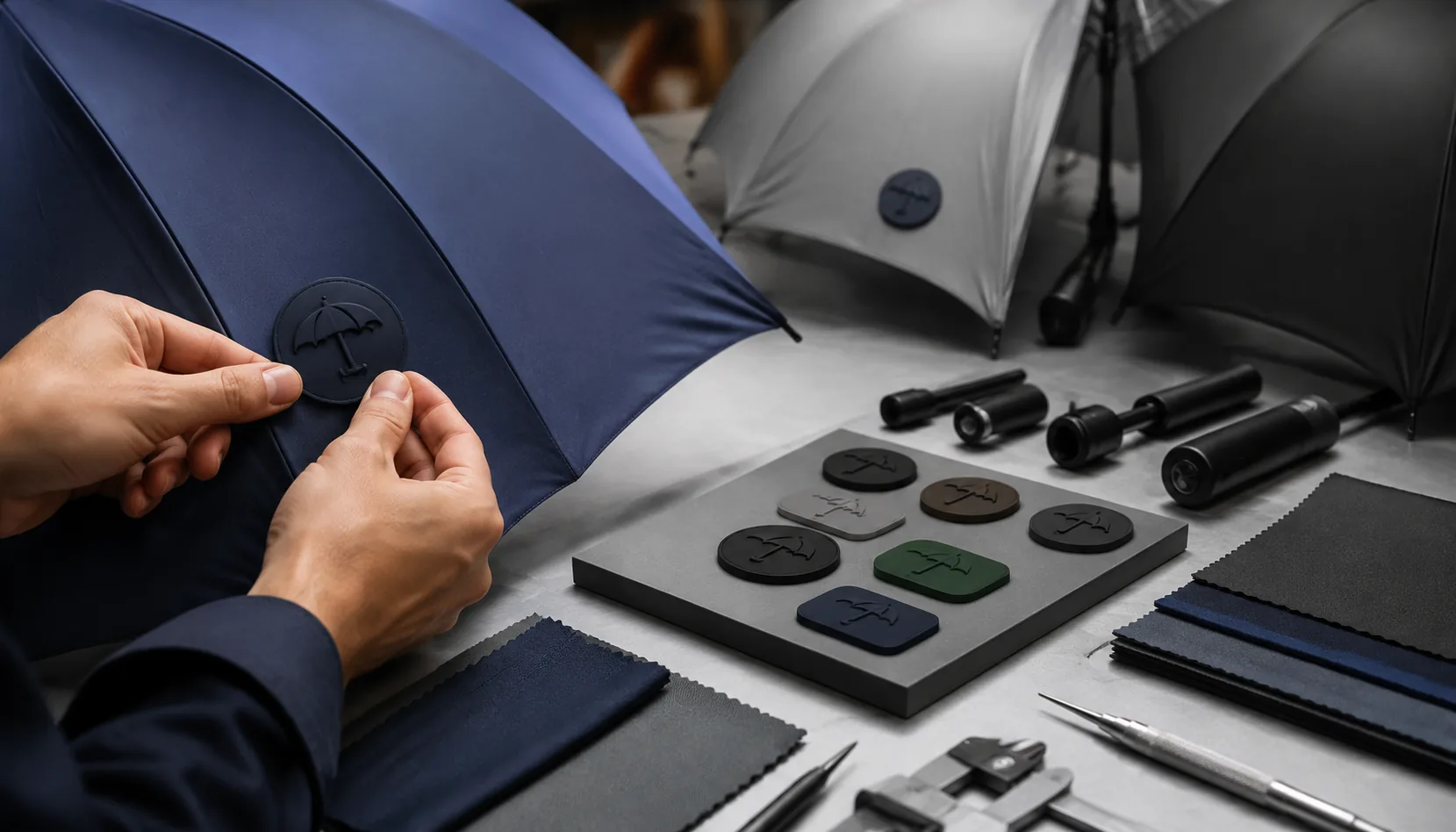
Silicone Patch Branding for Premium Umbrella Programs
Use silicone or rubber logo patches on straps, sleeves, or canopy trim with clear specs for mold cost, placement, stitch...
Read More »
Tone-on-Tone Umbrella Branding for Premium Corporate Programs
Use tone-on-tone umbrella branding to create subtle premium gifts with controlled fabric sheen, logo contrast, frame spe...
Read More »
Metallic Logo Effects on Premium Branded Umbrellas
Compare metallic ink, foil transfer, and subtle premium logo effects for umbrellas, including fabric limits, durability ...
Read More »