Testing Umbrella Open-Close Cycles for Long-Term Durability
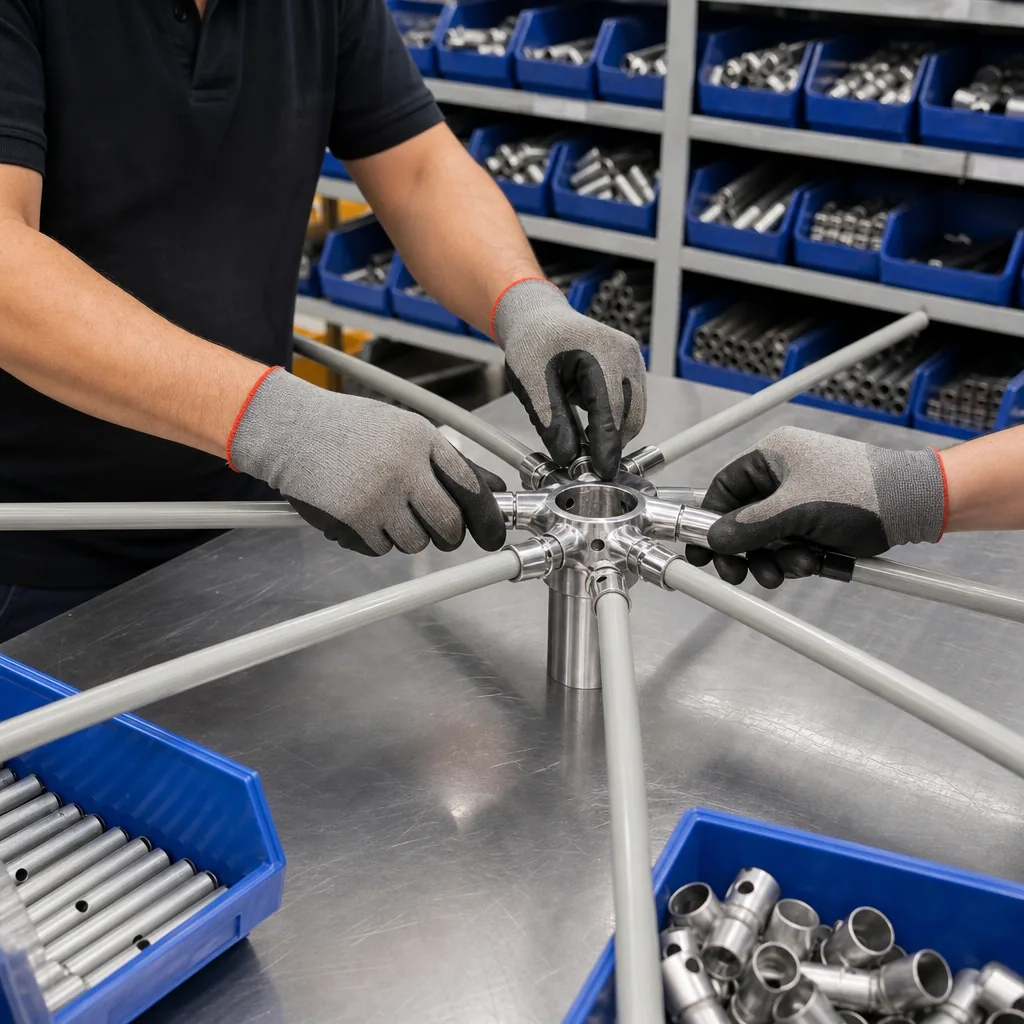
Buyers do not lose money because an umbrella opens once in the showroom; they lose it when springs weaken, runners wear flat, and joints loosen after weeks of repeated use. At the factory, umbrella open-close cycle testing exposes those failure points before shipment by simulating the same motions retail and promotional umbrellas will face in the field. It is the fastest way to separate a product that merely looks right from one that will keep working through real customer use.
- 1. What open-close cycle testing measures in umbrella manufacturing
- 2. How factories run cycle tests on manual and automatic models
- 3. Common failures found before mass production approval
- 4. Material and construction choices that improve cycle life
- 5. How procurement teams should write cycle-test requirements
What open-close cycle testing measures in umbrella manufacturing
Umbrella open-close cycle testing measures how the frame holds up to repeated use under controlled stroke length, opening speed, and locking force. A cycle test machine runs the umbrella through set repetitions until a part loosens, cracks, binds, or stops locking correctly. The first wear points are usually the compression spring in an auto-open shaft, the runner on the center pole, rib-to-stretcher rivets, ferrules, and the upper and lower locking points. Good umbrella open-close cycle testing checks more than visual damage: it verifies clean opening, latch reset, rib alignment, and whether the mechanism still engages at the same force after repeated cycles. For OEM umbrella QC, that is the real test of whether the product will survive customer use, not just warehouse handling.
Buyers should ask for cycle targets by product type instead of accepting one generic number. A basic 21-inch or 23-inch manual umbrella with steel ribs is often acceptable at 500 to 1,000 cycles for promotional use. Retail manual stick or folding umbrellas with fiberglass ribs and reinforced rivets are more credible at 1,500 to 3,000 cycles. Auto-open models should typically pass at least 3,000 cycles because spring fatigue and latch timing fail early, while auto-open-close compact umbrellas should target 5,000 cycles or more for meaningful umbrella lifetime testing. For 27-inch or 30-inch windproof umbrellas, ask for both cycle and wind verification; a frame rated for 50+ mph wind resistance can still fail if the runner binds or a locking point wears. After testing, confirm the ferrule stays tight, rivets do not oval out, steel plating does not flake, fiberglass ribs do not whiten at bend zones, and the canopy remains centered.
When comparing supplier quotes, require the exact test method, sample size, pass/fail criteria, and whether the result applies to the quoted 8K, 10K, or 16K frame. Rib count, resin content, and mechanism design can change wear life significantly, so a passing result on one build does not transfer to another. Also keep final inspection linked to the lab result: AQL 2.5 should still be used to catch assembly defects that a cycle test will miss, such as loose handle joints, uneven rib tension, or poor riveting. Ask for the actual failure mode if the test stops early, not just a pass/fail label. That gives you a better cost-risk read before approving mass production or reorders.
How factories run cycle tests on manual and automatic models
Umbrella open-close cycle testing is a screening tool for early failure before shipment, not proof of a marketing life claim. For automatic styles, factories usually run a cycle test machine at a fixed actuation speed and stop at checkpoints such as 100, 300, 500, and 1,000 cycles to inspect the shaft, runner, spring, ferrule, push button, rivets, and rib joints. Manual umbrellas are better tested by hand or with a basic actuator because the failure pattern is different: loose rivets, bent ribs, twisted shafts, or handles that begin rotating under load. Auto-open models need tighter checks on release-spring output and latch engagement after repeated firing. Auto-open-close frames carry the highest risk because the system must open fully, collapse smoothly, and return to a locked position every time, without partial deployment, button sticking, or incomplete reset. On 8K and 10K frames, inspectors should also watch rib symmetry and fabric tracking during umbrella lifetime testing; geometry drift often appears before a full break at the rib joint or runner.
The most useful result is the trend line, not the headline cycle count. A usable OEM umbrella QC report should record opening force, closing force, button travel, lock engagement, test speed, and the exact cycle at which performance changes or failure starts. It should also tie the result to the actual build: model size such as 21 inch, 23 inch, or 27 inch, rib material such as fiberglass or steel, shaft diameter, and spring type. After the repeated-actuation test, visual inspection matters as much as the machine log. Inspectors should check for cracked plastic parts, worn coating on steel shafts, popped stitches at canopy tips, bent stretchers, loosened screws, and excessive play in the runner or button. The QC record should also list sample quantity, pass/fail result, failure mode, photos, repairability, acceptance standard, lot number, inspection date, AQL 2.5 if the lot is sampled that way, and whether the tested units match the approved pre-production sample. That makes auto-open mechanism durability comparable across suppliers, lots, and frame specifications.
Common failures found before mass production approval
Most failures in umbrella open-close cycle testing start as wear, not breakage. Spring fatigue is usually first: the runner spring or top spring loses rebound after a few hundred to a few thousand cycles when the wire diameter is inconsistent or the steel is not heat treated correctly. On auto-open mechanism durability checks, button failure often follows the same curve. The latch edge rounds off, plastic button caps crack, and the return spring weakens, so the umbrella opens slowly, stops short, or no longer locks with a clean click. For OEM umbrella QC, that is a red flag even when the unit still completes the stroke. A proper cycle test machine should log stroke count plus opening force, closing force, and latch engagement consistency, because a mechanism can remain functional while drifting out of spec well before mass production approval.
Frame failures depend heavily on whether the build uses steel or fiberglass. Steel frames are more likely to develop shaft wobble, ovalized tubes, and loose swaged joints after repeated cycling, especially in lower-cost 21" to 27" constructions with thin tube walls. That play shifts the canopy off center and can make wind loading uneven. Fiberglass frames avoid rust, but they fail in a different way: ribs can whiten, splinter, or take a permanent set at bend points, especially in 8K and 10K builds with narrow rib sections. In umbrella lifetime testing, even 2 to 3 mm of shaft movement is a practical reject marker because it usually keeps growing. Canopy loosening is another common miss. Stitch holes at the rib tips elongate, thread tension relaxes, and the top crown socket can slip or spin, particularly on 190T pongee or lighter POE canopies. Before approval, samples should finish the full cycle count with no rib-end punch-through, no stitch creep, and no visible canopy slackening.
Material and construction choices that improve cycle life
In umbrella open-close cycle testing, the first failures usually show up where the canopy creases, at runner contact points, and around seam stress zones, so fabric spec matters more than decoration. For entry-level promotional units, 190T pongee is still the cost baseline, but 210T pongee usually lasts longer in umbrella lifetime testing because the tighter weave resists fraying at panel corners, stitch holes, and fold lines after repeated open-close cycles. It also holds seam tension better when an auto-open spring snaps the canopy fully open; the load spreads across a denser yarn structure instead of concentrating on a looser weave. That gain disappears if cutting and sewing are loose. Accurate panel alignment, stable stitch density, and clean edge sealing reduce abrasion and seam creep more than an upgraded print ever will. For OEM umbrella QC, the practical buying decision is simple: use a well-made 210T canopy for daily-use programs and reserve 190T for short-run promotional distribution where cost matters more than long-cycle durability.
Frame construction usually decides whether the umbrella reaches a high cycle count or fails early on a cycle test machine. Fiberglass ribs generally outperform thin steel ribs because they flex and recover instead of taking a permanent bend at the tips, stretchers, and joint holes after thousands of openings. In long-cycle testing, an 8K or 10K fiberglass frame with reinforced joints will often outlast a cheaper 16K steel frame, even if the steel frame feels stiffer at first inspection. A thicker shaft with higher wall thickness also matters: it reduces wobble, keeps the runner tracking straight, and cuts wear on the spring, slider, and crown, which directly improves auto-open mechanism durability. Surface treatment affects service life for the same reason. Weak nickel or black plating wears through first at hinge points and rivet holes, exposing steel to corrosion that increases friction and shortens cycle life. Better electroplating, powder coating, or anti-rust treatment on the shaft, ferrule, rib ends, and spring housing keeps movement smoother under humidity and salt-spray exposure. Higher-spec fabric pays off only when the frame hardware is built to the same standard; otherwise the mechanism fails before the canopy does.
How procurement teams should write cycle-test requirements
Make umbrella open-close cycle testing a written RFQ requirement, not a vague note to “check durability.” Identify the exact SKU family and mechanism being quoted: 21 in. or 23 in. 3-fold auto-open-close, 27 in. straight auto-open, or 30 in. golf; frame construction should also be fixed upfront, such as 8K steel, 8K fiberglass, or mixed fiberglass/steel ribs. Add the canopy material because 190T pongee, 210T pongee, POE, and PVC do not fatigue the same way under repeated flexing. Your tech pack should also define the cycle test machine method so results are comparable across OEM umbrella QC suppliers: one cycle equals full open to full lock, then full close to strap-ready position. Require the report to record machine type, cycle speed, dwell time in the open position, and whether reset is manual or pneumatic. Without that detail, suppliers can change the setup and still claim a “pass,” which makes umbrella lifetime testing data hard to compare across price tiers or factories.
The commercial terms need a numeric pass standard. Do not write only “passes 10,000 cycles.” State the required cycle count by product type and price point, then define what counts as a failure: broken spring, runner jam, latch non-release, shaft deformation, rib inversion that does not recover, canopy detachment, handle movement over 2 mm, or any unit that cannot open and close with normal hand force. The draft thresholds here are workable: 3,000-5,000 cycles for compact auto-open-close umbrellas, 5,000 for manual 3-fold frames, and 8,000+ for straight automatic frames, with the buyer approving the final target. Pair that with a clear acceptance rule, such as 0 failures from 5 samples for premium programs or no more than 1 failure from 8 samples for lower-risk orders, so auto-open mechanism durability is judged on function rather than cosmetic arguments.
Sampling and timing should be fixed in the RFQ. Keep AQL 2.5 for finished-goods inspection, but separate it from cycle testing because AQL is a shipment sample plan, while cycle testing is a reliability check. State whether samples come from first article, PP sample, or mass production; whether tested units are retained; and how long the factory must hold them. A practical structure is 1 tested sample plus 1 sealed counter-sample retained by the factory for 6-12 months, with 1 control sample available to the buyer or third-party lab. Also specify timing: require testing before PP approval for any new mold, new frame supplier, new auto-open mechanism, or higher wind-resistance requirement, and require a pre-shipment retest for high-risk orders or orders above 10,000 pcs. For FOB or DDP shipments, require the cycle-test report, AQL 2.5 inspection report, and corrective-action closure before release to reduce the risk of delays after vessel booking or delivery scheduling.
Frequently Asked Questions
How many open-close cycles should a buyer require?
It depends on the umbrella category. Promotional umbrellas may need a lower verified cycle count, while retail and travel umbrellas should be specified with a higher target and no functional failure at the end of testing.
Does cycle testing replace normal inspection?
No. Cycle testing validates mechanical durability, but it should be used together with dimensional checks, fabric inspection, and carton checks before shipment.
How many open-close cycles should a commercial umbrella pass before shipment?
For OEM umbrella orders, buyers often request 1,000 to 5,000 cycles for standard manual models and 3,000 to 10,000 cycles for automatic models, depending on price point and market requirements. High-use retail or promotional umbrellas may need a higher target if the customer expects longer service life.
Which parts usually fail first in umbrella cycle testing?
The most common weak points are the spring in the auto-open mechanism, the runner track, and loose rib joints. After several hundred to a few thousand cycles, testers also look for handle loosening, button failure, and fabric stress near the crown.
Can cycle testing be added to an OEM umbrella QC plan?
Yes. Many factories test 5 to 10 samples per lot, then run cycle tests on representative units before final packing. A buyer can specify the required cycle count, inspection standard, and acceptance criteria in the purchase order or QC agreement.
Looking to Launch Your Custom Umbrella Line?
ZheBrella is a Zhejiang-based OEM/ODM umbrella manufacturer with 17 years of export experience. Free design, low MOQ from 100 pieces, windproof construction, full-color print.
Get Free Quote Now »People Also Search For
Related Articles
Umbrella Frame Torque Testing for Smooth Opening and Closure
Learn how torque, spring force, and cycle testing keep auto-open and manual umbrellas smooth, safe, and consistent in ma...
Read More »Umbrella Opening Cycle Tests for Durable OEM Mechanisms
See how factories test manual and auto-open umbrellas for cycle life, spring stability, and field reliability before bul...
Read More »
Umbrella Fatigue Testing Protocols for OEM Durability Approval
Learn which fatigue tests matter for umbrella OEM orders, from opening cycles to rib-joint wear, with pass criteria buye...
Read More »