Umbrella Assembly Line QC Checks Before Final AQL Inspection
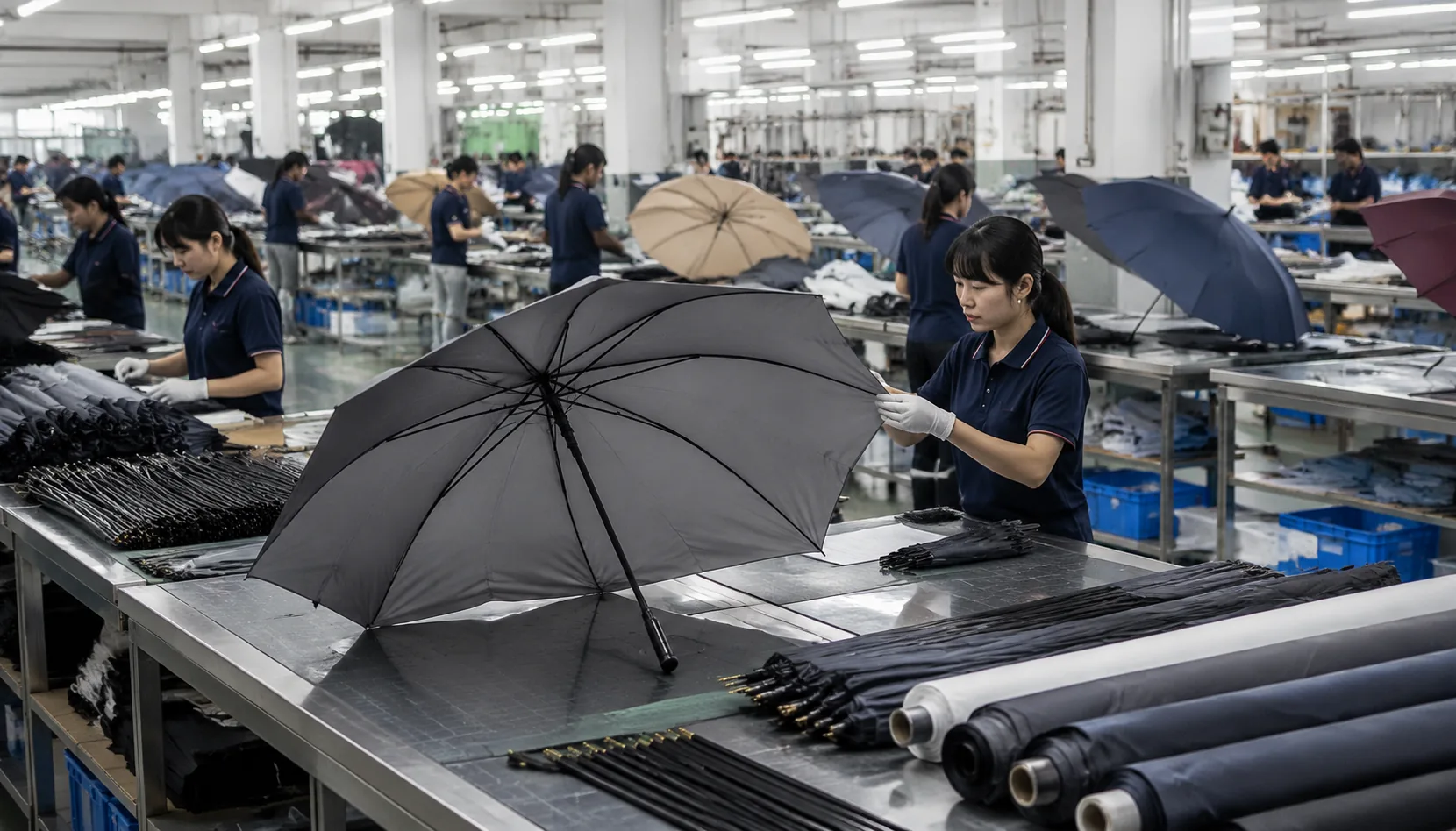
By the time an umbrella reaches final AQL 2.5 inspection, the most expensive defects are already built in: loose ribs, twisted panels, weak seams, sticking runners, or cartons packed with mixed specs. On our Songxia factory floor, umbrella assembly line QC is treated as a series of checkpoints at frame fitting, fabric cutting, sewing, mechanism testing, and packing—not a last-minute sorting job. That approach keeps rework contained and gives buyers cleaner shipments with fewer surprises.
Why Final Inspection Alone Misses Costly Defects
AQL 2.5 umbrella inspection is a buyer-protection sampling method, not a production control system. By the time cartons are sealed and the inspector pulls samples under ISO 2859-1, the factory has already paid for fabric cutting, logo printing, rib assembly, sewing, handle fitting, polybagging, and export cartons. If the sample fails for major defects, the real problem is not the failed report; it is that hundreds or thousands of umbrellas may already share the same defect. On a 10,000-piece OEM umbrella manufacturing order, one wrong screen-print position on 190T pongee, one weak runner spring, or one batch of loose 8K steel ribs can force full unpacking, sorting, and repacking. Final inspection can catch the issue statistically, but it cannot tell the sewing line to stop yesterday.
The umbrella assembly line QC checks that matter happen before defects multiply. After frame assembly, we open and close samples from each worktable to catch bent shafts, weak stretchers, missing rivets, tight runners, and auto-open failures before canopies are attached. After canopy sewing, inspectors check panel tension, seam puckering, tip alignment, and whether 21", 23", or 27" covers sit evenly on the frame. After printing, we verify logo color, registration, curing, and adhesion, especially on coated pongee, POE, PVC, and EVA materials where ink behavior changes. This in-process umbrella inspection is where most umbrella production defects are cheapest to fix: replace a rib before sewing, not after the umbrella is packed in an inner box with hangtag and barcode.
For ODM and OEM orders shipping DDP, late defects become expensive very quickly because the supplier is not just repairing umbrellas; they are protecting a delivery date, freight booking, retail launch, or event deadline. A failed final AQL can add 3 to 7 days for sorting, reinspection, carton replacement, and updated booking, which may be worse than the repair cost itself. Our standard practice at ZheBrella is to run umbrella assembly line QC at material receiving, frame assembly, canopy sewing, printing, final assembly, and pre-pack stages, then use AQL 2.5 as the last verification gate. That sequence reduces rework, avoids mixed-defect cartons, and gives buyers cleaner shipment records when customs, Amazon FBA appointments, or distributor delivery windows are already fixed.
Incoming Material Checks Before Assembly Starts
Bad umbrellas usually start as bad incoming parts, not bad final assembly. Before an umbrella assembly line QC station even sees a half-built unit, we check 190T and 210T pongee rolls for shade matching, GSM, yarn streaks, pinholes, coating uniformity, and hand feel. A 190T pongee canopy for a promotional 21" or 23" umbrella often lands around 70–85 GSM, while heavier 210T retail work may run closer to 90–105 GSM depending on PU, Teflon, or black UV backing. For UPF 50+ orders, we do not rely on supplier labels; we verify coating side, opacity, rubbing resistance, and sample UV performance before cutting. Color is checked under D65 light against the approved lab dip or Pantone target, because a 2% shade drift across panels becomes very visible after sewing. For printed OEM umbrella manufacturing, we also confirm fabric shrinkage and ink compatibility before approving bulk cutting.
Frame components need the same discipline because small tolerance errors become umbrella production defects later. Steel ribs are checked for plating thickness, burrs, straightness, rivet hole alignment, and rust marks, especially on black electroplated 8K and 10K frames. Fiberglass ribs are inspected for splintering, resin voids, uneven diameter, and tip bonding strength; a vented double-canopy golf umbrella with 27" or 30" ribs cannot survive a 50+ mph wind-tunnel claim if the rib sockets are loose. Shafts are rolled on a flat bench to catch bends, then checked for wall thickness, finish scratches, button hole position, and runner travel. Tips, end caps, notch springs, washers, and top caps are fitted to real production frames, not just measured with calipers. This is where umbrella assembly line QC prevents rework: if the runner sticks or the rib angle is wrong, sewing quality cannot save the umbrella.
Handles and mechanisms deserve special attention because buyers notice failures there before they notice a 1 mm stitch variation. We test plastic, EVA, rubberized, wooden, and crook handles for color, molding flash, thread fit, glue bite, logo position, and pull strength after assembly simulation. Auto-open and auto-open-close mechanisms are cycled before production release, usually 20–30 times at incoming inspection and more during pilot assembly, to catch weak springs, misaligned buttons, noisy sliders, or unsafe snap-back. Component fit is verified as a system: shaft diameter to handle socket, runner to shaft, rib tip to fabric pocket, cap thread to shaft, and ferrule to canopy stack height. Our standard practice at ZheBrella is to quarantine mismatched lots before cutting starts, because once panels are printed, sewn, and tied to frames, the cost of rejection under AQL 2.5 umbrella inspection is far higher than rejecting one carton of bad runners at the gate.
Line Checks During Sewing and Frame Mounting
The most useful umbrella assembly line QC happens before the canopy is permanently married to the frame, because sewing errors become expensive once tips, ferrules, and ribs are mounted. For standard 190T or 210T pongee panels, I want a seam allowance held at 6–8 mm, not guessed by eye, with stitch density around 9–11 stitches per inch for straight seams and slightly tighter control at the top cap reinforcement. Panel matching is checked by laying the cut panels flat before closing the canopy: stripe direction, logo orientation, and color shade must line up across all 8K, 10K, or 16K sections. On promotional and retail OEM umbrella manufacturing jobs, a 3 mm print shift may be accepted on a low-cost giveaway, but it is not acceptable when a heat-transfer logo crosses two panels or sits near a seam fold.
During in-process umbrella inspection at frame mounting, the operator and line QC both check tip attachment, rib pocket position, and canopy tension before the runner is cycled 3–5 times. Metal tips should be fully seated without cutting through the fabric; plastic tips must not rotate freely after riveting or stitching. Rib alignment is checked with the umbrella open on a flat table: each rib should track cleanly to its panel seam, with no twisted stretcher, bent steel rib, or fiberglass rib sitting outside the stitched channel. Canopy tension should be even enough to remove wrinkles but not so tight that the fabric pulls the tips inward or overloads the notch spring. Our standard practice at ZheBrella is to reject frames that need hand-bending to look straight, because those become return claims after shipping, especially on 23 inch auto-open and 27 inch golf umbrellas.
16K frames and double-canopy vented windproof models need slower line checks because there are more failure points hidden under the fabric. On 16K umbrellas, small rib-spacing errors accumulate quickly; if four adjacent ribs are 2–3 mm off, the canopy looks lopsided even when each seam passed sewing QC. For double-canopy windproof styles, the lower and upper canopy layers must be centered separately, with vent overlap consistent around the full circle, usually 20–30 mm depending on the pattern. QC should open the umbrella against airflow or a shop fan to confirm the vent lifts evenly instead of ballooning on one side. These umbrella production defects are exactly what final AQL 2.5 umbrella inspection may catch too late, so disciplined umbrella assembly line QC protects delivery dates as much as product quality.
Function Tests for Manual and Auto-Open Umbrellas
On an umbrella assembly line QC floor, the first thing we check is not appearance but movement. A manual stick umbrella should open with steady force, not a hard jerk that tells you the stretcher geometry is wrong, and it should close without binding at the top spreader or the runner collar. For auto-open models, the button travel, spring return, and final latch engagement matter just as much as canopy sewing. If the runner does not lock cleanly, the umbrella will creep shut in shipment or fail after a few cycles. We also do a shake test on the fully opened frame to catch loose rivets, weak tip fixing, and rattling joints that usually show up later as umbrella production defects. In OEM umbrella manufacturing, this stage is where you catch poor rib stamping and crooked ferrules before they become scrap.
Rib symmetry is a practical in-process umbrella inspection point, not a cosmetic preference. We compare opposite panels for equal tension, verify that each rib reaches the same open angle, and check that the canopy crown sits centered on the frame instead of pulling to one side. A compact auto-open umbrella needs extra attention here because the shorter shaft, smaller runner, and tighter spring package magnify any assembly error; even a slightly mis-set rib can make the closing stroke feel gritty or incomplete. Straight golf umbrellas are less sensitive on the button mechanism, but they demand stronger symmetry across a larger span, especially on 27" and 30" frames where one twisted rib can distort the whole profile. On umbrella assembly line QC, I prefer to reject early rather than rely on final sorting.
Opening cycle sampling should be built into every lot, especially before AQL 2.5 umbrella inspection. We do repeated open-close cycles on a sample from each batch to catch fatigue in the spring, wear on the runner lock, and weak stitching around the pocket points where the ribs pull hardest. Manual umbrellas usually fail by drag or misalignment, while auto-open and auto-open-close units fail by inconsistent trigger force, slow rebound, or partial closure after repeated use. The sample size should reflect the order mix: compact promotional models need more cycle checks because the mechanism is tighter and less forgiving, while golf umbrellas need longer shake and wind-load checks because the frame is larger and the rib spacing makes asymmetry easier to see. That is the practical difference between a passable umbrella and one that will survive real customer use.
Packing Audits Before Carton Sealing
Packing audits catch the mistakes that survive the sewing table and the frame bench. In umbrella assembly line QC, I check sleeve fit against the finished canopy first, because a sleeve that is too tight scuffs the tip and ferrule, while one that is loose shifts during transit and tears the polybag. The hangtag and barcode need to match the SKU, canopy color, size, and handle type; if the barcode scans to the wrong carton code, the warehouse will discover it only after receiving, which is the most expensive time to fix it. This is standard in-process umbrella inspection for OEM umbrella manufacturing, not a cosmetic step. For AQL 2.5 umbrella inspection, we also confirm the pack count, the polybag seal, and whether the shipping mark matches the buyer’s carton label format before the carton is closed. That is where most umbrella production defects become avoidable paperwork problems instead of chargebacks.
Carton sealing is where packing mistakes turn into freight damage and import disputes. I always look at drop risk: if the inner packs have too much empty space, the carton will crush on a corner drop and the ribs can punch through the canopy or sleeve, even when the umbrellas passed function testing. Shipping mark verification matters just as much as the count, because FOB and DDP terms both punish sloppy carton identification, only in different places in the chain. Under FOB, the buyer may catch the mismatch at destination and file a claim; under DDP, the seller eats the rework, repack, and re-delivery cost. On MOQ runs, a one-carton shortage or a mixed barcode pallet can create a larger receiving dispute than a visible fabric defect. Clean packing audits before sealing cut those claims down and keep the final AQL 2.5 umbrella inspection focused on real product quality instead of avoidable packing errors.
Frequently Asked Questions
How is in-process QC different from AQL 2.5 inspection?
In-process QC checks production while goods are being made, so defects can be corrected immediately. AQL 2.5 is usually a final sampling inspection after goods are packed.
Which umbrella defects should be treated as critical?
Critical defects include unsafe sharp edges, broken auto-open springs, frames that collapse during normal use, and incorrect compliance labels. Buyers should define these separately from major cosmetic defects.
What QC checks should happen on an umbrella assembly line before final AQL 2.5 inspection?
A practical line check usually covers frame straightness, rib symmetry, fabric panel tension, stitch consistency, open-close function, and handle attachment. Many factories inspect every 30-60 minutes or after each batch change so defects are caught before they become mass issues.
Which umbrella defects are most often caught in process instead of at final inspection?
The most common in-process defects are bent ribs, loose joints, skipped stitches, uneven canopy panels, printing misalignment, and packaging damage. Catching these early helps reduce AQL failures caused by repeated process errors across multiple units.
How does in-process QC support OEM umbrella manufacturing timelines?
In-process QC reduces rework at the end of production, which can save 1-3 days on a typical order depending on defect volume. It also helps keep the final AQL inspection focused on sampling rather than sorting out preventable line defects.
Looking to Launch Your Custom Umbrella Line?
ZheBrella is a Zhejiang-based OEM/ODM umbrella manufacturer with 17 years of export experience. Free design, low MOQ from 100 pieces, windproof construction, full-color print.
Get Free Quote Now »People Also Search For
Related Articles
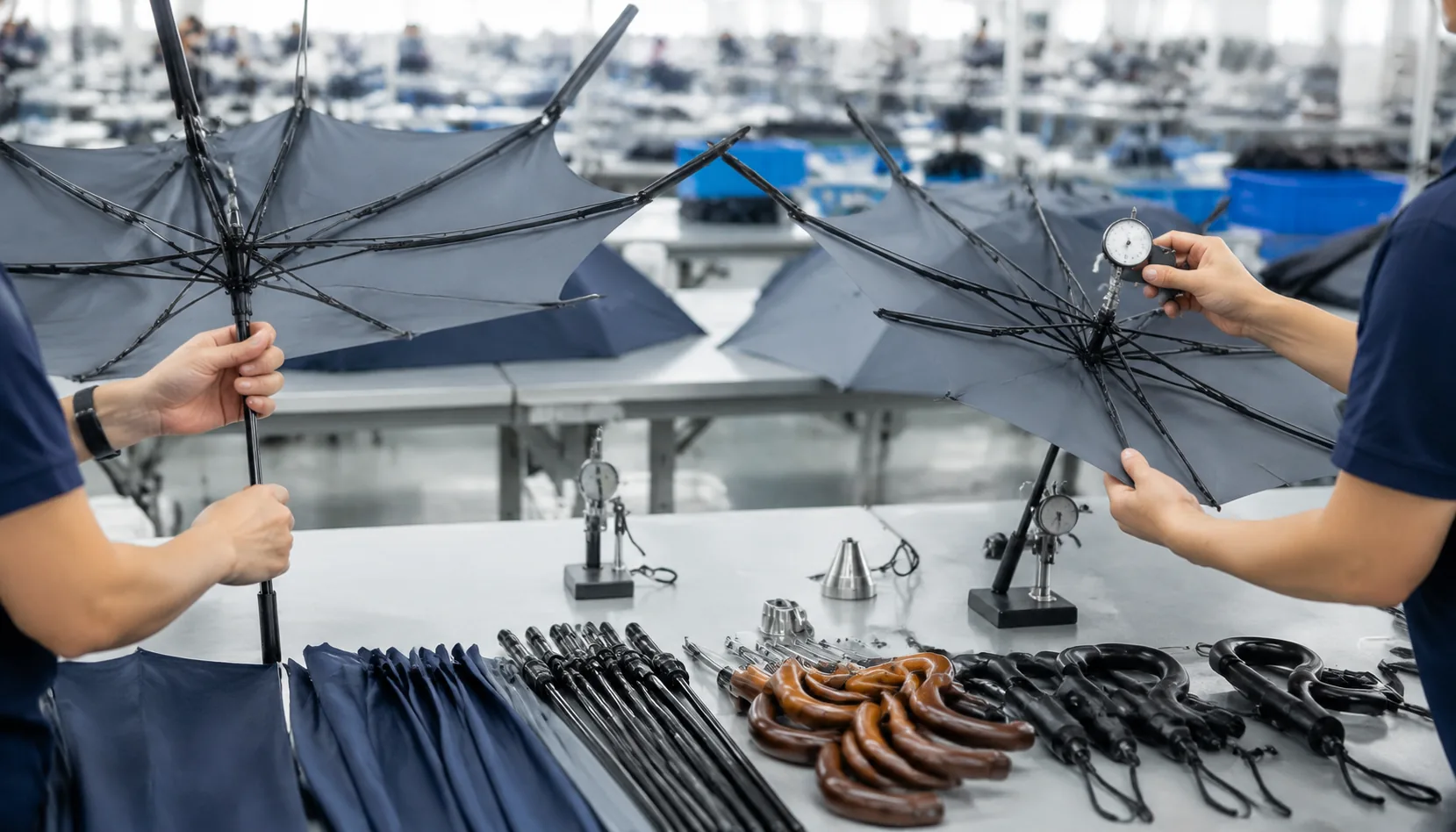
Inline Umbrella Assembly Checks Before Final Inspection
Use inline assembly checks to catch frame, fabric, handle, and mechanism issues earlier, reducing rework before final AQ...
Read More »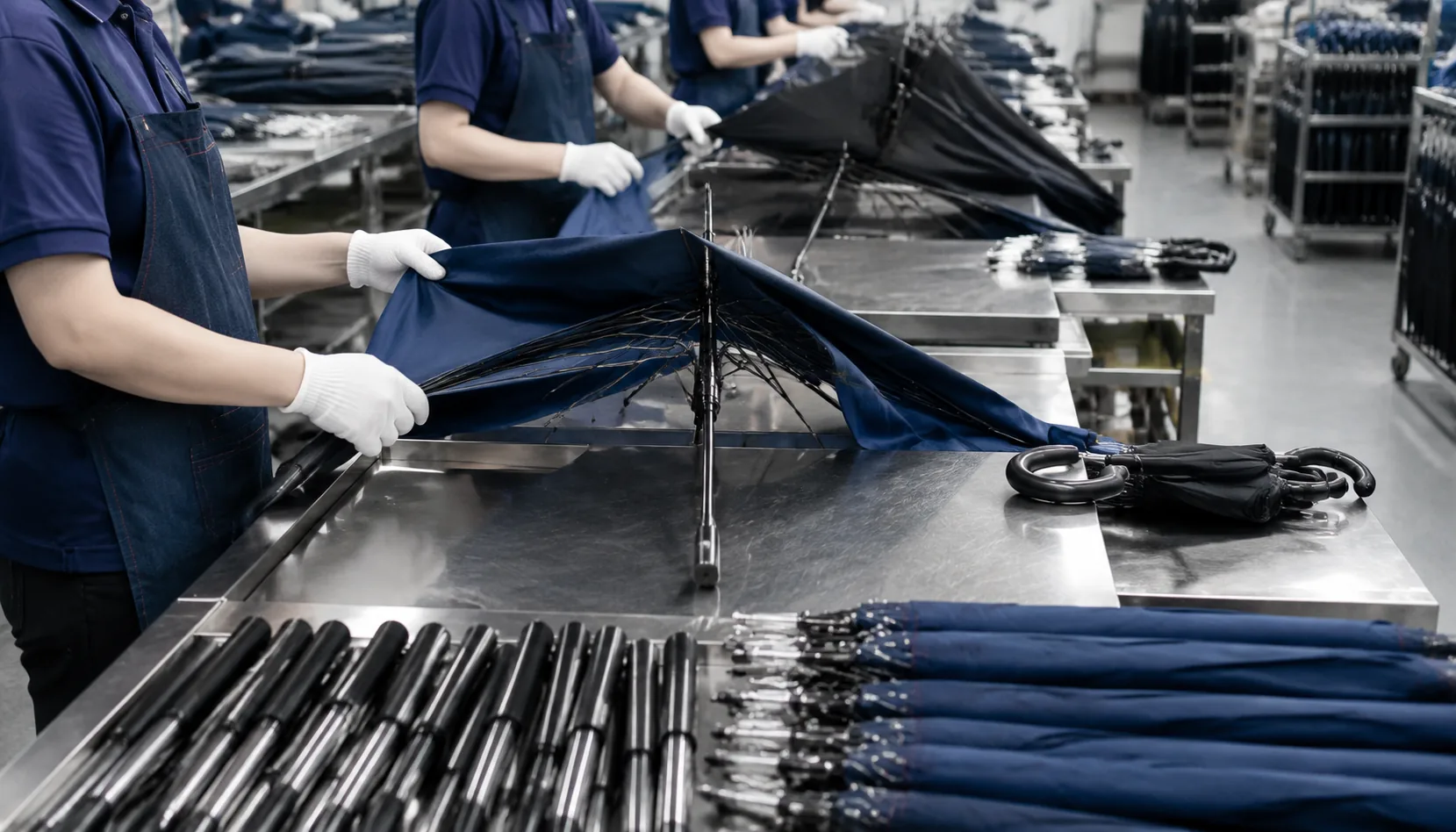
Umbrella Final Assembly Line Setup for Consistent Quality
Plan a reliable umbrella final assembly line with station controls for canopy mounting, opening tests, labeling, packing...
Read More »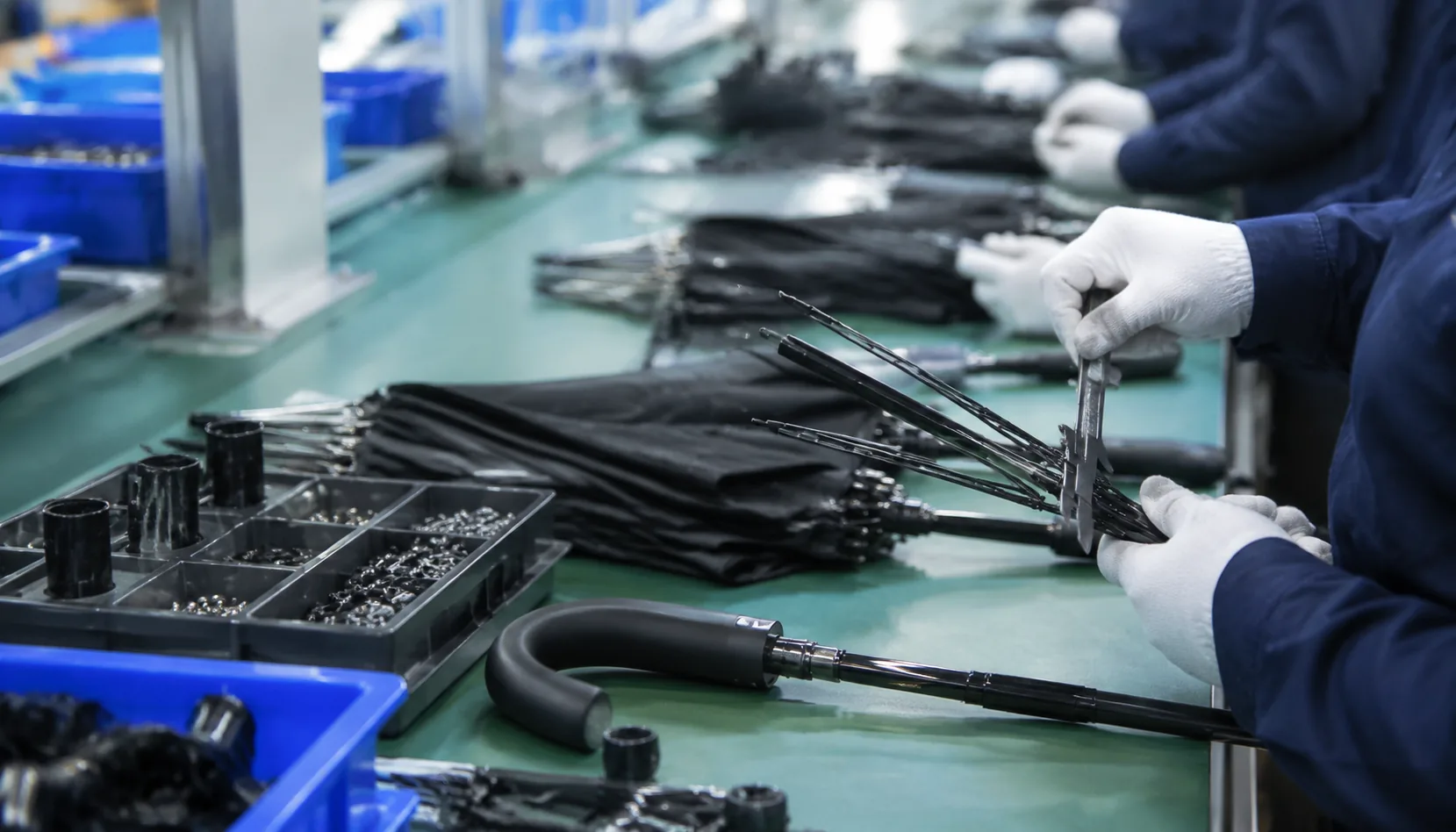
Inline Umbrella Assembly QC Gates Before Final Inspection
Map practical in-line QC gates for frames, canopies, auto-open mechanisms, and export packing so defects are caught befo...
Read More »