Umbrella Canopy Seam Sealing and Leak Resistance in Production
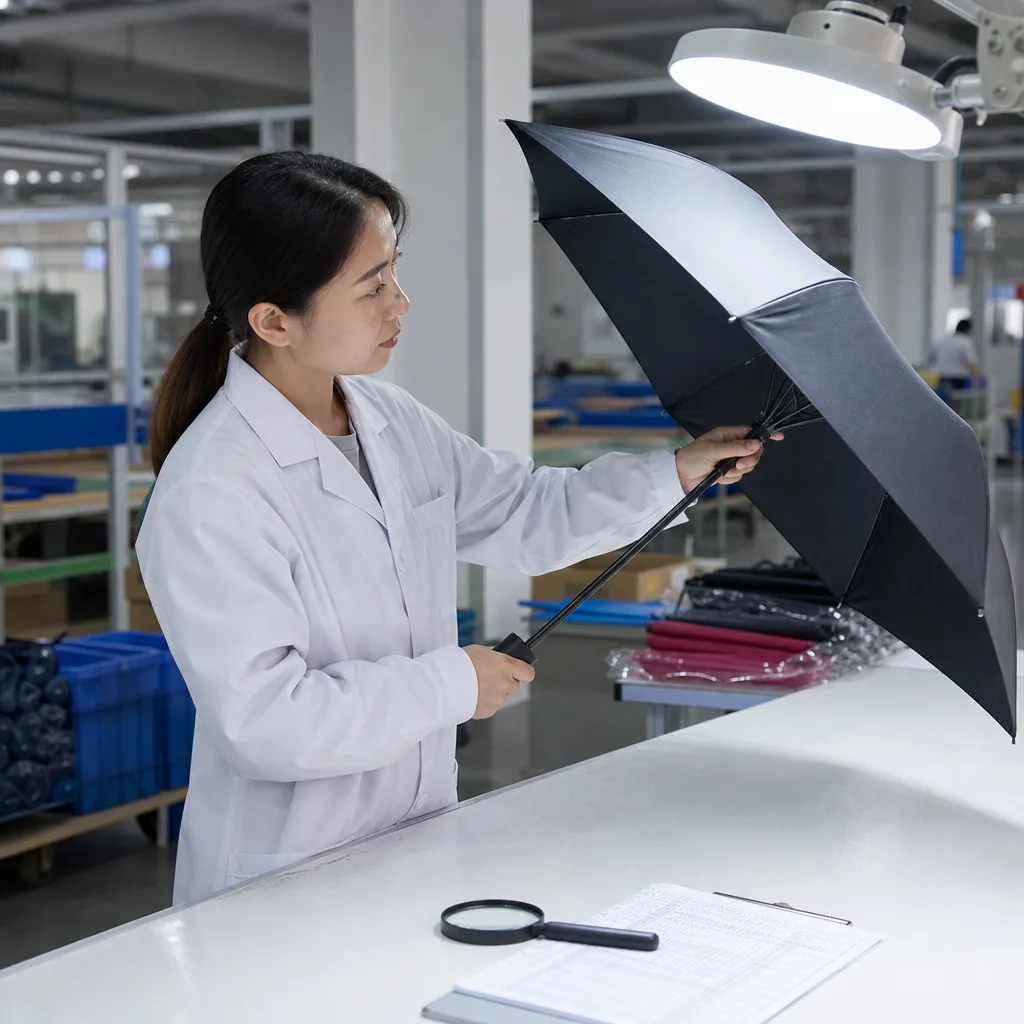
In bulk umbrella production, leak complaints usually start at the seams, not the fabric itself. Getting umbrella canopy seam sealing right means controlling stitch density, tape adhesion, heat, and material behavior on the line so every panel holds under wind-driven rain, folding stress, and repeated use. Buyers need more than a waterproof spec sheet; they need a factory process that keeps failure rates low across large orders.
Where Water Gets In: Common Seam Failure Points
Water rarely gets into an umbrella through one dramatic defect; it usually creeps in at the seam line where two canopy panels are joined. On pongee 190T, the needle perforations sit close enough that poor stitch density, uneven thread tension, or skipped stitches create a capillary path after the first real rain. In OEM umbrella manufacturing, I look first at the panel seams because that is where a canopy passes from looking acceptable on the table to leaking in the field. If the seam line is over-stitched, the fabric can distort; if it is under-stitched, the holes stay open longer and water tracks along the thread bundle.
The second weak point is the tip area, where the canopy is pulled tight over the runner and ferrule and the fabric sees repeated flexing. Small puckers around the tip make the seam seal less uniform, and once the user opens and closes the umbrella a few dozen times, those concentrated stress points start to split the coating or lift the tape edge. Vent overlaps on double-canopy styles are another common failure point because airflow and movement work the bond line loose. Good umbrella canopy seam sealing has to account for these geometry changes, not just lay tape over a flat sample and call it finished.
Weak seam tape adhesion is the fastest way to fail leak resistance testing, especially after heat, humidity, and repeated folding. If the adhesive is too hard, it cracks at the fold line; if it is too soft, it creeps and peels at the seam edge. We see this most often when the stitch pattern, coating chemistry, and tape bonding process were set up separately instead of being matched as one system. A canopy can pass a quick spray check and still leak after a longer rain exposure, so the production standard should be wet-cycle testing on the finished assembly, not just a visual inspection of the tape line.
Stitching, Tape, and Bonding Methods Compared
Plain stitching is the cheapest way to close a canopy panel, but by itself it is not a leak-control method. On `pongee 190T`, the needle holes open up faster under repeated wetting and drying, especially on 21" and 23" compact umbrellas with tight panel curvature. `pongee 210T` has a denser weave and holds the thread line better, but if the crown sees hard wind loading or the umbrella uses a deeper vented profile, I still treat the seams as a water path and specify either reinforcement tape or a sealing film. In `OEM umbrella manufacturing`, that decision is usually driven by the target price point and whether the product must pass real rain exposure instead of just looking clean on the sample table.
Reinforced seam tape is the most common step up because it improves `umbrella canopy seam sealing` without changing the sewing line too much. Good `seam tape bonding` works best when the tape is matched to the canopy resin system and pressed at the right temperature; if the adhesive window is wrong, the tape peels at the seam apex after only a few flex cycles. Ulrasonic bonding can remove needle holes altogether, but it is not universal: it works better on thermoplastic face fabrics and narrower seam geometries, and it usually needs tighter pattern control than stitched panels. Seam sealing films sit between those two approaches, giving a cleaner internal finish than plain tape but adding material cost and more inspection points.
For cost and schedule, stitched seams are fastest, then tape-reinforced seams, then bonded constructions, with ultrasonic and film sealing adding the most process control. A bonded seam usually raises unit cost by a few cents on simple auto-open models and more on large 27" or 30" golf umbrellas because the labor savings are not enough to offset equipment setup, adhesive handling, and extra QC. Lead time also stretches when we add cure time, adhesion testing, or rework for edge lift, so I quote an extra 2-4 days for bonded programs versus plain sewing. For `leak resistance testing`, I do not trust a quick spray test alone; we use repeated wet cycles and seam-focused inspection because the failure often shows up at the stitch exit, not in the fabric field.
Material Choices That Improve Leak Resistance
For leak control, the first decision is fabric, not tape. In umbrella canopy seam sealing work, a tight plain weave like pongee 190T or 210T gives you a denser starting point than a loose polyester, so the needle holes have less open space to wick water. Higher thread counts and finer filament yarns slow penetration, but the real advantage is consistency: the fabric behaves more predictably during cutting, stitching, and heat activation, which matters in OEM umbrella manufacturing where the same panel pattern has to run across multiple sizes and frame types. If the cloth is too airy, no amount of aftertreatment will fully compensate for poor base construction.
Coatings matter, but they do different jobs. PU, silver, and black coatings can improve water holdout, and a DWR finish helps water bead and roll off the face of the canopy, especially on first contact. But DWR is only a surface effect; once the stitch line is loaded, water still finds the seam and the folded hem if the pattern is weak. That is why seam tape bonding has to be matched to the fabric chemistry and the sew construction. A 190T pongee canopy with a clean stitch path and properly activated tape will outperform a heavier-looking fabric that was cut or sewn carelessly.
Buyers should ask for leak resistance testing when the umbrella will see repeated wet-dry cycles, retail returns are costly, or the canopy has large panels and long seam runs. Hydrostatic testing is the better check when you need a numeric water column target, while spray testing is useful for spotting pinhole leaks, edge wicking, and failures around the runner or vent area. The point is to verify both the cloth and the seam package, because umbrella canopy seam sealing is usually where a low-price build starts to fail. If a supplier cannot show test data tied to the exact fabric, coating, and tape stack, the sample is not enough to judge production performance.
Production Controls That Keep Seams Consistent
For umbrella canopy seam sealing, the real control starts before tape ever hits the fabric. Stitch length needs to stay tight and uniform, usually in the 3.0–3.5 mm range for pongee 190T, because long stitches open up under wind flex and short stitches pucker the seam. Tension calibration matters just as much: if upper and bobbin tension drift, the seam line wanders, needle holes enlarge, and seam tape bonding becomes inconsistent. In OEM umbrella manufacturing, I insist on a written machine setup sheet per style, because the same operator can still produce different seam behavior if the presser foot pressure, feed timing, or thread brand changes between runs.
Operator training is where most factories lose consistency. People need to know how to keep panel edges matched within a few millimeters, how to spot fabric stretch before sewing, and how to stop when the seam starts curling instead of forcing it through. Inline inspection should check seam alignment, stitch density, skipped stitches, and whether the tape sits flat without bubbles or edge lift. For leak resistance testing, I do not trust visual checks alone; a small seam that looks clean can still fail after spray or pressure testing if the needle path is too close to the cut edge or the tape is bonded onto a contaminated seam.
First article approval should lock down the exact sample that production must follow, not just the general design. Before mass production, verify the canopy panel size, seam overlap, tape width, stitch path, thread color, and the result after one full leak resistance test cycle, then compare it against the approved standard under the same lighting and handling conditions. Record every sample defect in a simple log with defect type, location, severity, machine number, operator, and correction action; that record becomes the reference when the line starts drifting. In practice, this is the only way to keep umbrella canopy seam sealing stable across shifts instead of discovering problems after cartons are already packed.
Inspection Standards and Buyer Sign-Off
For umbrella canopy seam sealing, the pass/fail rule has to be written before production starts, not argued after a wet test fails. In OEM umbrella manufacturing, I treat seam leaks as a functional defect, so the buyer and factory should agree on where the seam tape is applied, the allowable tape width tolerance, and whether any needle puncture at the rib pocket is acceptable. For pongee 190T canopies, the baseline should include a defined rain-simulation exposure, then a visual and hand-check for seepage along every stitched seam; if water crosses the seam line, that panel fails, full stop. AQL 2.5 is fine for final inspection, but only if the sampling plan names the critical points: crown, panel joins, vent seams on double-canopy styles, and any welded or taped reinforcement zones.
Carton sampling should not be random in the lazy sense; it should be traceable by lot, color, size, and sewing line, with enough units pulled to represent the run and catch process drift. For leak resistance testing, I prefer a simple buyer sign-off sheet that records test duration, spray intensity, umbrella open angle, and the exact failure threshold, such as visible drips inside the canopy, wet seam trace longer than a specified length, or water pooling at the runner. If the first carton passes and the third carton fails, the order still fails because the issue is process stability, not a lucky sample. That is the kind of detail that keeps seam tape bonding from becoming a subjective argument between procurement and the plant.
For repeat orders and seasonal replenishment, lock the approved seam spec into the tech pack with photos, not just text. The file should show stitch type, seam tape bonding method, tape material, thread spec, seam allowance, and the exact rain-simulation setup used for approval, so the next production run can match it without re-qualification unless something changes. In practice, I keep one signed sample, one inspection record, and one reference video tied to the PO number; that prevents disputes when the same canopy is reordered six months later under a different shipment window. If the buyer wants faster replenishment, the approved leak resistance testing result should be treated as the control standard until fabric, thread, or tape supplier changes trigger a fresh validation.
Frequently Asked Questions
Is seam tape always necessary on an umbrella canopy?
No. Many standard promotional umbrellas use stitched seams only, while higher-end or hospitality models may need tape or bonded seams for improved leak resistance. The decision depends on expected rain exposure, fabric choice, and target price.
What canopy fabric is usually easier to seal reliably?
Pongee is commonly used because it has a stable weave and consistent coating behavior, which helps seam performance. A 190T or 210T grade can work well if stitch density and tape adhesion are controlled during production.
Does 190T pongee always need seam tape for a rain umbrella order?
Not always. 190T pongee has good surface water repellency, but stitched needle holes can still leak under steady rain or spray testing, so seam tape is recommended for premium rain umbrellas or low-return retail programs.
What production variables most affect seam tape bonding consistency?
The main factors are bonding temperature, dwell time, tape width, and fabric coating compatibility. In bulk production, factories typically validate settings at line start and recheck after material lot changes to avoid edge lifting or weak adhesion.
How can a buyer set an acceptable leak-rate standard for a bulk umbrella order?
A practical QC standard is to define the test method, sample size, and maximum failures before production starts, such as spray or shower testing on finished umbrellas from each lot. Many buyers set a low single-digit failure threshold for retail programs, then require rework or replacement if the lot exceeds that limit.
Looking to Launch Your Custom Umbrella Line?
ZheBrella is a Zhejiang-based OEM/ODM umbrella manufacturer with 17 years of export experience. Free design, low MOQ from 100 pieces, windproof construction, full-color print.
Get Free Quote Now »People Also Search For
Related Articles
Umbrella Seam Sealing Methods for Leak Resistance in Production
Learn how stitching, seam tape, and seam layout affect leak resistance, rework rates, and quality control on bulk umbrel...
Read More »
Umbrella Canopy Seam Sealing Methods for Leak Control
Compare stitched, taped, and welded canopy seams and how each affects leak resistance, hand feel, and production cost fo...
Read More »
Umbrella Canopy Seam Specs That Improve Leak Resistance in Production
Specify stitch count, seam allowance, thread type, and seam sealing methods so your umbrella canopy resists leaks, frayi...
Read More »