Umbrella Canopy Seam Specs That Improve Leak Resistance in Production
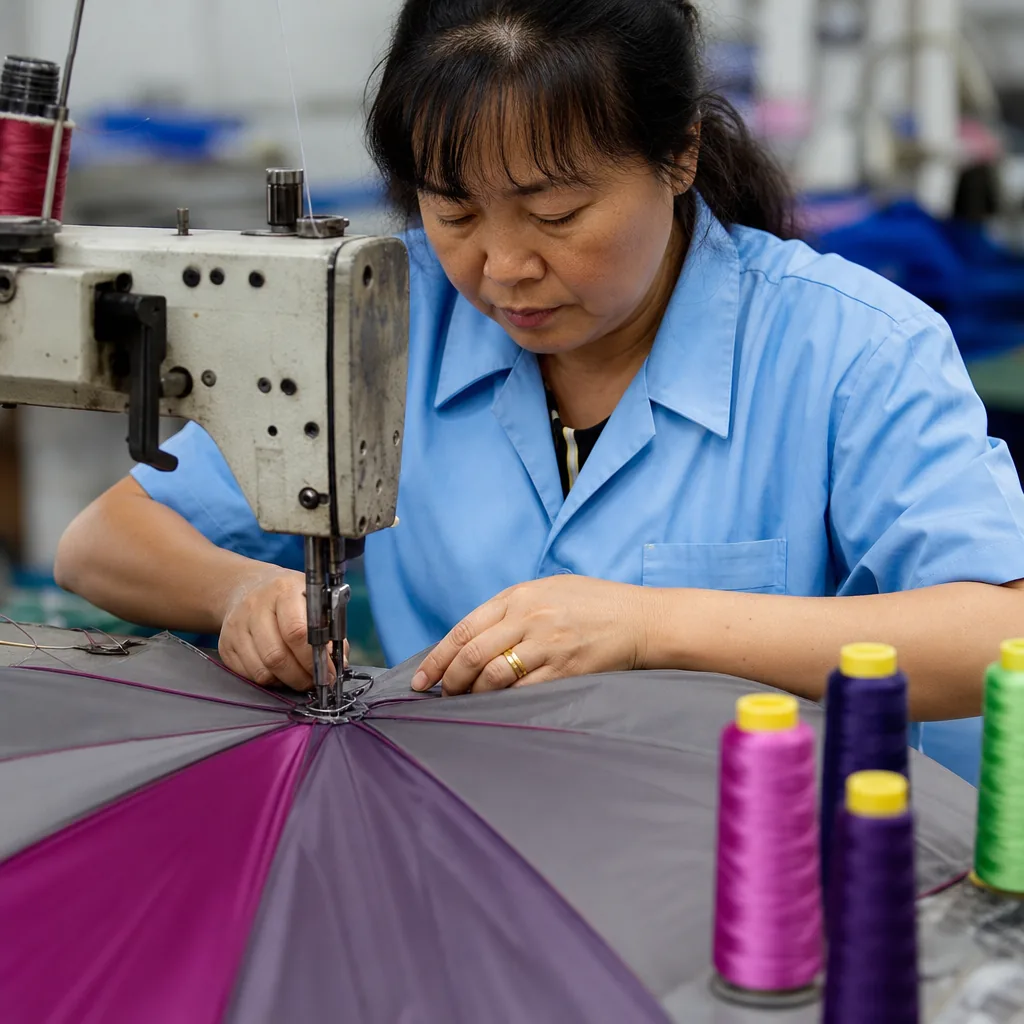
When an umbrella starts leaking, the failure usually traces back to the canopy seam long before the fabric itself is blamed. Buyers who specify umbrella seam specifications too loosely end up with uneven stitch density, weak seam allowances, and sealing methods that do not hold up under opening stress or wet-out cycles. On the factory floor, the difference between a durable canopy and a返品-prone one comes down to controlling those details before production starts.
Where canopy leaks actually begin
Leaking usually starts at the seam line, not on the open face of the canopy. In umbrella seam specifications, the real weak points are the needle penetrations where two pongee panels are joined, plus the apex where multiple panels crowd together under tension. If the stitch density is too high, the perforations become a capillary path; if it is too loose, the panel edge lifts and water tracks along the thread. That is why umbrella stitching quality has to be judged by hole geometry and thread compression, not just by how straight the seam looks. On 190T or 210T pongee, a clean seam can still wick water if the thread is oversized, the feed tension is inconsistent, or the seam allowance is too narrow for the panel load. In OEM umbrella production, leak resistance starts with the pattern and stitch spec, not with a post-production spray test.
There is a big difference between surface wetting and true seam penetration. Surface wetting is when droplets bead on the PU, Teflon, or UV-coated face and run off; the fabric itself is still doing its job. Seam penetration happens when water follows the stitch holes or a poorly locked seam and gets through to the inside, usually first appearing near the ribs, tips, or top hub after repeated flexing. That is why a canopy can look dry for minutes and then show leakage after shaking, folding, or wind loading. The common failure is not the fabric membrane but the line where panels meet and the coating is disturbed by the needle. Good canopy leak resistance depends on matching panel shape, needle size, thread count, and seam direction so the waterproof finish is not overstressed at the fold line.
For production control, umbrella seam specifications should call out more than stitch count. I want seam allowance, needle size, thread type, seam tension, and whether the top-stitch or hidden-stitch construction is used, because each choice changes how seam sealing umbrella performance holds up in rain. On vented or double-canopy builds, the outer panel may shed water well while the inner seam still wicks if the apex reinforcement is too small or the seam tape does not fully cover the punctures. Our standard practice is to check seam penetration after cyclic opening, not only after a static spray test, because folding and rebound expose the real weak points. If the canopy passes only on the first test but fails after flex, the issue is almost always in the stitch path, not the coating itself.
Stitch count, seam allowance, and thread selection
For 190T pongee, a practical starting point is 8 to 10 stitches per inch on the panel seam, with a seam allowance around 6 to 7 mm after trimming. On 210T pongee, I usually push to 9 to 11 stitches per inch because the fabric is denser and holds the seam better, but only if the needle size and thread balance are correct. In umbrella seam specifications, the stitch count is only one part of the job; the real target is a stable seam that survives opening cycles, panel tension, and wet-dry shrink changes without puckering. In OEM umbrella production, a clean seam at 190T often beats a dense seam done badly on 210T, because distortion at the hem or rib point creates weak spots that show up fast in rain testing.
Tighter stitching can improve mechanical strength, but it can also raise needle-hole leakage if the construction is poor. That is why canopy leak resistance depends on thread selection, needle size, and seam handling, not just stitch density. For pongee, bonded polyester thread in the 40s range is a better default than cotton or weak spun thread, because it resists wicking and keeps seam tension more consistent under UV and moisture. A smaller needle, usually in the 65/9 to 70/10 range, reduces hole diameter, but if the needle is too fine for the thread, you get skipped stitches and abrasion. On the floor, I look for even tension, no tunnel effect, and no thread twisting at the start and end of each panel. That is the difference between useful umbrella stitching quality and a seam that looks tight but leaks under pressure.
If the product needs seam sealing umbrella treatment, the seam geometry has to be stable first; sealant cannot fix a loose or distorted stitch line. Our standard practice is to test stitched panels on both 190T and 210T with water spray and flex cycling before approving the final needle and thread combination. For straight fold umbrellas, a consistent 6 mm seam allowance is usually enough, while vented or double-canopy builds may need a wider allowance to hold the edge and reduce stress at the join. In umbrella seam specifications, I would rather see a slightly lower stitch density with clean penetration than an aggressive tight stitch that punches a row of holes through overloaded fabric. In production terms, the best result is a seam that passes AQL 2.5 inspection, keeps leak points low after repeated opening, and does not force extra rework at the canopy sewing station.
Needle holes, seam tape, and waterproofing methods
In OEM umbrella production, the leak path is usually not the fabric itself but the needle line. Good umbrella seam specifications start with stitch density, thread selection, and how much tension the operator puts into the seam. For standard rain umbrellas, a 190T or 210T pongee canopy with a straight lockstitch can be enough if the seams are kept tight and the panel overlap is controlled. For better canopy leak resistance, bonded polyester thread reduces capillary wicking better than cheap spun thread, especially after the first few wash cycles and repeated flexing. The weak point is always the puncture holes, so a clean seam line with consistent needle size matters more than people think. In our standard practice at ZheBrella, we treat seam control as a production variable, not a cosmetic one, because poor umbrella stitching quality shows up first in spray tests and customer claims, not on the line.
Seam sealing umbrella tape is the most direct fix when the product needs real waterproofing instead of just water shedding. PU or hot-melt seam tape works best on premium windproof and golf models with large panels, where the canopy sees more stress and the seams are exposed to driving rain. Tape adds cost and process time, but it closes the stitch holes and gives repeatable results if the heat, pressure, and dwell time are controlled. It is usually the best option for auto-open-close umbrellas, double-canopy vented windproof designs, and larger 27-inch or 30-inch golf frames where seam failure is easy to see. On standard promotional rain umbrellas, tape can be overkill unless the buyer is asking for a higher waterproof rating or a stricter spray test.
Coating-based water resistance is cheaper and simpler, but it does not solve bad sewing. A PU coating, PVC layer, or DWR-style finish on the canopy helps water bead off the surface, yet it cannot fully block leakage through overstressed needle holes or crooked seams. That is why coatings work well on entry-level rain umbrellas and light-use OEM umbrella production, while taped seams are better for premium builds that need higher durability. If the specification calls for waterproof performance, the buyer should define the method clearly: coating for surface repellency, bonded thread for reduced wicking, and seam tape for actual hole sealing. The best spec mixes all three only when the margin and use case justify it; otherwise you end up paying for redundant features instead of measurable canopy leak resistance.
How canopy construction affects open-close durability
In practice, umbrella seam specifications are not just a sewing note; they decide whether the canopy stays stable when the frame snaps open and then cycles back down 500 times in a factory test. The seam line needs to sit clear of the main rib contact path, especially on 8K and 10K frames where fiberglass ribs flex more than steel and sweep a wider arc under load. If the seam is too close to the rib pocket, the repeated snap from an auto-open mechanism concentrates stress at the crown and starts the usual failure chain: thread abrasion, puckering, then a pinhole leak along the stitch line. On double-canopy vented styles, the upper and lower panels should not fight each other at the vent edge; if the seam allowance is inconsistent, the vent opens unevenly and the canopy twists instead of breathing.
The most common problem I see in OEM umbrella production is crown puckering caused by oversized panel tension combined with short stitch length and weak seam allowance control. Good umbrella stitching quality starts with matched panel geometry, not with sealing tape after the fact. If the center crown point is cut too tight, the fabric has nowhere to relax when the ribs fully extend, so the stitches bunch and the coating film cracks faster on pongee 190T or 210T. For canopy leak resistance, the seam needs enough bite for strength but not so much needle perforation that water tracks through the holes. That is why seam placement should avoid high-curvature zones near the top ferrule and the first rib hinge; those spots move the most during open-close cycles and show wear first after rain exposure and packing abuse.
If the program calls for seam sealing umbrella construction, the seal must follow the actual stress map, not just the visible seam line. Tape or hot-air sealing works best on straight or gently curved joints; on tight crown seams it can bridge badly, trap wrinkles, and peel at the edges after temperature swings. Our standard practice at ZheBrella is to verify the open-close cycle with the same canopy on the final frame before sealing approval, because a good-looking seam can still fail once the runner hits full lock and the ribs pull the crown outward. In field terms, the reliable result is a seam that stays flat, keeps the canopy centered, and does not open micro-gaps after repeated cycling. That is the difference between a product that passes AQL 2.5 and one that comes back with customer complaints about seepage around the crown and vent line.
Testing leak resistance before mass production
Testing leak resistance before mass production starts with simple abuse, not with a lab fantasy. In OEM umbrella production, I want the sample held under a steady spray for several minutes, then a focused water hose aimed at the crown, seam intersections, and tip ends, because most failures show up where the canopy is folded under thread tension. The umbrella seam specifications should call out thread type, stitch density, seam allowance, and whether the seam is later sealed with tape, PU coating, or hot-melt film. After spray testing, open and close the sample 20 to 50 cycles, then inspect the underside for capillary seepage along the needle holes, not just obvious drips. Canopy leak resistance depends on stitching quality as much as the fabric itself, so a pongee 190T canopy with sloppy seam control will leak faster than a tighter 210T build with better handling.
Before approval, the buyer should lock the sample record with exact drip-point limits, repair rules, and pass/fail photos, otherwise every factory will interpret the result differently. For umbrella seam specifications, I recommend marking acceptable locations for one or two minor drips at the edge only, and listing any drip at the seam intersection, vent panel, or stitch line as a fail unless repaired and re-tested. If the sample is repaired, the rule should say who fixes it, what method is allowed, and whether the repaired panel gets another full spray test before approval. That avoids arguments later when the first bulk lot shows the same problem. ZheBrella’s standard practice is to sign off the final pre-production sample only after the canopy leak resistance check, the seam sealing umbrella method, and the cycle test all match the buyer’s written standard, not a verbal promise.
Frequently Asked Questions
Does a higher stitch count always mean a better canopy?
No. Too many stitches can weaken the fabric around the needle holes if the seam allowance and thread choice are not matched to the material. The best result is a balanced spec, not the densest stitch line.
Should buyers ask for seam tape on every umbrella order?
Only if the market needs stronger leak resistance or a premium claim. Seam tape adds cost and can affect production speed, so it should be specified by use case rather than as a default.
What stitch count is usually used for umbrella canopy seams?
Most OEM umbrella canopies use about 8 to 12 stitches per inch, depending on fabric weight and panel curvature. Higher stitch density helps control seam opening under wind load, but too many stitches can perforate lightweight fabrics and increase leak risk.
How wide should the seam allowance be on a rain umbrella canopy?
A seam allowance of 6 to 10 mm is common for production umbrellas. Wider allowances give more material for sealing and improve strength, but they must be balanced against panel shape so the canopy still opens cleanly.
Is seam tape better than liquid seam sealant for umbrella production?
Seam tape is better when you want consistent waterproofing across high-volume runs, especially on polyester or nylon canopies. Liquid sealant can work for smaller batches or curved areas, but it usually needs tighter process control and longer cure time.
Looking to Launch Your Custom Umbrella Line?
ZheBrella is a Zhejiang-based OEM/ODM umbrella manufacturer with 17 years of export experience. Free design, low MOQ from 100 pieces, windproof construction, full-color print.
Get Free Quote Now »People Also Search For
Related Articles
Umbrella Seam Sealing Methods for Leak Resistance in Production
Learn how stitching, seam tape, and seam layout affect leak resistance, rework rates, and quality control on bulk umbrel...
Read More »
Umbrella Panel Stitching Specs for Leak Resistance in Production
Learn the stitching specs, seam allowances, and QC checks that reduce seam leakage in OEM umbrella production and stabil...
Read More »
Umbrella Canopy Seam Sealing and Leak Resistance in Production
Learn how seam construction, tape bonding, and fabric choice affect leak resistance, repair rates, and waterproof perfor...
Read More »