Umbrella Care Cards That Reinforce Premium Brand Value
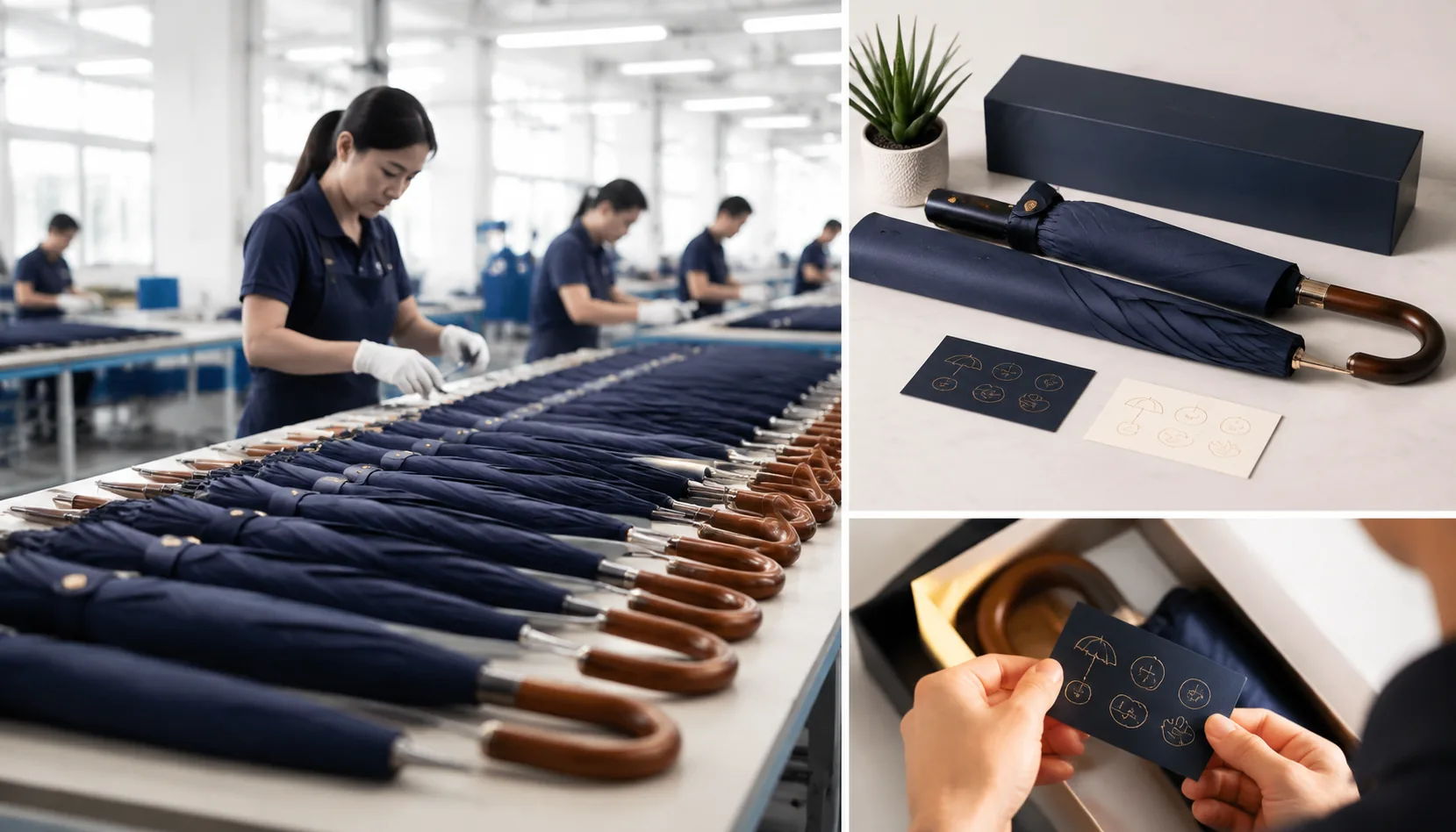
A premium umbrella can lose value quickly if the customer folds it wet, forces the runner, or stores it under load, and those problems often come back to the buyer as complaints instead of misuse. On our Songxia production floor, we treat umbrella care card printing as part of the product build: the insert must match the fabric, frame, packaging sequence, warranty promise, and retail or gifting channel so it protects both the umbrella and the brand.
Why Care Cards Matter for Branded Umbrella Programs
A care card is a small print item, but in branded umbrella programs it often becomes the first proof that the buyer did not source a cheap giveaway. When a customer opens a 23" auto-open stick umbrella with 190T pongee, fiberglass ribs, and a soft-touch handle, the insert should explain why it feels different: dry the canopy fully before sleeve storage, do not force the runner against wind pressure, rinse salt after coastal use, and close the double-canopy vented frame by hand instead of twisting the ribs. Good umbrella care card printing turns technical decisions into brand trust. If the umbrella claims UPF 50+, Teflon water repellency, or 50+ mph wind-tunnel resistance, the card can state proper use conditions clearly so expectations stay realistic and warranty disputes stay low.
Retail umbrella packaging needs a different insert than a hotel lobby umbrella or a one-day event giveaway. For retail, the card supports shelf value: fiber content, rib count such as 8K or 10K, opening mechanism, care steps, barcode-side warranty language, and brand story. For hotels, branded umbrella inserts should be short, durable, and service-oriented, because the umbrella may be borrowed, sold, or placed in-room with a deposit policy. Event planners usually need fast-read cards tied to a campaign QR code, while corporate gifting inserts should feel more like stationery than a manual, especially for executive 27" golf umbrellas, 21" folding umbrellas, or compact auto-open-close models packed in gift boxes.
The best umbrella warranty card is honest about what the product can and cannot survive. A 16K fiberglass golf umbrella can flex in gusts that would bend steel ribs, but no frame should be left open on a balcony overnight; a PVC or POE clear umbrella must be kept away from high-heat car storage because the canopy can deform; EVA rainwear-style materials need different folding pressure than 210T pongee. Our standard practice at ZheBrella is to align card copy with the production spec sheet and AQL 2.5 inspection criteria, so claims do not outrun the actual frame, coating, or seam strength. For FOB or DDP programs with MOQ commitments, this reduces after-sale emails and protects reorder value.
What Product Details the Card Should Explain
UPF 50+ coated canopies need separate storage language because the coating is the value, not just the fabric. Tell users to dry the canopy fully before folding, avoid long-term storage in hot car trunks, and keep the coated side from rubbing against keys, rough bag hardware, or dirty hook-and-loop straps. For double-canopy vented windproof models, the card should explain that the top vent layer is intentional and should not be stitched, glued, or pulled flat; it releases pressure during gusts and helps the frame survive 50+ mph wind-tunnel testing when paired with fiberglass ribs. Corporate gifting inserts can also include a short “after strong wind” check: confirm rib tips are seated in the pockets, the runner locks cleanly, and no stretcher is twisted before closing. Our standard practice at ZheBrella is to keep these points concise, using icons plus one sentence per action, so umbrella care card printing supports premium value without becoming a folded instruction manual.
Designing Inserts for Brand Consistency
Brand consistency starts with physical fit, not artwork. A care insert that curls inside a 23" sleeve or jams against a gift-mailer corner makes a premium umbrella feel cheap before the buyer reads one word. For sleeve-packed compact umbrellas, I recommend 85 × 140 mm or 90 × 150 mm cards on 250–300 gsm C1S art card; they slide beside a folded 21" auto-open-close frame without catching the runner. For boxed 27" golf umbrellas, 100 × 180 mm gives enough room for care icons, an umbrella warranty card section, and a QR code without looking crowded. In retail umbrella packaging, keep at least 5 mm clearance from box walls and avoid square oversized cards unless the box has a dedicated paper slot. Corporate gifting inserts should be tested inside the actual mailer with tissue, handle wrap, and any hangtag already included, because paper bends most often during final packing, not during printing.
Logo placement should follow the same hierarchy as the canopy label, sleeve label, and carton mark. Put the master logo on the front top third, centered or left-aligned depending on the brand system, and keep it clear of fold lines, rounded corners, and QR codes. Pantone color control matters in umbrella care card printing because buyers compare the insert directly against printed pongee 190T/210T panels, sleeve labels, and gift boxes; a 2–3 Delta E shift is visible when navy, red, or luxury beige is involved. Our standard practice at ZheBrella is to request Pantone Solid Coated values for paper, then separately match canopy printing by screen ink, heat transfer film, or sublimation profile. Do not rely on CMYK screenshots from a brand PDF. Use the same brand voice as the product: a luxury retail umbrella should say “Dry open before storage,” while a trade-show giveaway can use shorter icon-led instructions.
QR codes and warranty URLs should be treated as functional parts, not decoration. A QR code for care instructions, replacement policy, or registration should be at least 18 × 18 mm, printed with high contrast, and tested after matte lamination or spot UV because glare can break scanning under store lighting. If the card includes branded umbrella inserts for multiple markets, build a multilingual layout from the start instead of shrinking English, French, German, Spanish, and Japanese into one crowded block. I prefer a front side with brand message, QR code, and warranty URL, then a back side with icon-based drying, storage, wind-use, and cleaning guidance. For umbrella care card printing tied to premium retail, include batch or PO reference discreetly near the bottom edge; it helps trace AQL 2.5 complaints, coating issues, or frame claims without making the customer feel they are holding a factory document.
Printing Specs and Approval Process
For premium umbrella care card printing, the paper choice should feel intentional before the customer reads a single word. I normally specify 250–350 gsm art card for retail umbrella packaging, with 300 gsm as the practical sweet spot: stiff enough to sit flat inside a sleeve or gift box, but not so thick that it jams automatic insertion or raises freight volume. Recycled stock is workable, especially 250–300 gsm FSC recycled board, but buyers should approve the shade because recycled white often runs slightly gray or warm. For luxury private-label umbrellas, matte lamination on both sides protects against scuffing during packing and gives a softer hand feel than gloss. If the card sits near wet canopies during after-rain repacking, lamination also prevents edge curling. For folded branded umbrella inserts, we keep the fold line tested after lamination because low-grade film can crack on 300 gsm board.
Color control matters because a care card often carries the same brand cues as the canopy print, woven label, sleeve, and hangtag. CMYK is cost-efficient for photos, gradients, and multi-language layouts, but spot color is better for strict brand colors, especially navy, red, metallic gold simulations, or a logo that must match Pantone-coated references. On small corporate gifting inserts, I prefer fewer colors, larger type, and high-contrast icons because customers actually read simple care instructions. QR codes need more discipline than most buyers expect: keep them at least 18–22 mm wide, avoid low-contrast gray-on-white combinations, and leave a quiet zone around all sides. Before mass production, we scan test QR codes with iPhone and Android phones under warehouse lighting, through matte lamination glare, and from normal hand distance. This prevents a beautiful umbrella warranty card from becoming a customer-service problem.
Our standard practice at ZheBrella is to treat care cards like any other printed component: artwork check, digital proof, pre-production hard copy, sample sign-off, then mass production. The proofing stage confirms trim size, bleed, fold position, barcode or QR destination, logo placement, language, warranty terms, and whether the card fits the final pouch, box, or belly band without bending. For umbrella care card printing tied to a custom umbrella order, the signed sample should be matched against the approved canopy, sleeve, and carton marks so the whole set looks like one retail program. During production, AQL 2.5 visual inspection covers color deviation, scratches, lamination bubbles, dirty edges, misregistration, wrong QR link, poor cutting, and mixed versions. I also recommend retaining five approved samples at the factory and five with the buyer, because disputes about paper tone or logo color are much easier to settle against a signed physical standard than a screen image.
Packout, MOQ, and Lead Time Planning
The safest way to control inserts is to treat them as a packed component, not as a marketing afterthought. For umbrella care card printing, we match the insert count to the final packed umbrella quantity plus a controlled overage, usually 1% to 2% for line loss, QC sampling, and carton resealing. During packout, cards are issued to the packing line by work order: if 5,000 23-inch auto-open umbrellas are packed one per polybag, the line receives 5,050 cards, not an open carton of loose paper. The packer places the card in the same position every time—inside the sleeve, under the belly band, or inside the retail box—so supervisors can visually check rhythm and placement. For premium retail umbrella packaging, random placement looks cheap and creates complaint risk. Our standard practice at ZheBrella is to verify inserts during in-line inspection and final AQL 2.5 checking, with missing-card defects recorded separately from canopy, frame, and printing issues.
MOQ planning should start before artwork approval because paper inserts, branded umbrella inserts, hangtags, and an umbrella warranty card often have different supplier minimums than the umbrella itself. A custom umbrella MOQ may be 500 or 1,000 units depending on frame, canopy fabric, and logo process, while offset-printed cards may price best at 3,000 to 5,000 pieces. Digital printing can cover small corporate gifting inserts, but unit cost is higher and color matching is less stable than offset for repeat orders. If the umbrella order is 1,200 pieces, I usually recommend printing 1,500 or 2,000 cards and holding the balance for replenishment, provided the warranty terms, QR code, and distributor contact will not change. Avoid printing exactly to order quantity; rework from one wet carton, wrong language version, or changed EAN label can consume the reserve fast.
Lead time for printed components is normally 5 to 10 days after final AI/PDF artwork approval, longer if the card uses spot UV, embossing, foil stamping, rounded corners, or FSC paper. That schedule must be tied to umbrella production, not handled separately, because final packing cannot start until cards, sleeves, barcode labels, master carton marks, and instruction inserts are all released. For FOB shipments, the packing list should show carton quantity, gross/net weight, carton size, and any retail insert count if the buyer requires component traceability. For DDP orders, carton documentation matters even more because customs brokers and last-mile warehouses rely on accurate SKU, HS code, country-of-origin marking, and carton labeling. A simple insert can delay shipment if it changes declared retail set contents, so lock the packout specification before mass production starts.
Frequently Asked Questions
What should a care card say for an auto-open umbrella?
It should explain the button function, safe closing method, and drying before storage. This reduces mechanism damage claims, especially for compact auto-open models.
Can warranty QR codes be tested before production?
Yes. The factory should scan printed proofs at final size and check codes after lamination because gloss, size, and low contrast can reduce readability.
What information should a care card include for automatic umbrellas?
For automatic open/close umbrellas, include clear steps for closing the canopy, compressing the shaft, drying before storage, and avoiding manual force on the ribs. A simple 4-6 step layout helps reduce damage claims caused by incorrect closing.
Can warranty cards be customized by market or retailer?
Yes. Warranty cards can be printed with retailer-specific warranty periods, QR codes, customer service emails, batch codes, and local language instructions. Many importers use separate inserts for the U.S., EU, and Japan markets to match compliance and service expectations.
What card size and paper stock are practical for retail umbrella packaging?
Common insert sizes are 90 x 55 mm, A6, or folded mini cards that fit inside sleeves, hang bags, or gift boxes. For premium retail programs, 250-350 gsm coated paper or matte art card is typically used to improve perceived value.
Looking to Launch Your Custom Umbrella Line?
ZheBrella is a Zhejiang-based OEM/ODM umbrella manufacturer with 17 years of export experience. Free design, low MOQ from 100 pieces, windproof construction, full-color print.
Get Free Quote Now »People Also Search For
Related Articles
Printed Umbrella Care Cards That Reinforce Brand Value
Use care cards, warranty inserts, and QR codes to protect product quality, reduce returns, and strengthen brand storytel...
Read More »
Umbrella Insert Cards for Branded Gifting and Aftercare
Use insert cards to explain features, care, warranty, and brand story while improving the gift feel of 190T, 210T, windp...
Read More »
Custom Umbrella Insert Cards for Brand Storytelling
Use umbrella insert cards to explain brand value, care steps, UPF 50+ claims, and warranty details while improving gifti...
Read More »