Umbrella Factory PFMEA: Preventing Defects Before Bulk Production
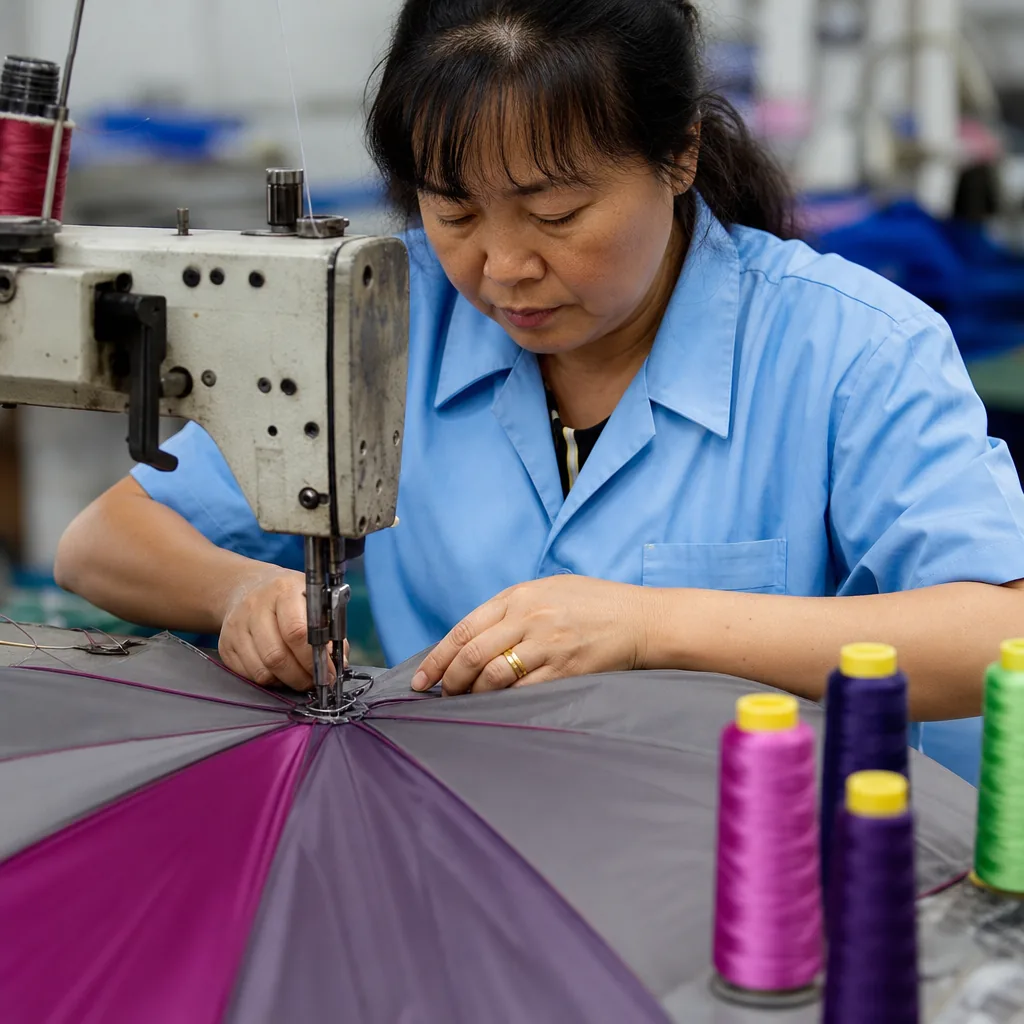
Bulk umbrella orders usually go sideways for the same reasons: rib assembly variation, fabric tension drift, coating defects, and handle fit issues that only show up after pilot samples pass. On our Songxia production floor, PFMEA is where we force those risks into the open by ranking failure modes at each operation before mass run approval, so umbrella PFMEA manufacturing becomes a practical control tool instead of a paperwork exercise.
What PFMEA Looks Like in an Umbrella Factory
Process failure mode and effects analysis in an umbrella factory is a working risk-control document tied to the exact production route, not a generic quality form. For OEM and ODM orders, the team reviews each operation from incoming fabric and frame inspection through cutting, printing, sewing, frame assembly, mechanism installation, and packing, then records three things in plain manufacturing terms: what can fail, what causes it, and which control will stop it before bulk shipment. In umbrella PFMEA manufacturing, that means specific failure modes such as 190T pongee shade variation after a dye-lot change, panel misalignment during cutting, screen-print registration drift across alternating panels, skipped top notches in sewing, or a runner spring installed with the wrong tension on an auto open-close shaft. Each item is scored for severity, occurrence, and detection, then turned into a control plan with named checks: raw-material approval, first-piece signoff, cutter templates, print strike-off limits, in-line pull tests, torque checks, and AQL 2.5 final inspection. For buyers, that is the practical value of process failure mode analysis: clearer OEM production risk control before 10,000 units are committed.
The document only works when it follows the real process step by step. Cutting controls define panel size tolerance, fabric grain skew, and marker layout that can distort edge shape on 21 inch and 23 inch compact umbrellas. Printing shifts the focus to logo position, curing temperature, color consistency, and coating compatibility, especially on 190T or 210T pongee with UV or Teflon finishes where adhesion issues may appear only after rub testing. Sewing reviews seam allowance, cap alignment, tip pocket strength, and vent spacing on double-canopy windproof styles; with POE, EVA, or PVC canopies, the risk list changes to heat marks, scratches, and handling wrinkles. Frame assembly verifies that steel or fiberglass ribs match the 8K, 10K, or 16K canopy pattern and that rivets, stretchers, and notch joints survive repeated open-close cycling and wind-test targets above 50 mph. Mechanism installation and packing close the loop by checking sticky sliders, off-center shafts, weak springs, handle glue failure, pinch points, moisture exposure, barcode mismatch, assortment errors, and strap fit against export carton count. Strong pre production quality planning updates the PFMEA after the pilot run so umbrella defect prevention reflects actual line conditions, not the quotation sheet.
High-Risk Failure Modes by Production Stage
In umbrella PFMEA manufacturing, the highest-severity failure modes usually start in frame forming and auto-open assembly because they cause immediate function loss and the clearest safety exposure. Rib deformation is a standard example. On fiberglass frames, a 0.7 mm rib can crack at the notch if the forming heat curve is wrong; on steel frames, thin-wall ribs can twist or flatten when stamping dies drift out of tolerance. Auto-open units on 21 inch and 23 inch stick umbrellas should rank even higher in process failure mode analysis. A reversed spring seat, weak runner lock, or incorrect spring preload can cause slow opening, incomplete lockup, or snapback after only a few open-close cycles. For OEM production risk control, tell the writer to rank these failures first by function, then by safety: spring and lock defects are the top risk, followed by rib deformation, because both drive returns, pinch hazards, and wind-performance failure around the 45 to 50 mph range. The control point is upstream, not only at final inspection: verify forming parameters, die wear, spring orientation, and lock engagement before bulk production ramps.
Canopy, fabric, and packing failures usually rank lower for safety, but they often create faster claim rates on retail and promotional orders where appearance specs are tight. A common high-risk example is canopy skew on 16K styles: if the cutting template drifts 2 to 3 mm per panel, the error accumulates across all seams and creates a visible spiral pull after canopy mounting. Fabric shade variation is another core umbrella defect prevention item, especially on 190T or 210T pongee split across dye lots or replenishment rolls; the umbrella functions, but panel mismatch is obvious in daylight and usually unacceptable for branded programs. Packing risk also belongs in pre production quality planning. Weak inner sleeves, low-burst export cartons, or loose carton fill can let tips, ferrules, and curved handles rub through in FOB or DDP transit, and a 27 inch vented golf umbrella loads a carton much harder than a compact 3-fold. Tell the writer to rank canopy skew and shade variation highest for appearance, weak packing as a mixed appearance-and-function risk, and to set these rankings before trial production, with AQL 2.5 used as a final check rather than the main control.
How Materials and Design Choices Change the Risk Profile
Double-canopy windproof umbrellas carry a higher assembly risk because the factory is controlling two canopy layers, two stitch paths, and a vent structure instead of a single cover. On 23 inch or 27 inch 8K and 10K frames, operators must hold upper and lower canopy panel alignment, vent opening position, crown hole location, strap placement, and top-notch fit within a tight visual tolerance; even a slight offset shows immediately when the umbrella opens or closes. In umbrella PFMEA manufacturing, those checkpoints should rank high in the process failure mode analysis because upper and lower canopy hole position, rib-tip tension, vent symmetry, and top-notch alignment compound across the assembly. Windproof designs targeting 50+ mph testing often shift from steel to fiberglass ribs, stronger spreaders, and higher canopy tension. That improves durability, but it also raises the chance of puckering, skipped stitches around vent edges, canopy twist during closing, and slow rework if the two layers are sewn out of position. The practical control point is before bulk cutting: confirm vent templates, notch positions, and sample opening-closing performance before line release.
Fabric and finish changes also alter the risk profile enough to require separate controls in pre production quality planning. A 190T polyester pongee is lighter and moves more during panel stacking, so seam allowance control, edge handling, and panel-to-panel color registration need closer monitoring, especially on auto-open-close compact umbrellas where folded canopy volume is limited. A 210T pongee usually sews more steadily, but its firmer hand can create more needle heat, more visible seam tracking, and extra bulk at ferrule and tip closing points; needle size, thread tension, and folding sequence should therefore be fixed during trial runs, not adjusted on the line. Specialty finishes such as UPF 50+ or Teflon-type coatings need added verification for coating adhesion, shade consistency, water behavior, and print compatibility, because visual approval does not confirm the functional claim. The same OEM production risk control logic applies to custom handles, shafts, and packaging: a nonstandard ABS handle may need a new mold, a square shaft can require revised runner and spring fit, and a bottle pack or gift box can add drop-test risk, carton inefficiency, and longer lead times. Those items belong in umbrella defect prevention before bulk material orders are placed.
Turning PFMEA into Control Plans, Tests, and Inspection Gates
In umbrella PFMEA manufacturing, the usable output is a station-by-station control plan, not an RPN table. Every high-risk failure mode needs one defined checkpoint before bulk cutting or assembly: the spec to hold, the test method, the sampling frequency, and the person responsible. If the PFMEA flags runner jamming, top-notch loosening, rib inversion, or canopy misalignment, translate each item into first-piece approval for every model and colorway on the actual 21 inch, 23 inch, 27 inch, or 30 inch production frame. That approval should check frame geometry, finished diameter, open-close function, stitch density, panel alignment, logo position, ferrule seating, and strap location against the signed sample. After startup, operator self-checks should run at fixed intervals, typically every 30 to 50 pieces, because umbrella defects usually repeat once a jig, die, or sewing setting drifts. Engineering, QC, and the line leader should sign the same first-piece standard and stop the line as soon as dimensions or function move out of spec.
Process failure mode analysis should also determine which in-line tests belong at assembly, not at final packing. If the risk is weak rib joints, shaft play, or loose fittings, add pull tests and torque checks at the relevant station; if the frame claim is wind resistance, cycle testing has to match the structure and sales promise. A basic 8K steel promotional umbrella may justify 500 to 1,000 open-close cycles, while a 10K fiberglass windproof or double-canopy frame sold with a 50+ mph claim needs a tougher cycle plan and wind-equivalent loading. Material controls should be equally specific: 190T or 210T pongee requires coating, shade, and water-repellency checks, while POE or PVC clear canopies need weld-strength, transparency, and scratch inspection under retail-light conditions. AQL 2.5 belongs at final inspection as a validation gate for pre production quality planning and OEM production risk control. Use it to confirm visible defects such as stitch faults, print registration, handle scratches, wrong rib count such as 8K versus 16K, function failures, and carton-mark errors against the approved spec. Do not treat AQL 2.5 as umbrella defect prevention; sample inspection cannot recover a process that already allowed weak riveting, marginal spring force, or poor heat-transfer adhesion into packed FOB or DDP shipments.
How Buyers Can Use PFMEA During Sampling and Order Launch
Before PO release, ask for the factory’s PFMEA risk list in plain production terms, not a sales recap. It should name the failure modes tied to your exact construction: sublimation shade shift, seam leakage, crooked top-cap alignment, auto-open spring misfire, rib cracking at the fiberglass-to-runner joint, or scratching on a clear POE canopy during packing. In umbrella PFMEA manufacturing, the useful question is whether each risk is scored for severity, occurrence, and detection, then linked to a control point at fabric cutting, sewing, printing, frame assembly, or final inspection. Push the supplier to separate risks by model. A 21-inch auto-open-close folding umbrella, a 27-inch straight umbrella, and a clear-canopy promo style do not share the same weak points, so they should not share the same process failure mode analysis. If the supplier cannot show which items it treats as high risk by construction type, it is probably depending on end-of-line sorting instead of true umbrella defect prevention. That usually means more sample revisions, slower approval, and a higher chance of bulk defects escaping into shipment.
Before order launch, request three documents together: the control plan, pilot-run data, and written corrective actions. The control plan should state the actual checks and limits, such as incoming fabric verification for 190T or 210T pongee, shaft and runner pull-force or torque checks during assembly, spray-test confirmation for Teflon finish, canopy size tolerances, and AQL 2.5 final inspection by defect class. For any windproof claim, ask whether the pilot lot passed open-close cycle testing and wind testing, for example whether a vented double-canopy frame held above 50 mph without rib inversion. Pilot-run quantity matters: 30 to 50 pieces may expose cosmetic variation, but 100 to 300 pieces is a better screen for assembly drift, print registration error, and packing damage. This is where pre production quality planning affects cost and schedule. A proven stock design can often stay at a 500 to 1,000 piece MOQ with one pre-production sample round and a 25 to 35 day lead time after approval. A higher-risk OEM program, such as a new 10K mini frame, custom molded handle, reflective trim, UPF 50+ coating, or clear EVA canopy, usually needs a pilot run, one or two extra sample rounds, a 1,000 to 3,000 piece MOQ, and 7 to 15 extra production days. Under FOB Ningbo, that mainly moves carton readiness and vessel booking; under DDP, it also pushes customs documents, delivery appointments, and final-mile scheduling.
Frequently Asked Questions
Is PFMEA only useful for complex auto-open umbrellas?
No. It is especially valuable on auto-open mechanisms, but even simple manual umbrellas have recurring risks in cutting, sewing, frame alignment, and packing. Basic styles benefit when the factory uses PFMEA to prevent repeat defects.
Can a buyer ask for PFMEA output without getting a supplier's confidential details?
Yes. Buyers can request a summarized risk matrix, key failure modes, and related control actions without asking for proprietary line settings or full internal documents. That usually gives enough visibility for sourcing decisions and launch planning.
Which umbrella production steps usually carry the highest PFMEA risk scores?
In most factories, the highest-risk steps are canopy panel cutting, stitching alignment, frame riveting, runner assembly, and final opening/closing tests. These operations affect appearance, function, and durability at the same time, so they typically receive the most attention in pre-production reviews.
When should a buyer ask the factory to update its PFMEA during an OEM umbrella project?
A PFMEA should be updated whenever you change fabric, frame structure, handle type, printing method, or packaging spec. Buyers should also request a revision after pilot run defects, supplier changes, or any corrective action that affects the process flow.
Can PFMEA reduce inspection costs for repeat umbrella orders?
Yes, if the PFMEA is tied to a control plan and the same materials and process settings are retained. On stable repeat programs, buyers often shift more checks to in-line controls and sample-based final inspection, which can reduce rework, claims, and inspection time over successive orders.
Looking to Launch Your Custom Umbrella Line?
ZheBrella is a Zhejiang-based OEM/ODM umbrella manufacturer with 17 years of export experience. Free design, low MOQ from 100 pieces, windproof construction, full-color print.
Get Free Quote Now »People Also Search For
Related Articles
PPAP-Style Documentation for Custom Umbrella Manufacturing
Use a PPAP-style approval process for umbrellas to reduce misbuilds, document specs, and keep OEM orders on track from s...
Read More »
Umbrella Factory PPAP: How to Approve Parts Before Mass Run
Learn how umbrella PPAP-style approvals reduce defects by locking materials, dimensions, and golden samples before bulk ...
Read More »
Umbrella Assembly Line Process for Consistent OEM Quality
See how umbrella factories control frame fit, canopy tension, and packing accuracy with in-line checks that reduce defec...
Read More »