Umbrella Hardware Plating and Salt-Air Corrosion Control
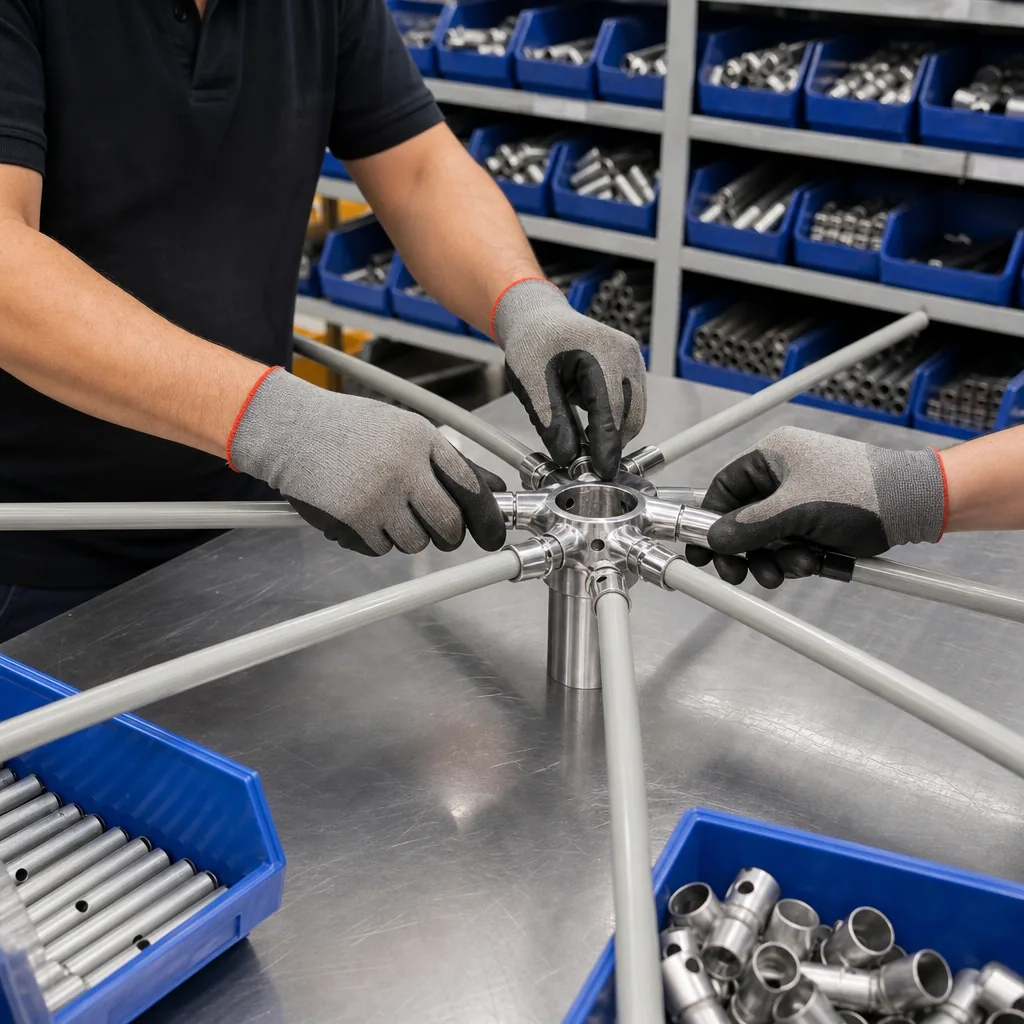
When buyers specify umbrella hardware plating for coastal programs, the real challenge is not the finish name on the drawing but how that finish survives salt spray, condensation, assembly abrasion, and months of use. At the factory floor, corrosion problems usually start at edges, threads, rivet heads, and cut ends where coverage thins, so the right process choice depends on substrate prep, deposit thickness, and QC that matches actual service conditions.
Where corrosion starts in umbrella hardware
Corrosion starts at the places buyers usually overlook: the rib tips, stretcher pivots, shaft welds, spring housings, rivets, and ferrules. Those parts get the worst mix of flexing, abrasion, and trapped moisture, so a thin decorative finish is not enough. On steel frames, once the plated layer is scratched at a joint or hole edge, rust spreads under the coating and shows up first where the umbrella opens and closes every day. That is why umbrella hardware plating has to be evaluated as a system, not as a single shiny surface.
Sweat is a real corrosion driver in handheld umbrellas because it carries chloride and acids straight into the handle area, runner, and spring contact points. In coastal use, salt air does the same thing from the outside: it settles on exposed metal, absorbs humidity, and keeps the surface damp long after the umbrella is dry to the eye. That is exactly where corrosion resistant umbrella frames fail first—on plated joints, punched holes, and folded steel edges where the coating is thinnest and the base metal is already stressed.
For coastal umbrella components, the practical question is not whether the frame looks bright on day one, but how long the finish holds after repeated wet-dry cycles. Salt spray testing is the quickest way to expose weak plating, poor pretreatment, and low-grade steel, because bad hardware blisters, pits, or turns red around the rivets and ferrules before the rest of the frame shows damage. A good OEM hardware finish should cover the full wear path, including concealed contact zones, or the umbrella will fail from the inside out even if the canopy still looks fine.
Plating options for better corrosion resistance
For umbrella hardware plating, the first decision is usually substrate, not finish: steel parts need a barrier that can tolerate scratches and edge exposure, while aluminum parts are often better served by conversion coating plus paint or electrophoretic coating rather than heavy metallic plating. Nickel gives a bright, hard surface and decent corrosion delay on small steel fittings, but it is not a cure-all for coastal umbrella components because any pinhole becomes a rust starting point. Chrome is even more about appearance than true salt-air defense; it is thin, expensive, and best reserved for decorative shafts, tips, or premium trims where the buyer wants a harder, cleaner look and accepts that it is not the strongest answer for corrosion resistant umbrella frames.
Electrophoretic coating is the workhorse finish for hidden steel umbrella hardware because it covers recesses, rivets, and stamped edges far more evenly than spray paint. It is usually paired with phosphating or zinc pretreatment on steel, and it can be tuned to a controlled film build that does not choke tight joints. Powder coating is thicker and tougher on visible steel brackets, ferrules, and runners, but once you start stacking thickness on moving umbrella parts, tolerances get tight: the coating can interfere with rib pivots, slide buttons, and telescoping tubes, so the tooling allowance has to be planned before production. On aluminum, powder is common when the part is large enough to accept the build; on small hardware, an OEM hardware finish that stays thinner is often safer.
Zinc-based protection is still the practical baseline for many steel umbrella components because it protects sacrificially, which matters when the product gets scraped in packing, shipping, or field use. For outdoor contracts, I would not approve a finish package without salt spray testing tied to the target market, because 48-hour and 72-hour results tell you very different things from a coastal deployment point of view. Finish thickness changes both cost and fit: thinner zinc or electrophoretic layers keep assembly smooth and cheap, while thicker powder or multi-layer nickel/chrome stacks add labor, rework risk, and tighter QC on moving joints. For most corrosion resistant umbrella frames sold into humid or seaside markets, the right answer is usually a thin functional base layer on steel, thicker decorative coating only where the part does not move, and a finish spec written around actual clearances instead of catalog assumptions.
Material pairing matters more than one coating
The first mistake people make with umbrella hardware plating is treating every metal the same. Fiberglass ribs are basically inert in salt air, so they rarely drive corrosion on their own; the problems start when you hang them on stainless fasteners, aluminum shafts, and mild-steel brackets that all see wet-dry cycling. In coastal service, stainless fasteners can still tea-stain if the grade is wrong or if chloride gets trapped under a washer, while aluminum shafts will pit fast if their coating is thin or scratched. For corrosion resistant umbrella frames, the real issue is not just the plating layer but the whole material stack, because one weak interface ruins the assembly faster than a slightly thinner finish elsewhere.
When mixed metals touch, galvanic corrosion becomes the failure mode you actually have to design around. Put stainless screws directly into bare aluminum and you create a battery in the presence of salt water; the aluminum becomes the sacrifice point. The practical fix is simple: isolate contact points with nylon washers, plastic bushings, painted sleeves, or powder-coated barriers, and keep drain paths open so water does not sit in the joint. On OEM hardware finish work, I always want the plating or coating to cover cut edges, threads, and any stamped seam, because exposed edges are where coastal umbrella components start to fail first. Good umbrella hardware plating is not the shiny topcoat people see; it is the system that keeps dissimilar metals from staying electrically connected when they are wet.
For salt-air programs, salt spray testing should be tied to the actual bill of materials, not a generic frame coupon. A stainless fastener passing 48 hours in a lab means little if it is assembled against raw aluminum and a zinc-plated clip in the real product. The better practice is to test the full joint after assembly, then inspect for white corrosion, blistering, thread seizure, and galvanic creep around washers and rivet heads. If a buyer wants corrosion resistant umbrella frames for beachfront or marina use, I would prioritize matched alloys, sealed interfaces, and a finish spec that names thickness, adhesion, and post-treatment, because those details matter more than a marketing claim about the coating alone.
How factories test salt-air durability
Salt spray testing is the first gate for umbrella hardware plating because coastal failures show up fast when the zinc layer is thin or the chromate conversion is sloppy. In practice, buyers for resort and marine programs usually ask for 24, 48, 72, or 96 hours of exposure on steel shafts, runners, stretchers, and spring parts, with more demanding programs pushing to 120 or 168 hours. We look at the parts under white-light inspection first, then after neutral salt fog we judge whether the finish shows only light edge haze or whether red rust starts at cut edges, rivets, and weld toes. For corrosion resistant umbrella frames, the important point is not zero change; it is whether the coating still protects the base metal and whether the test panel matches the actual OEM hardware finish on production parts.
Humidity cycling matters because salt fog alone does not represent a beach club or marina locker room. A good test program alternates high humidity, often 95% RH at elevated temperature, with dry-down periods so the coating is forced to breathe and any poor adhesion lifts at corners, hooks, and crimped joints. Typical coastal umbrella components are run for several cycles over 24 to 72 hours, then checked for blistering, underfilm creep, and powdery corrosion around punched holes. If the plating starts lifting or the hinges seize after the cycle, the finish is not suitable, even if the surface still looks acceptable from a distance.
Abrasion is the part many buyers ignore, but that is where umbrella hardware plating gets proven or rejected in real use. We rub plated tubes, ferrules, and joint areas with standardized pads, then repeat salt spray and humidity exposure to see whether the topcoat scratches through too easily or whether the exposed metal stays stable. Acceptable results usually mean no functional joint seizure, no sharp corrosion growth at moving interfaces, and only limited rust that can be cleaned without pitting the steel. For resort buying, the specification should spell out the test sequence, the allowed rust percentage, and the maximum coating lift at bends and contacts; otherwise two suppliers can both claim salt spray testing and still deliver very different field life.
How to write a corrosion-resistant spec
The spec has to start with the substrate, because plating only performs as well as the metal underneath it. For umbrella hardware plating, buyers should name the base material explicitly — low-carbon steel, stainless steel, zinc alloy, or aluminum — then define where each part is used: runner, tip cup, shaft ferrule, joint rivet, and ferrule caps. If the goal is corrosion resistant umbrella frames for coastal use, I would also ask for the steel grade and whether the parts are polished, tumbled, or pre-degreased before plating, because poor surface prep will blow up adhesion no matter how good the finish looks on day one.
Next, specify the plating system by name and by stack, not just a vague “anti-rust finish.” For coastal umbrella components, that usually means zinc plating with clear/blue passivation, nickel-chrome on visible hardware, or e-coat plus topcoat for higher-end OEM hardware finish work. Ask for thickness range in microns or mils for each layer, and write down the target corrosion class if the supplier has one. In practice, premium finishes cost more in MOQ and usually add lead time because the line has to be batched, so a 500-piece order with a special matte black finish will not move like a standard silver zinc run.
Salt spray testing should be written in hours and tied to a pass/fail rule, not just a marketing claim. For normal export hardware I would expect a minimum test window and a clear definition of red rust, white rust, blistering, or adhesion loss; for coastal programs the buyer should push for a longer exposure and ask for the exact standard used, whether it is ASTM B117 or ISO 9227. Final inspection should be under AQL 2.5, with visible-surface checks for color consistency, scratch marks, pitting, and rack marks, plus spot checks on thickness and adhesion. If the finish is decorative and functional at the same time, request lot-level records so failed lots can be traced before shipment.
Frequently Asked Questions
Is chrome plating enough for coastal umbrellas?
Usually not by itself. Chrome can improve appearance, but salt-air projects often need a corrosion system that starts with the right base metal and adds zinc, electrophoretic, or powder protection.
Can fiberglass ribs eliminate rust complaints completely?
They remove rust from the rib itself, but not from springs, runners, shafts, or fasteners. Buyers still need a full hardware spec if the umbrella will be used near the coast.
What salt spray test level should a buyer specify for umbrellas sold in coastal markets?
For coastal distribution, buyers commonly ask for 48 to 96 hours of neutral salt spray on plated steel hardware, depending on price point and channel. For premium outdoor lines, some importers set separate requirements for visible rust, blistering, and hinge function after testing.
Which hardware areas usually fail first in salt-air exposure?
The first failure points are typically rivets, spring mechanisms, rib joints, top notches, and cut edges where plating is thinnest. Mixed-metal contact areas and scratched assembly points also show red rust earlier than straight shafts or larger tubes.
How should OEM umbrella hardware finishes be written into a factory QC spec?
A practical QC spec should name the finish type, coating thickness or plating standard, salt spray hours, pass/fail criteria, and the exact parts covered. Buyers often also require pre-production sample approval and batch-level corrosion checks during final inspection.
Looking to Launch Your Custom Umbrella Line?
ZheBrella is a Zhejiang-based OEM/ODM umbrella manufacturer with 17 years of export experience. Free design, low MOQ from 100 pieces, windproof construction, full-color print.
Get Free Quote Now »People Also Search For
Related Articles

Umbrella Hardware Plating and Salt-Spray Testing for OEM Orders
Understand how umbrella factories test plating, coatings, and hardware corrosion resistance so export orders last longer...
Read More »Umbrella Frame Corrosion Testing for Salt-Air Markets and Resorts
Learn how salt spray testing, plating thickness, and hardware specs help buyers choose umbrella frames that resist rust ...
Read More »
Salt Spray and Corrosion Testing for Coastal Umbrella Orders
Specify corrosion-resistant umbrellas for coastal markets with smarter frame materials, coatings, salt spray tests, insp...
Read More »