Umbrella Logo Lockups for OEM and Private Label Programs
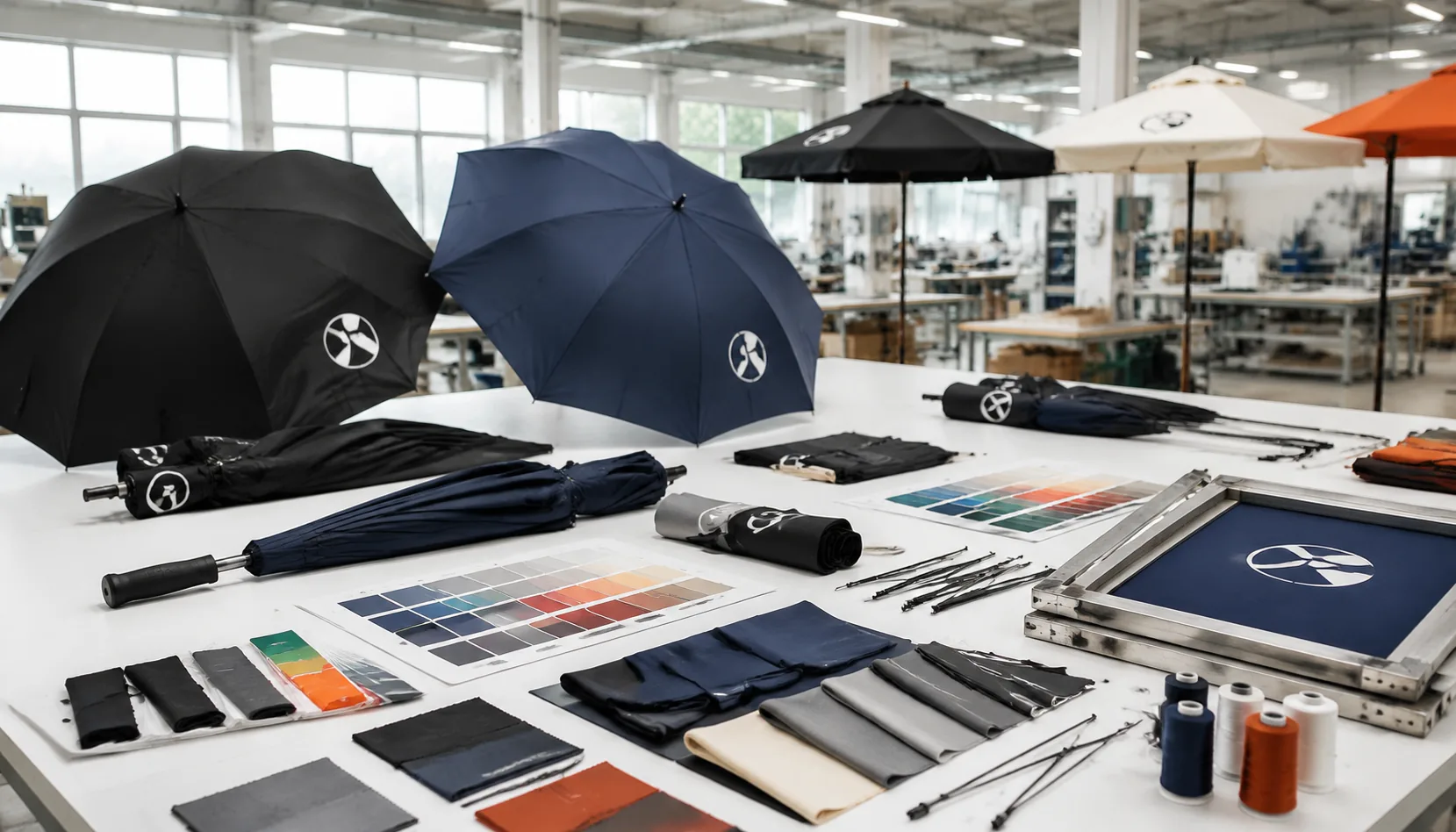
For OEM and private label umbrella programs, the logo lockup is where brand intent meets manufacturing reality: a mark that looks clean on a flat proof can crowd a curved canopy seam, disappear on a narrow strap, or fail once Pantone, stitch count, and panel layout are locked. At the factory floor, the job is to define clear spacing, placement rules, and approval checkpoints early so every unit carries the brand consistently without slowing production.
Why logo lockups matter in umbrella manufacturing
Umbrella logo lockups matter because the canopy is not a flat poster; it is a moving set of narrow panels that distort artwork as soon as the frame opens. A clean lockup keeps the primary mark, wordmark, and icon relationship stable across 21" compact manuals, 23" golf styles, and larger 27" or 30" frames, even when the panel count changes from 8K to 16K. In practice, umbrella logo lockups prevent the common factory mistake where a logo looks acceptable on one sample but breaks apart when stretched across seam lines, vented double-canopy panels, or the tighter print zone near the tips and ferrule.
For branded umbrella artwork, the choice between a wordmark, stacked version, or icon-only version should follow the decoration method, not personal preference. A simple wordmark usually prints best on 190T pongee when the panel is short and the ink sits cleanly, while 210T pongee gives a slightly tighter, smoother face for sharper edges and smaller type. Screen print is the safest option for bold OEM umbrella logos with flat color blocks; heat transfer works better when the lockup has fine lines or gradients; sublimation is useful on white or light polyester where the artwork needs full coverage without heavy hand feel.
Private label umbrella branding needs logo approval specs before production, not after the first bulk run. That means defining minimum stroke width, clear space, Pantone or CMYK targets, placement distance from the seam, and whether the artwork can be rotated to fit panel geometry. Our standard practice is to tie those logo approval specs to the actual canopy template, because brand guideline umbrellas fail when the approved artwork was designed for a flat sheet instead of a curved, sewn product. If the brand wants one master mark, I usually recommend preparing three versions: full lockup for retail cartons and tags, stacked lockup for smaller panels, and icon-only for low-area placements on shaft sleeves, straps, or labels.
Match the lockup to the decoration zone
On umbrellas, the decoration zone matters more than the artwork file. A clean logo on a 23" or 27" canopy panel can look sharp, while the same mark shoved too close to the seam or vent edge turns muddy once the ribs flex. For umbrella logo lockups on the canopy, I usually insist on a live area that keeps at least 8 to 10 mm away from panel stitching and 12 mm from any hem or vent cut line; that leaves room for movement and keeps the print from cracking at the fold. On 8K panels, the usable flat area is broader, so a wordmark can stay readable at around 22 to 25 mm wide for small placements, but on 16K panels the narrower triangles force simpler branded umbrella artwork with fewer fine strokes and more open spacing. If the buyer wants private label umbrella branding with multiple colors, I push them toward higher-contrast logos and thicker letterforms, because micro text disappears fast on coated pongee.
Tie strap, sleeve, and ferrule area graphics need a different standard than canopy print because each one is either curved, stitched, or mechanically exposed. A tie strap usually gives only a narrow strip, so the minimum readable size is often 6 to 8 mm high for a short word or icon, and the logo should avoid the snap or Velcro landing zone. Sleeves can carry better detail, but the artwork must stay clear of the seam allowance and any hanging loop; I ask for 10 to 15 mm edge clearance so the print does not distort when the sleeve is folded. Ferrule-area marking is mostly for very small OEM umbrella logos or origin marks, and it only works if the brand guideline umbrellas allow a simplified icon, not a full lockup. For logo approval specs, the cleanest files are vector artwork with one-color, two-color, and reversed versions prepared separately, because factory-side redraws waste time and usually miss the spacing the brand team actually wants.
For OEM umbrella logos, the real issue is not whether the logo fits, but whether it still reads after repeated opening, rain, and abrasion. On a double-canopy vented windproof model, the canopy panels move more, so I avoid delicate serif text and recommend a minimum line weight that survives screen printing or heat transfer without filling in. ZheBrella’s standard practice is to request a placement mockup for each zone, then confirm the lockup against the panel count, rib layout, and coating color before sampling. If the buyer needs a strict approval step, the logo approval specs should call out exact width, height, Pantone references, and exclusion zones for seams, rivets, and ferrule caps; that keeps private label umbrella branding consistent from sample to mass production. In practice, the best umbrella logo lockups are the ones that respect the decoration zone first and the brand system second, because a logo that is technically on-brand but unreadable on a 16K canopy is just wasted space.
Build a brand file that factories can follow
Factory teams move fastest when the brand file is clean enough to cut from, print from, and approve without back-and-forth. For `umbrella logo lockups`, the buyer should send editable vector artwork in `AI`, `EPS`, or `PDF` with outlined fonts, not a flattened `JPG` pulled from a website. We also need the exact color callouts in `Pantone` or `Solid Coated` references, because screen printing, heat transfer, and sublimation do not all behave the same way on pongee 190T, 210T, or `POE` canopies. If the logo has multiple versions, send the primary mark, stacked and horizontal lockups, and the minimum size where each version still reads on a 21-inch or 23-inch panel.
A proper brand file should also include one-color fallback art and approved reverse versions for dark canopies, especially when the umbrella is black, navy, or forest green. That matters for private label umbrella branding because the factory may have to switch between white ink, spot-color printing, and embroidery on different frame types without guessing what is allowed. If the buyer only sends the full-color logo, the sample usually comes back with extra revisions: wrong stroke weight, unreadable small text, or a reversed mark that was never approved. Clear `logo approval specs` avoid that churn and keep the production sample aligned with the retailer’s brand rules.
For repeat orders, the best file set includes a short brand sheet that defines clear space, prohibited color substitutions, and placement rules for each panel position, ferrule, and tie strap. That is the practical difference between random artwork and usable `OEM umbrella logos`: one gets redrawn every season, the other can be reused on reorders with the same tooling and print screens. Our standard practice is to archive the approved art with the PO so future runs match the same `branded umbrella artwork` and `brand guideline umbrellas` without another approval cycle, which saves days on sampling and prevents avoidable color disputes at AQL 2.5 inspection.
Set approval rules for OEM and ODM orders
For OEM and ODM orders, the easiest way to avoid disputes is to freeze the artwork and the factory tolerance in writing before cutting fabric or making screens. A proper approval pack for umbrella logo lockups should show exact placement on the canopy panel, shaft hang tag, sleeve, and strap; acceptable color shift under daylight and store light; and the maximum distortion allowed when the logo wraps over curved panels or seams. In practice, I specify placement tolerance in millimeters, such as ±3 mm for centered chest-style marks on the panel and ±5 mm for larger side graphics, because “close enough” becomes meaningless once 5,000 units are running. For private label umbrella branding, the approval sheet should also state whether the artwork is locked to Pantone, CMYK, or a visual sample, since OEM umbrella logos often fail when the buyer assumes a screen-print match will behave like a digital proof.
Color control needs the same discipline as placement. On pongee 190T or 210T canopy cloth, a small ink change can look larger after heat, stretching, and topcoat curing, so logo approval specs should define the acceptable Delta E range or at least require a signed master sample from the first strike-off. I also call out distortion limits by logo type: thin line art, reversed text, and small registration marks should be rejected if the stroke gain or letter deformation exceeds the agreed sample. Brand guideline umbrellas usually need a second sign-off for any vented double-canopy layout, because panel curvature changes the visual center and a flat artwork proof does not tell you how the mark reads in hand.
Before bulk production, the buyer should sign off three checkpoints: artwork placement on the final panel template, color on actual canopy substrate, and one pre-production sample built with the real frame, coating, and print method. Under AQL 2.5, I inspect a pilot lot for print alignment, color consistency between panels, pinholes, bleeding, and edge lift, and I do not release mass production until the signed sample matches the approved spec and the inspection photo set is attached to the PO. If the order includes multiple sizes such as 21-inch, 23-inch, and 27-inch, each size needs its own sign-off because panel geometry changes the logo lockup. ZheBrella’s standard practice is to treat those approvals as part of the purchase contract, not as informal email notes, because that is what keeps rework and chargebacks under control.
Protect logo consistency across replenishment runs
The fastest way to keep umbrella logo lockups consistent is to treat the decoration file as part of the SKU, not as a loose attachment that gets re-sent every season. We pin the artwork to a specific product code, panel count, canopy material, and print method, then carry the same identifier through all reorder paperwork so purchasing, sampling, and production are looking at the same file set. For branded umbrella artwork, that means one approved vector file, one color reference, and one placement record tied to the dieline notes; if the logo moves even 5 mm on an 8K or 10K frame, it is a different approval from our point of view. Version control matters more than people admit: file names should show revision, date, and customer code, and the latest approved PDF should be the only file used for future releases.
For private label umbrella branding, the approval pack should include logo approval specs, panel artwork position, bleed, safe area, Pantone targets, and any restrictions for seams, vents, or telescoping shafts. I also insist on a written note that says whether the same OEM umbrella logos can be reused across 21-inch, 23-inch, or 27-inch sizes, because artwork that looks centered on a compact folding style often drifts on a long straight-handle frame. If the brand guideline umbrellas are meant to stay unchanged across replenishment runs, lock the proof number, the ink method, and the canopy color into the record; that prevents sales teams from “helpfully” re-exporting the file at a different scale or with the wrong stroke weight.
Lead time and MOQ affect approval timing more than most buyers expect. If the order is FOB, the buyer usually needs artwork sign-off before material booking and print plate setup, because we cannot afford to wait while goods are already moving into cutting and sewing; with DDP, approval should happen even earlier, since freight, customs, and delivery scheduling leave less room for late artwork changes. As a rule, MOQ for repeat logo work is easier to hold than a fresh development run, but only if the artwork is frozen before mass production; once the first sample is signed, any new revision should trigger a new version number and a new approval cycle. Our standard practice is to treat umbrella logo lockups as a controlled document, so a reorder six months later still matches the first shipment instead of becoming a near-match that fails at receiving.
Frequently Asked Questions
What logo format works best for umbrella branding orders?
A vector file with outlined fonts is best, usually in AI, EPS, or PDF format. It lets the factory scale the logo for canopy panels, straps, and packaging without losing sharpness.
How do buyers prevent logo changes between reorders?
Use a brand spec sheet that defines artwork version, color values, placement, and acceptable size ranges. That makes repeat production faster and reduces approval drift across new batches.
What logo files should buyers provide for OEM umbrella production?
Provide vector files such as AI, EPS, or PDF with outlined fonts and Pantone or CMYK color references. For woven labels, straps, or packaging, include separate artwork files if the logo size or lockup changes by location.
How much clear space is needed around a logo on umbrella panels?
A practical rule is to keep clear space equal to at least the height of one logo letter or icon element on all sides. For curved canopy panels, factories may recommend extra margin near seams to prevent distortion after sewing.
When is logo approval completed before bulk umbrella production?
Logo approval is usually confirmed after a digital proof and, for new private label programs, a pre-production sample. Digital proofing often takes 1–3 business days, while a physical logo sample may add 5–10 days before mass production.
Looking to Launch Your Custom Umbrella Line?
ZheBrella is a Zhejiang-based OEM/ODM umbrella manufacturer with 17 years of export experience. Free design, low MOQ from 100 pieces, windproof construction, full-color print.
Get Free Quote Now »People Also Search For
Related Articles
Umbrella Packaging for Hotel, Resort, and Amenity Brand Programs
Design packaging for hotel and resort umbrella programs that protects the product, supports brand standards, and simplif...
Read More »
Metallic Ink Umbrella Logos for Premium Brand Programs
Plan metallic umbrella logos with the right fabric, ink, placement, and QC controls so premium brand programs look consi...
Read More »
Embossed Handle Logos on Umbrellas: OEM Options and Limits
Compare embossed, debossed, and molded handle logo options by material, MOQ, tooling, and lead time to choose a workable...
Read More »