Umbrella Rivet Quality: Shear Strength, Plating, and Assembly Control
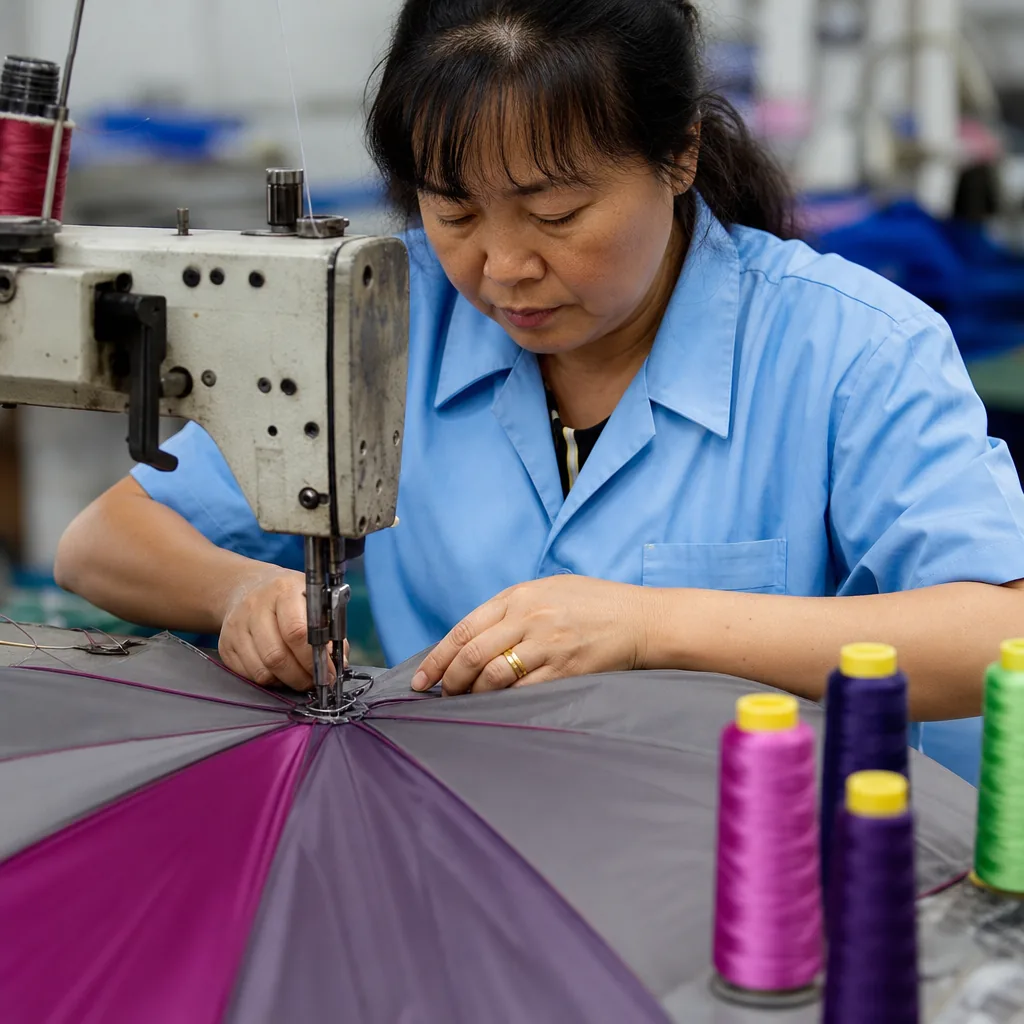
For OEM umbrella frames, small rivet changes often drive the biggest swings in field failure rates: loose joints, cracked ribs, red rust, or stiffness that throws off opening force. On the line in Songxia, we see umbrella rivet quality come down to three linked controls—wire hardness and shank geometry, plating thickness and adhesion, and the press setting that forms the head without cutting into the rib or runner.
Why Rivets Matter More Than Buyers Expect
Most buyers compare canopy fabric or wind-test claims first, but umbrella rivet quality is what keeps the frame usable after hundreds of open-close cycles. On 21 inch and 23 inch folding umbrellas, rivets carry the moving load at the runner, stretcher, rib, and notch. When the rivet shank is undersized, the head is poorly formed, or the hole tolerance is too loose, the joint develops play early. That small gap quickly becomes an ovalized hole, uneven tracking, and off-axis stress on the stretcher and rib. The visible sequence is consistent: the canopy starts leaning, the frame wobbles, auto-open or auto-open-close action turns rough, and then a bent stretcher or snapped rib ends service life. For the buyer, the result is not just breakage. It is higher return rates, more complaints about a "cheap" feel, and shorter field life even when the 190T pongee canopy, handle, and shaft still look acceptable.
Rivet weakness shows up fastest in high-cycle and wet-use markets. Promotional umbrellas used by hotels, schools, trade-show teams, and delivery fleets may be opened several times per day, so rivet shear strength matters more than a clean pre-shipment sample. The same is true for commuter 8K and 10K folding frames with steel shafts and fiberglass ribs: repeated snap-open shock loading can loosen weak joints after roughly 300 to 500 cycles, even if the sample passed a 50+ mph wind test. Corrosion creates a second failure path. Low-grade plated iron rivets may look acceptable at packing, then develop red rust or white corrosion in humid or coastal markets such as Southeast Asia, the Gulf, Florida, or coastal Europe. As plated rivets corrosion progresses, friction rises, joints roughen, and rivet heads are more likely to crack during use or factory rework. Good OEM umbrella quality control should check plating consistency, clinch tightness, and free play inline, then verify finished goods at AQL 2.5, because strong ribs cannot compensate for weak hardware in umbrella frame assembly.
Choosing Rivet Materials and Plating for the End Market
Select rivet material by joint load, opening cycle count, and frame type before you choose finish. For a 21" or 23" manual promotional umbrella with steel ribs, low-carbon iron rivets are the lowest-cost option, but they deform sooner under repeated open-close cycles and show red rust quickly if plating is thin. On any auto-open or auto-open-close frame, carbon steel is the practical minimum because rivet shear strength is higher and the head and notch hold shape better against spring force and runner impact. Stainless steel rivets raise unit cost and slow umbrella frame assembly because hole diameter and upset tolerance must be controlled more tightly, but they are the best choice for long-life outdoor use at the top notch, stretcher joint, and runner connection. Aluminum rivets save weight and do not need plating for basic rust resistance, yet they are softer; on 27" and 30" frames, they can loosen at high-stress pivots unless the rib geometry is designed for lower hardness and clamp load.
Match plating to both the base metal and the rest of the joint. Zinc is the standard finish on steel rivets because it is cost-effective and usually sufficient for retail programs, but plated rivets corrosion starts early if surface prep is weak or the umbrella is stored wet in a sleeve. Nickel plating gives exposed joints a cleaner, more uniform appearance, but a thin deposit improves looks more than service life. Black finishes—black zinc, black nickel tone, or electrophoretic coating—fit black frames, though the coating can scuff if the rivet head is over-spun during umbrella frame assembly. Plating choice is more visible on fiberglass ribs because the rib itself will not rust; any corrosion at the rivet head, washer, or cap stands out and can stain light 190T or 210T pongee. On steel ribs, the failure risk shifts to the weakest coated part in the joint, so a well-plated rivet will not offset a poorly coated rib, spring, or washer.
For resort, marine, and coastal programs, write anti-corrosion requirements as a hardware system, not a single rivet spec. Salt air, sunscreen residue, and damp storage accelerate corrosion on beach umbrellas, golf umbrellas, and hospitality stock left open for hours. In those cases, umbrella rivet quality should move to stainless rivets at critical pivots or at least upgraded steel rivets with verified plating thickness, with springs, washers, and caps reviewed at the same time. The same logic applies when the frame must hold wind performance above 50 mph on a vented double-canopy design: once joint loads increase, a seized or weakened rivet often fails before a fiberglass rib does. Good OEM umbrella quality control starts with the end market. A city commuter program may be fine with zinc-plated steel hardware, while a coastal resort order needs stronger anti-corrosion specs before mass production to reduce staining, returns, and field failures.
Assembly Variables That Change Joint Strength and Movement
Joint strength in umbrella frame assembly starts with stack-up fit: rivet diameter, shank length, and the combined thickness of the rib, stretcher, runner, or notch parts being pinned. If the rivet is undersized for the hole, the joint rocks under cyclic load, the hole starts to oval, and wear shows up before the frame fails a wind test. If shank length is too short, clinching cannot form a full rolled head; if it is too long, the tail mushrooms unevenly and adds friction and side-load at the pivot. On small runner and stretcher joints, a 0.1-0.2 mm mismatch can materially shorten service life because these are moving pivots, not static fasteners, and they may cycle thousands of times on a 21-inch or 23-inch frame. Better umbrella rivet quality comes from sizing the rivet to each pivot point rather than forcing one diameter across ribs, notch joints, and top joints just to simplify purchasing.
Clinching pressure and hole tolerance determine whether the joint moves cleanly after assembly. Over-compression creates binding: link plates clamp too tightly, runner travel feels jerky, and an auto-open spring has to overcome unnecessary drag. Under-compression creates looseness: the frame opens easily at first, but excess clearance lets ribs chatter, canopy tension drop, and hole-edge wear accelerate. The practical controls are straightforward: verify hole size with go/no-go gauges before riveting and set press stroke to the actual rolled-head geometry of the plated rivet, not just nominal shank size. That also helps reduce plated rivets corrosion risk, because excessive deformation can crack nickel or black plating at the clinched end and expose base steel, which then shows red rust after salt-spray exposure or humid storage. Load paths also change by frame type, so one rivet setting rarely fits every model: 21-inch or 23-inch manual frames usually see lower shock at the runner than auto-open frames, auto-open-close frames add reversal load during closing, and double-canopy vented windproof frames shift stress toward end ribs and the top notch in gusts above 50 mph. For OEM umbrella quality control, qualify each frame family separately with opening-cycle tests, side-load checks, and AQL 2.5 inspection for loose, frozen, or plating-damaged joints.
Test Protocols Buyers Should Request From the Factory
Request a written test matrix tied to the exact umbrella frame assembly you are buying, not a generic wind-resistance claim. For umbrella rivet quality, the factory should run destructive shear or pull tests on assembled production joints: runner-to-rib, stretcher-to-rib, top notch, and handle pin. The report should show sample quantity by joint type, pass/fail limits, and photos of the failure mode, because a shank fracture creates a different field risk than rivet elongation, loosening, or pull-through at the rib hole. Test assembled frames rather than loose rivets; hole diameter, rib wall thickness, and crimp setting directly affect rivet shear strength. On 21 inch and 23 inch folding umbrellas, especially auto-open-close models, require extra attention on runner joints because spring shock loads expose weak assemblies faster than static loading. Ask for the same protocol twice: first on pre-production samples, then again on early in-line output after the first 50 to 200 units, when mixed hardware, die wear, and over-crimping typically start to appear.
Do not accept plating approval based on appearance alone. If the frame uses nickel-, zinc-, or black-plated steel rivets, ask for salt-spray or high-humidity exposure on assembled joints, since plated rivets corrosion usually begins at the formed head and tool-marked contact points. A practical sequence is humidity exposure, then opening-cycle testing, then joint-play measurement before and after cycling. The factory should record side-to-side movement at rib joints, runner wobble, and any gap growth that can distort canopy tracking. On 8K and 10K steel/fiberglass frames, looseness often appears before full rivet failure, so movement limits matter as much as breakage. Final inspection under AQL 2.5 should go beyond visual review: random open-close checks, burr and cracked-plating checks, spot measurement of joint movement, and carton-level sampling. Tighten the OEM umbrella quality control plan for auto-open frames, double-canopy vented styles, and 27 inch to 30 inch golf umbrellas, where joint loads are higher than on a basic manual 190T pongee stick umbrella.
How Rivet Specs Affect Cost, Production Speed, and Claims Risk
Rivet upgrades affect umbrella cost through purchasing scale and throughput, not just the piece price. A typical 21-inch or 23-inch folding umbrella frame assembly uses nickel- or zinc-plated carbon-steel rivets at the runner, top notch, and multiple rib joints. The delta often looks minor—about $0.01 to $0.04 per umbrella—but it multiplies across 8K and 10K frames with several rivet points per unit. MOQ changes faster than buyers expect: standard plated rivets usually work with general-stock buying at 3,000 to 5,000 pieces, while nonstandard shank diameters, tighter head tolerances, stainless, brass, or custom finishes are more economical at 10,000 to 30,000 pieces. Lead time is the second constraint. Stock plated hardware can fit a 35- to 45-day production schedule; upgraded rivets often add 7 to 15 days for sourcing, plating, and incoming inspection. For most programs, umbrella rivet quality is a scheduling and MOQ decision before it becomes a material-cost decision.
Production speed depends on how forgiving the rivet spec is on the line. Standard plated rivets run faster on semi-automatic riveting machines because operators already know the shank hardness, head geometry, and die settings. When buyers specify higher rivet shear strength, thicker shanks, or heavier plating, the assembly window narrows: over-set the joint and the hinge binds; under-set it and free play develops into wobble, poor tracking, or broken stretcher ends. That risk is highest on auto-open-close frames, 10K compact umbrellas, and double-canopy vented designs rated for 50+ mph. Good OEM umbrella quality control should verify spin torque, joint free play, and open-close cycling before mass production, because unmatched premium hardware can slow output and raise rework instead of improving service life.
Upgraded hardware makes sense when replacement costs are high or exposure is severe. For promotional umbrellas in 190T pongee with simple manual-open steel/fiberglass frames, standard plated rivets corrosion resistance is usually adequate if cartons stay dry and the expected life is short. The economics change for higher-end retail umbrellas, 27-inch golf styles, and UPF 50+ beach umbrellas with larger canopies and thicker shafts that see more cycles, wet storage, salt air, and sunscreen residue. In those cases, better plating or stainless rivets can reduce claims tied to plated rivets corrosion and marginal rivet shear strength. The same math applies to DDP programs: if one failure triggers parcel reshipment, customs handling, marketplace penalties, and service labor, a $0.02 to $0.06 hardware upgrade is often cheaper than a 1% to 2% field failure rate. That is where stronger umbrella rivet quality protects margin, not just durability.
Frequently Asked Questions
Is stainless steel always the best rivet option for umbrellas?
It offers strong corrosion resistance, but it is not always the best cost-performance choice. For many indoor or short-use promo programs, plated steel rivets may be enough if cycle testing and corrosion requirements are modest.
Can rivet assembly settings affect how smoothly an umbrella opens?
Yes. Over-set rivets can create stiff joints and binding, while under-set rivets cause wobble and instability. Factories should control clinching pressure and check joint movement during in-line QC.
What rivet shear strength level is usually acceptable for a folding umbrella frame?
The target depends on frame size and rib design, but buyers commonly ask factories to define a minimum shear value by rivet position and verify it during pre-production. For OEM orders, a practical QC method is destructive testing by joint type on pilot samples and then routine lot checks during mass production.
How can a buyer reduce rust complaints caused by plated rivets in coastal or humid markets?
Specify the plating type and salt spray requirement in the purchase specification, not just 'plated rivet.' Many importers require nickel or improved anti-rust finishing plus a minimum salt spray benchmark, and they also ask for sealed carton storage and dry packing because poor storage can undermine plating performance.
Which assembly controls matter most when setting umbrella rivets on high-volume OEM lines?
The most important controls are rivet length tolerance, hole alignment, press or spin setting pressure, and head formation consistency. On large runs, factories often check these at line start, after tooling changes, and by hourly in-line sampling to prevent loose joints, cracked plating, or over-compressed frame movement.
Looking to Launch Your Custom Umbrella Line?
ZheBrella is a Zhejiang-based OEM/ODM umbrella manufacturer with 17 years of export experience. Free design, low MOQ from 100 pieces, windproof construction, full-color print.
Get Free Quote Now »People Also Search For
Related Articles
Umbrella Frame Assembly Line: Rivets, Jigs, and Tolerance Control
Learn how umbrella frames are assembled with rivets, jigs, and tolerance checks so bulk OEM orders open smoothly and pas...
Read More »
Umbrella Frame Assembly Process: Rivets, Stretchers, and QC
See how umbrella frames are assembled, riveted, tensioned, and inspected so bulk OEM orders meet durability, opening, an...
Read More »
Umbrella Frame Riveting Process Controls for OEM Durability
See how rivet diameter, setting force, washer fit, and in-line pull tests prevent loose ribs, noisy frames, and AQL 2.5 ...
Read More »