From Sketch to Sample: The Custom Umbrella Development Timeline
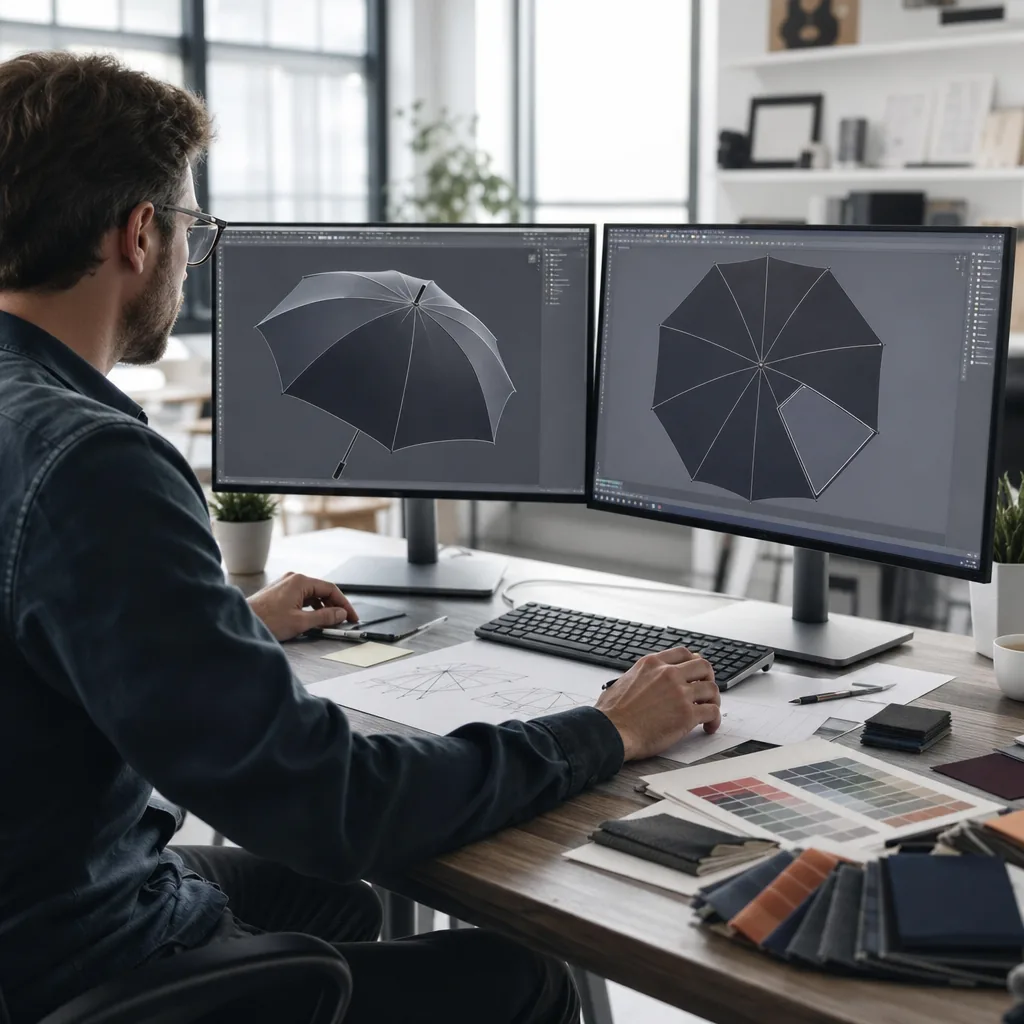
Turning a sketch into a sellable custom umbrella is usually less about creativity than controlling a chain of small decisions that can derail cost, color, function, and timing. At the factory floor, umbrella sample development moves through tech packs, counter samples, lab dips, and pre-production checks, with each step exposing issues in fabric shrinkage, print alignment, frame strength, and coating consistency before mass production begins.
Starting with a tech pack or reference
A factory cannot quote or sample accurately from a pretty sketch alone. For umbrella sample development, the minimum usable input is a tech pack or a physical reference sample with clear specs: open diameter, closed length, canopy shape, fabric type, rib count, shaft material, handle style, print file, and target function such as manual, auto-open, or auto-open-close. If you want a 23" compact with 8K fiberglass ribs and 190T pongee, say that up front; if you only say “premium black umbrella,” the quote will be a guess and the first sample will waste time.
The umbrella sampling process also needs construction details that buyers often leave out. Wind resistance target, coating choice, and decoration method all change the build: a double-canopy vented frame with UV coating and Teflon finish is a different project from a basic steel-rib POE golf umbrella. I also need the artwork in vector format, Pantone references, print placement, and whether the product must pass a certain AQL 2.5 inspection level. Those details affect panel layout, seam allowance, color matching, and whether the factory can hit your expected umbrella production timeline without redoing the sample.
The best input package is a tech pack plus one good reference photo set, not a scattered email thread. Include buyer country, target MOQ, target FOB or DDP terms, carton requirements, and any compliance needs such as REACH, Prop 65, or UV performance claims. If the reference umbrella is from another supplier, say what you want to keep and what must change, because copying the look while changing the frame, fabric weight, or mechanism is what determines cost and lead time. In practice, the cleaner the brief, the faster the custom umbrella prototype moves from drawing board to first sample.
Counter sample and approval rounds
The first physical sample is usually where the drawing stops lying. In umbrella sample development, the counter sample is made to test the real structure: shaft diameter, runner fit, ferrule length, rib geometry, canopy panel count, and whether the chosen fabric actually hangs and stitches the way the CAD sketch promised. For a standard 21" or 23" promotional umbrella, a basic custom umbrella prototype can move from approved artwork to bench sample in about 5 to 10 days if the frame components are already in stock; if the order needs new tooling, special handle molding, or a unique vented double-canopy build, add another week or more. The point of this first sample is not beauty. It is to expose mechanical problems early, before anyone commits to a production run.
The umbrella sampling process normally runs in approval rounds, and the factory-side feedback has to be specific or the timeline drifts. Buyers should mark changes by category: frame action, fabric hand, print color, seam layout, stitching density, and packaging. A sample that looks fine on video can still fail in hand if the auto-open spring is too stiff, the fiberglass ribs twist under load, or the 190T pongee canopy wrinkles after heat-transfer printing. In practice, one revision round is common, two is normal for branded retail programs, and three means the brief was underdefined. Each round typically adds 3 to 7 days, depending on whether the adjustment is only cosmetic or requires a new rib set, new canopy cutting, or reworked sewing patterns.
For a realistic umbrella production timeline, buyers should expect 7 to 14 days from first sample request to signed approval on a simple style, and 2 to 4 weeks for technical models such as 10K or 16K windproof frames, UPF 50+ coated canopies, or auto-open-close mechanisms. AQL 2.5 inspection starts only after approval, so rushing the sample stage usually costs more later in scrapped fabric, reprinted panels, or mismatched components. Our standard practice is to freeze the structure first, then confirm decoration, because changing both at once makes it impossible to tell whether a problem came from the frame, the canopy, or the printing. If the sample is approved cleanly, the production order can move straight into bulk scheduling with far less risk of late-stage rework.
Lab dips, strike-offs, and color sign-off
For printing, the umbrella sampling process should separate artwork approval from production approval. A strike-off on a 21" or 23" panel may look clean, but once the same art is mapped across 8K, 10K, or 16K panels, seam alignment, repeat spacing, and center-point distortion become obvious. I insist on a physical strike-off for screen print, heat-transfer, or sublimation before cutting the full set of panels, because a logo that looks fine on a flat sheet can warp badly when sewn into a curved canopy. This is especially true on vented double-canopy windproof styles, where the graphic has to survive panel overlap and seam allowance without breaking the visual lines.
The color sign-off should happen before the pre-production sample is built, otherwise you waste time rebuilding the same frame and canopy just to change ink tone or fabric shade. In a normal custom umbrella prototype, the buyer approves the lab dip for fabric, the strike-off for print, and then we lock those references into the production spec sheet with tolerances, usually using AQL 2.5 language for later inspection. The umbrella production timeline moves faster when this step is disciplined: a clean approval cycle can save several days, while endless shade revisions can push the sample back by a week or more. Our standard practice is to freeze color and artwork first, then cut and sew the pre-production sample only after both are signed off in writing.
Pre-production sample (PPS) and golden sample
The pre-production sample, or PPS, is the first umbrella built to the actual production method, not a loose “looks close enough” mockup. In umbrella sample development, this is the point where we lock the real frame spec, canopy fabric, printing placement, handle, tip, ferrule, and opening mechanism so the factory can test the exact build sequence. If the prototype was made in a sample room by one skilled technician, the PPS proves whether the same result can be repeated on the line with normal operators, normal tooling, and the intended materials—whether that is 190T pongee, 210T pongee, POE, or PVC, with steel or fiberglass ribs, 8K through 16K construction, and manual, auto-open, or auto-open-close mechanisms.
The PPS becomes the production benchmark when it passes visual checks and functional checks: panel symmetry, seam alignment, canopy tension, shaft straightness, snap-open force, closure fit, and print registration. On a proper custom umbrella prototype review, we also verify wind behavior if it is a vented double-canopy or fiberglass windproof model, because a nice-looking sample that twists at 30 mph is a bad sample. In practice, the umbrella sampling process should include a clear AQL standard, color reference, artwork approval, and any coating requirements such as Teflon water resistance or UPF 50+ UV treatment, so the factory is not guessing later when bulk fabric arrives.
The golden sample is the retained master copy, sealed and signed off by both sides, and it is the piece everyone compares against during bulk production and final inspection. If a dispute comes up about panel size, hem width, logo position, or handle finish, the golden sample wins over memory, screenshots, and casual promises. For a realistic umbrella production timeline, I tell buyers to treat the golden sample as a control document: store one in purchasing, one in QC if needed, and keep the approved BOM and artwork tied to it. That is the only reliable way to keep MOQ lots, reorders, and color repeats consistent across FOB or DDP shipments.
Realistic timelines and how to compress them
For a standard custom umbrella prototype, a realistic umbrella production timeline is 18 to 35 calendar days from approved artwork to first sample, assuming you are not waiting on brand approvals or special components. Pattern making and canopy layout usually take 2 to 4 days, frame matching and ferrule/hub selection another 3 to 5 days, and cutting plus sewing 2 to 4 days if the fabric is in stock. If the order needs 190T pongee with a specific UV coating, or a new handle mold, add 5 to 10 days because those items slow everything down more than the sewing line does. The biggest mistake buyers make in umbrella sample development is treating the canopy as the only variable; in reality, rib count, shaft diameter, vent structure, and print method all affect the sample clock.
The umbrella sampling process gets compressed fastest when the buyer locks the spec sheet early and limits revisions to one clean round. If the first sample is a 23" or 27" auto-open style with standard steel shaft and fiberglass ribs, you can often cut the cycle by 4 to 7 days versus a fully customized 8K or 10K windproof build with double-canopy venting. Our standard practice is to confirm artwork in vector format, approve Pantone references before cutting, and pre-check the open-close mechanism and runner tolerance before sewing the canopy. That avoids rebuilding a sample because a logo shifted 8 mm or the hook-and-loop strap interfered with the tie closure.
Do not skip QC if you want speed; compress the timeline by parallelizing checks instead. Inspect frame parts on arrival, run a dry-fit before canopy sewing, and review the first assembled sample under opening-cycle testing and seam inspection the same day. For production intent, I recommend asking for AQL 2.5 on the pilot run, even if the sample itself is one piece, because it forces everyone to respect panel alignment, tip insertion, and stitching density from the start. The fastest projects are usually 12 to 20 days to sample when materials are standard, while DDP or FOB lead time for the full order depends on carton booking, labeling, and export paperwork, not just the umbrella sample development stage.
Frequently Asked Questions
How long does umbrella sampling take?
A counter sample typically takes 7-12 days, plus shipping. With lab dips and a pre-production sample, the full approval cycle before bulk often runs 3-5 weeks depending on complexity and revision rounds.
Do I have to pay for umbrella samples?
Usually yes - a sample fee plus courier, often credited back against a bulk order. Custom tooling or fully bespoke designs may carry an additional development charge.
How long does each custom umbrella sample stage usually take?
A first counter sample usually takes 5-10 days after the tech pack is confirmed. Lab dips or color matching can add 3-7 days, and the pre-production sample often needs another 7-14 days if the structure or printing must be adjusted.
What should a buyer include in the tech pack to avoid delays?
Include umbrella size, frame type, canopy fabric, Pantone colors, logo artwork, print position, handle material, and packaging requirements. Missing artwork files or unclear color targets are the most common reasons a sample gets delayed by 3-5 days or more.
How many sample rounds are typical before mass production?
For a straightforward OEM umbrella, 1-2 sample rounds are common. Complex requests such as custom panels, special coatings, or strict Pantone matching may need 2-3 rounds before the pre-production sample is approved.
Looking to Launch Your Custom Umbrella Line?
ZheBrella is a Zhejiang-based OEM/ODM umbrella manufacturer with 17 years of export experience. Free design, low MOQ from 100 pieces, windproof construction, full-color print.
Get Free Quote Now »People Also Search For
Related Articles
How Umbrella Samples Are Approved Before Mass Production
Learn how prototype, pre-production, and golden samples reduce color, fit, and mechanism errors before bulk umbrella pro...
Read More »Umbrella Sample Approval Process for OEM Brand Orders
Learn how to approve umbrella samples faster with clear checkpoints for materials, print color, mechanism feel, and pre-...
Read More »
How to Audit Umbrella Samples Before Approving Mass Production
Use a practical sample-audit checklist to catch fabric, frame, print, and packing issues before umbrella mass production...
Read More »