Umbrella Shaft Straightening and Runout Checks in Production
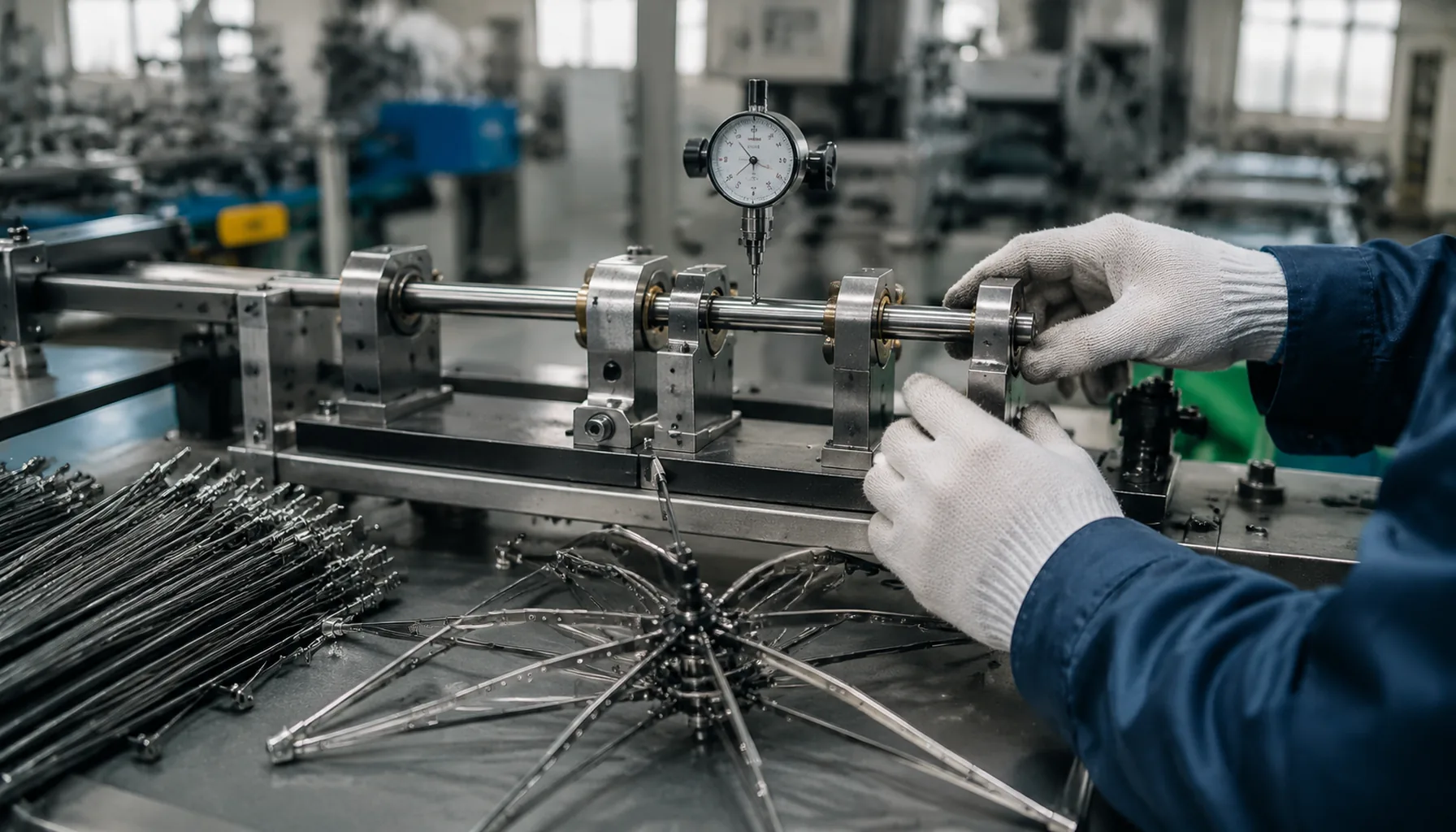
A bent or poorly controlled shaft does not always show up at assembly, but it will show up as canopy wobble, weak auto-open travel, scratched cartons, or a buyer’s incoming reject report. On our Songxia production floor, umbrella shaft straightness tolerance is managed from tube forming through rolling checks, handle fitting, and final packing because runout is a process signal, not just a final inspection number.
What Shaft Runout Means for Umbrella Quality
Runout is the amount a shaft wanders from its true centerline when the umbrella is rotated or cycled, and it is not the same thing as simple straightness. Straightness is the physical bend along the tube or rod, usually checked against a flat V-block or dial gauge. Runout is what that bend becomes in the assembled umbrella: the top cap, notch, runner, ribs, and handle no longer share one clean axis. Wobble is the user-visible effect, especially when the canopy is spun by hand or when an auto-open frame snaps upward. Concentricity means the shaft, runner bore, notch, ferrule, and handle hole are centered around the same axis. In umbrella shaft manufacturing, we normally care less about a beautiful raw tube and more about whether the final assembly stays within the umbrella shaft straightness tolerance after cutting, swaging, drilling, riveting, plating, and handle insertion.
A bent shaft pulls the canopy off-center even if the fabric panels are cut correctly. On a 23" stick umbrella, a small shaft deviation near the notch can shift rib tips several millimeters, making one side of the canopy sit tight while the opposite side looks loose or scalloped. The runner also suffers: if the shaft bows, the runner bore drags on one side, so opening force rises and the user feels a scrape or hesitation instead of a smooth slide. In auto-open umbrella production, this gets worse because the spring releases load quickly; the runner can cock slightly, ribs open unevenly, and the umbrella may stop short of full lock. That is why umbrella runout inspection should be done after key forming operations, not only on incoming tube stock.
The quality cost shows up at retail as complaints that sound unrelated: “canopy is crooked,” “hard to open,” “umbrella shakes,” or “looks cheap.” In factory terms, many of those are shaft-axis problems. For OEM umbrella quality control, we usually define a practical umbrella shaft straightness tolerance by product grade: tighter for golf umbrellas with 27" or 30" fiberglass frames, more forgiving for low-cost 21" manual compacts, but always tied to runner travel and finished appearance. AQL 2.5 inspection should include visual canopy centering, full open-close cycling, and a runout gauge check on samples from each batch. At ZheBrella, our standard practice is to inspect shafts after straightening and again after assembly because riveting, handle press-fit, and heat from coating or plating can reintroduce bend that the raw-material check never catches.
Tube Forming and Straightening Steps
Straight shafts start with tube discipline, not with final inspection. For center-pole umbrellas we usually run low-carbon steel tube around 8–10 mm OD for 23" and 27" models, while golf umbrellas move to larger steel or aluminum center shafts, often 12–14 mm depending on the frame load and handle design. Incoming tube is checked for wall consistency before cutting because a thin seam side will pull during forming and later show as wobble at the runner. Cut length tolerance is normally held within ±0.5 mm before end forming; after cutting, both ends are deburred so the notch, spring hole, and cap insert do not pick up burrs that scratch the runner or jam the auto-open button. In umbrella shaft manufacturing, I prefer mechanical end-form gauges over visual checks because a tube can look clean but still have an oval mouth that makes the top notch sit off-axis.
Steel shafts are drawn or roll-formed, then punched for spring buttons, runner stops, or rib-holder holes before plating or powder coating. Chrome, black electrophoresis, nickel, and zinc plating all add thickness, so hole size and runner clearance must be planned before surface treatment, not corrected after. Aluminum shafts for lighter 21" and 23" promotional umbrellas are usually anodized or painted; they are easier to dent, so we reduce clamp pressure during straightening and use nylon contact rollers instead of bare steel V-blocks. Our standard practice at ZheBrella is to straighten after major forming and again after coating if the process involves heat, because even a small bow becomes obvious once the canopy is sewn tight and the runner travels under load. A practical umbrella shaft straightness tolerance for most stick umbrellas is checked against a go/no-go runout target rather than a cosmetic line-of-sight judgment.
Control points change sharply by product type. A 30" golf umbrella shaft is long enough that 1.5 mm of total indicated runout can make the canopy rotate unevenly in wind-tunnel testing, especially with 8K or 16K fiberglass ribs and a vented double canopy rated around 50+ mph. Compact telescopic shafts are harder: each aluminum or steel section must slide cleanly, lock positively, and stay concentric after swaging, so umbrella runout inspection includes each tube section plus the assembled stack. In auto-open umbrella production, the inner shaft must also align with the spring and button slot; if the hole is punched off-center, the umbrella may pass opening once but fail after 20–30 cycles. For OEM umbrella quality control, we record shaft runout in-process before frame assembly, then confirm finished-frame opening, runner travel, and handle alignment under AQL 2.5 inspection, especially on FOB and DDP orders where rework after packing is expensive.
Impact on Auto-Open and Telescopic Mechanisms
Auto-open umbrellas are unforgiving because the shaft is not just a handle support; it is the rail that controls runner speed, spring release, and final canopy lock-up. In auto-open umbrella production, a shaft that looks acceptable by eye can still create enough side load to slow the runner, especially on 23" and 27" models with stronger opening springs. When the runner drags on one side, the spring energy is wasted overcoming friction instead of pushing the stretcher set evenly, so the umbrella may open late, stop short of the top notch, or snap open with a crooked canopy. That is why umbrella shaft straightness tolerance should be treated as a functional dimension, not only a cosmetic check. For steel center rods we typically check runout on V-blocks with a dial indicator, while aluminum and fiberglass shafts need lighter fixturing so the inspection force does not mask the bend. A good umbrella runout inspection catches problems before assembly, not after 500 pieces fail final opening tests.
Compact telescopic umbrellas are even more sensitive because each section multiplies small errors. A three-fold 21" umbrella may have inner tubes of 8 mm, 10 mm, and 12 mm diameter, and a 0.4 mm bend in one section can become a visible bind when the tubes slide through bushings and plastic collars. During umbrella shaft manufacturing, we check each drawn tube before cutting, then recheck after slotting, drilling, riveting, and black nickel or chrome plating, because heat, clamping pressure, and uneven plating thickness can all change runout. For manual umbrellas, the user can sometimes force the runner past a tight spot, but auto-open mechanisms do not forgive that resistance. The spring has one fast release cycle; if the telescopic shaft hesitates halfway, the ribs may deploy unevenly and the canopy will appear weak even when the 190T or 210T pongee sewing is correct.
Our standard practice at ZheBrella is to combine gauge checks with functional cycling because numbers alone do not catch every sliding issue. For OEM umbrella quality control, we set the umbrella shaft straightness tolerance by product type: tighter on auto-open-close compact models, slightly more forgiving on straight-stick 27" golf umbrellas with a single steel or fiberglass shaft. Inline operators roll shafts on a flat granite plate for quick screening, then QC samples by AQL 2.5 use dial runout readings, runner drop tests, and repeated open-close cycles. On auto-open-close samples, we also check whether the lower tube retracts smoothly after release, because a small bend near the joint can cause sticking only during closing, not opening. A shaft that passes visual inspection but fails after 20 cycles is rejected before packing; otherwise the buyer receives umbrellas that open well in the sample room but jam during event distribution or retail returns.
Inspection Tools and Sampling Frequency
The fastest shop-floor screen for shaft bend is still a V-block rolling check, because it shows the problem before anyone argues about numbers. We place the cut shaft or assembled center pole on two hardened V-blocks, rotate it by hand, and watch the high point under a dial indicator set near the middle and again near the runner contact area. For steel shafts on 23" and 27" stick umbrellas, I expect total indicated runout to stay tight enough that the runner does not scrape or chatter; for aluminum and fiberglass composite shafts, the limit must account for material springback after riveting. A practical umbrella shaft straightness tolerance should be defined on the drawing, not decided at final inspection, because a 0.5 mm visual wobble can become a failed auto-open stroke once the spring load is installed.
Go/no-go gauges catch what dial indicators do not: hole position, tip fit, notch engagement, and whether the shaft passes cleanly through the runner bore after plating, anodizing, or powder coating. In umbrella shaft manufacturing, we use plug gauges for runner clearance, slot gauges for button openings, and fixture pins for rib notch alignment. Visual alignment is still useful, but only under controlled conditions: shaft vertical, handle removed if needed, white background, and the inspector sighting along the runner path rather than casually spinning the frame in the air. During umbrella runout inspection, borderline shafts are not mixed back into bulk bins; they are tagged by defect type, because bend from cutting, bend from crimping, and bend after auto-open spring assembly require different corrective action.
Sampling frequency should follow order risk, not a fixed habit. For a low-risk repeat MOQ order of 3,000 pieces using standard 8K steel ribs, 190T pongee canopy, and manual-open mechanism, in-process checks every 300 to 500 shafts plus final AQL 2.5 inspection may be enough. For 10K/16K frames, 30" golf umbrellas, heavy double-canopy vented models, or auto-open umbrella production, I tighten the sample interval to every 100 to 200 shafts and add assembled-frame opening tests before canopy sewing. OEM umbrella quality control should include repeated open-close cycles, runner travel smoothness, top notch locking, and handle-axis alignment, because a shaft that passes loose-part inspection can still twist under the load of fiberglass ribs, UPF 50+ coated fabric, or a windproof double-canopy build. At ZheBrella, high-risk custom orders get extra first-article approval before mass riveting starts.
Packaging Controls That Prevent New Bending
Most shaft bending after final inspection is caused by lazy pack-out, not bad umbrella shaft manufacturing. For straight stick and golf umbrellas, we lock the carton layout before mass production: same head-to-tail direction, no loose diagonal loading, and no mixed handle shapes fighting each other inside the box. J-handle umbrellas need alternating handle orientation or molded paper spacers so the crook does not press into the next shaft. EVA straight handles can usually be nested tighter, but wood and coated ABS handles need tissue or PE sleeves because surface dents become leverage points under compression. For compact auto-open umbrella production, inner boxes matter more than buyers expect; a 21" 3-fold auto-open-close umbrella with steel shaft can bend if 50 pieces are dumped into a master carton with no cell separation. Our standard practice is to treat packaging as part of OEM umbrella quality control, with drop tests and carton compression checks done before shipment release.
The practical target is to preserve umbrella shaft straightness tolerance after export, not just pass it at the assembly table. If a 23" stick umbrella passes umbrella runout inspection at final QC but cartons are stacked 6-high in a damp warehouse, thin steel shafts can take a permanent set before the container even closes. For FOB Ningbo or Shanghai orders, the factory controls packing up to handover, so we specify 5-ply K=A or K=K cartons for heavier 27" and 30" umbrellas, plastic strapping where needed, and clear stacking marks. For DDP shipments, we have to think further: domestic truck transfers, pallet re-stacking, courier depots, and last-mile handling. That usually means stronger inner cartons, corner boards, desiccant in humid seasons, and pallet height limits around 1.6 meters instead of chasing maximum cube. A cheap carton can erase a good AQL 2.5 inspection result.
Long golf umbrellas need stronger pack-out engineering because their shafts act like levers inside the carton. A 30" golf umbrella with fiberglass ribs and a 14 mm shaft may survive 50+ mph wind-tunnel testing, but if the tip end is unsupported and the handle end is crushed by adjacent cartons, runout can increase during transit. We prefer full-length inner boxes or rigid dividers for premium golf umbrellas, especially 8K or 16K double-canopy vented models with heavier frames. Container loading also matters: cartons should be aligned lengthwise, not bridged across pallet gaps, and heavy POE/PVC rainwear cartons or display fixtures should never sit on umbrella cartons unless compression data supports it. When buyers set an umbrella shaft straightness tolerance in the specification, packaging drawings should be attached to the PO, because the pack method is what keeps that tolerance intact from factory gate to retail warehouse.
Frequently Asked Questions
Is steel or aluminum more likely to bend during umbrella production?
Aluminum is lighter but can deform if wall thickness is too low or cartons are compressed. Steel is stronger but needs anti-rust finishing and straightness checks after cutting, plating, and assembly.
Should shaft straightness be checked before or after final assembly?
Both stages matter. Pre-assembly checks catch defective tubes early, while final checks confirm that ribs, runner, canopy tension, and auto-open mechanisms work correctly together.
What runout limit is typical for an umbrella shaft in production?
Most OEM factories set a tighter limit for auto-open models because small bends affect opening force and wobble. A common target is kept within a few millimeters over the full shaft length, but the final tolerance should match the umbrella size, tube spec, and customer QC standard.
Where should runout be checked during manufacturing?
Runout is usually checked after tube forming, after rolling or straightening, and again before packing. This catches deformation early and prevents assemblies with hidden bend or twist from reaching carton inspection.
How do packing controls reduce shipment rejects?
Factories typically use shaft supports, sleeve protection, and carton compression checks to keep the shaft from shifting during transit. Good packing control reduces bent shafts, scratched finishes, and failed outbound inspections.
Looking to Launch Your Custom Umbrella Line?
ZheBrella is a Zhejiang-based OEM/ODM umbrella manufacturer with 17 years of export experience. Free design, low MOQ from 100 pieces, windproof construction, full-color print.
Get Free Quote Now »People Also Search For
Related Articles
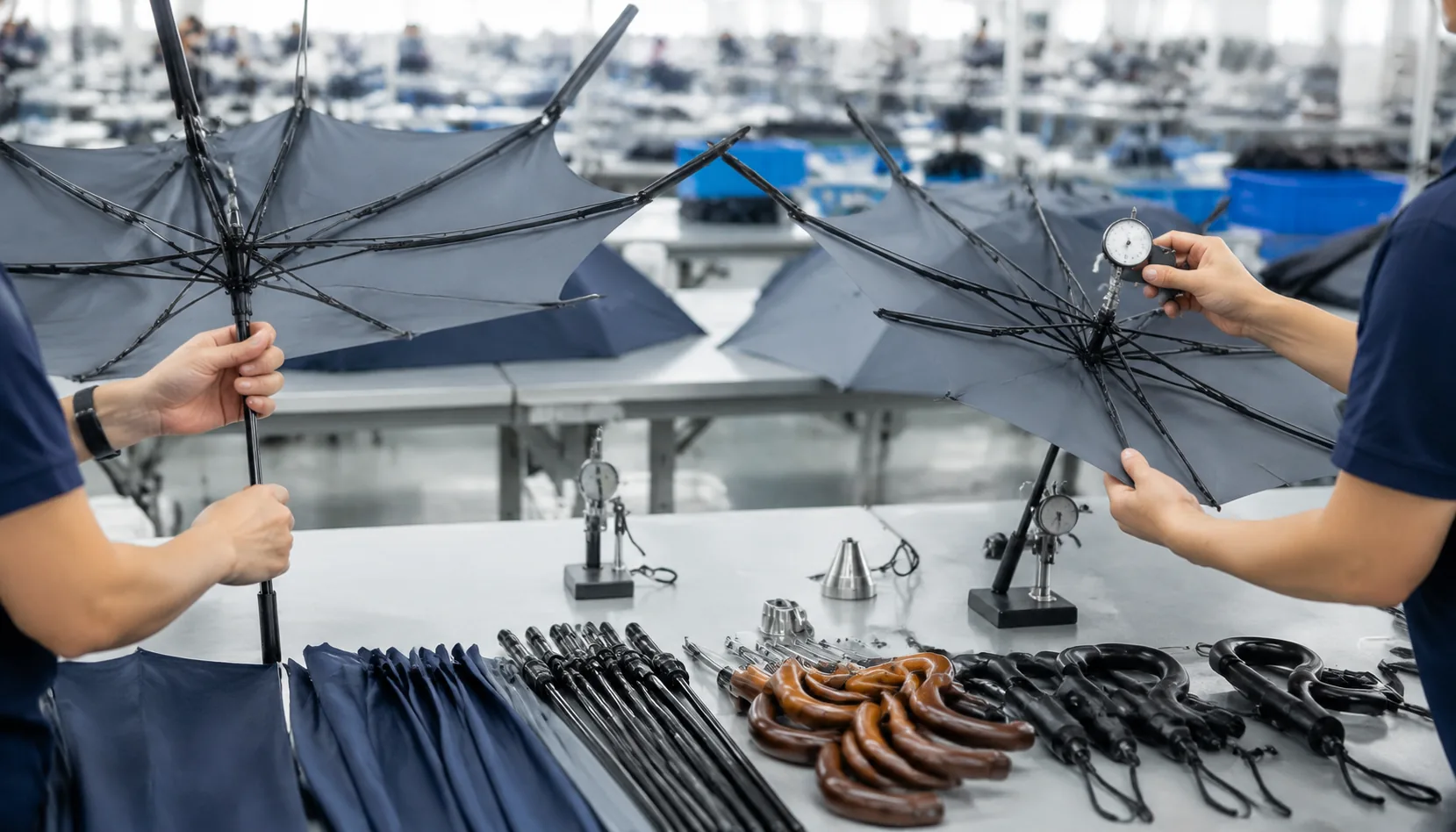
Inline Umbrella Assembly Checks Before Final Inspection
Use inline assembly checks to catch frame, fabric, handle, and mechanism issues earlier, reducing rework before final AQ...
Read More »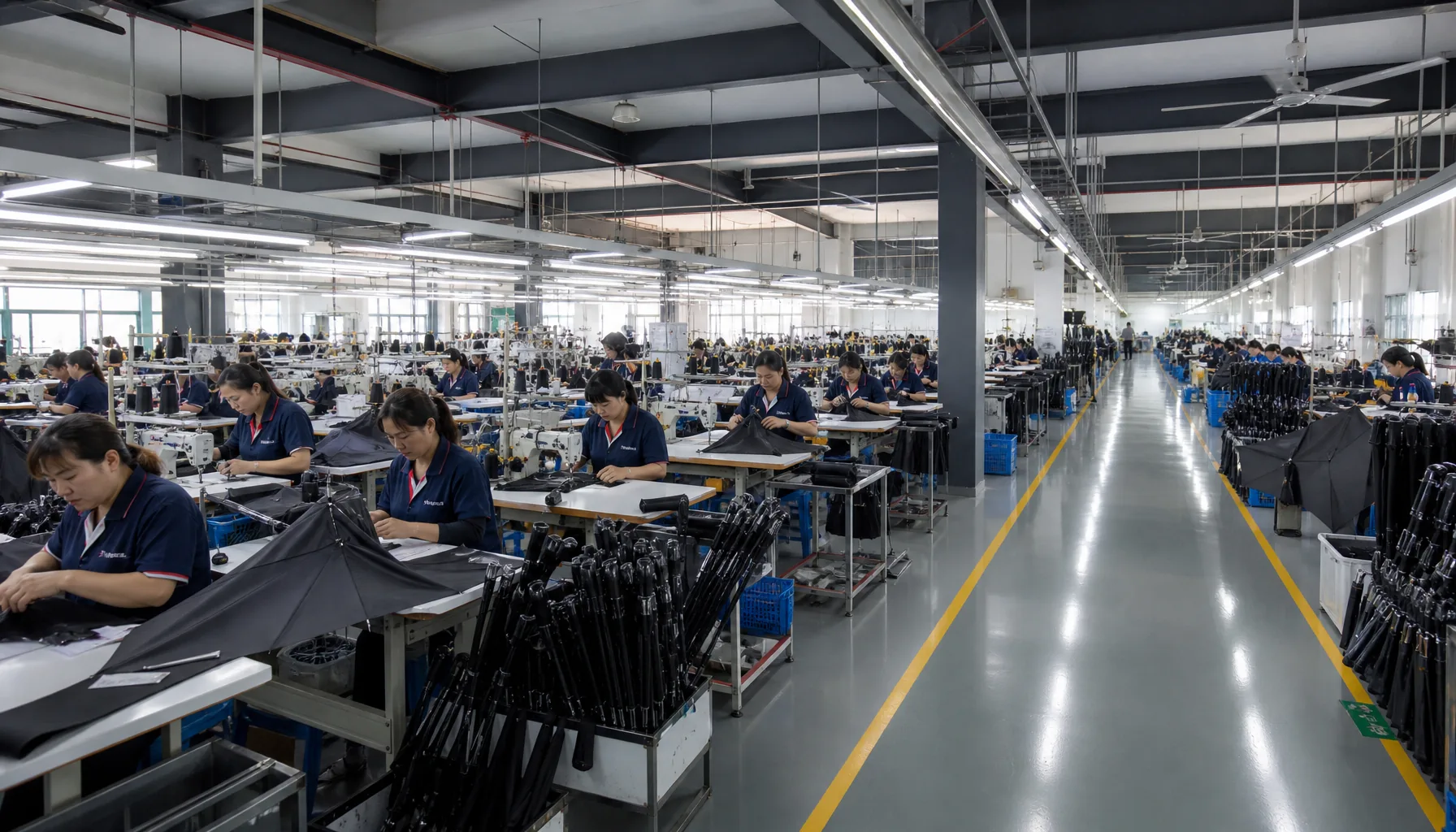
Umbrella Frame Riveting Process Controls for OEM Durability
See how rivet diameter, setting force, washer fit, and in-line pull tests prevent loose ribs, noisy frames, and AQL 2.5 ...
Read More »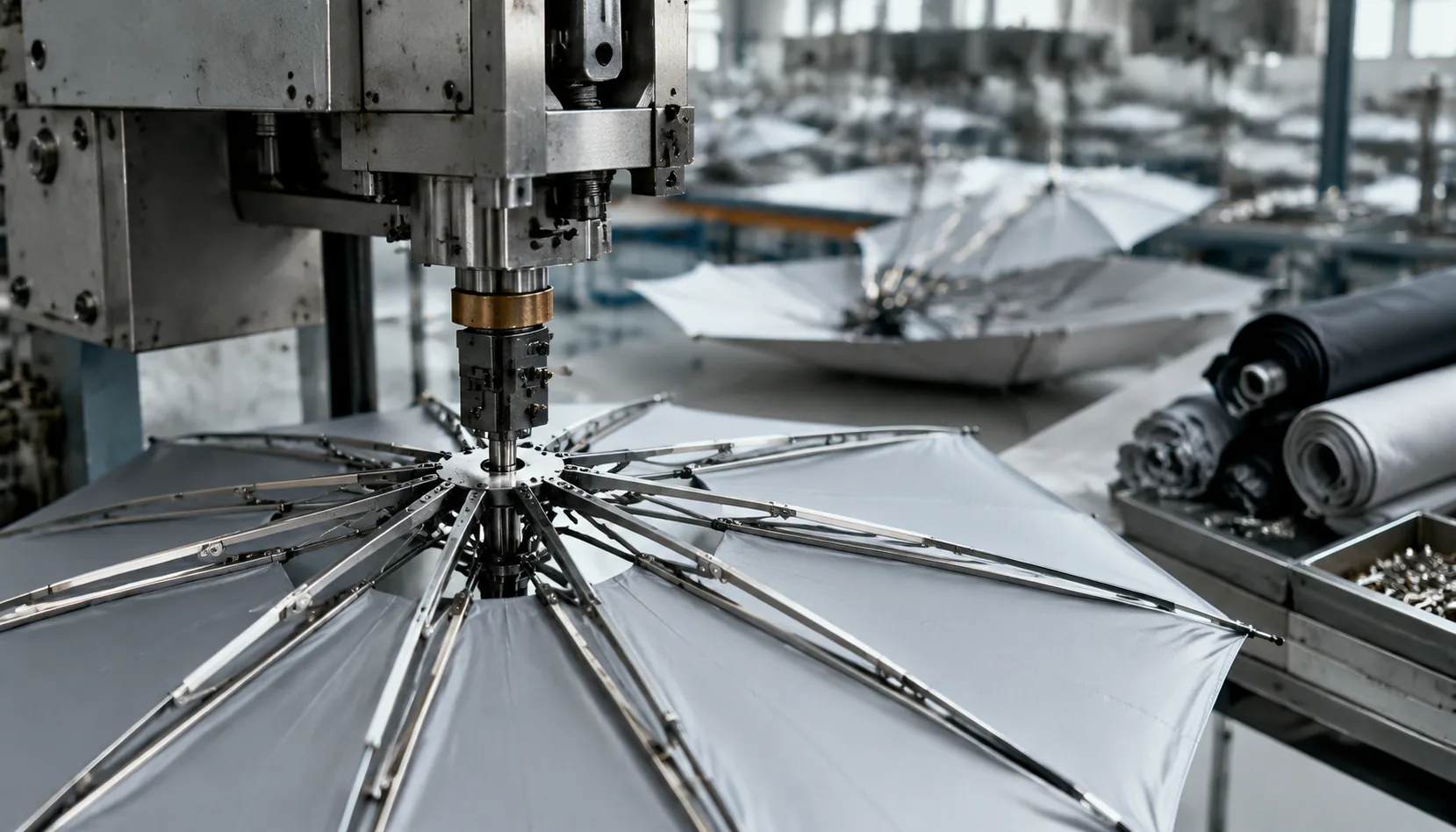
Umbrella Rib Riveting Process Controls for OEM Frame Quality
Control rib riveting quality with specs for joint play, pull force, 8K/16K frames, in-line checks, and AQL 2.5 acceptanc...
Read More »