Umbrella Rib Riveting Process Controls for OEM Frame Quality
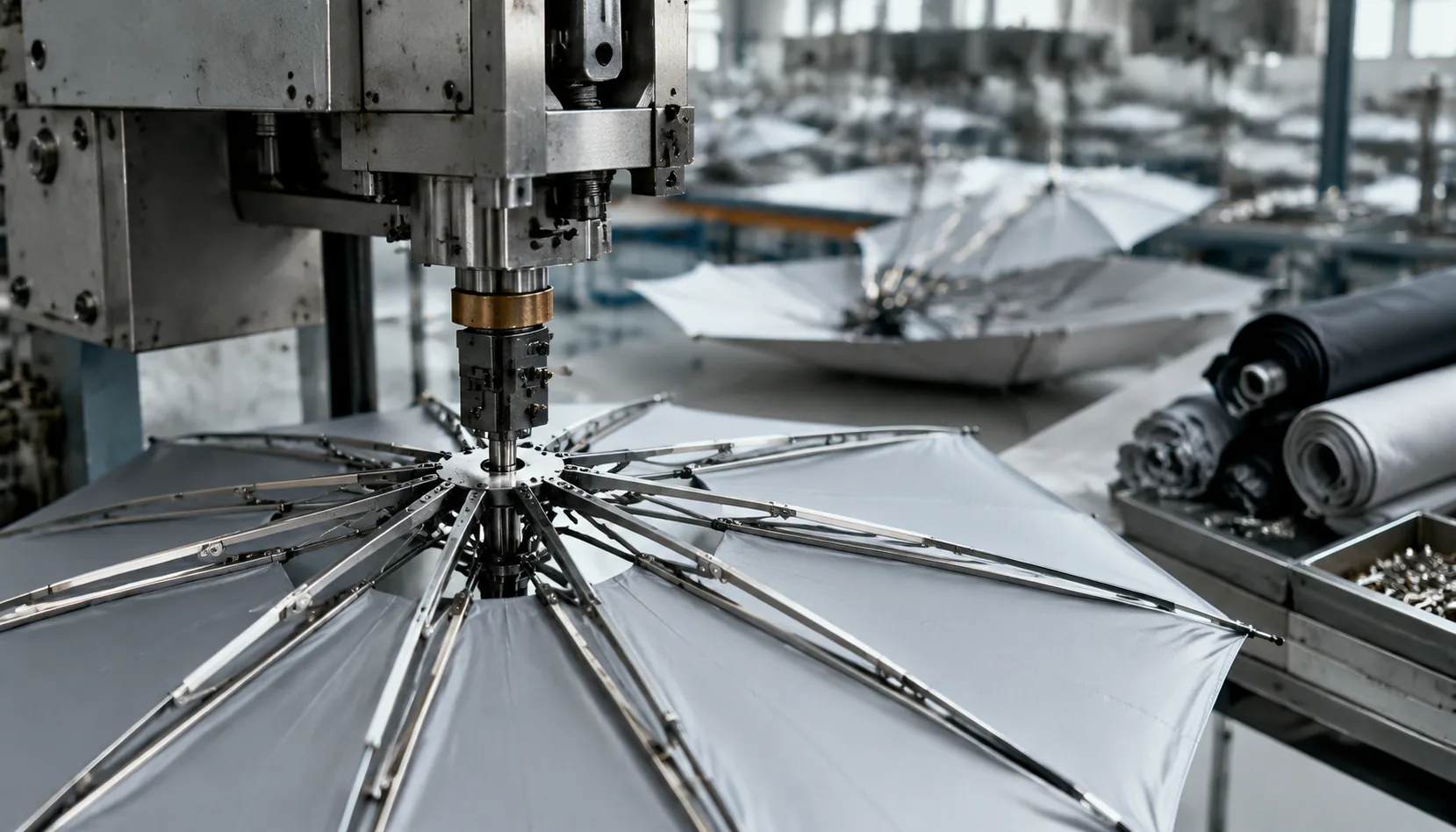
When an OEM frame fails in the market, the problem often starts at a rivet that looked acceptable on the line but had too much play, weak pull force, or inconsistent setting across 8K and 16K assemblies. In our Songxia workshop, the umbrella rib riveting process is controlled by joint clearance specs, pull checks, in-line sampling, and final AQL 2.5 inspection so shipment quality is proven before cartons leave the factory.
Riveting’s Role in Frame Strength
Our standard practice at ZheBrella is to treat umbrella rivet inspection as both a process check and a final AQL item. On the line, operators pull samples every batch to check rivet head diameter, flare consistency, rotation resistance, and whether the stretcher sits centered in the rib fork. A good joint should rotate smoothly by hand without rattling; if it needs force, it will bind under a wet 190T or 210T pongee canopy when the runner load increases. During AQL 2.5 umbrella checks, inspectors open and close samples repeatedly, shake the frame laterally, and look for asymmetric rib spacing, popped rivets, cracked fiberglass, or steel burrs that can cut fabric. For custom OEM orders, I prefer confirming one golden sample frame before canopy printing begins, because a rivet problem found after screen printing, heat transfer, or sublimation becomes expensive rework instead of a simple frame adjustment.
Key Rivet Specifications to Define
The most important rivet spec is not diameter alone; it is the fit between rivet shank, rib hole, washer or burr, and the movement required at that joint. For compact 21" and 23" auto-open-close frames, we usually define main rib and stretcher rivets at 1.8–2.2 mm diameter, with head height controlled around 0.45–0.65 mm so the canopy does not snag during closing. Steel ribs can tolerate a tighter peened joint, but fiberglass ribs need a cleaner bearing surface because crushed glass fiber around the hole will turn into wobble after 300–500 open-close cycles. In the umbrella rib riveting process, buyers should specify rivet material as nickel-plated steel, stainless steel, or brass-plated steel, plus salt-spray expectation if the order is for coastal retail markets. A vague note like “silver rivets” is not enough for OEM umbrella frame quality because plating thickness, rust resistance, and burr shape all change the joint life.
Joint clearance should be written as a measurable tolerance, not left to the frame supplier’s habit. For 8K umbrella frame production, I like to see free rotation at every rib-to-stretcher and runner-to-stretcher joint, with no binding under hand force, but lateral play limited to about 0.20–0.35 mm on compact umbrellas and 0.30–0.50 mm on 27" or 30" golf umbrellas. Golf frames have longer ribs and higher torque in wind, so the rivet head normally needs a larger bearing diameter and more consistent peening pressure, especially on 10K and 16K layouts where load distribution is better but total joint count is higher. For double-canopy vented windproof umbrellas rated around 50+ mph in a wind tunnel, the top canopy vent reduces inversion load, but the rib joints still flex repeatedly; we normally allow smoother rotation and slightly more controlled clearance instead of over-tight riveting, which causes ribs to bend before the vent can release pressure.
Buyer drawings should call out rivet diameter, shank length before peening, finished head height, head diameter, washer requirement, finish, joint clearance, and allowed lateral play at each frame position. The spec should also separate critical joints from cosmetic ones: crown, runner, stretcher pivot, rib tip, and secondary support struts do not fail in the same way. For umbrella rivet inspection, our standard practice at ZheBrella is to combine caliper checks with functional tests: open-close cycling, rib alignment, canopy tension after sewing, and manual shake testing for loose joints. In AQL 2.5 umbrella checks, loose rivets that affect opening, visible rust, cracked fiberglass around holes, sharp burrs touching 190T or 210T pongee, and asymmetric rib movement should be major defects, not minor workmanship comments. If the umbrella rib riveting process is defined this way before mass production, a factory can tune tooling pressure and rivet length during pre-production instead of discovering frame looseness after printing and final assembly.
In-Line Controls During Frame Assembly
Frame quality is mostly decided before the canopy ever reaches the sewing line, so our in-line controls start with the riveting fixture, not the finished umbrella. For 8K umbrella frame production, each rib station must hold the stretcher, main rib, runner link, and notch position square within about 0.5 mm; if the fixture is loose, the operator can still make a pretty rivet that gives a crooked opening arc. We use locating pins and stop blocks matched to the rib profile, with separate nests for steel U-channel ribs and fiberglass round ribs because the compression behavior is different. First-piece approval is done at every shift start, after tooling change, and after any air-pressure adjustment. The line leader opens and closes the first assembled frame 10 cycles, checks rib symmetry against a master sample, and confirms the crown, runner, and tips sit level before mass riveting continues.
Pneumatic riveting pressure is controlled by material, rivet diameter, and joint stack thickness; too light leaves axial play, while too heavy flares the rivet head and crushes the rib wall. In the umbrella rib riveting process, we normally set a defined pressure window on the regulator and lock it, then verify head height with a go/no-go gauge rather than relying on operator feel. A typical steel 8K frame uses nickel-plated or brass rivets around 2.2–2.5 mm, while larger 27 inch or 30 inch golf frames may require heavier rivets and slower ram speed to avoid cracking fiberglass stretchers. Operators check every 30–50 frames for free rotation, no burrs, no missing washers where specified, and no binding at the runner. Any frame with uneven rib spread, loose stretcher joints, or one rib lagging during auto-open testing is pulled immediately, not sent forward for canopy fitting.
Umbrella rivet inspection has to include movement under load because a joint can pass visual inspection and still fail after sewing tension is applied. Before canopy sewing, we run pull or flex checks on sampled frames: the rib-and-stretcher joint is flexed through the normal opening angle, the runner is pushed firmly to lock position, and the frame is shaken to detect chatter or ovalized rivet holes. For OEM umbrella frame quality, our standard practice is to record in-line findings separately from final AQL 2.5 umbrella checks, because catching a drifting rivet punch after 200 frames is much cheaper than rejecting packed goods. Inspection intervals tighten during new OEM projects, mixed-material frames, 10K/16K rib counts, or auto-open-close mechanisms, where one tight joint can slow the spring action and cause false functional failures. Only frames that pass alignment, rivet rotation, flex, and open-close checks should move to canopy sewing.
Common Riveting Defects and Root Causes
The fastest way to ruin OEM umbrella frame quality is to treat riveting as a simple squeeze operation. In 8K umbrella frame production, cracked fiberglass ribs usually come from too much air pressure on the riveting press, a die face that is too narrow, or a rivet shank that is slightly oversized for the drilled hole. Fiberglass does not forgive point loading; once the outer resin layer splinters, the rib may pass a casual visual check but fail after 200–300 open-close cycles. Bent steel stretchers are the opposite problem: the material yields before the rivet head forms cleanly, often because the lower anvil is not supporting the stretcher flat or the operator is feeding parts at an angle. I also see mixed rib gauges cause false settings—one batch of 0.45 mm steel stretchers and another at 0.50 mm cannot share the same press stroke without deforming one side.
Off-center rivets are usually not an operator “carelessness” issue; they are a fixture-control issue. If the jig hole is worn by even 0.2–0.3 mm, the rib and stretcher stack shifts during pressing, and the joint looks acceptable until the frame opens under canopy tension. In the umbrella rib riveting process, worn upper punches also create mushroomed rivet heads that pull to one side, especially on 23" and 27" straight umbrellas with longer stretcher leverage. Sharp burrs come from cheap plated iron rivets, dull cutting on semi-tubular rivet ends, or mismatched head diameter against the die cavity. During umbrella rivet inspection, we run a fingertip burr check because a raised edge can cut 190T pongee at the seam allowance or scratch POE/PVC panels on clear umbrellas. Burrs are not cosmetic; they become canopy complaints after packing compression and transit vibration.
Frozen joints happen when the rivet is crushed too tight, the washer stack is missing, or the hardware lot has inconsistent shank length. A good joint should rotate smoothly with controlled resistance; it should not rattle, but it also should not need thumb force to move. Mixed hardware lots are a common root cause because one carton may contain 5.8 mm rivets and another 6.2 mm rivets with the same surface finish, so the press setting produces loose joints on one lot and locked joints on the next. Our standard practice at ZheBrella is to separate rivets by diameter, shank length, plating lot, and supplier before line feeding, then confirm with first-piece torque feel and AQL 2.5 umbrella checks during inline inspection. For export orders, I prefer recording riveting pressure, die number, and defect counts per shift; otherwise the same failure repeats when the frame style moves from sample room to mass production.
Final Inspection and Buyer Acceptance Criteria
Rivet defects should not be treated as cosmetic noise in final inspection; they sit directly inside OEM umbrella frame quality because one bad joint changes how the whole frame opens under load. In an AQL 2.5 umbrella checks plan, I classify a missing rivet, cracked rib eyelet, rivet head pulled through the rib, or joint that separates during three open-close cycles as critical or major depending on the buyer’s standard, but never minor. Sharp burrs on rivet heads that can cut fingers or canopy fabric are critical in my book. Slight off-center heading with no looseness, no burr, and no movement after cycling can be minor, but it still gets recorded because it usually points back to worn riveting dies or inconsistent feeder pressure in 8K umbrella frame production.
A practical umbrella rivet inspection should combine visual checking, hand-feel checking, and functional cycling, not just a glance at the frame before packing. Inspectors should open each sampled umbrella fully, shake it lightly from the handle, then close it while watching the stretcher-to-rib joints and runner links. A loose rivet often shows up as delayed rib movement, asymmetric canopy tension, or a clicking sound near one panel. For 23-inch and 27-inch straight umbrellas, I like a simple rib symmetry check: stand the opened umbrella on the tip, view from above, and reject frames where one rib sits noticeably low or twists the canopy seam. On compact auto-open-close models, run at least five cycles on sampled units because spring force exposes weak rivet setting faster than a single manual opening.
Before FOB or DDP shipment, the QC checklist should name the acceptance criteria clearly: opening smoothness, rib symmetry, joint looseness, rivet head condition, and canopy damage caused by frame hardware. Our standard practice at ZheBrella is to separate these from fabric defects such as pinholes, printing shift, or sewing puckers, because frame failures require different corrective action on the assembly line. For the umbrella rib riveting process, buyers should request defect photos in the inspection report, including close-ups of rejected joints and one full-frame image showing rib alignment. If the order is for promotional umbrellas with steel ribs, the focus is usually burrs, rust marks, and loose heading; for fiberglass ribs, inspectors should watch for crushed rib ends and stress whitening around the rivet hole. Clear classification avoids arguments at shipment release and keeps the factory from passing marginal frames just because the canopy looks clean.
Frequently Asked Questions
Should buyers specify rivet material for umbrella frames?
Yes. Nickel-plated or stainless hardware improves corrosion resistance, especially for resort, coastal, and golf umbrellas. The choice should match the rib material and target price point.
Can poor riveting pass an opening cycle test at the factory?
Sometimes early samples pass, but loose or over-set rivets often fail after repeated cycles. For OEM orders, combine opening cycle tests with joint play and visual rivet checks during AQL 2.5 inspection.
What rib riveting defects should be checked during OEM umbrella production?
Inspectors should check loose rivets, cracked rib ends, excessive side play, misaligned joints, sharp burrs, and rivets that restrict smooth opening. These defects are usually checked in-line before canopy sewing and again during final AQL inspection.
What is an acceptable pull force for umbrella rib rivets?
The required pull force depends on rib material, rivet diameter, and frame size, but many OEM orders define a minimum joint pull force in the approved specification before mass production. For heavy-duty 8K or 16K frames, buyers should confirm the pull-force standard during pre-production sample approval.
How are rib riveting issues handled under AQL 2.5 inspection?
Under AQL 2.5, loose, missing, or function-affecting rivets are usually treated as major defects because they can cause frame failure in use. If the number of major defects exceeds the acceptance limit for the sample size, the shipment should be reworked or reinspected before release.
Looking to Launch Your Custom Umbrella Line?
ZheBrella is a Zhejiang-based OEM/ODM umbrella manufacturer with 17 years of export experience. Free design, low MOQ from 100 pieces, windproof construction, full-color print.
Get Free Quote Now »People Also Search For
Related Articles
Umbrella Frame Riveting Process Controls for OEM Durability
See how rivet diameter, setting force, washer fit, and in-line pull tests prevent loose ribs, noisy frames, and AQL 2.5 ...
Read More »
Umbrella Frame Riveting Process: Tolerances and QC Checks
Specify rivet size, hole tolerance, frame alignment, and inline pull checks to reduce loose ribs, jammed runners, and AQ...
Read More »
Umbrella Frame Riveting Quality: Tolerances and Pull Tests
Specify rivet fit, pull strength, and in-process checks to reduce loose ribs, canopy sag, and field failures in OEM umbr...
Read More »