Umbrella Tip and Ferrule Attachment Controls for Bulk Orders
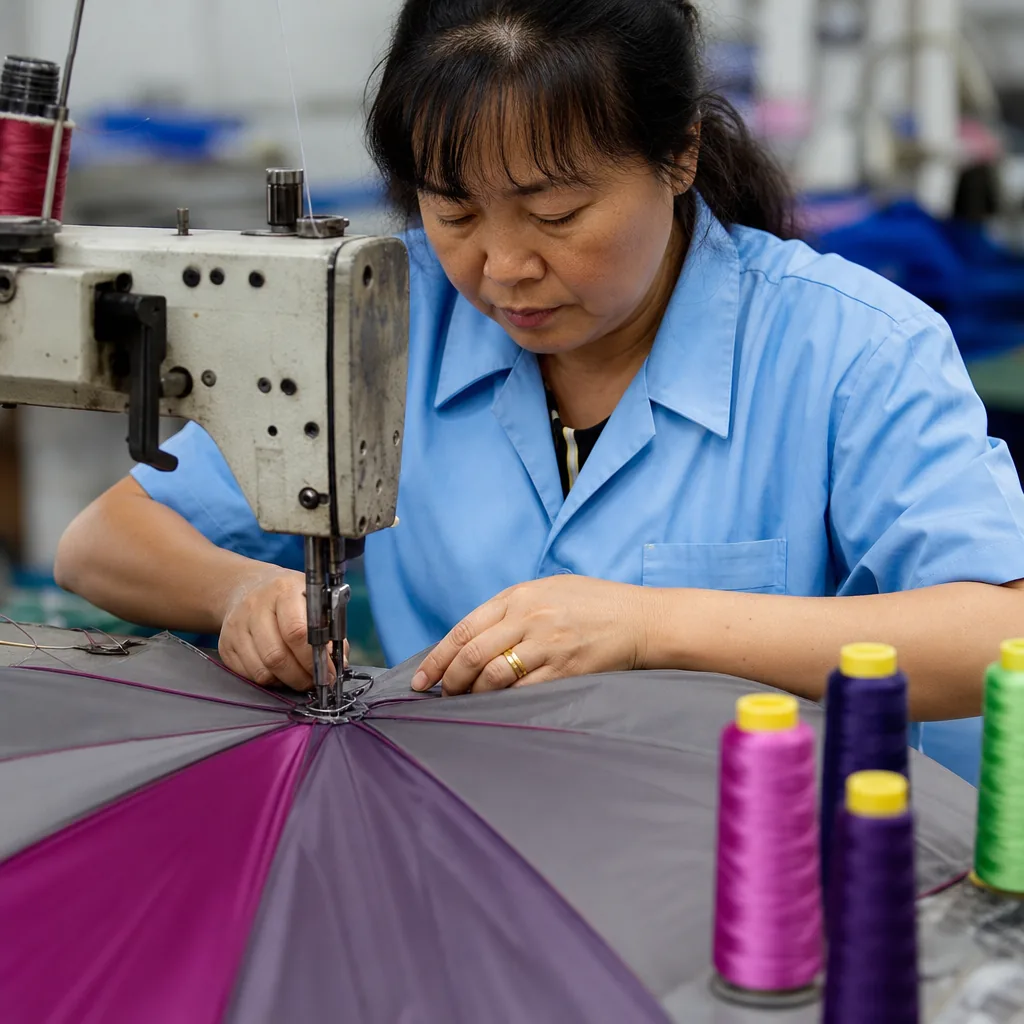
Loose tips and ferrules usually trace back to small process gaps: the wrong adhesive for the shaft material, uneven crimp pressure, short cure time, or sampling that misses the first signs of drift. On our Songxia production floor, umbrella tip attachment quality is controlled before packing through defined pull tests, fixture settings, cure records, and AQL checks, because one weak metal or plastic end part can turn a bulk order into a safety claim.
Why Small Attachment Parts Create Big Quality Risks
Tip caps, rib end tips, and the top ferrule look minor on a spec sheet, but they lock the umbrella system together. The rib tips hold the canopy edge at the correct tension; if one tip slips, the panel sags, the seam line twists, and the umbrella no longer opens with a clean round profile. The ferrule at the crown fixes the canopy stack, top notch, washer, and cap in alignment, so a weak crimp or poor adhesive bond can cause the fabric to rotate or wrinkle after only a few open-close cycles. In bulk umbrella production, I have seen 190T pongee canopies and powder-coated steel frames pass inspection, then fail buyer review because the tips were loose, scratched, or mismatched in color. That is why umbrella tip attachment quality must be treated as a functional control point, not a cosmetic afterthought.
Loose attachment parts also create real user-safety problems. A missing rib tip exposes a steel or fiberglass rib end that can scrape skin, puncture the canopy, or snag clothing when the user closes the umbrella. On kids’ umbrellas, POE clear umbrellas, and promotional 21-inch compact models, this risk is more visible because consumers handle the canopy edge directly. For 23-inch and 27-inch stick umbrellas, the ferrule can become a small falling part if the threaded cap, nail, or press-fit insert is not secured correctly. Our standard practice at ZheBrella is to include an umbrella pull test on critical attachments, especially before packing OEM orders: rib tips are checked by hand pull or gauge pull, ferrules are twisted and pulled, and suspect lots are separated before final AQL 2.5 inspection. A frame can survive a 50+ mph wind-tunnel claim, but that claim means little if the cap detaches in retail use.
The complaint pattern is predictable: the buyer says the umbrella “looks cheap” or “fell apart,” even when the canopy fabric, printing, and frame mechanism are technically acceptable. That happens because small plastic and metal parts are touched, seen, and stressed every time the umbrella opens. In umbrella ferrule manufacturing, tolerance matters: a ferrule hole that is 0.2 mm oversized, a shallow crimp, or insufficient glue curing time can produce a defect that only appears after shipping vibration or warehouse heat. Color consistency also matters for retail and promotional programs; a black 190T canopy with grayish tips, or a chrome ferrule with plating scratches, makes the whole order look poorly controlled. Good OEM umbrella quality control links the attachment method to the material: PVC tips need different bonding than nylon tips, fiberglass ribs need secure sleeves, and auto-open-close models require extra checks because the opening shock is higher.
Common Attachment Methods and Their Failure Modes
Stitching capture works best on rib tips where the canopy seam or pocket physically traps the part, so the load is shared by thread tension and fabric geometry rather than adhesive alone. It is reliable on 190T and 210T pongee if the seam allowance is consistent, but poor sewing registration can leave the tip half-captured and easy to pull out. Screw-type ferrules are stronger for wooden or metal stick umbrellas, especially 27-inch and 30-inch golf models, but thread engagement must be checked; short threads and soft aluminum inserts loosen under vibration during shipping. In umbrella ferrule manufacturing, plated steel screws also need corrosion control, because rust bleeding onto white or light-colored canopies causes claims even when the attachment strength is acceptable. For OEM umbrella quality control, I like a combined check: torque test for screw ferrules, axial pull test for tips, visual gap check under AQL 2.5, and carton drop simulation before release. That is the practical way to protect umbrella tip attachment quality across mixed materials and mechanisms.
Material Matching for Tips, Ferrules, and Rib Ends
Material matching starts with the job the umbrella must survive, not with the cheapest tip in the parts bin. For promotional 21" and 23" umbrellas, ABS or PP tips are common because they are light, color-match well, and keep the unit cost under control on 3,000 to 10,000 piece runs. Retail folding umbrellas usually need tougher nylon or POM tips because auto-open-close frames snap the canopy under higher initial tension. Resort and beach umbrellas are a different case: 27", 30", and larger canopies put more load on every rib end, so plated steel or aluminum tips with larger contact surfaces are safer. Good umbrella tip attachment quality depends on matching tip hardness, rib diameter, and canopy pull angle; a loose plastic tip on a 10K fiberglass frame will fail faster than a cheaper steel tip correctly crimped or riveted.
Ferrules see different abuse than tips, especially in coastal orders where salt air attacks poorly plated hardware. In umbrella ferrule manufacturing, we prefer aluminum, stainless steel, or well-coated zinc alloy for beach, golf, and hotel pool umbrellas; bright chrome-plated low-carbon steel looks fine in a showroom but often shows red rust after two wet weeks near the sea. Powder coating and electrophoretic coating help, but only if the coating thickness is consistent around the ferrule shoulder and not scratched during assembly. Our standard practice at ZheBrella is to run salt-spray checks on coastal specifications and to reject ferrules with exposed base metal at the notch or threaded section. For wooden center poles, ferrule fit also matters because swelling wood can split thin ferrules if the inside diameter tolerance is too tight.
Canopy fabric tension changes the hardware decision more than many buyers realize. A 190T pongee canopy has moderate tension and works with standard plastic tips on 8K steel or fiberglass ribs, provided the sewing allowance and tip pocket depth are controlled. A 210T pongee canopy, especially with Teflon or UPF 50+ coating, pulls tighter after sewing and finishing, so rib ends need stronger stitching, deeper tip engagement, or metal-reinforced ends. In bulk umbrella production, we verify this with an umbrella pull test, usually checking whether the tip, rib end, and seam hold under repeated loading before AQL 2.5 final inspection. For OEM umbrella quality control, the sample should lock the full system: rib material, tip resin or metal grade, ferrule coating, canopy fabric, and opening mechanism. Changing only one part after approval can quietly ruin umbrella tip attachment quality across the shipment.
Production Tests: Pull Force, Twist, and Visual Checks
The fastest way to find weak tips and ferrules is a controlled pull test, not a visual glance at the packed carton. For straight plastic tips on 8K and 10K steel or fiberglass frames, we normally test axial pull force after full adhesive cure, using a spring scale or digital force gauge and holding the rib/ferrule line straight to avoid side loading. A practical production range is often 35–50 N for small folding umbrellas and 60–80 N for 23" to 30" stick umbrellas, but the approved value should match the buyer’s construction, adhesive, and rib diameter. The operator should record pass/fail by station, not just by order number, because one poorly adjusted crimping jig can affect thousands of pieces in bulk umbrella production. For umbrella tip attachment quality, I prefer first-piece pull data from every assembly line before mass output, then hourly spot checks once production is stable.
Twist resistance matters because many failures happen when users close the umbrella and the canopy fabric drags against the rib end. A ferrule that survives a straight pull may still rotate loose if the crimp depth is shallow or the glue only wets one side of the metal. In umbrella ferrule manufacturing, the crimp position should sit squarely over the rib insertion zone, usually with a visible and repeatable bite mark but no rib deformation that cuts the fabric later. For glued plastic tips, adhesive cure time must be locked in the work instruction: instant handling strength is not the same as final strength. Cyanoacrylate, hot-melt, and two-part adhesives behave differently under humidity, so samples should not be tested only 5 minutes after assembly unless that is the agreed production standard. Twist checks can be simple: rotate the tip by hand or with a small torque fixture and reject any movement, cracking, whitening, or glue squeeze-out that indicates poor fit.
First-piece approval should include a real umbrella, not loose components on a bench. Open and close the frame, check whether all 8K, 10K, or 16K rib ends sit evenly under the canopy, confirm no sharp ferrule edge touches 190T or 210T pongee, and verify that the tip color, shape, and plated finish match the signed pre-production sample. Our standard practice at ZheBrella is to photograph the first approved piece, record pull and twist results, note adhesive batch and cure time, then keep the sample at the line until the order is finished. Before final AQL 2.5 inspection, sampling records should show date, line, operator, tested quantity, defect type, and corrective action. This gives OEM umbrella quality control something stronger than memory when a buyer asks why a shipment passed. A good umbrella pull test log also helps separate isolated handling damage from a systematic attachment problem.
Buyer Specifications That Reduce Loose-Part Defects
Loose tips and ferrules usually start with a vague tech pack, not with careless workers. For umbrella tip attachment quality, buyers should specify the exact part material first: PP or ABS plastic for standard straight tips, nylon for better impact resistance, zinc alloy or aluminum for premium ferrules, and stainless steel only when corrosion resistance justifies the cost. The finish must be defined as matte, glossy, plated, painted, rubberized, or fabric-wrapped, with a Pantone color or approved physical sample. For umbrella ferrule manufacturing, do not write “silver metal ferrule” and expect consistency; state the alloy, wall thickness, plating color, salt-spray expectation if needed, and whether the ferrule must match the runner, shaft, or handle hardware. On 21" and 23" folding umbrellas, small plastic tips often vary by 0.2–0.4 mm between molds, so the drawing should include inner diameter, insertion depth, and acceptable visual gap after assembly.
The attachment method is the control point buyers most often miss. A good tech pack should state whether the tip is sewn through the canopy edge, glued to the rib end, heat-crimped, riveted, or mechanically locked with a barb. For ferrules, specify threaded, press-fit, pinned, or glued construction, because each method behaves differently after carton vibration and repeated opening. I recommend defining an umbrella pull test in measurable terms: for example, tips must withstand 3–5 kgf for 10 seconds without detaching, while top ferrules on golf umbrellas may require 8–12 kgf depending on shaft diameter and canopy size. Also define acceptable gaps, such as no more than 1.0 mm between ferrule base and canopy cap, and no exposed sharp rib ends. In OEM umbrella quality control, these requirements should be checked during incoming parts inspection, in-line assembly inspection, and final AQL 2.5 sampling, not only after packing.
Stricter controls are realistic, but they change the commercial side of bulk umbrella production. Custom-molded ABS tips, plated ferrules, special Pantone finishes, or higher pull-test requirements can raise MOQ because the parts supplier may need one full injection batch or plating rack run; 3,000 pieces might be fine for standard black tips, while custom color parts may push the MOQ to 5,000–10,000 pieces. Unit cost also moves: a stronger nylon tip, extra glue operation, metal ferrule pinning, or 100% pull testing adds labor and scrap risk, usually more noticeable on low-cost promotional umbrellas than on 27" or 30" golf umbrellas. Lead time can extend by 3–7 days for custom parts and 5–10 days if a new mold, plating approval, or pre-production sample is required. Our standard practice at ZheBrella is to lock the approved tip and ferrule samples before canopy printing starts, because changing small parts after sewing can create rework, carton delays, and avoidable loose-part claims.
Frequently Asked Questions
Should buyers specify pull tests for umbrella tips and ferrules?
Yes. Pull tests are useful for identifying weak adhesive, poor crimping, or incorrect part fit before shipment. The required force should match the umbrella type, part material, and end-use market.
Do metal ferrules increase corrosion risk in bulk umbrella orders?
They can if the finish is not specified correctly. For coastal, resort, or outdoor retail programs, buyers should request corrosion-resistant plating or coated hardware and confirm it through in-line checks or salt-spray testing.
What pull-test requirement should a buyer put on umbrella tips and ferrules in a PO?
For bulk orders, buyers commonly specify a minimum axial pull force by umbrella type and size, then verify it at pre-production and inline stages. A practical PO term is a defined force threshold, hold time, and failure rule, such as no loosening, cracking, or separation during the test.
When should adhesive be used instead of crimping for ferrule attachment?
Adhesive is typically used when the shaft material, ferrule geometry, or finish makes mechanical crimping unreliable, especially on fiberglass or coated parts. Many factories use adhesive-only for plastic-to-fiberglass joints, while metal ferrules on metal shafts may use crimping or a crimp-plus-adhesive combination for higher retention.
How should attachment defects be sampled during mass production?
A common B2B approach is to approve golden samples first, then run first-piece checks, hourly inline checks, and final random inspection using an agreed AQL plan. For higher-risk attachment points, buyers often require destructive pull tests on a small sample from each production lot or each shift.
Looking to Launch Your Custom Umbrella Line?
ZheBrella is a Zhejiang-based OEM/ODM umbrella manufacturer with 17 years of export experience. Free design, low MOQ from 100 pieces, windproof construction, full-color print.
Get Free Quote Now »People Also Search For
Related Articles

Umbrella Handle and Shaft Bonding QC for Bulk Production
Specify pull, torque, and cure checks for handle-to-shaft bonding so steel, aluminum, or fiberglass shafts stay secure t...
Read More »
In-Line Umbrella Frame Assembly Controls for Bulk Orders
See how in-line frame assembly controls reduce loose rivets, misaligned ribs, weak springs, and opening failures before ...
Read More »
Umbrella Final Assembly Line Controls for Bulk OEM Orders
Improve bulk umbrella order consistency with final assembly controls for frame fit, auto-open function, canopy tension, ...
Read More »