In-Line Umbrella Frame Assembly Controls for Bulk Orders
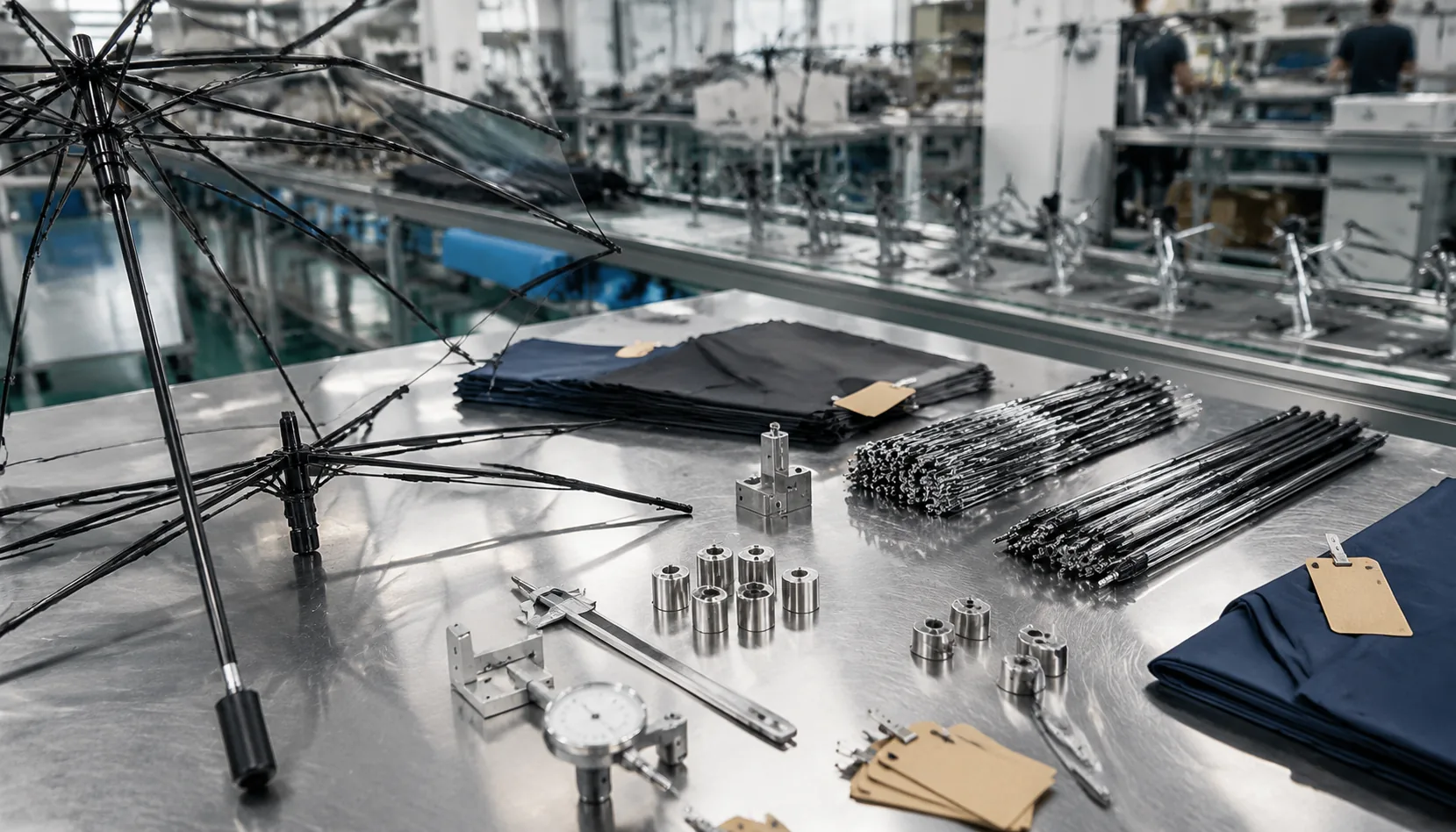
Bulk umbrella orders fail quietly when frame problems are allowed to travel downstream: a loose rivet, a rib set a few millimeters off, or a weak runner spring can pass sewing and only show up during opening tests. On our Songxia production floor, umbrella frame assembly controls are built into each line station so operators catch tension, alignment, and pivot issues before finished goods inspection becomes a sorting operation.
Incoming Frame Material Verification
Incoming verification is where umbrella frame assembly controls either save the order or let small mismatches multiply into thousands of bad units. For fiberglass umbrella ribs, the first check is flex recovery: bend samples from each lot through the specified arc and confirm they return without whitening, splintering, or permanent set. Steel ribs need a different eye: look for burrs at punched holes, inconsistent U-channel rolling, weak rivet flares, and rust risk at cut ends. On 8K and 10K rain umbrellas, a 0.2–0.3 mm rib width difference can already change canopy tension; on 16K golf frames, uneven rib stiffness makes the umbrella twist under wind load even if it passes a simple open-close test. Do not accept cartons labeled only by size. Each bundle should be tied to model code, rib count, runner type, shaft diameter, and finish spec before it reaches the line.
Shaft straightness is not cosmetic; it controls runner travel, auto-open force, and final umbrella alignment. For steel shafts, roll samples on a flat inspection table and reject obvious wobble, dented sections, ovalized tube ends, or plating buildup around the notch. For aluminum or fiberglass shafts, check straightness plus wall consistency, because thin-wall sections can crack at the spring button or handle joint after cycle testing. Plating and coating deserve close inspection under good light: nickel, black electroplate, powder coating, or painted finishes should be even, without exposed base metal, blistering, white oxidation, or oil contamination. In umbrella frame manufacturing, we normally test coating adhesion with tape pull and light scratch checks before mass assembly. A frame that looks acceptable in the carton can still fail AQL 2.5 later if plating flakes during riveting or if the runner scratches through a rough shaft coating.
Component matching by model is the most common incoming-control failure I see in bulk OEM orders, especially when factories try to consume leftover stock. A 23-inch 8K manual frame, a 23-inch 8K auto-open frame, and a 23-inch 8K frame for a deeper canopy may share the same marketing size but use different rib lengths, stretchers, runners, springs, tips, and shaft notches. Mixed lots create fit problems first: tight runners, uneven opening, loose tips, canopy wrinkles, or a crooked top notch. Durability problems show later, after 300–500 open-close cycles or wind testing above 50 mph, because one stiff rib transfers stress into weaker stretchers or rivets. Our standard practice at ZheBrella is to quarantine incoming frame parts by purchase lot and model BOM before release, then pull samples for dry assembly against the approved canopy pattern and auto-open umbrella mechanism where applicable. That is practical OEM umbrella quality control, not paperwork.
Rivet, Runner, and Notch Assembly Checks
Rivet tightness is the first hard stop in umbrella frame assembly controls because a loose rivet becomes a wobbling rib joint after only a few open-close cycles, while an over-pressed rivet freezes the stretcher and makes the canopy pull unevenly. On 8K and 10K promotional frames, our operators check every rib-to-stretcher and stretcher-to-runner rivet with a simple thumb-rock test: the joint must pivot freely, but side play should stay under about 0.5 mm. For fiberglass umbrella ribs, the hole edge is more sensitive than steel, so the punch die must stay sharp and the rivet head cannot bite into the rib wall. A good station check is fast: open the frame halfway, shake it lightly, and reject any clicking joint, cracked rib hole, mushroomed rivet, or stretcher that does not fall back under its own weight.
Runner travel and notch seating tell you whether the frame will feel clean in the buyer’s hand. The runner should slide from handle to notch without scraping, jumping, or needing a second push; on an auto-open umbrella mechanism, the spring must drive the runner fully into lock with one button press. At ZheBrella, our go/no-go check is to cycle each sampled frame 5 times before canopy sewing, then again after canopy attachment because fabric tension can expose a marginal lock. The notch must sit square on the shaft, with no burrs around the slot and no tilt that forces one stretcher higher than the others. For manual 23 inch and 27 inch straight umbrellas, a runner that stops 3-5 mm below the notch is usually a shaft burr, wrong runner ID, or stretcher length mix-up, not an operator “feel” issue.
Stretcher alignment and rib symmetry are where small umbrella frame manufacturing errors become visible to retail customers. Lay the opened frame on a flat checking table: all rib tips should touch the reference circle, opposite ribs should match height, and the crown should not lean. For 16K frames, tolerance stacking is worse because twice as many joints compete for the same canopy tension, so operators should compare rib arc before sewing 190T or 210T pongee panels. A practical OEM umbrella quality control routine is to mark one master frame per order, then use it for station comparison on rib length, stretcher angle, runner height, and notch lock depth. If one rib sits high, do not bend it by hand; trace the cause to mixed rib gauge, wrong stretcher hole position, uneven rivet pressure, or a runner channel that is off-center. These checks keep umbrella frame assembly controls measurable instead of relying on final AQL 2.5 inspection to catch avoidable structure defects.
Auto-Open Mechanism Setup
Auto-open failures usually start before canopy sewing, so the mechanism must be set up as a controlled subassembly, not adjusted later on the finished umbrella. For a 23" stick umbrella, we normally check the spring wire diameter, free length, compressed length, and opening force against the approved golden sample; a small change from 1.2 mm to 1.3 mm spring wire can make the button feel aggressive and damage the runner latch after cycling. On compact 21" auto-open umbrellas, the margin is tighter because the shaft stroke is shorter and the spring is under higher compression. As part of umbrella frame assembly controls, each batch should verify that the runner reaches full lock without bouncing back, the top notch seats cleanly, and the ribs open evenly without one panel lagging behind. Fiberglass umbrella ribs reduce breakage during snap opening, but they do not fix a bad spring or misaligned notch.
Button fit is where many cheap auto-open umbrella mechanism problems hide. The plastic button must sit flush in the handle window, move without side rubbing, and return fully after release; if the button cap is too tall by even 0.3 mm, cartons will show random accidental openings after vibration in transport. We use go/no-go feel checks plus functional opening tests on assembled shafts before the frame enters canopy mounting. Locking performance is checked in three positions: closed lock, pre-load stage, and fully open lock. A good frame opens with one press, locks with a clear click, and does not collapse when the shaft is pulled downward by hand. For OEM umbrella quality control, the buyer’s logo handle can create new risk because tooling shrinkage, paint thickness, or rubber coating changes the button clearance.
Cycle-test sampling should happen before bulk assembly, not after 20,000 pieces are already sewn and packed. For bulk orders, our standard practice at ZheBrella is to pull pre-production samples from actual mass-production parts and run 300 to 500 open-close cycles on auto-open frames, then inspect spring fatigue, runner wear, button return, notch deformation, and rib-end looseness. For retail programs or promotional orders with high return sensitivity, I prefer a smaller daily cycle sample from each assembly line plus AQL 2.5 final inspection on opening, locking, and safe release. Safe release testing means the umbrella should not fire open inside the carton, the button should not pinch the user’s thumb, and the shaft should not slam back when manually closing. These umbrella frame assembly controls add a little time at the start, but they prevent the expensive failure pattern: beautiful printed canopies attached to mechanisms that customers return after one week.
Windproof Frame Subassembly Control
Windproof performance is won or lost before the canopy is sewn, because a double-canopy frame only vents correctly when rib angle, stretcher length, and top-cover clearance stay consistent around the full circle. In umbrella frame manufacturing, we check the open angle of each rib position against a master gauge, typically holding variation within ±2 degrees on 23" and 27" golf frames. If one fiberglass stretcher sits high or twists at the runner joint, the vent gap can choke on one panel and over-open on the opposite panel, which causes flutter, noise, and early seam fatigue in 40–50 mph gust testing. Good umbrella frame assembly controls also include checking rivet tightness after cycling, because a loose stretcher rivet changes the whole geometry once the canopy is under wind load.
The biggest difference between 8K and 16K windproof frames is not just rib count; it is load distribution and assembly tolerance. An 8K standard frame with fiberglass umbrella ribs is lighter, cheaper, and acceptable for promotional 190T pongee umbrellas, but each rib carries a larger share of wind pressure. A 16K reinforced frame spreads the load across more ribs, so the canopy looks rounder and resists inversion better, but it also doubles the number of rib tips, stretchers, rivets, and alignment points that can go wrong. On 16K builds, we pay closer attention to equal rib spacing at the notch and runner, because even a 3–4 mm mismatch at the tip can make the double canopy vent uneven and pull the upper canopy off-center.
For bulk OEM orders, I prefer to lock the frame subassembly standard before printing fabric or cutting POE/PVC panels, because a late frame change can shift the vent overlap and make thousands of canopies unusable. Our standard practice at ZheBrella is to cycle sample frames 300–500 times, then test the auto-open umbrella mechanism for runner travel, spring force, and lock engagement before approving mass assembly. During OEM umbrella quality control, inspectors pull frames from the line under AQL 2.5 and check rib symmetry, stretcher alignment, hub cracks, rivet burrs, and tip position against the approved pre-production sample. These umbrella frame assembly controls matter most on windproof umbrellas because the vented canopy hides defects until wind hits it; by then the problem is already in the frame, not the fabric.
Recording Defects Before Final QC
The most useful defect record is made while the frame is still moving through assembly, not after the canopy is sewn on. For bulk orders, we separate frame defects into five practical categories: loose rivets at runner or stretcher joints, slow opening on manual or auto-open umbrella mechanism units, frame wobble after full extension, bent ribs or stretchers, and noisy mechanisms from dry springs, misaligned notches, or rough runner travel. On 8K and 10K steel frames, loose rivets usually come from worn riveting dies or uneven pressure; on fiberglass umbrella ribs, the more common issue is cracked tips, poor rib-to-stretcher alignment, or over-tight binding wire. These are not cosmetic notes. They decide whether the umbrella will survive repeated opening cycles and whether a 23 inch or 27 inch canopy will sit evenly after sewing. Our standard practice at ZheBrella is to log defects by workstation, frame size, rib count, material, and operator shift before any finished-goods QC starts.
Good umbrella frame assembly controls turn random complaints into traceable production data. If 3% of a 5,000-piece OEM order shows slow opening before canopy loading, we do not wait for final inspection; we check spring force, runner burrs, shaft straightness, and hook engagement immediately. If frame wobble appears mostly on 30 inch golf umbrellas with 16K fiberglass ribs, the corrective action may be rib length sorting or hub hole tolerance adjustment, not extra inspection at packing. For noisy mechanisms, we record whether the sound comes from the spring, button, runner, or top notch, because each points to a different process owner in umbrella frame manufacturing. A vague QC note like “bad frame” is almost useless. A good in-line record says “auto-open delay over 1.5 seconds, 18 pieces, line B, lot 2406-FR, runner friction visible,” which gives production a clear fix before the defect spreads across cartons.
These records also protect the final AQL 2.5 inspection from becoming a guessing game. Under AQL 2.5, the inspector samples finished umbrellas from packed goods and classifies defects as critical, major, or minor, but the final result is stronger when it is backed by in-line trend data. Loose rivets, bent ribs, non-opening frames, or severe wobble are normally major defects because they affect function and service life; slight operating noise may be minor unless it signals spring failure or poor locking. When the final QC team finds a repeated issue, the earlier in-line sheet shows whether it is isolated to one assembly batch, one rivet press, or one material lot. That is the difference between reworking 300 umbrellas and holding an entire 10,000-piece shipment. For OEM umbrella quality control, this traceability supports corrective action reports, supplier claims on frame parts, and buyer confidence when shipping FOB Ningbo or DDP to a retail warehouse.
Frequently Asked Questions
Which frame defects should be stopped before canopy mounting?
Loose rivets, uneven rib spread, rough runner movement, weak auto-open action, and bent shafts should be corrected before canopy assembly. Once the canopy is mounted, rework is slower and can damage fabric.
Are fiberglass ribs always better for bulk OEM orders?
Fiberglass ribs improve flexibility and wind recovery, especially in windproof models. Steel ribs can still be suitable for cost-sensitive umbrellas when rust protection, rib thickness, and QC controls are properly specified.
What frame defects are most common in bulk umbrella production?
The most common issues are loose rivets, misaligned ribs, weak or inconsistent spring tension, and opening failures. In a bulk OEM run, these usually show up when rivet staking, rib positioning, or spring compression is not checked at each assembly stage.
How many in-line control points are typically used before final inspection?
Most factories use 3 to 5 control points: rib fit check, rivet tightness check, spring force test, open-close cycle test, and visual alignment inspection. For large orders, adding a mid-line rejection check helps catch repeat defects before they move downstream.
Can fiberglass ribs be tested during assembly?
Yes. Fiberglass ribs are usually checked for straightness, flex consistency, and end-fit accuracy during assembly, then sampled for bending and open-close cycling. For OEM orders, buyers often request a minimum cycle test spec, such as 50 to 100 open-close cycles, before packing.
Looking to Launch Your Custom Umbrella Line?
ZheBrella is a Zhejiang-based OEM/ODM umbrella manufacturer with 17 years of export experience. Free design, low MOQ from 100 pieces, windproof construction, full-color print.
Get Free Quote Now »People Also Search For
Related Articles
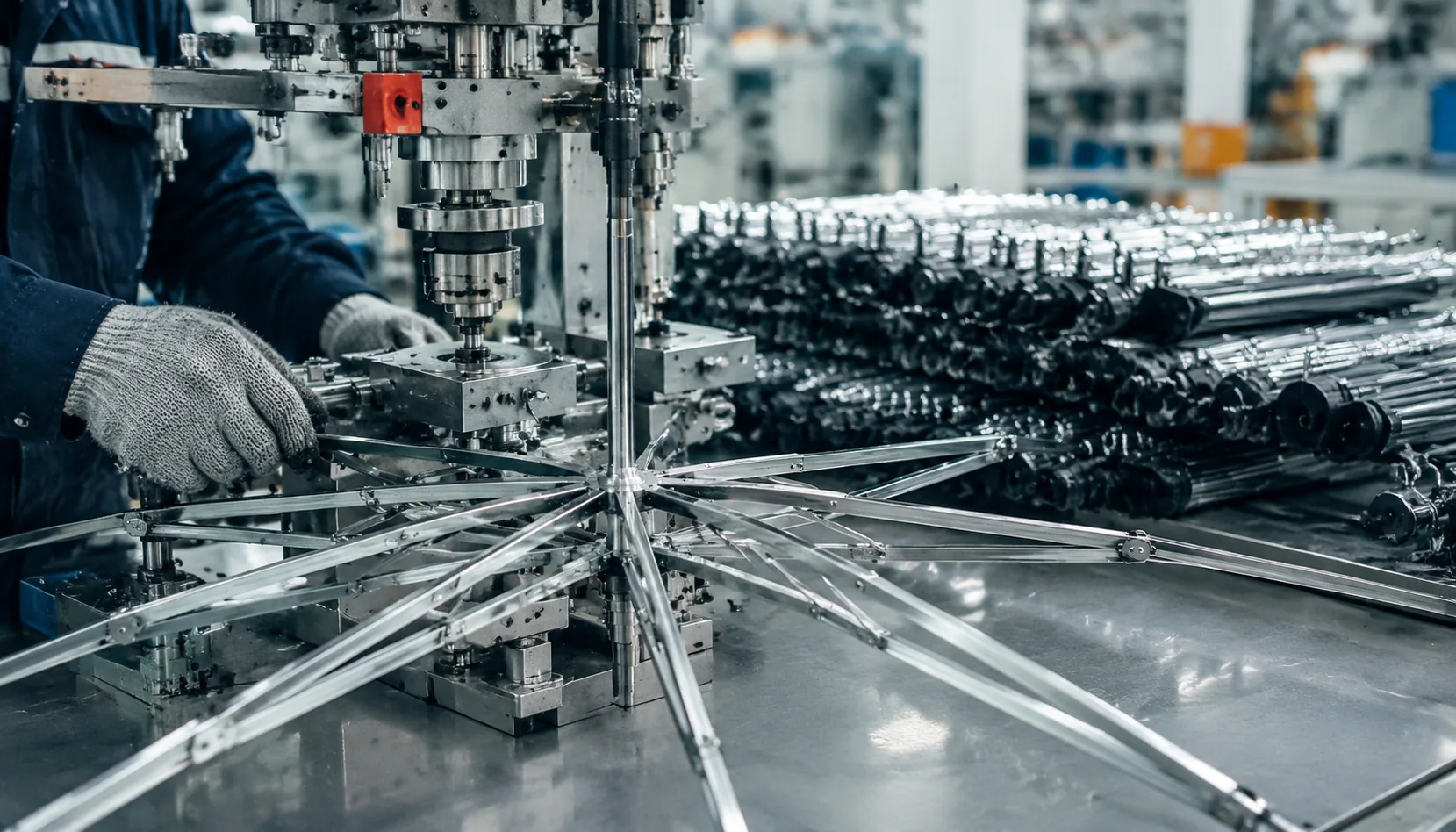
Umbrella Frame Riveting Process for Stronger Bulk Orders
Specify rivet diameter, washer stack, joint play, and pull tests so 8K and 16K umbrella frames open smoothly and pass AQ...
Read More »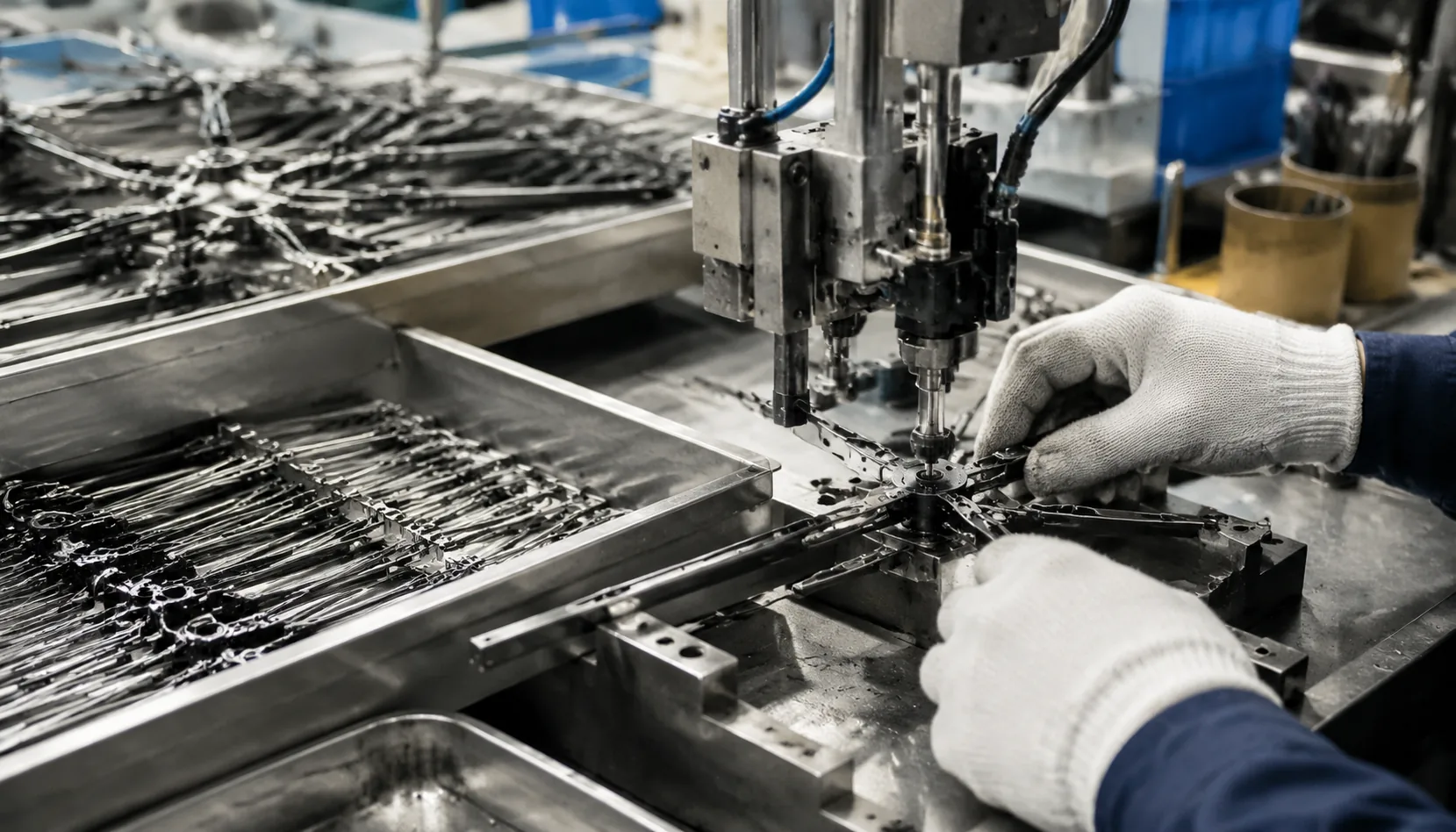
Umbrella Frame Riveting Process Control for Bulk Orders
See how rivet size, hole alignment, and pull-force checks improve umbrella frame durability across fiberglass, steel, 8K...
Read More »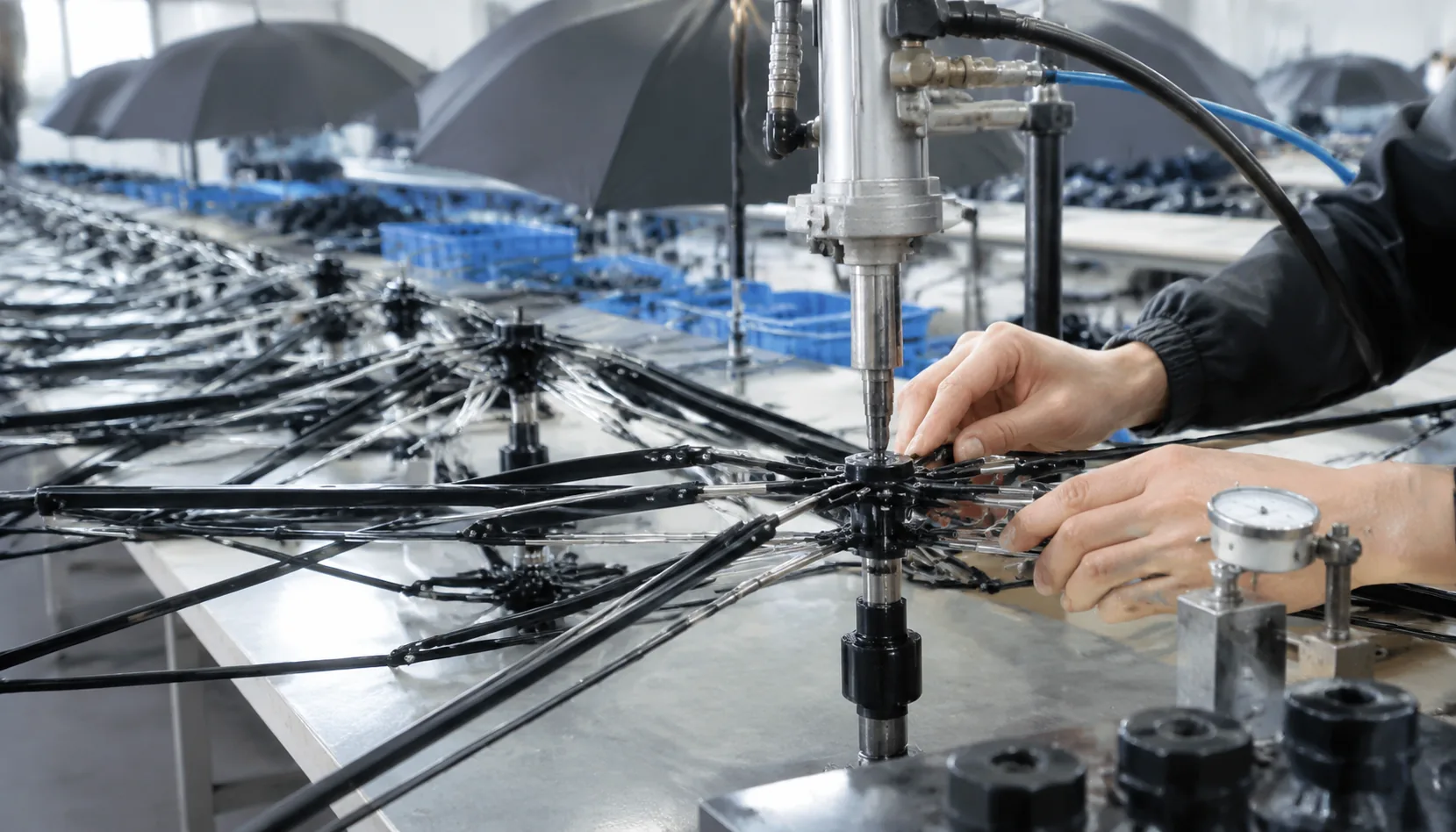
Umbrella Frame Riveting Process Controls for Bulk Orders
Set rivet, washer, and joint specs that reduce loose ribs, warped frames, and opening failures across steel and fibergla...
Read More »