Umbrella Welding and Rivet Specs for Durable OEM Frames
Buyers often focus on canopy fabric and handle finishes, but the real durability of an OEM umbrella starts in the frame shop. If welds are inconsistent, rivet holes drift, or joint tolerances are too loose, you get wobble, corrosion, and reject rates that show up long before the first complaint. At ZheBrella, we set umbrella frame welding specs around how the parts actually behave on the line, not just on paper.
Why joint design fails first in umbrella frames
The first thing that fails in an umbrella is almost never the canopy; it is the joint geometry. Rib tips, stretcher pivots, and the shaft-to-hub connection see the highest bending and torsion loads every time the frame snaps open, catches wind, or closes off-center. If the umbrella frame welding specs are sloppy, the stress concentrates at the heat-affected zone and at any punched hole near the weld, which is where cracked welds start. In production, the expensive mistake is to assume thicker metal automatically means better durability; in reality, poor alignment and inconsistent weld penetration kill OEM umbrella frame durability faster than a slightly lighter tube ever will.
Rivet fastening umbrella failures usually show up after repeated cycles, not in the first inspection. A loose rivet lets the stretcher rock side to side, which widens the hole, creates oval wear, and eventually causes the arm to walk out of position or bind during closure. That is why corrosion-resistant frame joints matter: once rust gets into the pivot stack, friction rises, coating flakes, and the metal begins to fret under load. On the factory floor, the strongest frames are built with controlled hole size, proper rivet upset, and clean contact between steel, aluminum, or fiberglass parts so the joint stays tight through thousands of openings.
Metal fatigue is the silent failure mode in export umbrella quality because buyers usually notice it only after returns start. A frame can pass a quick open-close check and still fail after a few hundred cycles if the stretcher knuckle is over-stamped, the weld bead is brittle, or the shaft connection has sharp corners that act like crack starters. The practical test is whether the joint keeps its shape after repeated shock loading, not whether it merely survives one pull. Good umbrella frame welding specs, paired with correct rivet sizing and controlled tolerances, are what separate a frame that lasts one season from one that holds up in real retail use.
Welded vs riveted connections in mass production
On the factory floor, spot welding is usually the fastest way to lock a steel or plated frame member when you are chasing volume. A decent weld cycle is measured in seconds, and once the electrodes are set up correctly, the repeatability is good enough for high-run programs. Ultrasonic joining only shows up on limited non-metal assemblies or hybrid parts, so it is not a real substitute for metal frame joints in most umbrella frame welding specs. The tradeoff is simple: welding gives you a compact joint and lower part count, but it needs stable current, clean metal surfaces, and electrode maintenance or you start seeing weak nuggets, burn-through, and ugly cosmetic marks that hurt export umbrella quality.
Mechanical riveting is slower per joint, but it is more forgiving when the line is dealing with mixed material stacks, plating variation, or a supplier that cannot hold tight weld consistency. For rivet fastening umbrella production, the press setup is straightforward, the cycle time is still acceptable, and the joint does not depend on heat input, so there is less risk of coating damage around the connection. Rivets also win on repairability: a damaged rib or stretcher can sometimes be replaced without scrapping the entire frame, which matters when OEM umbrella frame durability is being evaluated on warranty cost rather than just piece price.
Where weld quality really matters, process control has to be tighter than many buyers expect. You need fixture accuracy, repeatable electrode force, controlled weld energy, and routine pull tests if you want corrosion-resistant frame joints that survive salt spray and humidity without cracking at the HAZ. In practice, welded joints are better for clean, high-speed production when the tooling and inspection discipline are already mature; rivets are better when the program values tolerance for variation, easy service work, and fewer special controls. If the customer is asking for both low claim rates and aggressive pricing, the right answer is usually not one process only, but matching the joint type to the specific frame location and load path.
Tolerances that control frame alignment and swing
For umbrella frame welding specs, the numbers that actually matter on the shop floor are hole position, rivet head diameter, joint play, and rib symmetry. If the center-to-center hole offset drifts beyond about 0.3 mm on a 23-inch or 27-inch frame, the slider does not travel cleanly, and the user feels it as stickiness or a sudden jump when opening. Rivet heads need enough diameter to clamp the ferrule and rib plate without crushing the plated steel; if the head is too small, the joint loosens in transit, and if it is too large, it interferes with swing clearance. On OEM umbrella frame durability, I care more about repeatable fit than heroic material claims, because a frame with sloppy hole placement will fail visually even if the steel itself is strong.
Joint play is the other hidden problem. We normally watch for axial and lateral movement at the ferrule and hinge points, because even 0.5 mm of looseness shows up as crooked rib tracking and uneven canopy tension after a few open-close cycles. That is where rivet fastening umbrella construction either holds alignment or slowly eats itself; the rivet has to lock the joint without creating a hard spot that cracks coating or chews through the hole edge. Corrosion-resistant frame joints matter too, especially on export umbrella quality work headed to humid markets, so zinc-plated or nickel-plated rivets should be paired with clean deburring and controlled weld spatter, or the joint will rust before the canopy fabric wears out.
Tolerance stack-up is what changes the opening feel from smooth to rough. A frame can pass individual part checks and still finish crooked if the rib length, center runner slot, spoke angle, and weld location all drift in the same direction, which is why we check rib symmetry in pairs and compare opposite quadrants before packing. If one side is 1 mm longer, the canopy crowns unevenly, the edge tension shifts, and the finished umbrella no longer sits straight when closed. The practical rule is simple: tight frame welding specs only help when every welded node, rivet hole, and rib stop is measured as a system, not as isolated parts, because that is what keeps the opening arc consistent and the final profile straight.
Material pairings and anti-corrosion choices
Steel-to-steel umbrella frame welding specs are the easy part; the trouble starts at mixed-material interface points. If you weld a steel center pole, then fasten aluminum runners or fiberglass ribs with a plain carbon-steel rivet, the joint becomes a corrosion cell as soon as moisture gets in. For export umbrella quality, I spec the joint by load path, not by habit: welded steel nodes where the stress is highest, mechanical fastening where parts need serviceability, and insulating washers or sleeves anywhere dissimilar metals touch. That is how you protect OEM umbrella frame durability without overbuilding the whole frame.
Rivet fastening umbrella assemblies need the same discipline. In humid or coastal markets, bare rivets, unsealed holes, and thin nickel plating usually fail first at the head and shank interface, because salt spray creeps under the finish and starts white rust or red rust within weeks. Better choices are zinc-nickel or heavy electro-galvanized rivets, stainless hardware where cost allows, and e-coat, powder coat, or phosphate pretreatment on nearby steel parts so the corrosion-resistant frame joints stay intact after repeated wet-dry cycling. On fiberglass interfaces, avoid crushing the laminate: use larger bearing surfaces and controlled rivet set force so the hole does not ovalize under wind loading.
For humid, coastal, or salted-spray conditions, I write the spec around the whole fastener stack, not just the visible coating. That means sealed welds with no pinholes, deburred holes, painted or plated cut edges, and a corrosion test target that matches the destination market rather than a generic indoor standard. If the shipment is headed to Southeast Asia, the Middle East coast, or marine-adjacent retail, I would ask for salt-spray performance data, coating thickness checks, and AQL inspection at the joint level, because umbrella frame welding specs only matter if the rivet line survives actual weather. That is the difference between a frame that looks fine at packing and one that still opens cleanly after a season of storage in damp warehouses.
Inspection methods and buyer acceptance criteria
For umbrella frame welding specs, the only acceptance criteria worth writing into a PO are the ones you can measure on the floor: weld pull force, opening-and-closing cycle count, and a visual standard for bead shape, heat discoloration, and alignment. On OEM umbrella frame durability programs, I usually set a minimum pull test target for welded joints based on the material stack-up, then confirm the joint does not crack, loosen, or show sharp burrs after repeated loading. For rivet fastening umbrella constructions, the rivet head must sit flat, the shank must not spin, and the hinge should move without ovalizing the hole. If the buyer wants corrosion-resistant frame joints, specify the finish before production; plating failure after welding is a common reason export umbrella quality drops in salt-air shipments.
Cycle testing is where weak joints show up fast. A practical buyer target for manual and auto-open frames is several hundred full open-close cycles without rivet walkout, weld fracture, or excessive play at the runner, stretcher, and shaft interface; premium programs often ask for 1,000 cycles or more on 21-inch to 30-inch frames, especially when fiberglass and steel components are mixed. Visual checks should cover weld burn-through, cold welds, mislocated rivets, cracked powder coat near the joint, and asymmetric arm movement. In the PP approval stage, the buyer should document each defect category separately—weld failure, rivet deformation, corrosion spots, binding, cosmetic marks, and dimensional mismatch—so the factory knows which defects are rejectable versus reworkable.
For incoming inspection and final QA, AQL 2.5 is the normal sampling basis for joints on export orders, but the PO should state whether critical defects are zero-tolerance and whether major and minor defects follow the same table as canopy issues. I recommend buyers define the acceptance limit in plain language: no joint fracture, no loose rivet that affects function, no rust bleed after humidity exposure, and no more than the agreed cosmetic threshold on non-visible parts. ZheBrella’s standard practice is to lock those details into the sample sign-off sheet and PP checklist so the factory, inspector, and buyer are judging the same thing. If the order includes mixed sizes or mixed mechanisms, separate the acceptance criteria by model number; otherwise the inspection lot becomes impossible to defend when a single bad size skews the whole shipment.
Frequently Asked Questions
Should umbrella frames use welded or riveted joints for bulk OEM orders?
It depends on the frame architecture and target cost. Rivets usually offer better assembly speed and serviceability, while welds can be stronger if process control is stable and corrosion protection is managed well.
What joint defects should buyers ask factories to measure?
Ask for rivet looseness, weld penetration consistency, joint misalignment, and opening-cycle wear. Those four checks catch most early failures before shipment.
What weld points on an umbrella frame usually fail first in factory inspections?
The highest-risk points are runner-to-shaft welds, stretcher connection tabs, and top notch attachments because they take repeated open-close stress. Many buyers set a tighter visual standard there and require sample cycle testing before mass production.
What rivet tolerance is typically acceptable for OEM umbrella frame assembly?
For most mass-production frames, buyers look for rivets set tight enough to avoid wobble but loose enough to preserve smooth articulation, with no cracking, burrs, or deformation around the hole. In practice, factories often control this through approved golden samples and in-line functional checks rather than a single universal number.
How do corrosion-resistance requirements affect frame hardware selection for export orders?
If the order is for coastal, rainy, or promotional outdoor use, buyers commonly request plated steel, stainless rivets, or aluminum components plus salt spray testing. A typical export requirement may be 24 to 48 hours of salt spray performance depending on price tier, market, and retailer specification.
Looking to Launch Your Custom Umbrella Line?
ZheBrella is a Zhejiang-based OEM/ODM umbrella manufacturer with 17 years of export experience. Free design, low MOQ from 100 pieces, windproof construction, full-color print.
Get Free Quote Now »People Also Search For
Related Articles
Umbrella Hinge and Joint Engineering for OEM Durability
See how hinge geometry, rivet quality, and joint fatigue testing affect umbrella life, repair rates, and factory accepta...
Read More »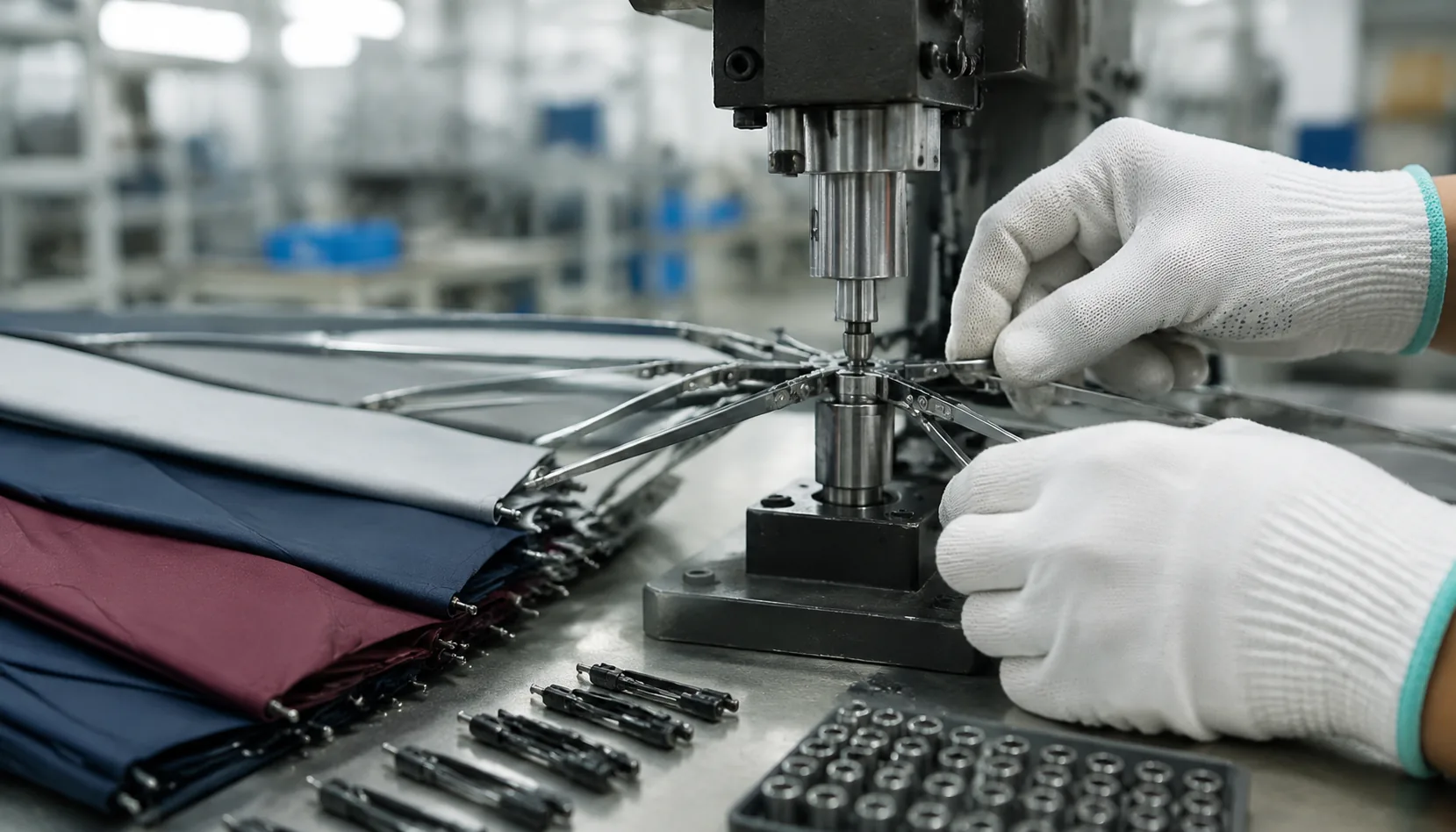
Umbrella Frame Riveting Quality: Preventing Loose Joints
Specify rivet materials, joint tolerances, pull checks, and in-line inspections to reduce loose ribs and frame failures ...
Read More »Umbrella Frame Riveting Process for Durable OEM Orders
See how rivet specs, hole tolerance, and pull-force checks keep 8K and 16K umbrella frames consistent before AQL inspect...
Read More »