Umbrellas for Cruise Lines and Shore Excursion Programs
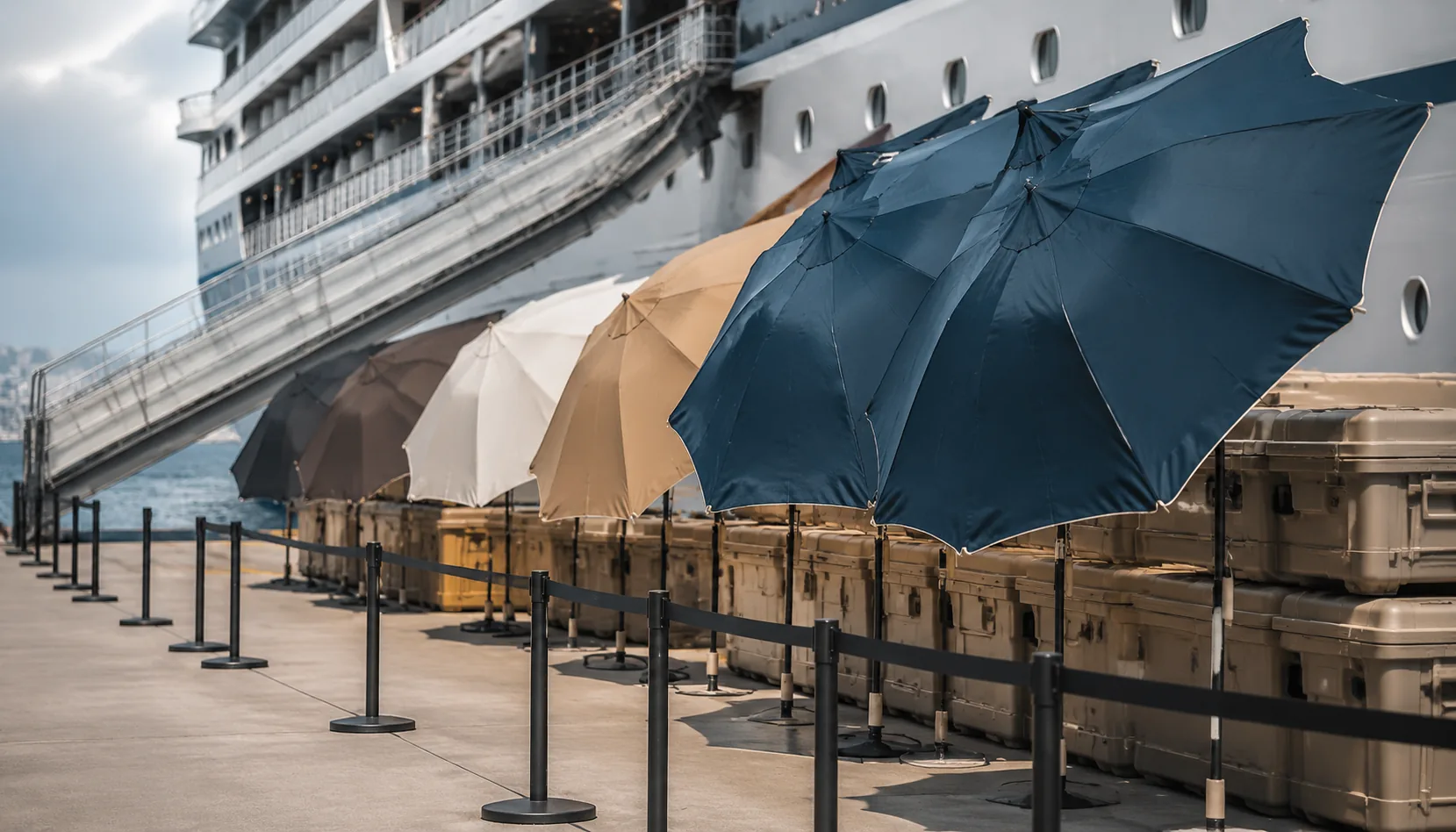
Cruise buyers need umbrellas that survive salt air, tight storage, mixed retail displays, and sudden shore-excursion downpours without creating complaints at the gangway. On our Songxia factory floor, we specify cruise line umbrellas around UPF 50+ coated canopies, corrosion-aware ribs and shafts, practical MOQs, realistic lead times, and carton packing that fits vessel replenishment schedules. The right build sheet keeps crew issue, onboard retail, and excursion programs consistent from sample approval to final inspection.
Where Umbrellas Fit in Cruise Operations
Cruise line umbrellas do not belong to one buying bucket; the spec changes by operating use. Onboard retail shops need resale-ready product: clean branding, hang tags with barcode, retail sleeve, and a perceived-value build such as a 23" auto-open stick umbrella with 190T or 210T pongee, fiberglass ribs, and a rubberized handle. Shore excursion umbrellas are different. They are handled hard, packed in buses, opened in wind at piers, and returned wet, so I would rather use a 21" or 23" compact with fiberglass ribs, reinforced tips, and a simple manual or auto-open mechanism that survives repeated use. VIP guest amenities can justify a better hand feel, such as Teflon-coated pongee, matte shaft, color-matched sleeve, and subtle logo printing instead of loud promotional panels.
Loaner programs should be engineered for loss control and fast cleaning, not just nice photos. A cruise operator may issue 200 to 2,000 shore excursion umbrellas per vessel depending on itinerary, with higher counts for Alaska, Northern Europe, Japan, and South China Sea routes during wet months. For loaners, we normally recommend high-visibility canopy colors, large one-color screen print, serialized inner labels, and storage cartons marked by excursion desk or bus group. POE or EVA clear umbrellas work well for port guides because passengers can see the flag, signs, and traffic while walking. For sun-heavy destinations, UPF 50+ umbrellas with black UV coating under 190T pongee reduce heat and make sense for tender queues, beach transfers, and open-air ruin tours.
Staff-issued and crew rain gear need the most conservative construction because a failed umbrella becomes a safety problem on gangways and wet piers. Crew models should use fiberglass ribs over thin steel where possible, especially in 8K or 10K frames, with windproof vented canopies for exposed terminals. A 27" or 30" golf umbrella is suitable for port-transfer coordinators, luggage handlers, and security teams, while cabin stewards or hospitality staff usually prefer compact marine travel umbrellas that fit service carts or lockers. Branded cruise merchandise can accept decorative details, but staff gear should prioritize dark soil-hiding colors, reflective trim if used at night, and AQL 2.5 inspection on opening force, rib alignment, print adhesion, and water repellency before FOB or DDP shipment. ZheBrella typically separates resale, loaner, and staff-issued specifications at quotation stage because combining them into one cheap model creates avoidable complaints later.
Materials for Sun, Rain, and Salt-Air Exposure
For cruise line umbrellas, I usually push buyers toward fiberglass ribs and stretchers, not painted steel, because salt-air exposure finds every weak point in a frame. Steel ribs are cheaper and can pass a normal indoor open-close test, but after repeated shore excursion use—wet folding, storage in a deck locker, and drying slowly in humid air—the rivets and rib tips are where orange rust starts. Fiberglass costs more, but it flexes better in gusts, has no red-rust issue, and is easier to justify for marine travel umbrellas expected to survive a full sailing season. If a buyer insists on steel for budget reasons, use electrophoretic-coated or zinc-plated steel, specify stainless hardware where possible, and accept that cosmetic corrosion risk remains higher. For windy ports, an 8K fiberglass frame is the baseline; 10K gives a cleaner round canopy, while 16K looks premium but adds weight and more sewing points to inspect.
Canopy fabric matters just as much as the frame. For most shore excursion umbrellas, 190T pongee is the sensible minimum because it packs well, prints cleanly, and dries faster than heavy polyester. I prefer 210T pongee when the umbrella is sold as branded cruise merchandise or issued to VIP guests, because the hand feel is smoother and the canopy holds tension better after repeated wet-dry cycles. A water-repellent finish should bead rain immediately in a spray test, but buyers should understand that DWR performance drops if umbrellas are packed wet and stored warm for days. Our standard practice at ZheBrella is to test fabric before cutting, because a poor coating lot will look fine on the roll but fail after sewing needle holes and canopy tension expose weak areas.
For tropical itineraries, UV protection is not decoration; it is a product requirement. Silver-coated pongee gives strong sun reflection and is cost-effective for UPF 50+ umbrellas, but the metallic underside has a more utilitarian look. Black UV coating feels more retail-grade, reduces glare under the canopy, and photographs better with dark logos, though it can make the umbrella feel warmer if ventilation is poor. On cruise line umbrellas, I like black-coated 210T pongee for premium retail and silver-coated 190T for high-volume shore programs where price and sun protection both matter. Screen printing works well on coated pongee if ink adhesion is tested, while heat transfer needs careful temperature control so the UV layer does not distort. Always confirm UPF 50+ with lab reporting, not just a supplier claim on a spec sheet.
Choosing Formats for Guests, Crew, and Retail
For cabin placement, compact auto-open is usually the right format because it fits drawers, welcome kits, and housekeeping carts without turning into clutter. I would specify a 21" or 23" 3-fold frame with 8 ribs, a steel shaft for cost control, fiberglass end ribs if the itinerary includes windy ports, and 190T or 210T pongee with a Teflon-type water-repellent finish. Auto-open is safer than full auto-open-close for mixed guest demographics because the spring load is lower and fewer guests pinch fingers when closing. For cruise line umbrellas placed in cabins, the sleeve matters more than buyers think: a tight sleeve slows housekeeping, while a slightly tapered sleeve with a pull tab lets staff re-pack wet umbrellas faster. A rubberized straight handle or matte ABS crook handle gives better grip with sunscreen or wet hands than glossy plastic, and a woven label on the sleeve often survives laundering and salt air better than a cheap transfer print.
For guided port tours, shore excursion umbrellas should be simple, visible, and hard to lose. An 8K straight umbrella in 23" or 27" size gives the tour leader enough canopy area for rain and sun identification without the bulk of a golf model. I prefer fiberglass ribs over painted steel for island routes, tender docks, and bus loading zones, because one gust can bend steel ribs permanently even if the canopy is still intact. Manual open is acceptable for tour operators, but auto-open is faster when a group of 40 guests steps off a coach into sudden rain. UPF 50+ umbrellas make sense for Caribbean, Mediterranean, and Southeast Asia programs, especially with silver or black UV coating under 190T pongee. For branding, use one large screen-printed panel for the ship or excursion logo and one smaller panel for color-coded group identification; too many panels turn the umbrella into visual noise in crowded ports.
Pier coordinators, luggage transfer teams, and meet-and-greet staff need 16K golf umbrellas, usually 30" or 32", because their job is coverage and visibility rather than packability. A double-canopy vented windproof construction with fiberglass ribs and shaft can survive 50+ mph gust testing when the runner, tips, and rib joints are properly specified; a cheap steel 16K frame only looks strong on a quotation sheet. For marine travel umbrellas sold as branded cruise merchandise, retail packaging must be decided before production: hang tag size, UPC/EAN barcode placement, country-of-origin text, polybag warning, and any onboard POS sticker area should be locked in with the artwork file. Our standard practice at ZheBrella is to barcode-scan retail samples during pre-shipment inspection, not just visually check tags, because cruise retail replenishment failures are often packaging-data problems rather than umbrella defects. For mixed programs, keep cabin compacts, tour 8K straights, and staff 16K golf umbrellas in separate SKUs with different sleeve colors so stores, housekeeping, and excursion desks do not cross-issue inventory.
Branding and Packaging for Multi-Port Programs
For cruise line umbrellas, branding has to survive more than a clean product photo; it has to look consistent when split across ships, ports, excursion desks, and onboard retail. I prefer assigning one or two fixed logo panels on an 8K or 10K canopy, then using the opposite panels for destination artwork such as Alaska glaciers, Caribbean port maps, Mediterranean skyline icons, or private-island graphics. On 190T or 210T pongee, screen printing is still the most economical for 1–3 solid colors, while heat transfer handles gradients and small text better. Full-panel sublimation works well for destination series, but only on white or very light fabric, and buyers should approve strike-offs under both indoor light and direct sun. If the same frame is used across several itineraries, keep the handle, sleeve, and carton SKU structure identical; changing only the canopy print reduces assembly mistakes and shortens repeat lead time by 3–5 days after the first production run.
Care labels are not decorative paperwork on shore excursion umbrellas; they prevent complaints when passengers use the product in salt air, rain squalls, and high-UV environments. Multilingual labels should cover English plus the main passenger languages for the route, often Spanish, French, German, Italian, Japanese, or simplified Chinese, with clear icons for drying open, rinsing after salt exposure, and keeping auto-open-close shafts away from children. For marine travel umbrellas, I recommend adding a small sewn-in composition label listing canopy fabric, rib material, country of origin, and UPF rating when applicable. UPF 50+ umbrellas should not just say “UV umbrella” on the hangtag; the buyer should request a coating specification, test report reference, and whether the protection comes from black coating, silver coating, or high-density yarn. Our standard practice at ZheBrella is to keep label artwork locked before bulk fabric cutting, because relabeling finished umbrellas is slow, messy, and usually visible at AQL 2.5 inspection.
Packaging for multi-port programs should be planned like logistics, not retail decoration. Basic polybags are fine for cabin giveaways and shore excursion kits, usually with warning text and barcode sticker, while printed sleeves or kraft gift boxes make more sense for branded cruise merchandise sold onboard. Gift boxes add carton volume, so a 23-inch auto-open umbrella that packs 36 pieces per export carton in sleeves may drop to 24 pieces when boxed. Master cartons should be labeled by ship name, sailing date, SKU, colorway, port delivery sequence, and purchase order number, with side marks large enough for warehouse teams to read without opening cartons. For split deliveries, use inner carton labels such as “Port 1: Miami,” “Port 2: Cozumel,” or “Port 3: Nassau,” and match the packing list exactly. This is where many programs fail: the umbrellas are acceptable, but the wrong artwork arrives at the wrong pier two hours before passenger boarding.
Sourcing, Inspection, and Delivery Controls
For cruise line umbrellas, MOQ planning should start from the sailing calendar, not from a catalog price sheet. If the item is for cabin retail or branded cruise merchandise, 1,000–3,000 pcs per SKU is usually workable for 23" auto-open or 21" folding models with 190T/210T pongee. Shore excursion umbrellas used by guides or sold at gangway kiosks often need mixed colors, so we normally split MOQ by canopy color, handle color, and print position before quoting. Pre-production samples should confirm rib count, fabric hand-feel, UPF 50+ coating, logo color, barcode labeling, and carton marks. I do not recommend approving mass production from a digital mockup alone; a 7–10 day physical sample catches 80% of problems before cutting fabric.
Production lead time is usually 25–35 days after sample approval for standard steel or fiberglass 8K frames, and 35–45 days for double-canopy vented windproof builds, custom molds, or heat-transfer panels with tight PMS matching. Inspection should be booked before final balance payment, using AQL 2.5 for major defects and a tighter internal screen for print alignment, seam tension, tip attachment, runner lock strength, and auto-open-close cycling. Marine travel umbrellas face harder storage conditions than airport promotional umbrellas, so packing matters: dry canopies fully before bagging, use silica gel in each inner carton, specify 5-ply export cartons, and avoid over-compressing POE/PVC/EVA models because creasing and trapped humidity can cause odor or print blocking during a 30–45 day sea leg.
FOB Ningbo or Shanghai is the right choice when the buyer already controls freight, consolidates several China vendors, or needs umbrellas loaded with other cruise supplies before sailing. It gives better visibility on factory handover, carton count, CBM, and container loading, but the buyer must manage booking, insurance, customs clearance, and delivery to the cruise line warehouse. DDP is better when the purchasing team wants landed-cost certainty to a Miami, Barcelona, Southampton, or Singapore consolidation warehouse, or when a port agent needs a smaller replenishment batch before a season starts. For shore excursion umbrellas tied to a launch date, DDP reduces coordination risk, but buyers should lock delivery terms early because customs exams, port congestion, and vessel schedule changes can erase any savings from choosing the cheapest freight option.
Frequently Asked Questions
Are UPF 50+ umbrellas necessary for cruise programs?
They are strongly recommended for shore excursions in sunny destinations. A UPF 50+ coated canopy gives the product a clear functional benefit beyond basic rain protection.
What frame material is best for cruise umbrellas?
Fiberglass ribs are generally preferred because they resist corrosion better and flex in wind. If steel is used for cost control, buyers should specify anti-rust coating and stricter inspection for plating quality.
What umbrella specifications work best for shore excursion programs?
For shore excursions, buyers typically choose 21–23 inch folding umbrellas with UPF 50+ polyester pongee, fiberglass ribs, and automatic open/close handles. A corrosion-aware shaft and rib coating is recommended for coastal routes exposed to salt air.
What MOQ should cruise lines expect for branded umbrellas?
A practical MOQ is usually 500–1,000 pieces per design for logo-printed folding umbrellas, depending on canopy fabric, frame type, and packaging. Fully custom colors, handles, or private-label retail packaging may require higher quantities.
How should umbrellas be packed for cruise retail and onboard storage?
Retail umbrellas are commonly packed 1 piece per polybag or fabric sleeve, then 24–48 pieces per export carton. For cruise inventory teams, carton labels should include SKU, design, quantity, gross weight, and destination program to simplify loading and replenishment.
Looking to Launch Your Custom Umbrella Line?
ZheBrella is a Zhejiang-based OEM/ODM umbrella manufacturer with 17 years of export experience. Free design, low MOQ from 100 pieces, windproof construction, full-color print.
Get Free Quote Now »People Also Search For
Related Articles
Custom Umbrellas for Cruise Lines and Shore Excursion Teams
Source cruise-ready umbrellas for shore teams, guest retail, and excursions with windproof frames, compact packing, and ...
Read More »
Custom Umbrellas for Cruise Lines and Ferry Operators
Source marine passenger umbrellas with windproof builds, corrosion-aware materials, and FOB/DDP planning for cruise, fer...
Read More »
Custom Umbrellas for Cruise Lines and Shore Excursions
Source cruise-ready umbrellas with compact frames, UPF 50+ canopies, corrosion-resistant ribs, and carton plans for cabi...
Read More »