Umbrellas for Sports Teams, Stadium Shops, and Fan Retail
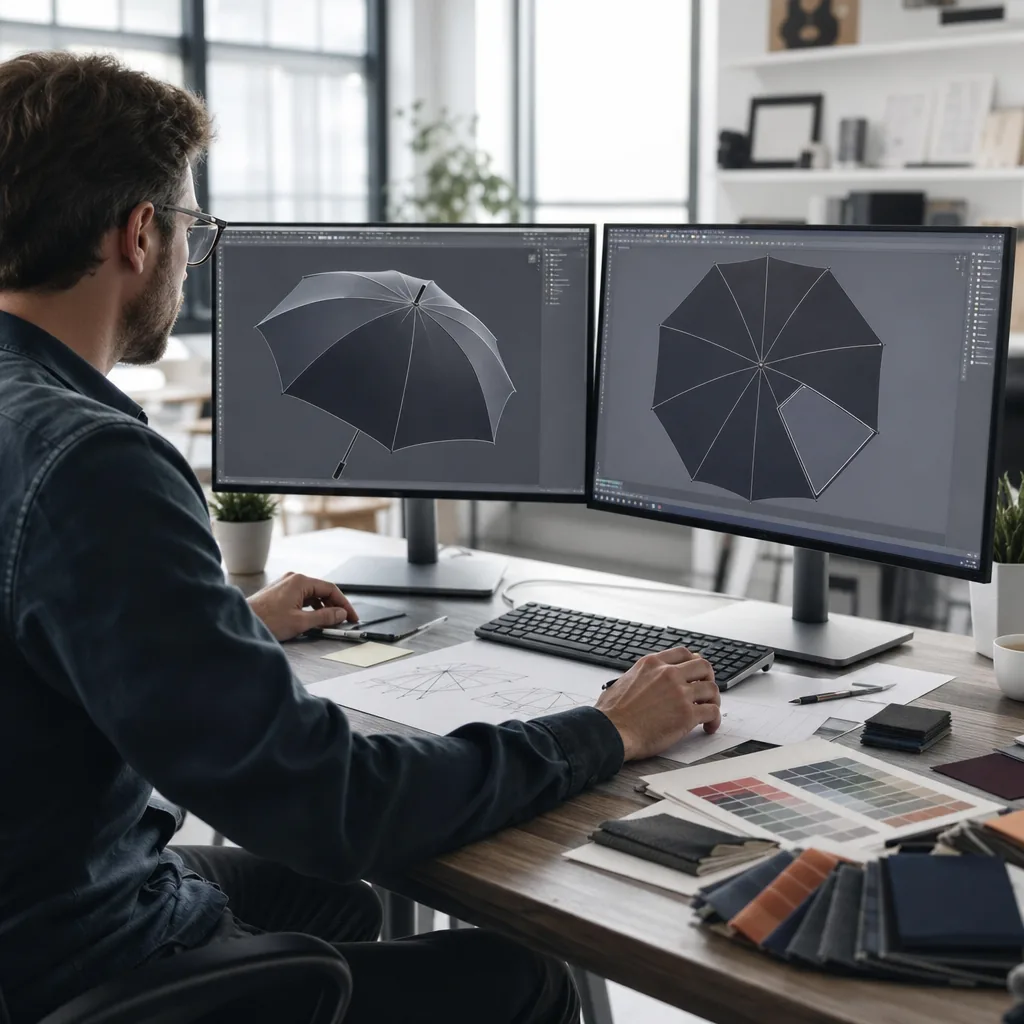
Buying umbrellas for sports teams and fan shops is a balancing act between visibility, durability, and margin. Stadium retail umbrellas have to fit licensing rules, hold up to repeated use, and carry enough print area to justify the unit cost, while still moving through shop inventories at a price fans will accept. On the factory floor, those decisions start with canopy size, frame weight, fabric choice, and how many reorders the design can survive without quality drifting.
What stadium and fan retail buyers need from an umbrella SKU
Stadium retail umbrellas need to behave like impulse merchandise, not catalog pieces. Buyers in venue shops care about carry convenience first: a 21" or 23" compact model that fits under a seat, slides into a tote, and still clears security without becoming a hassle. At the register, the product has to hit an impulse price point, so the construction should stay simple: manual or auto-open, 190T pongee, and a clean team mark on one panel or a small repeat logo. That is the lane for fan merchandise umbrellas, because fans buy them on weather and emotion, not on technical specs. If the SKU is too heavy, too long, or looks like a corporate golf item, it stops moving fast on game day.
Licensed sports umbrellas in a venue assortment usually split into two jobs. Compact retail models drive volume because they are easy to carry into a stadium and easy to justify at retail pricing, while larger premium umbrellas support sponsor-heavy displays and higher ticket averages. A 27" or 30" canopy, especially a double-canopy umbrella with 8K fiberglass ribs, gives a more substantial feel and handles wind better in open concourses and parking lots. That construction also gives licensors more print area for marks, sleeve graphics, and premium hangtags. If the range is built only around low-cost compacts, the shop misses the customer who wants a stronger souvenir and is willing to pay for a more durable frame and a cleaner finish.
The smartest stadium retail umbrellas assortment uses separate SKUs for different buying moments. The entry item should be lightweight, easy to stock, and priced for quick decisions at checkout; the premium item should look like a giftable piece and survive real outdoor use, not just indoor shelf display. In practice that means keeping the bulk umbrella MOQ realistic for licensed sports umbrellas, because reorders are often tied to team runs, playoff demand, or sponsor activations rather than year-round volume. Buyers should also think about packaging and case pack efficiency, since floor space in stadium shops is limited and restocking happens between events. The right mix is not one umbrella style, but two: a compact retail seller and a larger showcase model that carries the branding better and supports a higher margin.
Build options that balance visibility and durability
For stadium retail umbrellas, the frame choice should start with wind load, not decoration. An 8K frame is the practical baseline for compact fan merchandise umbrellas and entry-level licensed sports umbrellas because it keeps the cost down while still giving enough support for a 21" to 23" canopy. When the umbrella is going to sit in an open concourse, tailgate lot, or queue line, 16K structure is worth the extra material because the runner and rib joints hold shape better under gusts and repeated opening cycles. Fiberglass ribs are the better default for sports retail: they flex instead of staying bent, which matters when a crowd packs umbrellas together. Steel ribs are stiffer and cheaper, but they add weight and are more likely to deform permanently after a hard wind event or rough transport in bulk cartons.
Double-canopy umbrellas make sense when the venue is exposed, especially in upper decks, waterfront stadiums, and outdoor events with crosswinds. The vented top lets pressure escape instead of turning the canopy into a sail, so the umbrella stays usable longer and the ribs take less shock. In practice, double-canopy umbrellas with fiberglass frames outperform single-canopy steel versions in these conditions, even if the steel option looks heavier on paper. ZheBrella’s standard practice is to reserve this construction for open-air retail programs where the buyer expects real weather use, not just souvenir value. For 190T versus 210T pongee, 190T is fine for price-sensitive programs, but 210T gives a tighter hand feel, better print definition, and less light bleed for team colors and sponsor artwork.
Retail buyers usually care about the canopy first, so the fabric spec needs to support the print and the brand. 190T pongee works for short-run promotions, but 210T pongee is the safer choice for stadium retail umbrellas because it holds sublimation, screen print, and heat-transfer graphics more cleanly on licensed sports umbrellas. If the design is meant to be carried in sun as well as rain, add a UPF 50+ coating so the umbrella does more than look good in the shop. Auto-open is the right retail mechanism for most fan merchandise umbrellas because customers understand it immediately and it feels closer to a consumer product than a pure promo item. The bulk umbrella MOQ usually depends on canopy color count, print method, and whether the buyer wants 8K fiberglass ribs or a heavier 16K build, so it is better to lock the construction before quoting FOB or DDP pricing.
Artwork placement for teams, sponsors, and retail shelves
For stadium retail umbrellas, panel count is not a cosmetic detail. A 8-panel layout gives you larger print areas and cleaner team marks, while 10K, 12K, or 16K constructions break the artwork into narrower segments that can make stripes, wordmarks, and sponsor blocks look busier once the umbrella is open. If the goal is shelf impact, a full-wrap canopy usually outperforms a small chest logo because the product reads from 15 to 20 feet away in a concourse or club store. Fan merchandise umbrellas work best when the primary mark sits high on one or two panels and the secondary graphics, such as team colors or a subtle repeat pattern, carry the rest of the canopy without crowding the design.
Licensed sports umbrellas need tighter control than generic promotional stock. For flat colors and simple logos, screen print is still the most reliable for opacity and edge sharpness; for photographic art or gradients, sublimation on polyester gives better detail, while heat-transfer works when you need smaller runs with precise placement. Color matching should be locked to Pantone references before production, and the proof should show the panel seam layout so nobody gets surprised by a logo split across a rib line. With double-canopy umbrellas, the outer layer often takes the team art and the inner layer stays clean or uses a toned-down pattern, which helps the product look deliberate instead of crowded. For licensed programs, we also keep sponsor marks, hang tags, and packaging aligned so the retail shelf does not look messy, especially when the bulk umbrella MOQ is high enough that one bad artwork decision gets repeated across thousands of units.
MOQ, replenishment, and assortment planning
Build the core assortment around three layers: permanent team-color SKUs, event-driven playoff inventory, and weather-driven basics. The permanent line should cover the highest-volume colorways with licensed sports umbrellas in 23" or 27" sizes, usually manual or auto-open, with 190T pongee and 8K fiberglass ribs for a better balance of cost and wind performance. For stadium retail umbrellas, I would not overcomplicate the base line. Keep one compact style, one full-size stick umbrella, and one double-canopy vented windproof model so the shop can cover rain, wind, and premium gift demand without carrying 12 different constructions. Team colors matter more than novelty; the fastest turns usually come from the home jersey palette, then secondary accent colors, then a neutral black or navy fallback for fans who want something usable after the game.
MOQ is where most programs get hurt. A bulk umbrella MOQ that looks cheap on paper can become expensive if you split too many SKUs across small color runs, because printing screens, canopy cutting, and handle sourcing all change setup economics. For fan merchandise umbrellas, it is usually smarter to consolidate by construction and vary only the printed panel artwork, rather than chasing every alternate trim color. ZheBrella’s standard practice is to freeze the sample with final art and Pantone approval before production release, because panel alignment, logo placement, and stitch line visibility are what fail at inspection, not the catalog photo. Plan 7 to 10 days for sample approval if the artwork is final; if licensing or league approval is still open, allow more time or you will miss replenishment windows around playoffs and early-season weather spikes.
Safety stock should be different for stadium shops and e-commerce. Stadium retail umbrellas need a tighter on-hand buffer because demand is event-based and weather can double sales in one day, so I would hold 2 to 4 weeks of cover for core SKUs and keep deeper backup only on the top two team colors. E-commerce needs more depth on size and construction, because stockouts hit search ranking and shipping promises immediately; a 4 to 6 week buffer is more realistic if fulfillment is split across regions. For both channels, I would set the replenishment trigger by sell-through, not calendar date: when a SKU reaches 35% to 40% of its starting inventory, reorder the next lot. That keeps double-canopy umbrellas and other higher-ticket styles available for rain-heavy stretches without bloating cash in slow summer months.
Shipping terms and margin math for licensed merchandise
For licensed sports umbrellas, FOB and DDP are not just shipping terms; they change how cleanly you can protect margin. FOB works when the buyer has a freight forwarder and wants control over ocean rates, customs entry, and final-mile delivery, but it puts the burden of landed-cost forecasting on the retail team. DDP is better for stadium retail umbrellas and fan merchandise umbrellas when the buyer needs one delivered number per unit, especially for seasonal programs tied to opening day, playoffs, or holiday assortments. The catch is that DDP bakes in duty, inland freight, customs brokerage, and often a risk buffer from the supplier, so the quote can look higher even when the delivered cash outlay is easier to plan against.
The margin math gets tight fast on licensed sports umbrellas because small packaging changes move the landed cost more than buyers expect. A printed belly band, hangtag, retail polybag, and master carton spec can add $0.18 to $0.45 per piece, and a switch from FOB to DDP can add another 6% to 18% depending on destination duty, port handling, and the freight market. If your retail price is $19.99 and your true landed cost is $6.40 instead of $5.70, you just gave away 3.5 points of gross margin before royalties. Our standard practice is to lock art, panel count, trim colors, and carton pack before the first production run, because once those details are fixed the reorder cost drops quickly and the bulk umbrella MOQ becomes much more efficient to repeat on the same tooling and packing line.
Frequently Asked Questions
What umbrella style sells best in stadium shops?
Compact auto-open models usually move faster because fans can carry them after the event. Golf-size umbrellas work when the venue wants a larger logo area or a higher retail price point.
How do licensing and replenishment affect pricing?
Licensed programs usually require tighter artwork approval and often smaller initial MOQs, which raises unit cost. Reorders get better once the art is approved and the buyer can forecast by home schedule, weather, and game-day traffic.
Which umbrella size usually works better for stadium shops versus fan retail?
Stadium shops often do better with compact folding umbrellas because they are easier to carry through gates and store in a bag. Fan retail usually supports larger 48- to 62-inch styles when the goal is stronger shelf presence and more visible team graphics.
Does a double-canopy build make sense for licensed sports umbrellas?
Yes, if the program targets premium price points or outdoor use in windy venues. Double-canopy construction typically raises unit cost, but it also improves wind performance and gives buyers a more durable merchandising story.
What MOQ is typical for a licensed team umbrella run?
For OEM/ODM production, many licensed programs start around 300 to 1,000 pieces per colorway or design, depending on the print method and canopy construction. Reorder economics improve when artwork is standardized, because the same frame and panel layout can be reused across future drops.
Looking to Launch Your Custom Umbrella Line?
ZheBrella is a Zhejiang-based OEM/ODM umbrella manufacturer with 17 years of export experience. Free design, low MOQ from 100 pieces, windproof construction, full-color print.
Get Free Quote Now »People Also Search For
Related Articles
Branded Umbrellas for Stadium Retail and Fan Merchandise
Build profitable fan-gear umbrella assortments with durable frames, league-ready branding, and retail packaging that sup...
Read More »
Umbrella Sourcing for Sports Venues and Fan Shops
Learn how stadium operators and fan shops source umbrellas for licensed retail, sponsor activations, and weather protect...
Read More »Branded Umbrellas for Telecom Field Teams and Retail Stores
Source umbrellas for telecom stores, installers, and field teams with practical specs, durable frames, QC targets, and d...
Read More »